
[This is a long one: check it out on desktop or in the app]
Austra, aka Ostara aka Easter, is the beginning of the vernal season, the March holiday, and the start of the agricultural year. It is a day of renewal, of rebirth, beginnings. At Dísaþing, we planted our seeds, and here they begin to sprout. Spring has sprung! This is a time of beginnings. Those plans we talked about in Dísaþing? They begin here, now today! Get to work. But have fun. This is a joyous time of rebirth, of rekindling, of renewal. In this month, we also have the spring equinox: from that day’s dawn until the summer solstice, the day is longer than the night. As such, the ideal thing is to do a dawn-blót at sunrise on the equinox. But, sometimes that doesn’t work, and an Austrablót is done some time during the month.
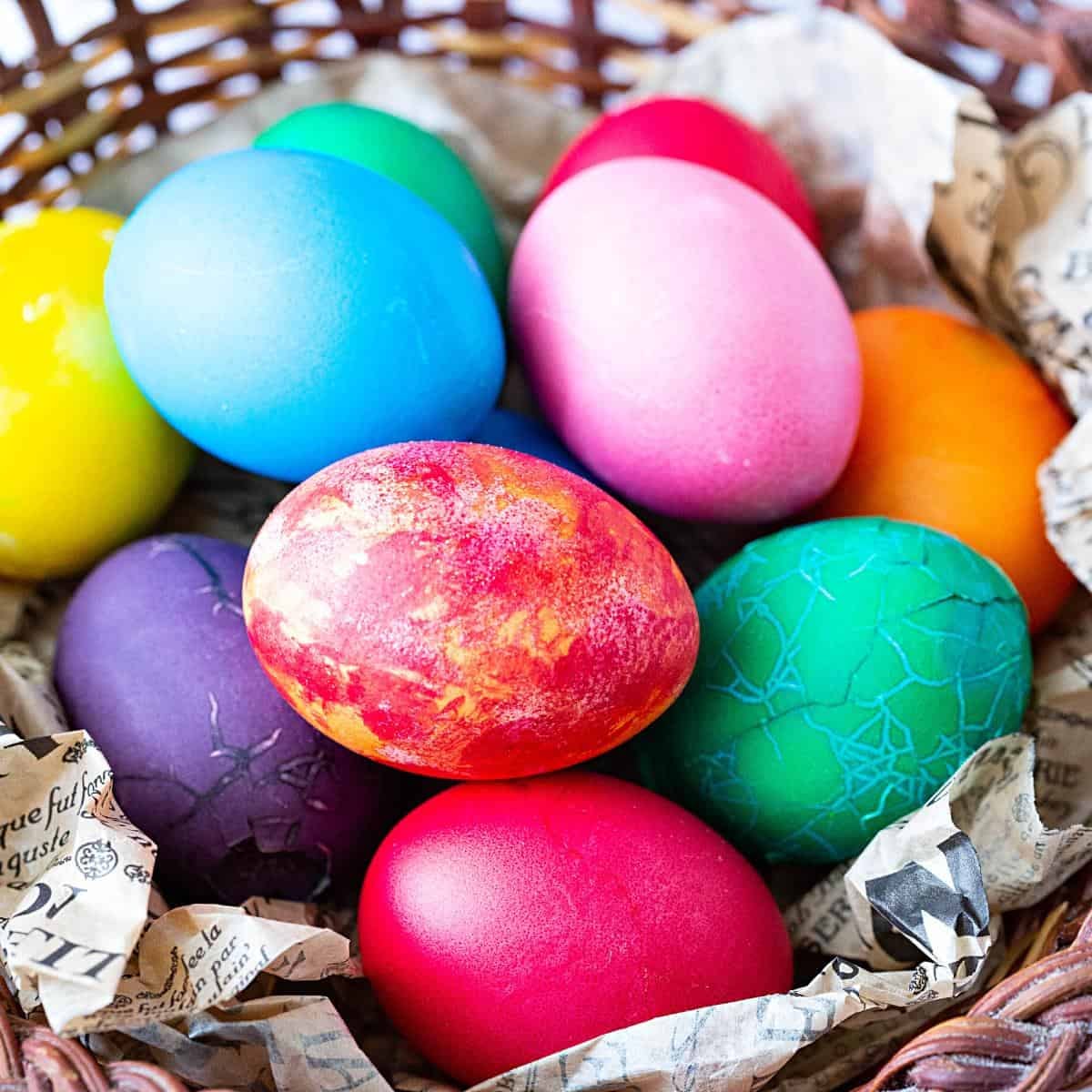
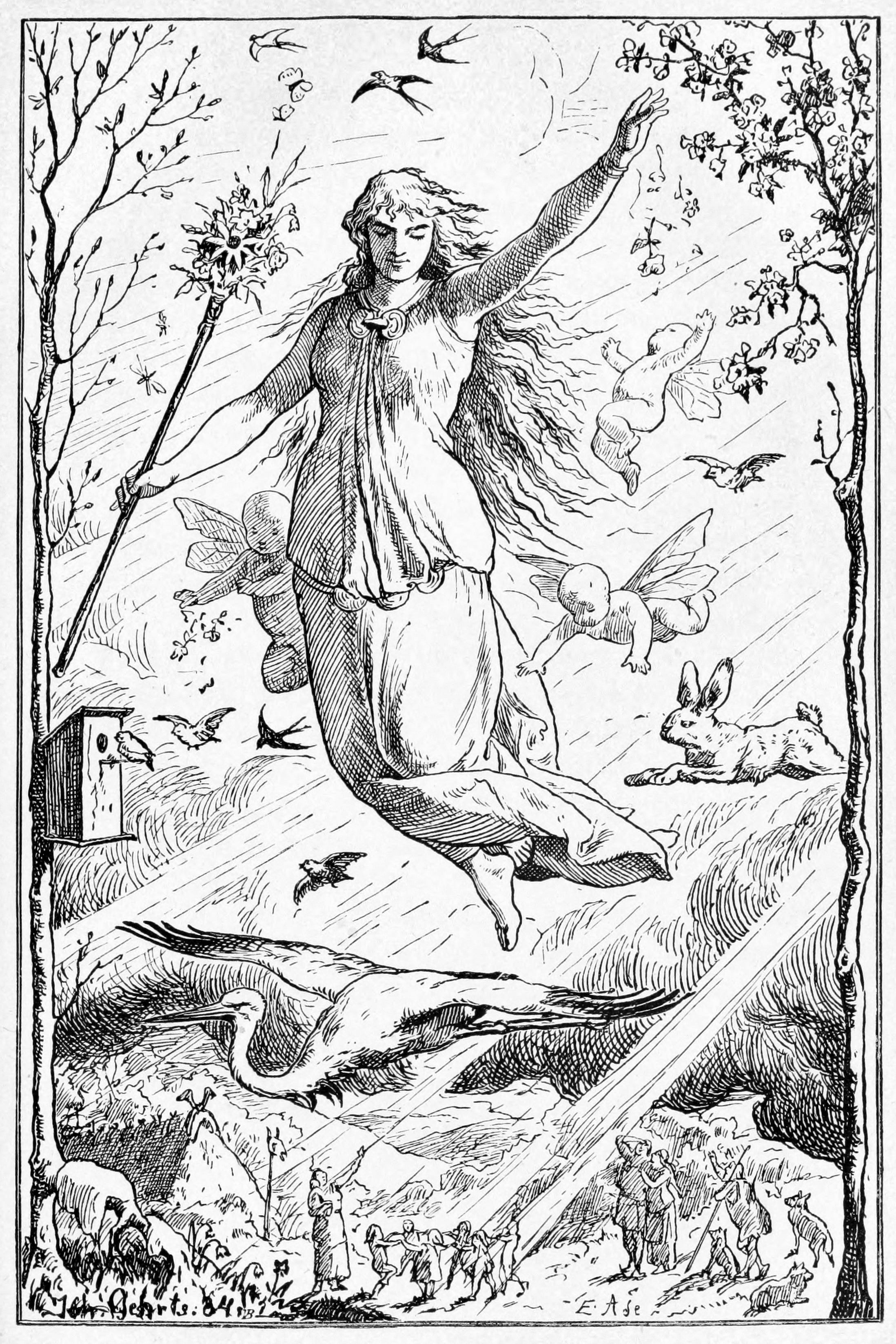
Ostara is also the Asatru parallel to the “colloquial European easter” holiday. Hares, flowers, and eggs are pertinent symbols of (re)birth, generation, and beginnings, and decorating hunting eggs are fun family friendly practices done at this holiday. But, they’re just imagery and fun, as the holiday’s, and the Asynja’s, solar imagery what’s really important here.
Some people get upset about the solar aspects of this holiday, that it’s not how it would have been practiced at some arbitrary point in the past, and as such is not “authentic”. Ignoring the fact that this is just wrong (Really? The DAWN GODDESS has no connection to the SPRING EQUINOX?) Ásatrúar worship the Gods here, now, today, and as such how we do things here, now, today, is the most authentic that we can be. It is also the most correct. The spring equinox is when the dawn heralds the sun’s triumph over darkness, and its ascent. This is the ideal day to worship the Goddess: every day’s dawn is the ideal time to worship her, but this is the best day of the year on which to hail the Dawn Goddess at the dawn. But every day is the second best day to do so.
In the Agricultural Cycle, Austra is when you’re supposed to put things in motion for the year to come. If you didn’t have a plan already (you didn’t have a plan already?), this is the time to make one ASAP, because this is when it’s best to set things in motion. It’s when you plant your seeds.
This holiday is named after one of the oldest and best attested of Aryan deities: the Dawn Goddess. The older name for the holiday in the modern era is “Ostara”, using her German name. Or rather, one of them, there’s like a dozen dialectical variants. Some people simply use the Modern English name for the Goddess, “Easter”. Officially, as a matter of standardization, the Asatru Folk Assembly uses the Norse “Austra”. All three names, alongside cognates elsewhere, mean something like “she who is of the east”: hence why the Modern English name is “Easter”. The “-er”, “-ara”, and “-ra” are descended from a Proto-Germanic suffix which forms agent nouns; it’s not a comparative (so the name doesn’t mean “she who is more eastern”), it just happens to look like the Modern English comparative suffix (“east-er” in German would be “öster”, not “östara”, for example).
Let’s address the other Easter here. In every language except English, German, and Dutch, the Christian holiday celebrating Rabbi Yeshua bar Yosef’s supposed resurrection is called something like “Passover”, a calque of that, or some derivative of the Greek “Pascha” from the Hebrew “pesakh” meaning “Passover”. English, German, and Dutch speaking Christians, however, refer to that holiday by the name of our Goddess here, who coincidentally had a festival in the same month(ish, we’ll get there) that Passover takes place. For clarity, from here on out I’m going to make a distinction between “Austra” (the Asatru holiday), “Christian Passover”, and “Common European Easter” (the bunnies and eggs). I’ll make it clear when I’m talking about the Goddess.
So what does a Christian Passover entail? A few things, which we’ll keep brief because there’s a lot. In short, the Christian Liturgical Year is ritually reenacting Yeshua’s birth, life, death, and resurrection in micro. Christian Passover is, in addition to a continuation of older Jewish Passover practices, also attached to the separate Common European Easter, which is a separate tradition that occurs cotemporally.
Christian Passover is the Sunday of Holy Week, a ritual reenactment of the last few days of Yeshua’s life. That goes like this: Palm Sunday (Yeshua goes to Jerusalem), Holy Monday and Holy Tuesday (a bunch of random stuff happens here), Spy Wednesday (Yudas sells Yeshua out), Maundy Thursday (the Passover Seder in the Cenacle), Good Friday (Yeshua gets crucified), Black Saturday (Yeshua’s burial in the cave), Resurrection Sunday (Yeshua comes back).
There’s a lot of other stuff that goes on here, too much to detail. Like, a statue of Yeshua processes through the temple and is worshiped. Water is blessed and aspersed on people. Other statues get veiled at a prior date, then are unveiled, and then get worshiped. Catechumens (people learning the religion) are baptized. A huge amount of specific passages from the Torah and the Gospels gets read. That’s just the obvious stuff on Resurrection Sunday.
Also, there’s a very complicated and longrunning discourse on precisely when Passover is supposed to be. In short, the Jewish calendar is lunisolar, meaning that everything moves around and nothing is ever fixed. So the obvious best solution was to celebrate Christian Passover on the first Sunday after the first full moon after March 21st (this ends up being somewhen in April or May). So, Julian vs Gregorian matters here, as “March 21st” is a date approximating the spring equinox, not the actual spring equinox (the spring equinox is not always on March 21st). This is why Passover is 2-months ahead in Eastern Orthodox Christianities: the drift caused by the Julian calendar’s defectiveness moves March 21st. Also, this means that Austra is celebrated before Passover is.
All of that is completely separate from both Austra and Common European Easter, both of which are ultimately about the renewal of life at a cosmic scale. It’s true that one single rabbi’s life getting renewed is the point of celebrating Christian Passover, but it’s not like he’s Orion from WHFB and dies and is resurrected every year. It’s also not really necessary for a Christian to actually do this all, in a sense, given that, well it’s not necessary.
It’s for this reason that Christian Passover is often attacked for being “Pagan” by Christians: the entire Christian Liturgical cycle itself is, in the eyes of many Christians. In a sense they’re not wrong in as much as Yeshua, being the Logos, is Halakha made physical, and he abrogated the Jewish holidays done in remembrance of historical events (or, at least, some of them; Yeshua practiced Pesakh, Hanukkah, Shuovot, and wore a tallit, after all). I suppose you could argue that celebrating his life in micro was Halakhically mandated, but that’s not really something I care about.
This is in contrast to Austra, which is of course the celebration of a cosmic act of rebirth. It is also an act of rebirth for the worshippers. It is, literally, the spring: the vernal season. Life begins to return to the world and to us. We move out of the stillness of winter and into the motion of summer. It is the dawning of a new age, with the Goddess as its herald. It’s not only cosmically necessary (the vernal equinox has to happen because of the tropical year’s cycle), but personally necessary (you must undergo a period of renewal to proceed with the Agricultural Cycle that we talked about in the master Holidays article).
As far as I, and a legion of academics before and after me, can tell, Common European Easter is a combination of various European folk customs with vague vestiges of the “cosmic rebirth” stuff that I just mentioned. It happens to take place near Christian Passover, so a lot of that folklore is attached to the timing of Holy Week in various Christianities, but most of it has absolutely nothing to do with Christianities proper. In Finland, Lutherans eat mämmi during this period. I don’t really see how that’s particularly Christian; it’s “Pagan” in as much as it’s not Christian, but it’s not really some holdover of ancient Perkele worship or whatever. Or rather, it doesn’t have to be.
The same is true for the eggs and bunnies, which Christian apologists tell us are obviously symbols of spontaneous generation, which is Christian, or something, because Aristotle. Except Aristotle doesn’t say that, and chickens and rabbits obviously come about because of sexual intercourse. Aristotle did say that mushrooms are plants that come about due to spontaneous generation of life from decaying matter (pretty darn close to the truth actually), but I struggle to see how you can attach this fungal metaphor to Christianity without committing a grievous and unforgiveable Christological heresy against Ruach haKadesh. If anything it’s unironically a better symbol of the Dawn Goddess’s arrival every day than anything to do with Yeshua (who explicitly is not spontaneously generated).
A lot of the “discourse” on this is usually just internet-Christians getting upset about how their specific sect invented rabbits, chocolate, and eggs: the most surface level aspects of Common European Easter. These specific traditions, at least here in the US, seem to be specifically British in origin. I think that e-crusaders, who don’t go celebrate Mass and all that, have to focus on these precisely because they’re so surface level: they’re the only part of this complex of traditions that you have forced in your face by corporate power every year. So, they want to claim that as a “dunk” on other people on the internet. But if you want to go worship the Dawn Goddess at the break of dawn, or get read passages from the Book of Isaiah late at night, you just can just... go do that. But you have to do it.
So why do we call the holiday Ostara? Or rather, why did we use the German name, as officially we use the Norse name, “Austra”. Let’s preface this: calling it Ostara isn’t an AFA thing. It’s not an Asatru thing, or even a Pagan thing. It’s just… what the holiday is called in English, and other European languages. Rather, a separation of “Easter” (“Christian Passover in English”) and “Ostara” (“the Asatru holiday celebrating the Dawn Goddess”) is actually quite old.
The problem with researching this in terms of primary texts is that “Ostara” is also a normalized form of the word for what the Christian Passover was called in Germany, so if you go looking for the history of the word “Ostara”, you will find a lot of material on the celebration of the Christian Passover in German. The other part is that the “ostara” is a type of bulb in Dutch flower ornamentation. “Ostará” is also a word in Brazilian Portuguese. And, of course, who could forget that there was a mid-20th-century magazine called “Ostara” which was involved with a certain ¡!HITLER!¡, so half the references are to that. But, perseverence is a virtue!
In 1900, Dr. Paul Carus published The History of the Devil and the Idea of Evil from the earliest times to the present day (source), and it made the distinction between Passover and “Ostara”. In the same year, Rev. A. B. King published The Purple and Scarlet Woman and her Relatives a book for the times (source), which is ultimately about how the Catholic Church is the Antichrist because something something Pope Dagon fish hat. But, it does contain reference to a letter sent to “one of the great daily papers of New York”, printed “just after Easter, 1896”, that talks about a “Preacher of the Gospel” who called out some Christian institution for celebrating Easter, which is a “heathen festival” in the honor of “Eostre, or Ostara, the Goddess of Spring”, and that it has “no Christian connection or relation between it and the Paschal Feast of the Jews”. The letter writer goes on to denounce holidays in general, as the 52-Sundays of Christian service attendance are far superior to nonsense like “Ash Wednesday”, “Ascension Day”, and “Whitsunday”, among others. Juicier still is The Gentleman’s Magazine Volume CCLXIX, July to December 1890 (source), which has an article discussing two songs that the article’s author alleges contain remnants of Paganism. I don’t really care to get into that, but he refers to the “goddess Ostara” of “German legend”. I cannot find earlier uses of the word in English. But, this gives us our answer: “Ostara” is the “Pagan” name for a European spring festival, and “Easter” is the European name for Passover.
As an aside, The Gentleman’s Magazine’s letter-writer is stating what is actually an extremely high-status position within Christianity as holy days are literally Paganism and have recurringly been denounced by Christian authorities going back to the Church Fathers as merely an attempt at getting Pagans onboard that must eventually be done away with (also see the stuff about Halakhic fulfillment). Getting sick of this “Pagan holdovers” thing and just wanting to have pure Christianity is the whole point of Puritanism. The idea of Christians trying defend calling Passover “Easter” has actually been a low status opinion within Christianity, one that has only been given breathing room in recent years by virtue of the universal decoupling of Christianity from European culture and peoples. This flummoxes some who do not realize that Christianity is an actual religion with beliefs, doctrines, and dogmas, not just “cool medieval stuff”.
But that’s English. The earliest reference to “Ostara”, the Goddess, in German appears to be Jacob Grimm’s Deutsche Mythologie, Vol 1. Or, rather, that’s the earliest historical reference that I can find; dictionaries cite “Ostara” as a dialectical variant of the name that is quite old, but those dictionaries are themselves later than Grimm’s work. In short, “Ostara” is a reconstructed name that Grimm derives from various German names for Passover (“ostermonat”, “ostarmanoth”). The problem that Christians usually run into here when they go looking into “why do we call Passover after an Asatru Goddess?” is that they don’t know enough about linguistics to see what Grimm is doing.
In short, Hochdeutsch (“modern German”) is a modern invented prestige dialect that has all but overtaken earlier colloquial varieties of German that Grimm is analyzing. Grimm is taking up those colloquial varieties and looking at how they differ to try to find an older form (spoiler: this is called “linguistic reconstruction”).
Further compounding the problem is that due to the monolingual English Christians not understanding how fusional languages work, they don’t get what Grimm means when he points out that these are genitives; the closest comparison in English would be how “I, me, my, mine” are all the same word and take different forms depending upon specific noun-case. So, he isn’t “making up” the name at all, as is sometimes alleged by the same people who believe that it’s a pia fraus to make up a Saint, rather he’s explaining what the thitherto unattested nominative form (“Ostara”) should look like in Hochdeutch based on various attested dialectical genitive forms in compound nouns (“ostar-”, “aostor-”), essentially recognizing the name “Ostara” from the possessive adjective “Ostara’s”. Only, he’s taking “Ostara’s” from multiple German dialects which all show the same phonological processes, indicating an original widespread “Ostara”.
The name also shows up in a variety of older Dutch names for Christian Passover, like “ostarun”, “ostern”, “eastran”, “eastern”, and “oosteren”. The oldest Dutch attestation is 1151-1200. In Old High German, it’s “ostra” circa the 800s, although forms like “eastre”, “oostrun”, “hostrun”, “ostra”, and “ostarun” are also found. There’s also attestation of the term as being a theologically incorrect equivalent to “Passover”. That notion that “Ostara” and “Pascha” refer to the same thing, but one is the proper name and one is the native colloquialism, is important, and attested by extremely old sources (source), (source).
Some of these colloquial Dutch and German (or just “German” because “Dutch” isn’t a distinct language from German in the period that we’re talking about) names actually do call her “Ostara”, interestingly enough. However, those names were missed by Grimm. Genealogically, Grimm did his initial study to produce the Hochdeutch name “Ostara”, but then later Indo-Europeanists just started from scratch, bypass Hochdeutsch entirely, and armed with more data. Fun! Also confusing because there is actual attestation of “Ostara” as being the name, but whether or not you will be exposed to that depends on whether you’re working with Grimm’s work or the later Indo-Europeanist work.
But can we do more? Yes! The largest number of ancient continental Germanic attestations are actually about 150 or so altars to the “MATRONAE AVSTRIAHENAE”, from the Roman period, which mean something like “ladies/mothers of the east” (spoiler: referring to the Dawn Goddess in plural is a common poetic device in other branches of Aryan religion due to a kenning of being eternally young due to repeated “rebirths” each day). Wait a minute: “Aust-”? “East”? Yes! Clever minds will notice that the ladies of the east are the “Austriahenae”, and that the country of Austria, a Latinized form of “Österreich” meaning “the eastern empire” also has “Aust-” in it! And “Österreich” has “Öst-”, which is related to “Ost”, “Oost”, “East”, “Eost”, and so on. Check out Philip A. Shaw’s Pagan Goddesses in the Early Germanic World if you’d like to see a very indepth discussion of the phonological processes at work here.
Also, I just want to head this off at the pass: no, the “aust-” here does not mean “south”, it’s transcribing a Germanic name. All other words containing “-HENAE” have the word suffixed to some kind of Celtic or Germanic term. “-HENAE” itself seems to mean something like “tribe” or “group”. So, the “AVSTRIAHENAE” were “the people of the one who is more east”, or “the people of Ostara”.
Anyways, a little later, Charlemagne’s biographer Einhard mentions “Aprilem” being “Ostarmanoth” in Frankish when discussing the calendar used by Charlemagne. It is this same month (April) that Bede lists as being “Eosturmonath”. The fact that the Julian calendar is a solar calendar, and the Germanic calendar was a lunar calendar, is a problem that has already been discussed in the parent article, so we can presume that the Franks and Anglo-Saxons would have been celebrating Austra in April in the years in which these names were decided (as already discussed, this is totally possible and in fact guaranteed due to the instability of lunar calendars) (source).
Before we continue, we should talk about calendars. The Germanic peoples used a lunar calendar in the elder times, which meant that a “month” (get it? A “moon-th”?) was actually 29.5 days long, and that they move, as a year has 365.25 days in it, and 365.25/29.5=12.381, and 29.5*12=354. Because of this, there’s a bit of drift backwards (as each year’s first month gets shorter). Furthermore, both Bede and Einhard are operating from the assumption of a Julian Calendar, not the Gregorian Calendar, so there’s subtle differences introduced by that too. On the Germanic Calendar’s end, this is in part because lunar calendars require intercalation, which the Germanic peoples did by adding an entire month in the summer (Bede says it’s “third litha”) because the calendar slowly “moves backwards” (due to the first month getting increasingly short). The sources seem to imply adding an entire month, which means 29.5 days: but months were counted by observed lunations, so they were 29 or 30 days in reality.
The fact that intercalation occurs means that they didn’t start the year every December 20th, it means that there must be a cycle of correcting for drift. There would be a drift of 11-days back per solar year (as the first month gets shorter), on top of a “base” lag of 6-days (compared to the Julian Calendar) so an intercalation every third year as a reset would make sense, as in the third solar year the lunar calendar is actually 28-days “early”.
All of this is to say that no, “Eosturmonath” would actually take place in the Gregorian Calendar’s March, sometimes. Of note, however, is that Bede tells us that when he was writing, Austra’s month, not her day, matched up more or less with April, which is the month that comes after the spring equinox. That is, there’s about 11-days in between the beginning of April and the spring equinox. Thus, in antiquity, Austra’s month more or less began with the spring equinox.
We’re not told by Bede what “Easter’s month” means, although literature outside of Bede tells us that the Anglo-Saxons associated the east with the dawn and the sun. The rest of the Indo-European world also does that for obvious reasons. The worship of her as a solar Goddess in modern times is thus modern in as much as it was instated by the Herald of Óðinn, but it’s also just sort of obvious thing to do (again: really? The DAWN GODDESS has nothing to do with the SPRING EQUINOX?). It is an eminently sensible practice, but we’re not given any notion of what an alternative would entail. We do actually know why other spring-festivals centered around the worship of the Dawn Goddess occurred, however, and we’ll get to those.
Back to names. Bede gives us this line in De Temporum ratione:
Eosturmonath has a name which is now translated “Paschal month”, and which was once called after a goddess of theirs named Eostre, in whose honour feasts were celebrated in that month. Now they designate that Paschal season by her name, calling the joys of the new rite by the time-honoured name of the old observance.
For those who aren’t aware, Bede talks about “eosturmonath” and the “paschal season” because in the ancient world, holidays were actually holy-tides, in which festivities were done across several days. We actually do this today in Asatru by virtue of each month’s holiday taking place across the entire month due to all of the moots and hof-events.
We know of at least one personal name that derives from the Goddess’s Anglo-Saxon name, and Bede would know it well: Eosterwine. It was the name of his abbot; it means “Easter’s friend”. The name is attested elsewhere, belonging to other clergymen; there was also at least one abbess named “Aestorhild” (“Easter’s battle”).
I’ve seen arguments that it also shows up in various placenames in England, like Austerfield, Eastry, Eastrea, and Eastrington: some of the arguments against some of these names are weak and are usually reliant upon appeals to “an otherwise unattested dialectical word for ‘east’ that occurs due to phonological processes that only affect this one word” to avoid having to accept the Goddess’s name being in them. I am open discussion on the matter, as for example the East Riding is patently not derived from the Goddess’s name (“Riding” is from the Old Norse “þriðjungr”, meaning “third”, hence why there’s no “South Riding”).
Now, the standard argument by Christians regarding all of this is that it is that Bede “made up” the Goddess, usually for some insane reason like “to explain the month’s name”. Given that Asatru was still widely practiced at the time, as Bede himself says, this seems bizarre. Why make up a Goddess for a religion that he was literally one of the ideologues charged with denouncing? And then go on to… convince his abott’s parents to name said abott after after this made-up Goddess? But then, I’ve never seen this theory be posited by someone who has actually looked into the matter at hand, as the people who posit this “Bede made her up” theory are also quick to say that there’s only one attestation of her name, which isn’t true (in Bede’s works alone there’s three, outside of references to placenames), as we’ve already covered.
The earliest reference to “Ostara” in The Runestone is 1978’s Spring edition. The Herald had this to say on the matter:
As you read this, the long-awaited spring equinox is well on its way. The promise of Júl was the promise that despitew inter’s chill and the dormancy of nature beneat her icy blanket, life would again burst forth and the sun would return to warm the landscape and our hearts. This promise is fulfilled in the spring equinox, and is an occasion for rejoicing among us. As you may well know, the word “Easter” is nothing more than a corruption of the name of Ostara, a Germanic goddess!
Our celebration at this time of year has a dual nature. In its deeper aspect it is a celebration of life and fertility and the fulfilled return of Sol from her icy habitations. During the Viking Age, however, Odin became strongly associated with this festival because it was this time of the year that men looked after their ships and weapons and embarked at last over the swan-road to go a-viking. This demonstrates remarkably the balance of our religion and the harmony which can exist between the way of the farmer and the way of the warrior, a balance of life and of death, of the active and the passive.
March 20th is the spring equinox. In this season of rebirth we rejoice in the renewal of nature, in the constant renewal of joy in our hearts, and in the continuing renewal of Ásatrú. Let us give praise to Odin and to the deities of fertility with feasting and sacrifice, as did our forefathers of old!
Giving praise to Óðinn here is apt, for reasons that will become apparent in the coming paragraphs (tl;dr Austra is one of the chief agents of his will in terms of the maintenance of the cosmos), but the Herald is also referencing Sigrblót here, which is a different holiday that we now practice in July.
The earliest meaningful point that we can trace our religion’s history to is the ancient past of Eastern Europe, on the shores of the Black Sea circa 6,000BC or so. From there, our ancestors rolled out into the rest of Europe. The White race as it is today came about through the migrations out of that Proto-Indo-European urheimat. The Gods have been with us ever since.
Today, we in the Asatru Folk Assembly begin from the Germanic, specifically Nordic, perspective, as it is the one most suited to beginning the practice of worshiping the Gods and the Ancestors here, now, today. Let’s be clear: we are not trying to recreate or reconstruct the Medieval Scandinavian religion to some arbitrary degree of perfection: we are trying to get our Folk to worship the Gods and Ancestors here, now, today, using the Germanic, specifically Nordic, tradition as a starting point for the reforging of our people’s piety to the Gods.
Hermeneutically, we start with the assumption that the Gods are real spiritual persons that actually exist. That means that we believe that the Gods are real, and not simply fictional characters that we are arguing over, nor are they a science project that is ours to tinker with. Because of this, the Asatru Folk Assembly has generally been loathe to play games of “are X and Y from separate traditions the same God/Goddess”. The answer is always extremely complicated to unravel, and often is completely useless to practice today. Furthermore, it is better to worship one deity twice under two names than to reject worshiping a deity because you mistakenly believe that two deities are only one, and we don’t want to be insulting by declaring that two separate entities are actually one, or that one is in fact two. Nor do we want to assume that we can just haphazardly slap together the Gods’ instructions for their worship into whatever we please.
It is better and more pious to come to the Gods honestly, worshiping them here, now, today, and seeking their wisdom and guidance in how to proceed, than it is to try and create some universal theory of everything before leaving your basement, paralyzed by analysis out of the fear of being wrong, putting pride and arrogance before piety and praise. None the less, we can see in the various mythologies of the Indo-European world reflections of real spiritual persons that are the Gods who have been with us from the beginnings of our race, and existed well before that; beams of light flickering through the leaves tree, dancing upon ground in the breeze. Let us now look at some of those beams of light.
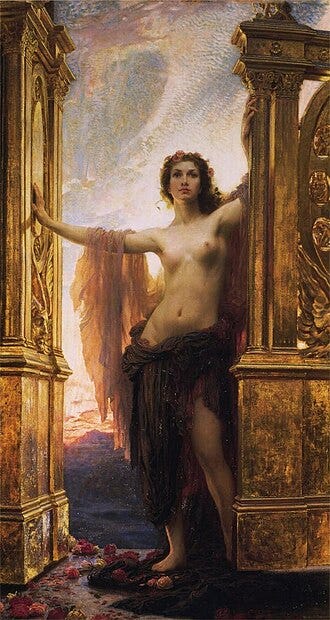
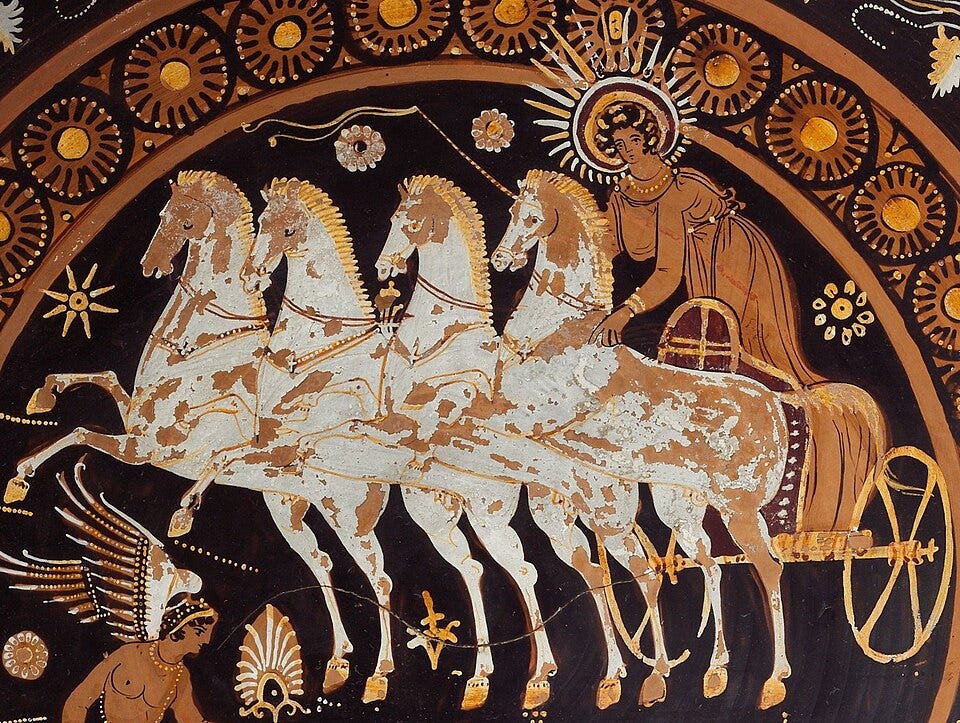
“Ἠώς”; “Eos”, shows up frequently in Greek poetry. You might know her better as “rosy-fingered dawn”, or maybe “early-born”. Of Titanic blood, but loyal to Zeus, she rides out on her chariot each day, heralding the coming of day and her brother’s arrival. While she was not the subject of any largescale institutional cults that we know of, she was near omnipresent in Hellenic culture , religion, and poetry. The best attested mythic tales are of her lustful predations upon mortal men, like Orion, Cleitus, Cephalus, and Tithonus. The Dawn Goddess as a beautiful, and even erotic, being is attested throughout the Indo-European world, but her as a maneaster is unique to Greece. But she is not a harlot: she is a lady of power, a “potnia”, literally something like “powerful-lady”; in Linear B this means something like “queen”. That attestation in Linear B means that Austra is actually one of the oldest attested European deities.
This name is directly cognate with “Easter”. In Greek poetry, a lot of the general Dawn Goddess imagery gets applied to Helen and Aphrodite. Some people have a hard time wrapping their heads around how that works: in short, in poetry, the words are both the units of information, and of imagery. To make things similar, one must literally use the same words to describe them. This is roughly equivalent to how every American knows that Grand Moff Tarkin is both a Nazi and a Colonial era British officer, despite living a long time ago on an artificial planet-exploding moon in space that’s in another galaxy. The visual and audio imagery is used to convey meaning by association. In poetry, there’s no separation, it’s all just words.
Greek poems about the Dawn Goddess share with Baltic poems of the Dawn Goddess a patronage of weddings, and with the Vedic poems, birth from a cosmic egg. The three traditions also have the Dawn Goddess descending from a sky deity, and a marital relationship with a twin who is associated with horses. Amongst the Greeks, Vedics, and Balts, we are told of an association with smiles: literally, she is “smile-loving” in these tongues. She is also associated with the colors red, yellow, and orange.
Alcman’s first Partheneion mentions a Spartan predawn festival, in which ladies would carry a plow during spring. I quote Indo-European Poetry at length:
On one interpretation of lines 39–43 Agido, a girl who is located apart from the singers and whose ‘light’ they acclaim, ‘is bearing witness to us that the sun is shining’: this could mean that she is standing on an eminence, watching for the first appearance of the sun’s disc above the horizon and signalling it by raising a torch. In lines 87–9 the chorus sings, ‘my chief desire is to be pleasing to Aotis, for she has become our healer of toils’. Aotis is evidently a divinity, and her name can only be an extended form of Aos, Dawn. Here then is a dawn goddess celebrated on the occasion of what is presumably an annual festival. Perhaps her appearance on this day brings to an end the toils of winter.
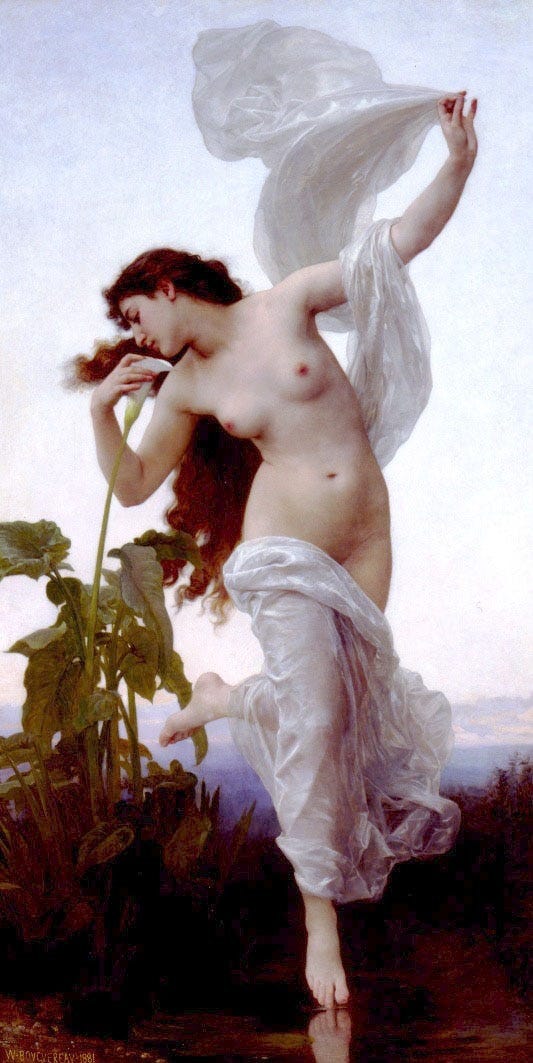
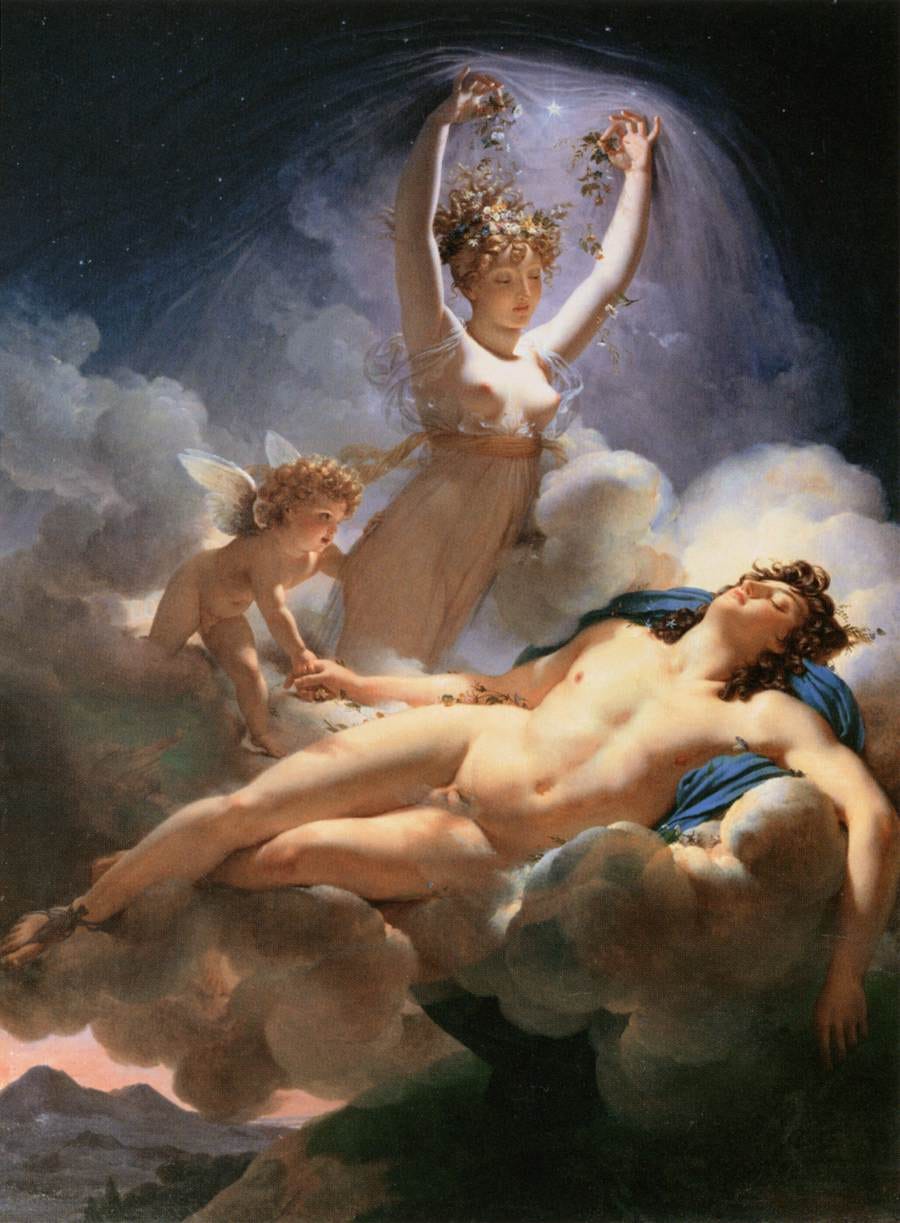
AVRORA to the Romans had a mythology much like that of Eos, inspired by the Greeks: some of this is clearly shared heritage from the mists of time, but some of it is also obviously just syncretism with the Greek tradition. At least in parentage and taking mortal lovers: her being the mother of the winds was apparently not carried over. She was also referred to as MATER MATVTA (according to Priscus and Lucretius): “MATVTA” means something like “related to “MATVTINVS”, meaning “of the morning”. The festival of Matralia was centered around her worship: it took place on June 11th, 6-months distant from Saturnalia. Good women of the city would worship the Goddess, and offer her yellow cakes (“FLAVA”, which is both blonde and red).
This name too, is cognate with “Easter”: “AVRORA” is actually a native Latin term and not a Greek import. The Goddess was worshiped in Italy before the importation of Greek media (long story short, the Rs in the name give it away).
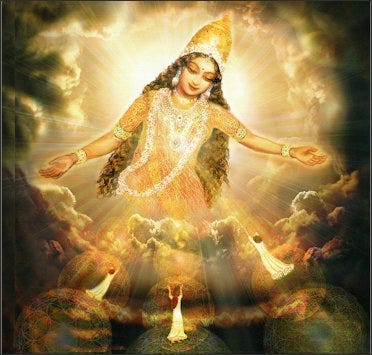
उषस् to the Vedics, Ushas is extremely well attested; she actually receives the most praise poetry of any Goddess in the Rig Veda, and receives more praise poems than most (but not all) male deities!
This name too is cognate with “Easter”. Of note here is that Ushas does not have any tales concerning her taking mortal lovers, unlike the Greek tales of Eos’s predations upon men. She is described as beautiful, loving, and of an erotic beauty. The Vedic poems say that she is associated with cows, and the sun. Several kennings for her in the Vedic poems are also shared with those found in the Greek and Baltic poems: “Sun’s daughter”, “Heaven’s daughter”. In all three traditions, she is seen, by all, and cherished by all. She is also ever-young, and watches as men age. She is also a bringer of youth, like the sun rising every day, reemerging from the ruins of night as a new-born child.
The Vedic poems, like the Baltic, Slavic, and Greek ones, say that the Dawn Goddess is the victim of kidnapping (Goddessnapping?), and a pair of twins associated with horses must go on a journey to save her. She is also, as in these traditions, pursued by a hunter-lover.
The ancient Proto-Indo-Europeans saw the night-sky as a great celestial hunt: when certain figures catch others, the world will end. But other figures must catch their quarry, lest tragedy ensue.

The Lithuanian tradition speaks of a Dawn Goddess. Each morning, she rides out to prepare the way for the sun. I’ve already spilled the beans on a lot of imagery in the Baltic tradition, so I apologize for the dearth here. She’s associated with the morning star (Venus in the morning), which is quite common amongst these personas.
The “rake” pattern in traditional Lithuania textiles is related to her (source).

A rare treat for you Indo-Europeanists: here have Albanian content! Like amongst the Greeks, the Vedics, the Lithuanians, and the Romans, here the Dawn Goddess is the daughter of Zojz, a term used for both Yahweh in Christianity and for the chief deity of the ancient Albanians. And of course, like everything to do with the Albanian language, the etymology and linguistic reconstruction involved here is a total mess. But, she is a Goddess of beauty, the dawn, and the Morning Star.
The rainbow is her belt.
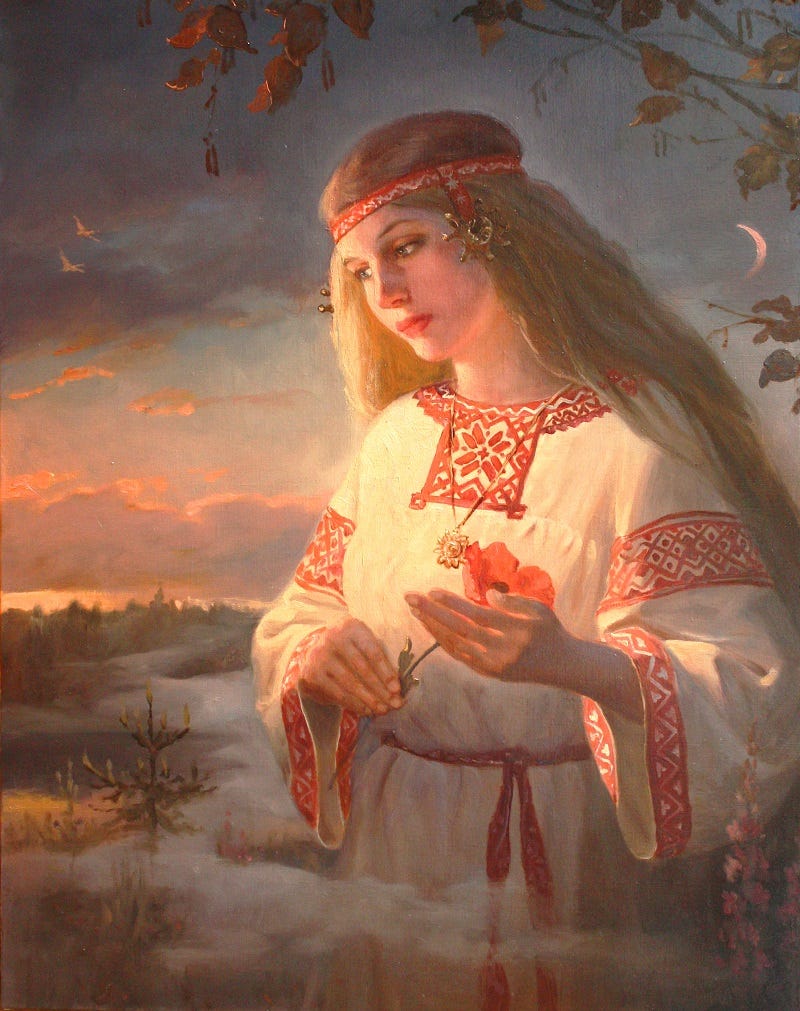
This name is not cognate with “Easter”: it just means “dawn”, although the root means something like “that which is seen”. A sister to other celestial objects, like the moon, the Dawn Goddess dwells in the east, acting as the herald of the sun and opening the gate for it. She is associated with red and gold, and like her personas amongst the Greeks and Vedics drives a golden chariot. She is spoken of in old tales from every Slavic language, and there’s a common Slavic myth of her being saved by the twin brothers St. George and St. Nicholas (the latter of whom is also the Archangel Michael, who is of course a horse): the ubiquity of this myth and its syncretic origins mean that it comes from somewhere after 700AD or so. She is also the subject of worship and veneration in traditional Slavic magic.
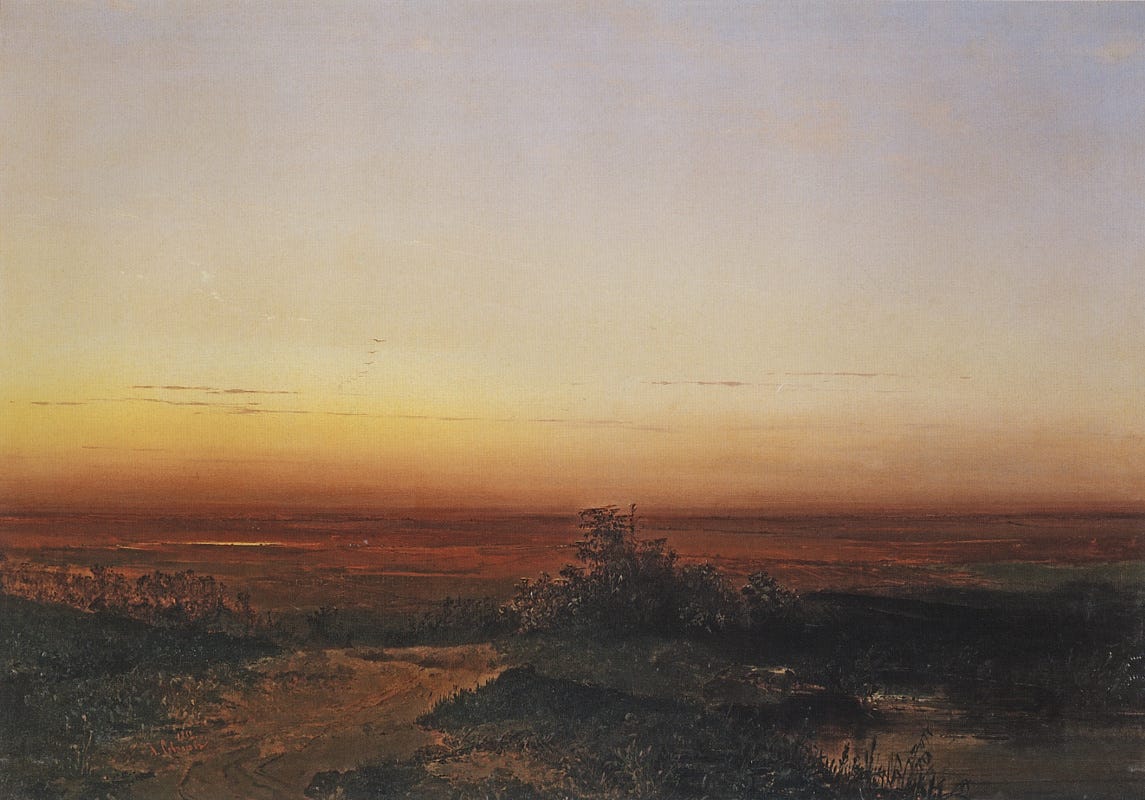
If we take these names (or rather, the ones that are descended from the same source), we can reverse the sound changes and asymmetries to produce a reconstructed Proto-Indo-European name: *H₂éwsōs. “H₂” was probably something like the “ch” in the Scottish “loch”. The Wikipedia article for her reconstructed PIE name has a massive list of all of the daughter-words of *H₂éwsōs, if you’re curious (source).
It’s worth noting that Easter, Ostara, Oostaroon, Austria, Eos, Aurora, and Ausrine are all cognates, meaning that they all descend from the same name: in fact, they are the same name. A rough comparison (as the Goddess’s name is far older) is how Jesus, Jésus, Jesús, Jezus, Jesuz, Xesus, Zisu, and Isus all descend from “Yeshua”. The Vedic (2000BCish) and Homeric (1000BCish) attestations confirm the antiquity of the Goddess’s worship, if that wasn’t obvious. But then, there are people who will argue until they’re red in the face that George Washington, Вашингтон Джордж, and 乔治华盛顿 are all separate men. You can lead a horse to water, but you can’t make him think!
If you go looking, you will see some people suggest that Brigid is “Dawn Goddess”: however, after conferring with my esteemed Celticist colleague, Folkbuilder Aidan McMillan, I do not believe that this is the case. While Brigid is associated with the dawn, she is not the figure that we are describing here. The general mytheme of the Dawn Goddess opening the gates for the sun and heralding its procession is absent in the Celtic world. I am unable to have an educated opinion on this aspect of Celtic matters, so I defer to his expertise.
These names have no relationship to “Ishtar” (aka “Inanna”), an ancient Mesopotamian Goddess, who has no relationship to the dawn, or hares and eggs for that matter. There is no possible way to get “Easter”, “Ostara”, “Oosten”, “Aurora”, “Eos”, “Ushas”, etc from “Ishtar” without blowing everything else up in terms of linguistics (tl;dr “eesh-tahr” would have to enter Proto-Germanic via Greek, and it would go through sound changes from there that would not produce a word that at all sounds like “Easter”).
In terms of symbolism, there isn’t much overlap. Ishtar and Inanna are associated with war and conquest, lions, doves, and the planet Venus. While the Dawn Goddess is associated with the Morning Star, it’s just one of various “morning things” that she’s associated with, and her palace isn’t really in the underworld (as in, where the dead go; in some tellings it is underwater, or below the world, but not with the dead). By contrast, Ishtar/Inanna is heavily associated with Venus, such as her descent into the underworld (as in, where the dead go), and a dual nature (as both the morning and evening stars).
While sexually powerful and beautiful, Ishtar/Inanna isn’t very loving in what we’re told of her. In fact, we’re told the opposite: that she’s capricious, temperamental, and spiteful. We’re not told that about the Dawn Goddess, who is loving and bounteous, to all in fact, not just those who grovel at her feet. Ishtar/Inanna was, with her brother, a dispenser of justice: the Dawn Goddess isn’t. Ishtar/Inanna descends into the underworld, the Dawn Goddess retires for the evening in her palace. After she gets done working. At her job. Because she is one of the Himinnverðir, the Gods and Goddesses charged by the Allfather with the maintenance of the cosmos. She is a hard and dutiful worker. Ishtar/Inanna isn’t, and is usually portrayed as a flighty and erratic aristocratess who spends her days getting in scuffles and sexcapades with various other powerful entities.
This article in particular is a special one to me, as Rosy-Fingered Dawn was the first of the Æsir that I reached out to on my journey home. Her blessings started me upon a path that has improved my life a thousand fold. I hope that this is some small act of thanks to the Goddess, and that one day you, the reader, will also come to the AFA, and be blessed to share the dawn with your Folk.
The most obvious thing to do at this holiday is to worship Austra, and the most ideal time to do that is at the dawn of March 20th. Depending on where you live, that will likely be relatively early: the astronomical equinox (the actual “midpoint” of the sun’s journey) in 2026 is going to be at 9:46AM EST. Gathering a group together from across your state or province requires planning in advance, which luckily you don’t have to do, as your local Asatru Folk Assembly folkbuilder is going to do just that (possibly not at 9:46AM on a Friday). However, it’s absolutely possible for individuals and families to hail the dawn and the day (something that you should actually be doing every day) and to perform blót to lady Austra.
Decorating Easter Eggs is also a fun thing to do. Some people call them Ostara Eggs or Austra Eggs, but Easter, Ostara, and Austra are all cognate so it’s literally all the same. Decorated eggs can be heirlooms (you might want to fill them with something to give them some rigidity!), or offered to the Goddess as sacrifice. If you have kids, egg hunts are great fun. They’re also fun if you’re an adult!
Austra is a loving, joyful, and bounteous Goddess, who fills the world with beauty. So have a smile on your face as an offering to her, kiss someone that you love, spend time with your family and friends. Make the world a beautiful place for the Goddess. Smile, because spring has sprung.
-Folkbuilder Chris Savich
For more about the Ásatrú Folk Assembly, visit our website!
Thanks for reading the Runestone Newsletter! Subscribe, share, and donate to help bring the Folk home.
No posts
Comments
Nothing yet. Say the first thing.
Sign in to join the conversation.