
I trust Kenji’s Seattle restaurant recommendations more than food media lists, I’m more willing to buy from clothing brands Ken Sakata features in his educational videos, I don’t just listen to Dua Lipa, I read book recommendations through Service 95, her media company focused on travel recs and a book club.
These creators (brands of their own) still produce original content, but they’ve understood that in a world of information overload, there’s value in aggregating what they share and having a point of view on it.
Brands have tapped into Creators’ success through influencer marketing, but it’s time they continue following their lead. From thinking “what should we create next” to “who/what is already doing something we want to be a part of?”, brands can become Curators too.
I’m far from the first to observe the shift Creators have made to curating, the main culprits being algorithms, AI, and the never-ending Creator economy.
The algorithms were supposed to give us more of what we love, the original supposed curators. The trade off of course was that we spend more and more time on their platforms, and as more suppliers (content creators) competed with each other to go viral and gain success, they were incentivized to create more, not better, making our algorithms worse.
AI then came in to “help”. The slop mound grew and grows and continues to make it increasingly hard to find content that’s good and actually true. Even when the floor is rising, it just means there’s more to sift through.
All of this coupled with more people depending on their content’s success for their livelihoods means there’s constant pressure to jump on trends and trade quality for quantity.
So what did the smart Creators do? They began by recognizing the only way through was putting out quality content and making sure it got to the right people. They adopted more series formats (which established realistic content expectations), got Patreons (which established loyalty and moved their audience to another platform of distribution). But most importantly, they realized they didn’t have to put out original content to be considered a Creator. This was the grand pivot to the world of curation, because in a world where everything is available, the real value is knowing what actually matters.
Curation is just putting things together, right? After all, there is more content about content than content itself. Anyone can do that. Not quite, let’s discuss.
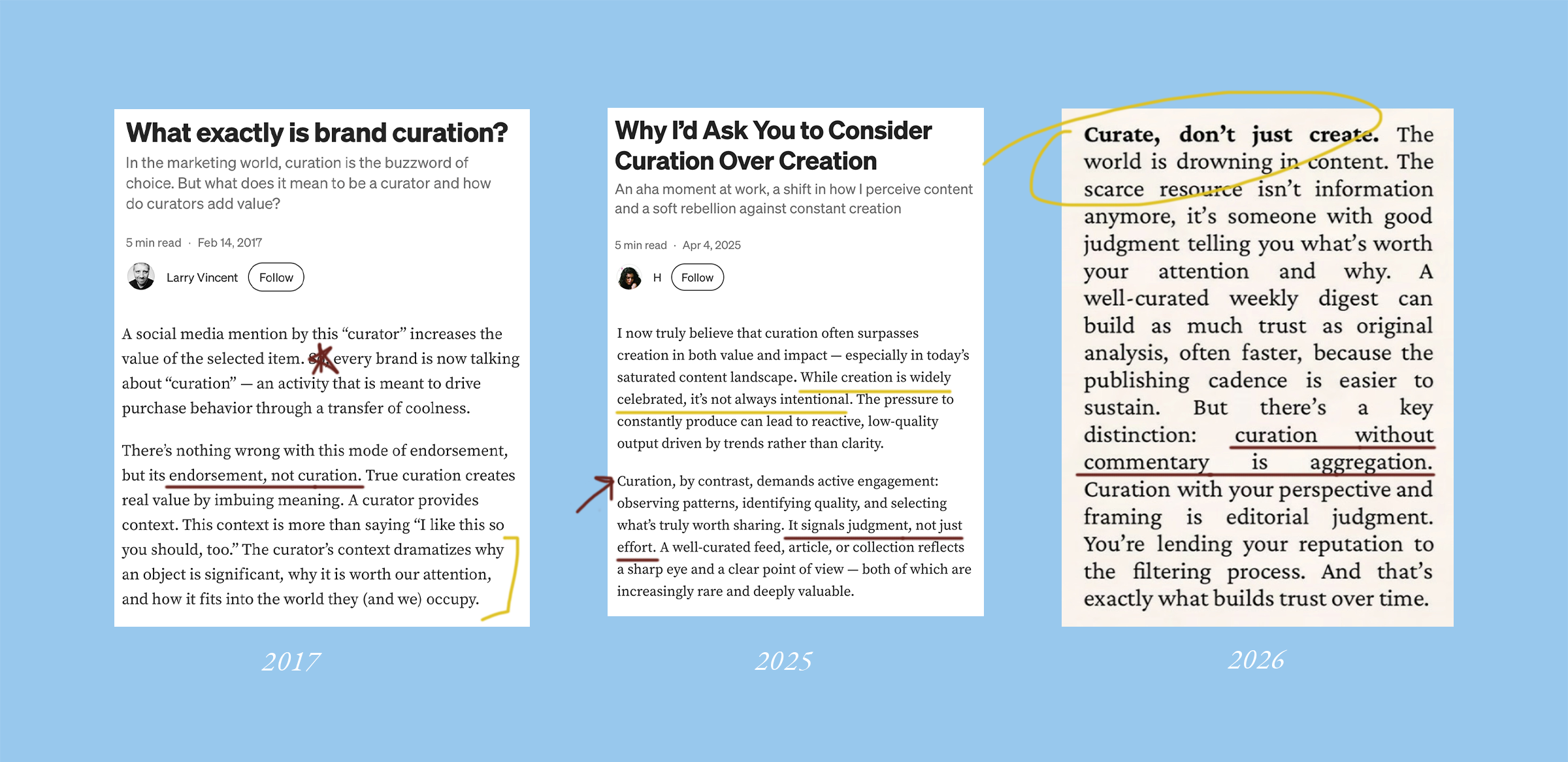
Others have said it best. Ultimately, “a curator provides context.” If that’s what we’ve established a curator does, and I’m a brand, then all I have to do is select cool things and give them context? Almost.
If “context” is defined as “the parts that surround a [word, phrase, passage, etc] and that help to explain its meaning”, the parents of context are expertise and taste. And both require work.
Expertise is self explanatory. And though it’s gone from the high bar of being an expert PhD in that field, to have you read two books about it, it still implies a level of deep understanding. Taste on the other hand is more elusive, but simply put, doesn’t just come from liking things. It comes from disliking things - and knowing why.
Those smart Creators we’ve been talking about, they’ve been putting in this context work, and it’s been rewarded. Rewarded with more loyal followers (for themselves and whatever businesses they go on to create), more brand partnerships, more reasons to continue putting in the effort.
How can brands get in on this?
Record labels, Media companies, Grocery stores.
Eventually these companies might go on to create their own products but for the most part, their brand is established in how they curate.
In Austin, I hear Laurie Gallardo’s song recommendations on our community-support radio KUTX, I look into where those bands are playing, I associate those venues with a certain context and taste, I even begin to associate their sister news station KUT with similar values.
At HEB, I see new local brands their buyers have chosen to spotlight, I read about how they donated $6M to Texas food banks when SNAP funding was threatened to be cut, I continue to happily drink their kool-aid (even better if it’s one of their Hill Country Fare private label ones).
On an international level, there are the shows HBO curates, online publication rankings like Allure’s Best of Beauty, and even the brands I’m expected to find at Whole Foods, no matter which country I’m in.
(A word on AI: Yes, algorithms can also give me recommendations, as Spotify’s song radios regularly do, but AI can’t attend concerts, taste a locally made salsa, or put makeup on their skin. Even if they could, my trust still lies in the beings that can provide expertise and taste, and the LLM’s would just be aggregating those beings’ opinions.)
Ok, but what if I’m a company who mainly profits from creating my own products, how do I curate?
We’ve gotten near the end only for me to make this whole thing a lesson of conscious capitalism? Kind of.
Even if you and your businesses only care about profits, unless your business operates on always being the cheapest or having insanely unique products, your brand matters.
It’s the only differentiator, it’s the thing that gives consumers context, it’s the thing that has been studied, researched, and proven to be more resilient in downturns, command higher prices, and attract better talent.
So let’s go back to the question - how can I prove my ability to curate?
Follow the tried and true model of distribution companies, with a splash of what Creators are doing:
Find other companies that align with your brand’s mission.
Confirm your CAC (Customer Acquisition Cost) from other channels, like Meta ads. Get your Marketing team to do the math on the possible range of what your CAC could be from partnering with companies.
Determine how much of your Marketing budget you’re willing to test on these new partners.
Partner with the chosen ones from #1.
Analyze if this way of spending the budget established more brand trust and awareness vs other ads (Do you have access to customers across more direct channels? What do your Partner’s customers have to say about you?).
^If yes, build a relationship with those partners. Create consistency.
^^If no, figure out why. Was it a partner mismatch? Did your brand’s brief have unclear objectives?
Brands who are experts in a category you’ll never be in - Airlines and their snack selections: Cathay Pacific x Hong Kong Beer Co, Southwest x Stellar Snacks, American x Biscoff. These food and beverage brands range from family-owned to conglomerate-owned, and yes, differing flavors play a role here, but at an altitude where your taste buds are dulled, the choices each airline made isn’t by chance.
Events that showcase your taste - Rivian this year was the main sponsor at SXSW. More than half of their own panels didn’t include any Rivian employees. Going beyond endorsement, they lent their space to talks about underrepresented outdoor collectives across the Atlantic, what it takes to sustain Austin’s thriving music city, and even a chef reclaiming Native American cuisine. They’re building a brand, not just EVs.
Long-term third space partners - For brands that don’t have physical spaces, or only have them at less convenient addresses, curating these types of brand partners puts your product in an everyday place of your consumers’ lives. Scholz Garten, the oldest Biergarten in the states, is the exclusive distributor of upcoming Shiner products in Austin, making it the only on-trade place in the city where people can taste their recent foray into vodka and gin, and provide a direct feedback line from customers to bartenders to brand.
The pattern: going beyond brand endorsement and choosing to curate partners that show off your expertise and taste. Instead of engaging in the endless rat race of content, see if there are other content creators, physical spaces, events, brands that align with you. Luxury brands have mastered this but they shouldn’t be the only ones having fun.
As a wealthy patron, you wouldn’t choose to house an artist whose work you didn’t like. You chose them for a reason. Show and tell your customers why.
Comments
Nothing yet. Say the first thing.
Sign in to join the conversation.