
The heart and the brain are the organs we treat as the signs that a body is alive. But in neither of them can we ever locate the thing that is actually running the show, the consciousness that commands the whole body. In the Vajrayāna description, consciousness is not confined to the brain. Wherever the channels and winds move, consciousness is there. A few of the major channels pass through the brain, the heart, and the small intestine at the same time, and consciousness is especially active in them. From there it spreads out through branching, netlike structures into every part of the body. Even so, nowhere in that architecture can we find the one who is supposed to be the subject, the “I.”
People spend their lives chasing a partner, money, children, position (resources, platform, standing), and health and long life. How much of any of it a person actually gets, whether the road runs smooth or breaks apart under them, was never something a “self” got to decide. It all comes down to causes and conditions, and those conditions run at a scale past what any supercomputer could hold. That is why the future can’t be predicted. But think about it carefully. This solid self that has followed you your entire life, what if it simply isn’t there? Would you feel terror, or would you feel free? Understanding selflessness without error, in strict doctrinal terms, is hard and requires a lot of groundwork. Still, at the level of direct experience we can run a similar thought experiment and get close to the taste of it.
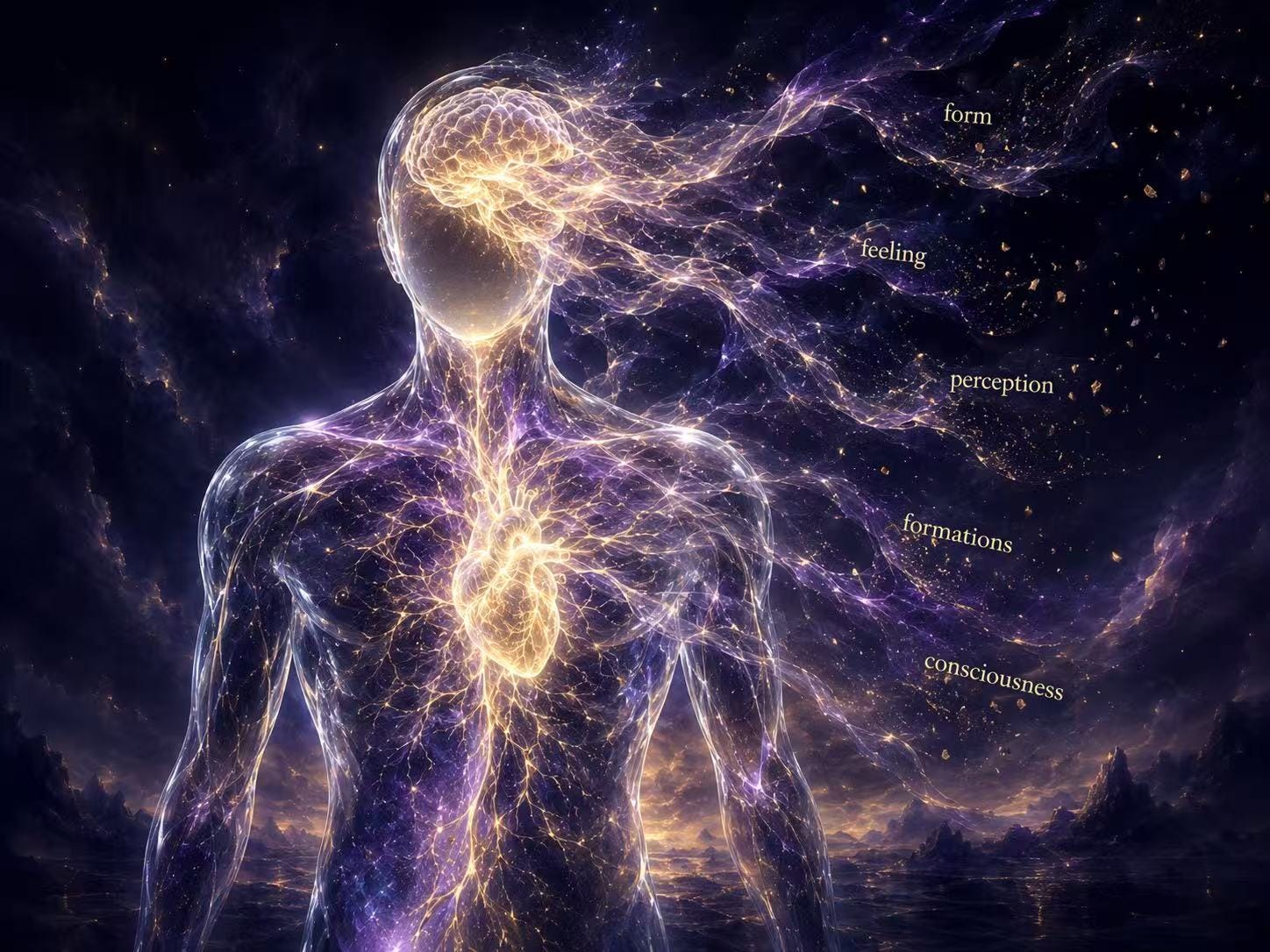
In the previous piece we went through the thought experiment with the cart. But a cart is too simple. Look at yourself instead and the feeling comes through more directly. Pull the five aggregates apart, form, feeling, discrimination, formation, consciousness, and each one turns out to run on its own logic and its own rules. People who haven’t studied Buddhism aren’t used to this, so they first have to learn the fine-grained taxonomy of cognition, the fifty-one mental factors and so on. The point is that cognition is not one solid whole. Like matter, it is assembled out of many different parts. Visible physical stuff is made of atoms, atoms contain a nucleus and electrons around it, the nucleus is protons and neutrons, and inside those are quarks. Cognition works the same way. Inside it are the five omnipresent mental factors, each with its own function, and most moments of cognition also carry the five object-determining factors, along with whatever afflictive factors are in play. Which is to say we do not have a single “mind,” and the mind of each instant changes, no two alike. So does “I think, therefore I am” still hold? If our thinking is different in every instant, how many I’s are there?
The ordinary structure of a person’s thought on an ordinary day is not decided by an “I” at all. What you are thinking in this instant did not begin with an “I want to think about this” that then produced the thought. The things that set off a thought are numerous and can be very trivial. A second ago you saw a cute dog, which brought to mind a relative who keeps dogs, which brought to mind that this relative is in business, which brought you immediately to how your own business is doing. Dogs and your business have no direct connection. But the whole chain can take a few seconds, sometimes less than one. And often you don’t even register the links along the way, which is why people keep asking themselves, how did I even get to this thought?
So if there is no solid entity at the base of cognition, and no fixed entity anywhere along the chain of it, then where am I supposed to put myself? Buddhism posits the self only as something imputed, a designation laid on top of all of this. It is not an entity of any kind. If that is really how things stand, if we can’t even control our own thoughts, then what am I to do about my conduct, my circumstances, my fortune and misfortune? If the I that is supposed to govern self-awareness and destiny doesn’t exist, then what should we be directing our effort toward? If effort itself is just one more link inside a script we don’t author, then even whether we make the effort isn’t ours to decide. Some people simply keep working at things. Some people simply can’t sustain it. That was never settled by a passing decision on the person’s part. If life is observation, then even though you are inside the play, you look more like a member of the audience.
In traditional Buddhist practice, observation is itself the main mode of practice. It does not call for doing something. It calls for knowing something. You come to know what you did not know before, and the structure of cognition shifts on its own, takes a new shape, and the whole world and everything you meet in it changes with it. This is analytical meditation. Practice contains only analytical meditation and stabilizing meditation. Stabilizing meditation requires training in śamatha. That is the whole of Buddhist practice, those two. But can plain observation really have the power to change the underlying structure of a life? Isn’t that “effort” after all? What do you think?
If you enjoyed this piece, you might also like:
Collected Topics of Epistemology - Focuses on traditional Tibetan Buddhist logic/pramana teachings.
Adhiyana Buddhism - General Teachings from Neo Shakya covering broad Buddhist Topics.
OṂ A RA PA CA NA DHĪḤ
No posts
Comments
Nothing yet. Say the first thing.
Sign in to join the conversation.