
How loud do a people need to scream to be heard? I wonder to myself as I listen to M, the way that her sentences burst out of her with a raw pain, her voice tends to drift off, her eyes deaden as her psyche gets sucked into a memory words cannot express. She witnessed and lived through the January massacres. The US-Israeli bombings.
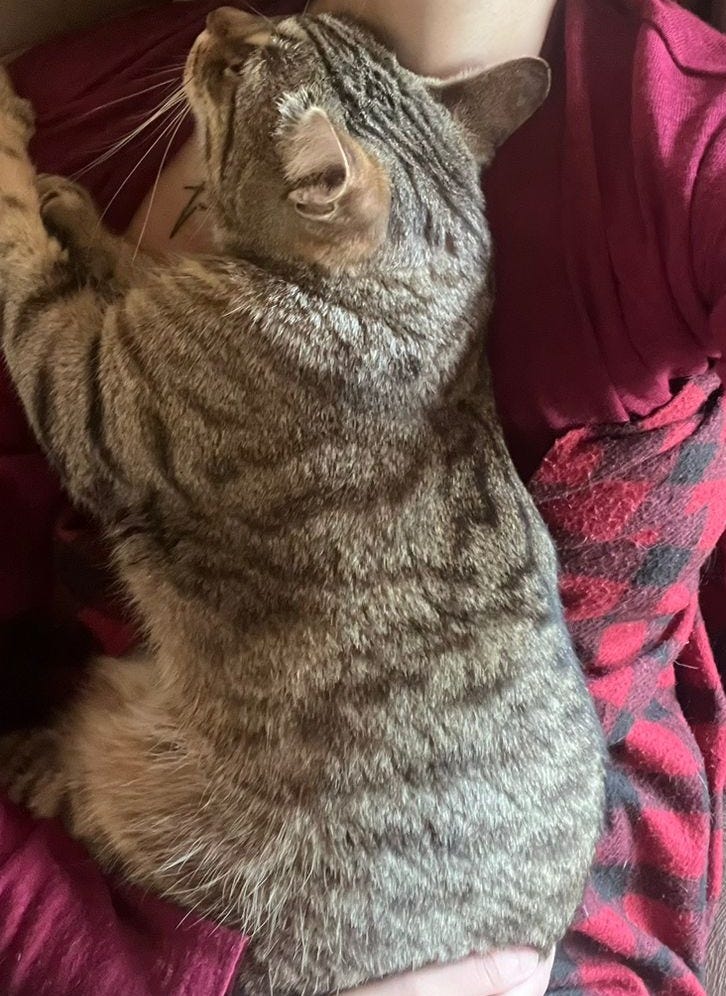
“I feel the weight of all the black bags. So many black bags. Did you see the black bags?” M mutters when her voice returns, curled up in a corner of my couch with my cat Burrito happily purring away in her lap. I’m grateful in that moment that my cats are little cheaters and non-selective in their cuddles.
M is a journalist who just got out of Iran and has been crashing at my place. She’s referring to the black bags of the dead, zipped, unzipped, sobs and wails as people searched for those they loved.
“What do you know about the people of Iran!” She explodes at the TV set we have on in the background. It’s an old white man, of course, on a talk show on a major network. I know him from my Iraq years and suffice to say he understood Iraq as well as I understand technology (just in case it’s not clear I don’t understand technology).
Her anger is more than justified. I also carry a version of it, the version that’s a byproduct of my own life and experiences, the disgust at how a people’s story, perspective, diversity gets hijacked by the media, governments, armchair pundits.
M has a list in her phone that she shares with me. Short choppy sentences.
The ways IRGC massacred Iranians in January:
The finishing shot (forehead shot at close range)
They shot people in the head, leaving their brains splattered across the asphalt.
There were trucks full of bodies
Using axes for killing
Shot from behind
Killed those who their hands were tied
Taking Money for bullets from families of killed people.
Using Poison gas and toxic pellets
Execution without trial
Killing the wounded in hospitals
Throat-slitting
Attack on a mourning ceremony
Arrest of family members of those have been killed.
There is no mention of this amid all the blaring headlines of a potential deal between the US and Iran, the Strait of Hormuz, oil prices, the global economy. It is all unsurprisingly, appallingly brushed under the proverbial carpet.
“They (the Iranian regime) just bought themselves another 10 years.” M comments.
“If not more” I respond.
The Iranian regime massacred at least 30,000 of its own people in January in the span of just 48 hours, as the country was under an internet blackout, one that still continues today.
How many deaths can a people endure? Physical killing, psychological killing. And as if that was not wretched enough, we kill their voice either by negating it, refusing to recognize it’s diversity, wanting to shove it into a neat little monochrome soundbite box to be regurgitated over and over.
M wrote the list at the time in January to have a record, to have something to do, because what does a person do when their brain wants to explode, when the eyes witness when the mind cannot comprehend?
“No one knows, no one understands these brutal evil murders. No one understand what we have been through.” She says. It’s true. We don’t. We can’t. I wonder if we realize how lucky we are that most of us don’t.
“I love my country, but my country doesn’t love me.”
M kept the list in her phone, refusing to delete it and any other potentially incriminating content as she crossed from Iran to Turkey. She acknowledges the recklessness of that, she personally knows the consequences of being imprisoned, but in some way it was her parting act of defiance, her own way of saying “F*ck you. I might be leaving for my and my family’s safety, but you will not fully break me.”
“Do people know all this? Did they care? Did it make a difference in anything?” she asks. It’s not a rhetorical question. She did not know what was being reported in the news. That’s what an internet and communications blackout does.
Yes, it was reported on, as the bits and pieces came out I tell her. Did they care? I suppose it depends on who they are, I say. What is “caring” these days? A reshare on social media, a box of “oh I did something” ticked? A “oh did you see what’s been happening in Iran, it’s so horrible” over morning coffee? Writing about it like I’m doing now?
Or is truly “caring” something bigger? Something that requires a certain level of self-sacrifice from those of us on the “outside”? Something that is supposed to be a power so strong it can course correct history?
Did it make a difference? The answer to that is no.
PROLOGUE: M’s identity is being kept anonymous for the obvious reason. Her family is still There is a lot more to M’s story as you can imagine. That is for her to share, when she is ready and how she chooses to do so. This piece is written with her approval.
Comments
Nothing yet. Say the first thing.
Sign in to join the conversation.