
There are memories that are like hazy paintings on a floating sheer cloth. And then there are those that are so clear, it’s as if they are in high definition. I call them my “freeze-frame moments”. People often ask about covering war and what stands out. For me it’s never really been the bombs and bullets but rather the human moments, moments that are rarely captured on camera, moments that happen on the “sidelines”, as if they are just out of the corner of your eye.
The battle for Samarra in October 2004 was my first real embedded offensive. Prior to that I had covered the fighting between the US military and the Shi’a militant group, the Mehdi Militia, in Kufa but we were staying on a base, going on quick operations, and often the fighting came to us since the base was regularly attacked. I had also done other smaller missions with the Americans; going out on whatever menu the US had to offer ranging from patrols in markets to under cover of darkness HVT (high value target) capture missions.
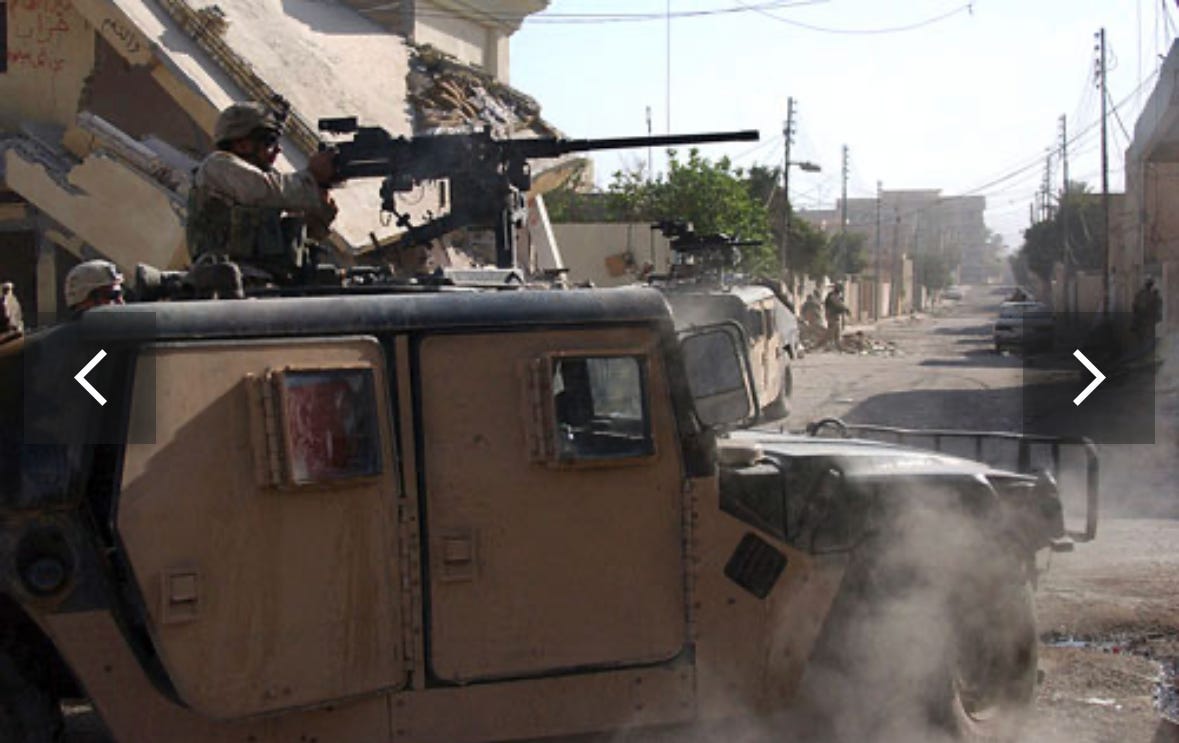
I was a perma-lance (what freelancers that were regularly hired by a network were called) producer for CNN back then, crammed into the back of an APC (Armored Personnel Carrier) with correspondent Jane Arraf, cameraman Neil Hallsworth, and anywhere between 8-12 American soldiers. We were parked outside of Samarra, part of the military’s “hurry up and wait” which essentially is like getting woken up by someone barking “CNN LET’S GO” and then waiting for hours for something to start.
Practically speaking it’s getting all the military’s various units into position under cover of darkness and waiting for daybreak. Either way, I really had to pee. I mean REALLY had to pee. Each time the troops cracked the back of the APC to try to let me out, RPG’s (rocket propelled grenades) would fly in. The males could piss out of the back by just barely cracking it open, ie RPG safe. Me, not so much. Neil comes up with the ingenious idea of cutting the top off a one-liter water bottle for me to pee into. And so yes, smushed between two soldiers, I drop my pants, squirm around, and do my business. It was pitch black in there, and only later did I remember that all the soldiers had night vision goggles, but frankly in circumstances like that who cares.
(Note to readers: The vast majority of my stories have an element of a desperate need for a toilet or a female related disaster. That’s just the reality of it.)
President George W. Bush had declared the end of major combat operations in Iraq 17 months earlier, and the Americans were in total denial that their Iraq project was unravelling and victory was a total farce. In fact it was such a farce that the press pretty much had to cover anything happening outside of Baghdad by being embedded. Far from ideal, but it was the only way to get around the country and cover what was happening, and for me since I am an Arabic speaker, it provided the opportunity to speak to people. Even in Baghdad by then it was super risky, though little did we know that it would get much much worse.
When it came to Samarra, Sunni insurgents had taken over the city, the areas around it had turned into no-go zones for the US military and the fledgling Iraqi security forces, ie they got attacked or blown up. The US had disbanded Saddam Hussein’s army upon taking over Iraq and in one fell swoop created loads of pissed off unemployed men, ie the insurgency. Over time their ranks would grow and elements of them would become more extreme.
This fledgling army, which the Americans started from scratch was nicknamed by us in the press as the “flip flop” soldiers, for no reason other than they were so poorly equipped most did not have proper boots, so were literally in flip flops. They had practically zero fighting experience, and the training exercises we covered were a joke. (Note: all this would change over years as the ISF gained real on the ground experience fighting for the next two decades).
As such, at the time, there would be the obligatory Iraqis attached to the Americans because the US really wanted to promote “joint operations”. I think that the US unit I was with had two of them.
I remember the sun rising casting its pink-orange glow over a sleeping city, or at least one that appeared to be sleeping. I remember wondering if Samarra’s civilians had any idea what was to come. I remember the first gunshots, cracking in the distance, echoing through the silence of Samarra’s streets and the crescendo as it grew into a full-fledged battle. I remember how the soldiers we were with would lay down suppressive fire; basically shooting down alleyways and streets so that the rest of the troops could cross.
I was so tired that each time we would pause I’d fall asleep, couldn’t have been for more than a few seconds at a time, redefining and later in my career perfecting my ability to sleep anywhere for any amount of time. At one point I totally passed out only to open my eyes and see that I was sleeping next to a small pile of fly covered rotting meat. It was not a high point.
And then there is that one memory, the one that always emerges whenever I’m asked about war, the one that clenched and twisted my guts.
The guns had settled, the Americans had declared victory, and we were driving to the morgue where Samarra’s civilians were permitted to identify and collect the bodies of the dead. I looked out through the filth covered thick bullet proof glass of the backseat of the Humvee. A woman was stumbling through a field of dirt, her steps so thick, it was as if she did not want to reach where she was going. I remember her falling to her knees, her black head covering falling off, dark chestnut hair tumbling out.
And then she wailed. “WHHHYYYYYYYYYY”
Or at least that’s what it sounded like. It was a sound so primal, so visceral, so deep, that as a write I can still feel that now familiar tentacle of another’s pain grip my own throat. It was a sound I did not know then a human could emit.
Postscript: We didn’t see any civilians until we got to the morgue after two days of fighting. We never got that woman’s name, but someone told me it was her brother who had been killed. The whole scene at the morgue was layers of sad and angry. The rhetoric of war whitewashes pain, all that is lost. The Americans constantly and consistently declared victory, be it in Samarra, later in Falluja, and later in all of Iraq. By Americans I don’t mean those who were on the ground, on the day to day missions, they quickly saw through it all. They lived the reality. But by the time the reports went up through each level of the chain of command “its a disaster” eventually turned into “things are going great”. The top military and government/diplomatic officials just wanted to be able to quickly scream “we won”. Their failures and inability to understand the dynamics of Iraq either deliberately or through willful ignorance, would a decade later be a major factor in the rise of ISIS.
Share "That time when ... " by Arwa Damon
Coming next: That time when I got butt blisters trying to be a hero
No posts
Comments
Nothing yet. Say the first thing.
Sign in to join the conversation.