
I’m sitting on the couch that converts into a bed for me and writing this from my Dad’s hospital room. He fell and fractured his femur/hip and I’m playing good daughter, which includes, but is not limited to, running out and getting ice coffees and decadent croissants stuffed with cream and fresh berries.
I see the disparities everywhere. Images of Gaza juxtapose themselves over what is in front of my eyes. We were picked up by an ambulance. In Gaza the injured - be it by bombings or by accident, ie like the one my Dad had - are transported to barely functioning hospitals on the back of donkey carts. Sourcing the pins/rods my Dad now has in his hip and leg were not an issue. We have our own room, plenty of painkillers as needed. I fill Dad’s water bottle regularly. I think about those in Gaza whose pain is not taken away, whose thirst is not quenched, who crave things those that love them cannot even provide.
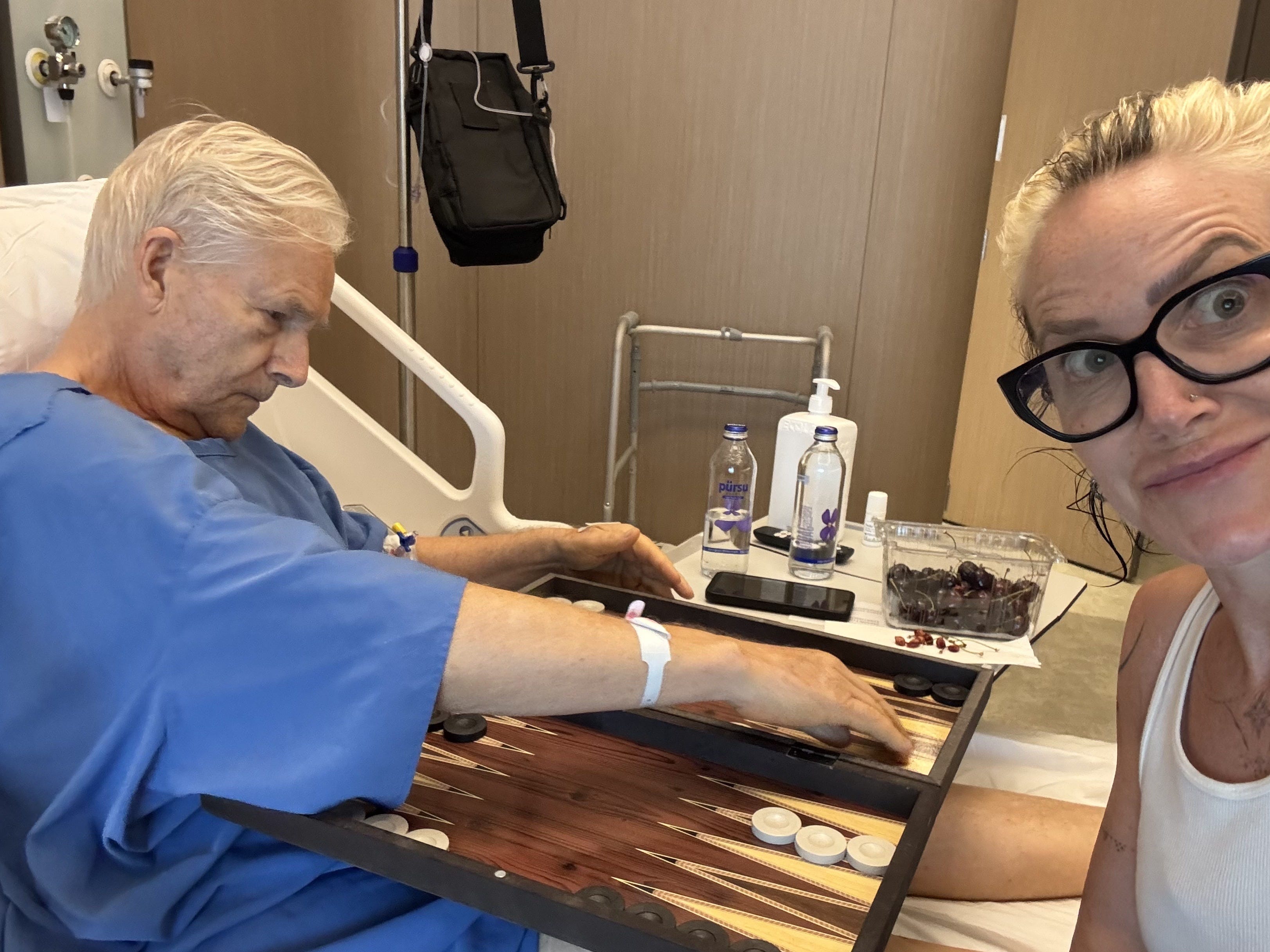
There’s one moment my mind keeps going back to, one that was generated after I bought a backgammon set to stem off the monotony of a hospital days.
It’s of little Aseel who I met in al Aqsa hospital in Nov of 2024. Her “hospital bed” was in the corridor. Her entire family was piled on it. I had promised I would do her nails black like mine. I just wanted to make her smile. I just wanted to give her a moment that would break up her day. Plus we had managed to find the creams she, her sister, and father needed for their burns.
Across from them was another little girl who had been injured 24 hours earlier in an Israeli strike and had not uttered a word since. On the day when I first met Aseel I had dropped off more pediatric tracheostomy tubes (ie children sizes, used mostly to decrease dependency on ventilators, without which often children don’t stabilize enough to be taken off the machines in the ICU). One little girl was fighting for her life. But if she survived, she would wake up to find out she was orphaned. One little boy had to have a piece of his skull removed, I could see his brain pulsing under the area where his skin was stitched together. There wasn’t enough soap for medical staff to keep up proper hygiene.
All these images come rushing back to me, along with present day reality. Not mine, but Gaza’s. How the nightmare for the people of Gaza is far from over. How little attention is paid to Gaza these days. How there is still a severe shortage in medicine, medical supplies, imaging capabilities, everything that you can imagine.
On July 20th, two days before my Dad’s accident, Israel hit a car just outside my charity INARA’s primary care clinic in Gaza City.
Our team was thankfully all OK and able to respond to the injured, among them many children. Mohammed, our physical therapist, messaged me with this video later and a brief message.
“The hardest thing I witnessed was while I was providing first aid to a baby no older than four months.” Mohammed wrote. “He had no idea what was happening—only blood, crying, and shock.”
One of our doctors, Dr Lara, commented that despite how terrifying and heartbreaking it all was, their instinct to help was stronger than any fear.
“In those moments, humanity took over, and all we could think about was reaching those in need.” She wrote.
None of us on the outside, even those of us like myself who have been there, can really understand what it’s like. People tend to look at how things have gotten “better”, but the baseline is starvation. According to the latest IPC report 1.4 million people are expected to face high levels of acute food insecurity through December 2026. That is a number that has gone up from the 1.2 million it was at in the mid-April–June period.
The daily death toll is less yes, but people are still dying regularly in bombings, being shot for accidentally crossing Israel’s barely demarcated and constantly shifting yellow line as Israel snatches more territory. You may remember Netanyahu proudly boasting that he ordered the IDF to take control of 70% of Gaza and that it is “just the start”.
People are dying from illnesses and diseases that would normally not be life threatening. Despite this so-called “ceasefire” it is all still so incomprehensibly relentless, the psychological toll is so immense it crushes the mind and soul with a force we cannot comprehend.
The day after my Dad’s surgery my phone was with him and I hear him say “God bless them this is real humanity. Life’s meaning is in what they are doing, caring for people in the worst conditions.”
I look up and realize he still has my phone.
“Dad are you reading my phone?” I ask laughing.
“No.”
“Yes you are.”
“Oh, this is your phone.”
My parents and I aren’t great with boundaries, which won’t come as a surprise to those of you who read about my mother calling CNN to get me off air during a breaking news firefight.
The messages my Dad had - allegedly - accidentally read were from a couple hours earlier in INARA’s senior staff group chat. Our clinic was damaged again. Yousra, our Gaza program coordinator, had sent over a series of videos with the message. “The Gaza center got affected by nearby heavy bombardment last night.”
“Is everyone OK?”
“Yes all is okay, thank God, but was an intense night while today Gaza is celebrating the annual high school graduation, tawjihi.”
High school annual graduation.
The team did the necessary repairs, cleaned up the space and opened.
I message Mohammad to check in on him, especially after that message about treating the baby and now this. He tells me that his brother graduated high school among the top of his class and asks how my Dad is doing.
“We’re used to in Gaza having to scrounge around for things, hopefully where you are are easier.” He says in a voicenote. “And if you need anything, like a bit more information about anything, just let me know. Remember after a surgery like that physical therapy is very important. We wish him a speedy recovery”.
I’m again, as I always and constantly am, blown away by the people of Gaza’s ability to show such compassion and care.
Prologue: Note to those who are new here: I went to Gaza four times with my charity INARA and then Israel denied me entry. We still have an ongoing court appeal to reverse that decision.
Dad was discharged. We got home. I think about all those in Gaza who leave the hospitals to go back to a tent, a flimsy mattress, the beating heat of summer, not enough water to drink, no ability to cool down. I look at the bag of medicine that I’m holding, the walker I was able to easily buy.
Dad told me he also was constantly thinking about what it was like to go through everything he went through with nothing.
I just saw a post from someone in Gaza whose father is in intensive care needs a pacemaker. He’s waiting for permission to leave Gaza. He just wants to save his father’s life. My eyes are burning. I keep thinking about him and all the others who are just watching those they love suffer without the ability to do anything about it.
It is all just so wrong. The way we treat each other is so wrong. What we allow to happen to others is so wrong.
No posts
Comments
Nothing yet. Say the first thing.
Sign in to join the conversation.