
(I missed posting last week due to a misadventure which saw me in the emergency room in the US in an unknown town, midway through our road-trip. Thankfully, it turned out to be kidney stones, very very painful, but better with medication and rest. On to our regular programming!)
They say life is stranger than fiction. In a similar vein, sport is stranger than drama. The T20 World Cup final between India-South Africa went beyond what could have been scripted, transcending theatre to become a living thing with a pounding pulse and a beating heart.
A world cup that had been rain-affected, low-scoring, and anti-climactic came alive in the finals. There had been few memorable moments till the finals: the Nepal-South Africa nail-biter, Afghanistan's triumph over Australia and then a close and keenly contested knock-out game against Bangladesh, USA’s performance in the cup, and of course the India-Pakistan match. The overall performance (or lack thereof) from West Indies, New Zealand, Australia, and Pakistan had been disappointing.
However, all of this was not of consequence to the finals. India and South Africa, the two teams that had remained undefeated through the tournament, were going to face-off for the championship.
However, the warp and woof that weaves our reality requires us to slow down before proceeding any further. We must look at the various strands to understand and appreciate the final game of the T20 World Cup championship.
Here is the thread about South Africa, a cricketing nation known through history for their acrobatic fielding, their quality pace bowling, and exceptional individual batting talent, but with a troubled past: The infamy of never having won a major tournament, of coming so close so many times, and yet always choking at the end. Could they avoid one more heart-break, and could they prove all the naysayers wrong? This team, well-balanced with pace and spin, with stroke players and pinch hitters: could they re-write the history books? Their performance till the finals had been scrappy; they had won all their matches, but many of these victories had been too close for comfort against unremarkable opposition. However, this wouldn't matter on the day of the finals, against India, an opposition they understood well, with many of their players having just returned from the Indian Premier League (IPL).
For India, there were multiple threads: the thread about Team India, of course, but also the threads of the individual players.
India had been searching for a major title for 11 years, having come within touching distance several times, the most recent being the calamitous loss to arch-rivals Australia in the finals of the ODI World Cup last November. The wound was still so raw; the ODI World Cup campaign for India bore an eerie similarity to this one, India having bossed all teams and having won all their matches till the finals convincingly, only to be dismantled by Australia in the finals, pipped at the post by an admirable band of thieves.
When the Indian team was assembled for this campaign, not everyone was happy. Many of the selected players had just come from an average IPL performance. One exception was Virat Kohli, whose individual excellence and heroics in the IPL hadn't been sufficient to lift the beleaguered Bengaluru franchise he played for to victory; it had been gut-wrenching to see a player who wore his heart on his sleeve crushed by the IPL loss. The other exception was the outstanding Jasprit Bumrah, a bowler of whom the great Andy Roberts said, “You could have taken the new ball in our bowling attack”, speaking of the greatest and most dreaded West Indian fast bowling pack of the '80's. Would Kohli and Bumrah be enough for this campaign? Would other great players on the team, like Rohit, Pant, Jadeja find their form? Was this too old and too-backwards looking a team, shouldn't we field a younger team for this world cup?
And then there were the individual stories.
Rohit Sharma, unmatched talented batsman (but he's lazy), genius IPL captain (but he's never won a title for India as captain), explosive opener in the last ODI world-cup (but he had got out so cheap against Australia in the ODI finals, he had an average IPL, and he's too old). He was broken by the loss to Australia in the ODI world cup, but had gotten up like a hero from the ashes, from the pain of loss. He had had eight T20 World Cup campaigns before this, having been part of the winning team in his first T20 World Cup in 2007. Could he have one last hurrah in what would likely be his last T20 international tournament?
Virat Kohli, a genius batsman, and a sportsman whose evolution as a person we had all witnessed, from the aggressive and brash young tyke to the husband and father who laughed and loved, to this statesmanlike and calm persona in whose eyes you could still see the embers, and from who you still heard the occasional “Ben Stokes”: what more to say? This would likely be his last campaign too, and our hopes rested with him. Inexplicably however, this champion who always rose to the occasion had had the worst world cup till the finals, getting out to low scores, and to bad deliveries. Perhaps it was all too much, he was done, and like greats who had stayed on for longer than they should have, he should have retired before the tournament on a high note...
There were other individual stories too: Hardik Pandya, the all-rounder, booed and derided at the IPL by fans; Rishabh Pant, in his first international tournament after a horrific road accident that had left the star out of international cricket for more than a year; Surya Kumar Yadav, SKY, who had never risen to the occasion against tough opposition or when it mattered; and “Sir” Jadeja, arguably India's best all-rounder, struggling to find form with bat and ball...
But there was yet one more story to tell from the Indian team, of a quiet and restrained man, who stayed in the shadows in a very visible team, and for whom too this was too be the last tournament. Rahul Dravid, the understated coach of the Indian team, one of India's finest test batsmen, who seemed from a different, more dignified time when cricket was indeed a gentleman's game. His last campaign in the West Indies, where the finals were to be held, was as captain in a losing cause. Could this final be a kind of redemption for the coach too?
The only movie-like cliche in this story, the day of the finals dawned bright and sunny in Barbados, a welcome change from the rain that had confounded teams throughout the tournament. India won the toss and chose to bat, and right from the first few overs of the game, there was a sense that this would be a final to remember.
Virat and Rohit both got off to a good start with cracking boundaries, but the tide soon turned, with Rohit who had had a great tournament so far throwing it away after 2 boundaries: Was this to be a repeat of the ODI World Cup last November, where he had gone soon in the finals after being the mainstay throughout the tournament? Rishabh Pant was gone for a duck soon after, with Surya Kumar Yadav (SKY) falling for 3 after a few more balls, and India looked in trouble.
However, champions bear that title for a reason, and Virat showed us why. He played a restrained, responsible innings, with beautiful cricketing shots, an out of form batsmen showing us - like Tendulkar or Federer in their last days - that their 20% performance is better than most stars 100%. He high scored with 76 of 59 balls, accelerating towards the end, ably supported by Axar (47 of 31) and a cameo by Dube (27 of 16).
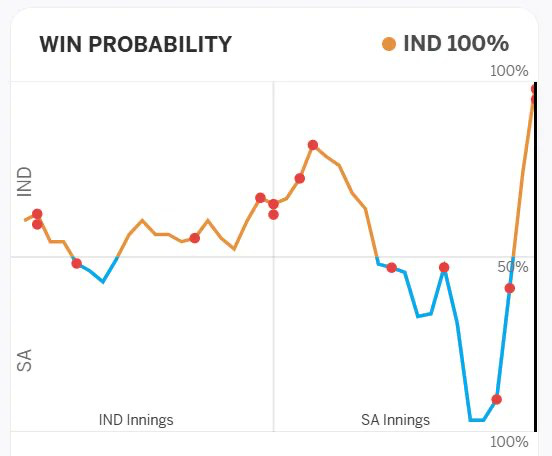
India finished their innings on 176 for 7, after being 34 for 3 at one time. While the par first innings score on this ground was 165, the 176 score seemed 15 runs short on a pitch that had played beautifully, a welcome change from many of the low-scoring pitches through the tournament.
And then, it was time for South Africa to chase down the runs.
South Africa too had an inauspicious start. Bumrah got the first breakthrough, bowling Reeza Hendricks with a beautiful inward ball that held its line; Arshdeep, who has matured as a new ball bowler through the tournament got the South Africa captain Markram in the third over. South Africa were 2 for 12, and India was in business.
However, the experienced Quinton de Kock and young Tristan Stubbs came together to steady the innings. The match slowly started to drift away from India's grasp, with the batsmen showing initiative in running the singles and taking the occasional boundary. When they both were finally out, at 106 for 4 in 12.3 overs, the match seemed poised for a close finish: 70 runs needed in 45 balls, Klaasen and Miller, the big hitters from South Africa who knew the Indian team from the recent IPL, facing off against the Indian spin trio, who had done well through the tournament.
Three overs later, and the match was all but over. Kuldeep and Jadeja, fine Indian spinners, had been taken apart by Miller and Klaasen; but worse was the 15th over from Axar, when Klaasen brutally crushed the bowler taking 24 runs off him in sixes and fours and nervousness induced wides.
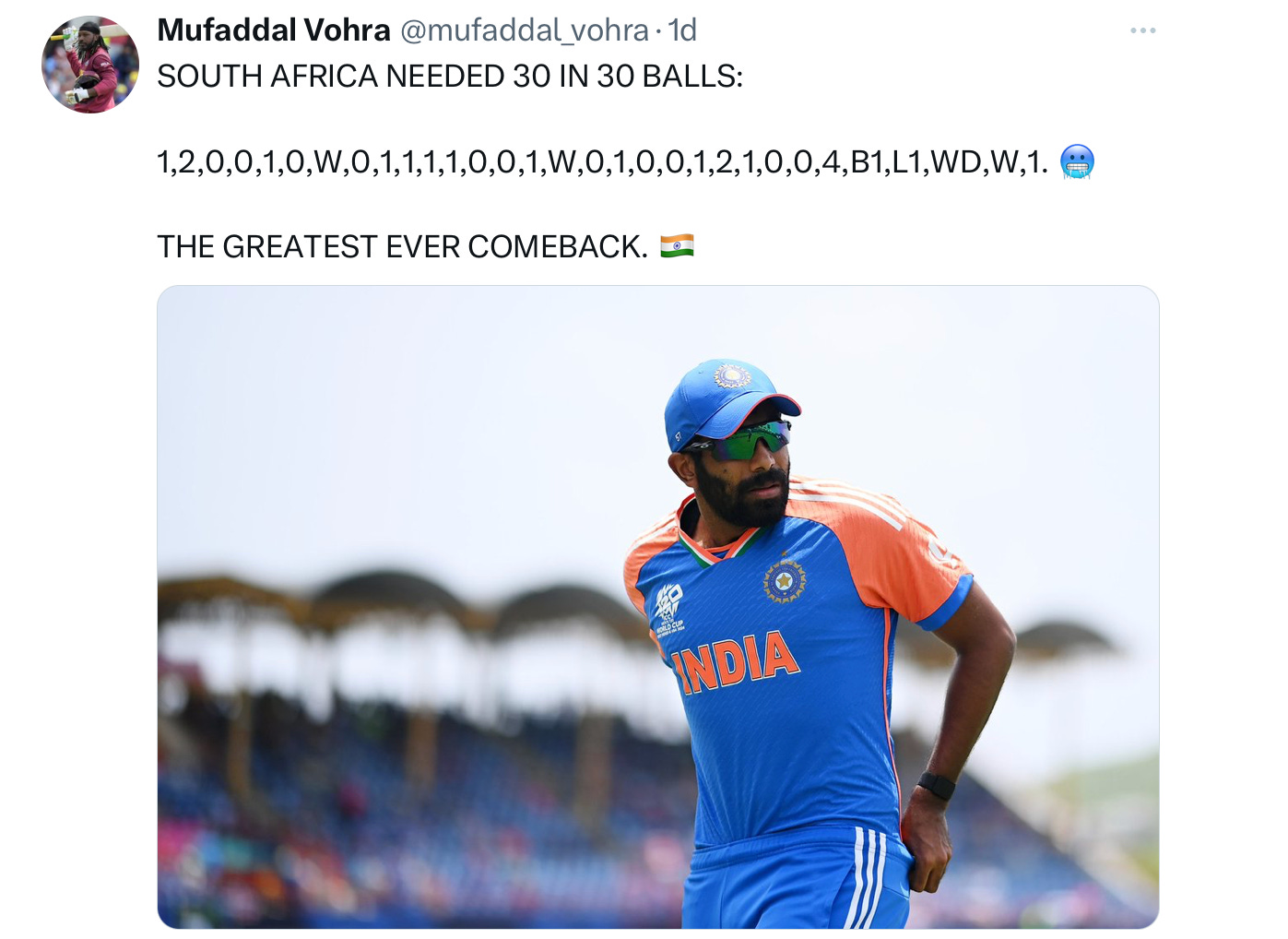
South Africa needed 30 runs from 30 balls with 6 wickets left, a mere formality in this format. But the Indian pace bowling attack — a phrase that brings out incredulous goosebumps for any Indian Gen X'er — the Indian pace bowling attack hadn't had its last say yet...
The IPL-reviled Hardik induced Klaasen into a false shot to a slower wide ball in the 17th over, and just like that Klaasen was gone for 52 off just 27 balls. Who would bowl the 18th? It had to be Bumrah.
And Bumrah it was, that beast of bowling with mastery over the black arts of getting the ball to do just what he wanted, of getting the ball to move and rise and speak to the bastsman. And what an over, one for the ages: he got Marco Jansen with a beautiful in-cutter and gave away just 4 runs in an over where every ball could have had a wicket. Arshdeep bowled the next over beautifully too, keeping calm, and not giving the well set Miller many balls to play.
So soon the match had tilted again in India's favor, exceptional pace bowling restricting the batsmen. South Africa needed 16 off the last over; Miller was facing, and was used to such challenges, Bumrah and Arshdeep had bowled their quota, and so the ball again went to Hardik...
So it boiled down to this. Would Hardik be hero and be vindicated, or would he justify the trolls and be vilified as villain? The next 6 balls would tell...
The first ball from Hardik. A low full toss outside off. Memories flash of another final, decades ago, Chetan Sharma, low full toss, to Miandad who put the ball away for six, could Miller do the same? Miller strikes it cleanly. The ball sails over long on: it's alol over now for sure.
But then what’s this, here's Surya, here's Kumar, here's Yadav, here's the eponymous SKY, catching the ball, tossing the ball into the air, stepping calmly over the ropes and then back again to catch it, impossible physics, an optical illusion, and the batsmen is out! This was a catch for the ages, the Gen Alpha equivalent of Kapil Dev's catch in another final two score years ago that defined fielding excellence for my generation. This ball never left the SKY once it was caught; I had tetched, “Gone again when it mattered”, when SKY got out cheaply while batting, but when it really really did matter in the first ball of the final over there was the SKY, the firmament, firm and forever etching his name in the history books with fantabulous fielding.
This was it, the match was all but over now. It had swung firmly towards India. Hardik kept it interesting with a wide and some loose balls, but the new batsmen weren't good enough to take advantage of his less than ideal death-over bowling. He emerged hero at the end, but he will forever owe a debt of gratitude to SKY who saved him the blushes...
India had won the World Cup from an impossible position. It was heart-break again for South Africa. Tears of joy, and of grief (in the South Africa camp) flowed.
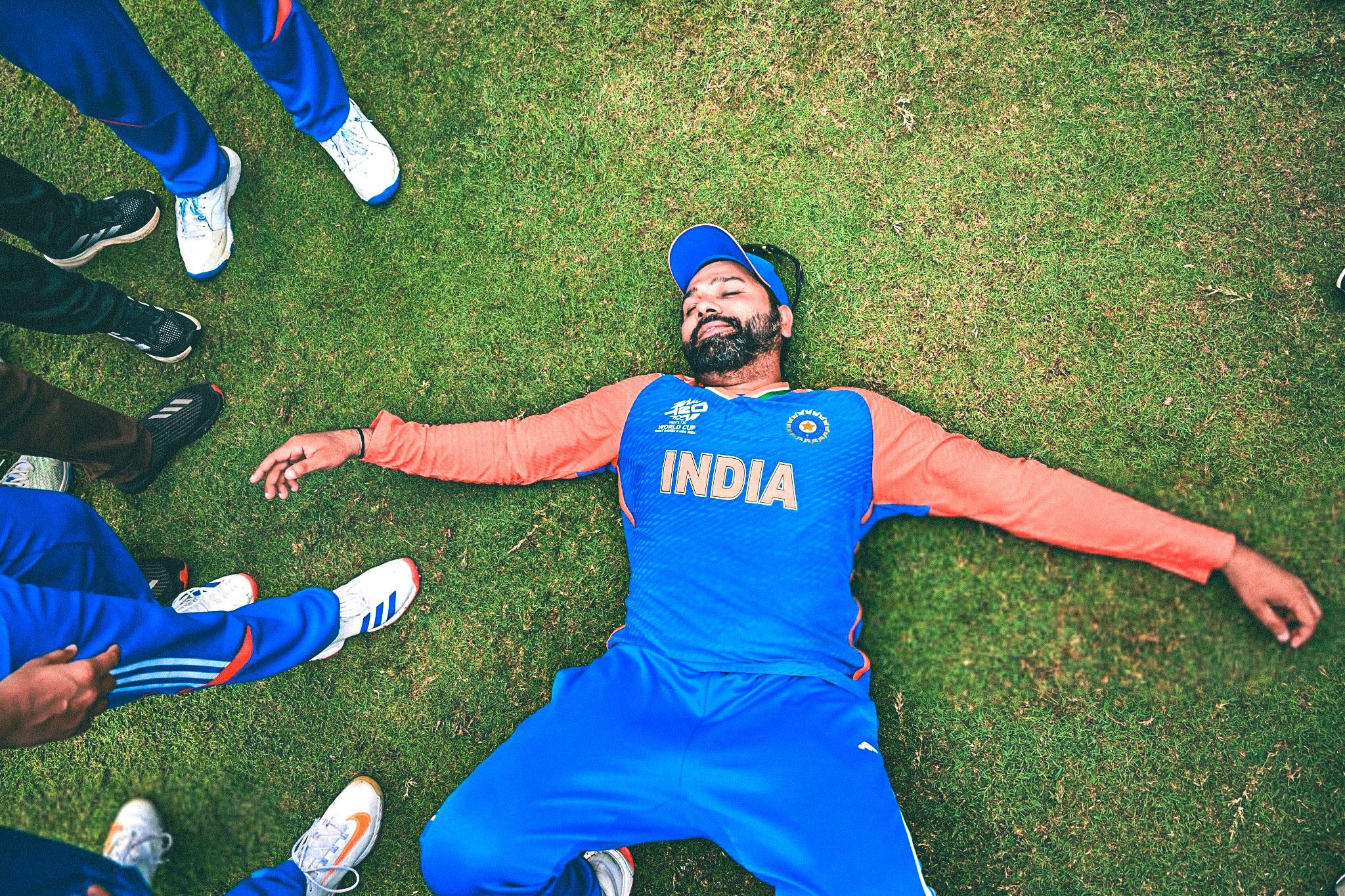
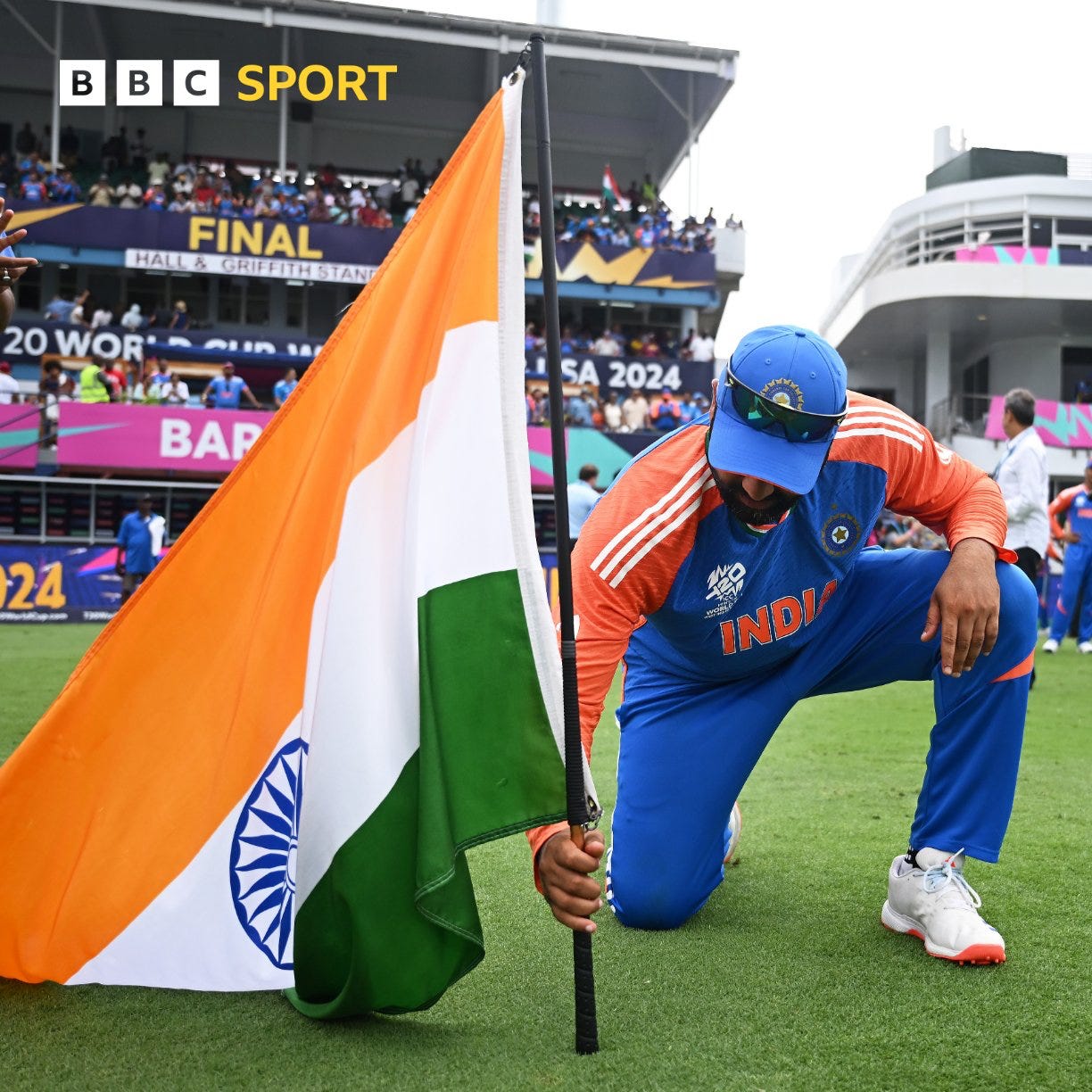
There are rare moments in sport when you get a glimpse behind the curtains and see the magic and wonder of life. That physics-defying catch by SKY had ripped a hole in the space-time continuum and opened up a portal to a different dimension, a different universe: a universe in which the unflappable Rohit Sharma was on his knees, beating the ground as though in retribution for the ODI World Cup loss; a universe in which Virat, the brash Delhi boy who seemingly believed only in his own work-ethic spoke, through tears, of divine grace and the power of prayer; a universe in which the poker-faced coach Dravid burst into vigorous fist-pumps of joy in the dressing room (not even in this universe would he have taken off his shirt and swung it about as his batting partner had once done at Lords!). Elsewhere in this universe Arshdeep and Axar were dancing Bhangra, Ishant Sharma was in tears in the studio, and Siraj (where did he come from?) was speaking in flowery English: the post-match celebrations were dreamlike and fantastic, the stuff of legend.
I stepped out of my brothers place in Princeton, where I had been watching the match, to see a car filled with Indian’s driving about and flying the Indian flag high. This wasn’t the effect of the morphine that I had been given for my kidney stones, this was the power of sport: to transport players, fans, and viewers into a magical new reality, a reality in which team India were champions once again.
My favorite pics from the T20 World Cup Finals
Thanks for reading Written by appa! Subscribe for free to receive new posts and support my work.
Comments
Nothing yet. Say the first thing.
Sign in to join the conversation.