
The art market returned to growth in 2025. Look closer, and you find a market carried by nine lots sold in a single November week – and a dealer sector that still hasn’t recovered from 2022.
There is a particular kind of optimism that circulates in art market reports when the numbers, after a period of decline, turn positive. It is the optimism of people who need things to be fine. The 2026 Art Basel and UBS Art Market Report, authored by Dr. Clare McAndrew of Arts Economics, delivers one such number: $59.6 billion in global art sales in 2025, up 4% year-on-year. The headline was welcomed. The market had returned to growth after two consecutive years of contraction.
But numbers are not neutral. They aggregate. They average. They smooth. And in a market as structurally unequal as the global art trade, the act of averaging is also the act of obscuring.
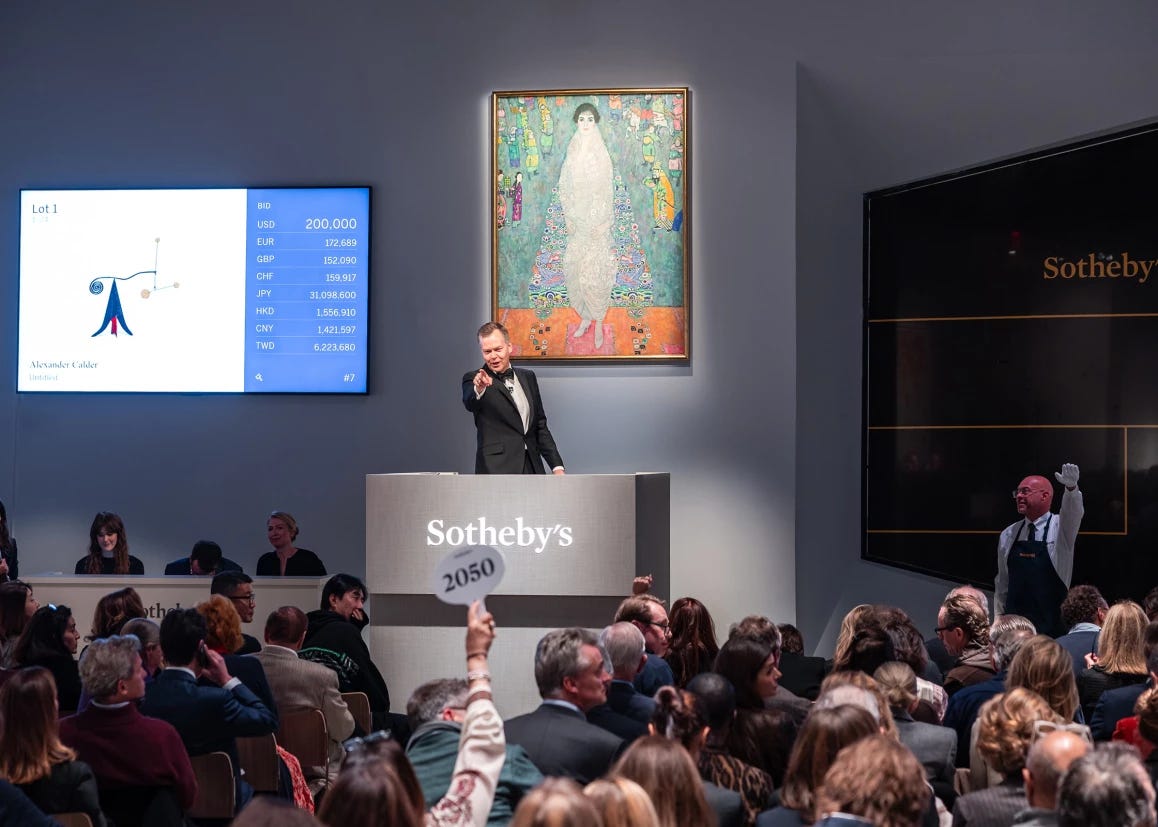
The most consequential fact in this year’s report is buried in the auction chapter: nine of the year’s top ten highest-priced lots were sold in a single week in November 2025, almost all at Christie’s and Sotheby’s in New York. The centrepiece was the Leonard A. Lauder collection evening sale at Sotheby’s, which alone generated $527.5 million – including a Gustav Klimt portrait that sold for $236.4 million, the second-highest auction price ever recorded.
Without the Lauder collection sale and that week in November, the global ‘recovery’ would have been a rounding error.
Since 2022, the auction market has operated on a logic of spectacle: a few exceptional lots, usually attached to a deceased collector’s estate, generate outsized value and temporarily flatter aggregate figures. The supply of such collections is, by definition, finite. What the 2025 data confirms is that the market’s recovery is not yet self-sustaining – it is event-dependent. Even with the uplift, the total value of the top 50 lots sold at auction in 2025 remains roughly a third below the 2022 peak.
Dealer sales grew 2% to an estimated $34.8 billion. Two percent. After two years of decline, that number barely qualifies as growth – it qualifies as stabilisation. And even that modest figure masks what actually happened inside the sector.
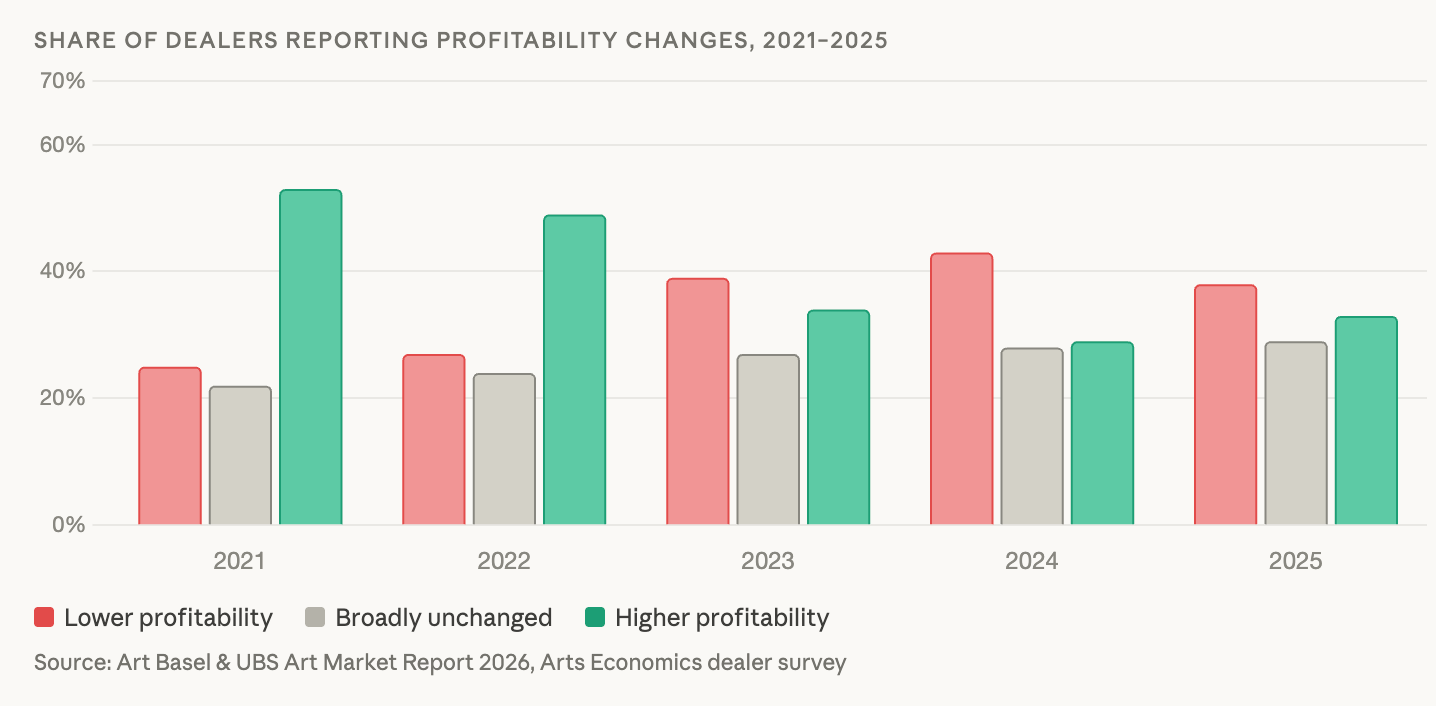
Profitability, the more honest measure of health, deteriorated for most of the market. Across all dealers, 38% reported lower profitability while just 33% reported higher profits. The middle of the market fared worst: dealers turning over between $250,000 and $500,000 saw 45% of businesses report declining margins – the highest share of any segment – even though this group also recorded one of the largest increases in aggregate sales. More revenue is being generated at higher cost, and the economics of operating a gallery in this range have become genuinely precarious.
Dealer quotes in the report say it plainly:
“While the prices for our artworks remain unchanged (and we can’t alter them or they wouldn’t sell), rising overheads mean our profits are in decline, making gallery operations unsustainable.”
“Art dealing feels more like gambling than doing business.”
Payroll and rent together consumed 43% of dealer costs. The operational scissors effect – costs outpacing what dealers can charge – that has been squeezing galleries since 2023 has not resolved. It has simply become normalised.
The high-profile gallery closures of 2025 – Blum, Clearing in New York and Los Angeles, Tanya Bonakdar’s LA space, Almine Rech’s London branch, Pace and Perrotin in Hong Kong – made headlines. The report’s response is to contextualise them: openings (42% of restructuring activity) outpaced closures (25%), with the remainder being relocations, downsizing, and expansions.
This framing is technically accurate and strategically incomplete. The relevant question is not whether more galleries opened than closed, but what kind of galleries are closing and what kind are opening. When Blum – founded in 1994, with premises across New York, Los Angeles, Hong Kong, and Tokyo – ceases operations, it is not equivalent to a new contemporary space opening in Seoul or Zurich, however promising. The ecosystem is not merely contracting; it is restructuring in ways that shift power further toward the largest institutional players and private operations, while the mid-range gallery model continues to hollow out.
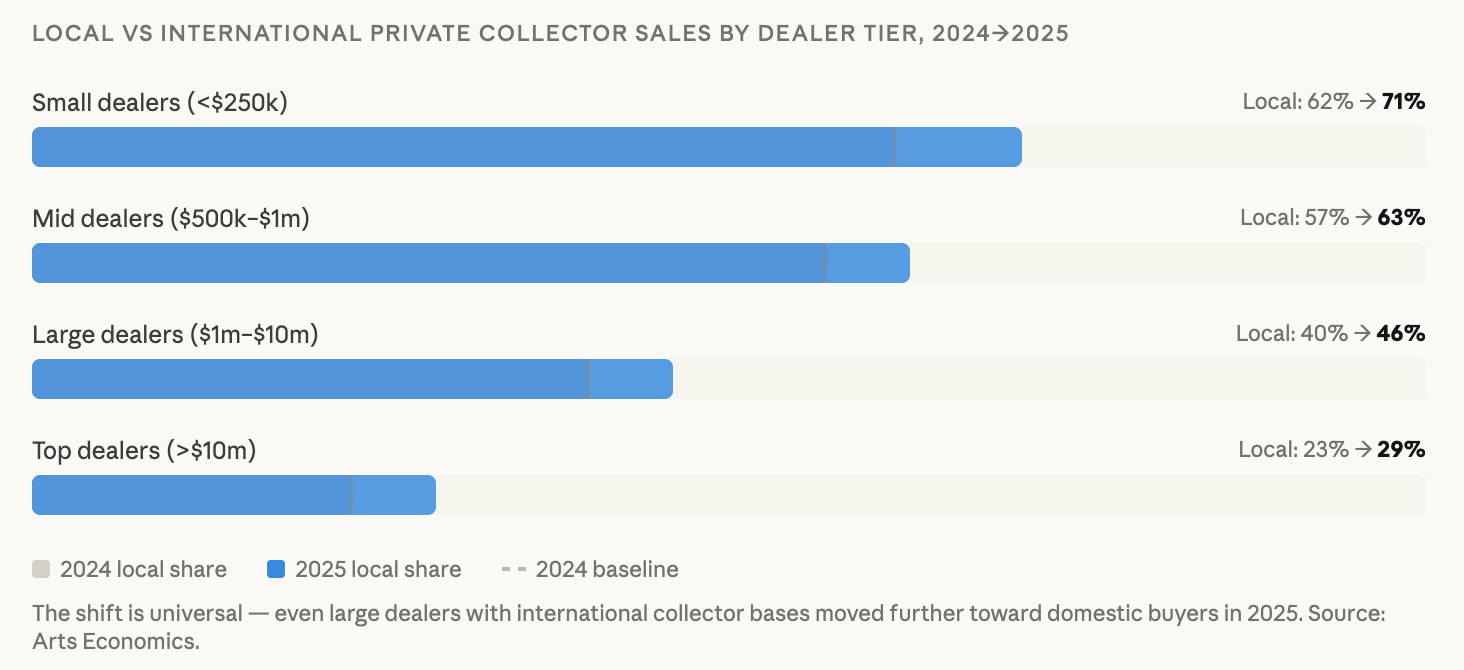
Perhaps the most structurally significant shift in the 2025 data is also the quietest: the art market is localising. Across all dealer segments, sales shifted further toward domestic buyers. The smallest dealers saw their share of local private collector sales rise to 71%, up 9% year-on-year. Even the largest dealers – those with turnover above $10 million, where international collectors traditionally dominate – saw local sales rise to 29%, up 6% year-on-year.
The cause is not difficult to identify. Tariffs, cross-border complexity, shipping cost inflation, and the administrative burden of international transactions have made dealing across borders more expensive and more uncertain. Over 56% of dealers reported that US tariff policy had a negative effect on their business. The figure for mid-tier auction houses was 80%. Not a single auction house surveyed reported a positive effect.
The report dedicates an entire exhibit to this structural rupture. Its argument is pointed: the shift from soft power to hard power as the dominant logic of geopolitics represents a systemic shock to the cultural sector. The US administration’s tariff architecture treated cultural goods as economic competition. Italy’s parliament moved to make immunity-from-seizure for international art loans conditional on reciprocity. The EU’s 2019 import regulation, designed to fight terrorism-era concerns, now sits as an anachronistic compliance burden in a world that has moved on to different threats entirely.
These are not temporary disruptions. They are the early legal and regulatory architecture of a more fractured art world – one where cultural goods flow along the same fault lines as geopolitical alliances, and where the frictionless international market of the 2000s and 2010s is not coming back.
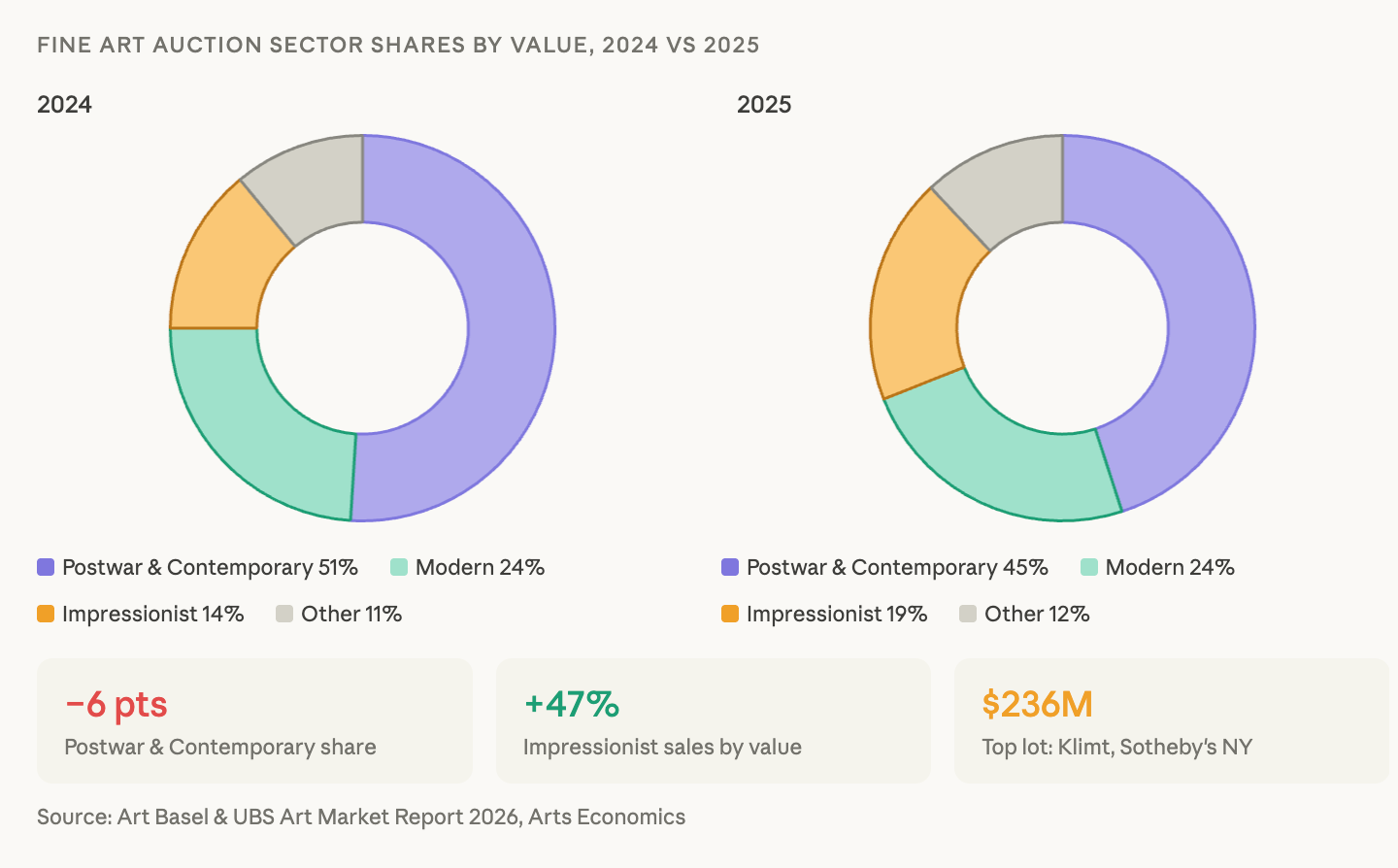
Two sectors of the auction market genuinely outperformed in 2025, and their identity is instructive. Impressionist and Post-Impressionist art grew 47% by value, its share of global fine art auction sales rising from 14% to 19%. Modern art grew 9%. Meanwhile, the Postwar and Contemporary sector, which had powered the post-pandemic boom, declined for the fourth consecutive year, its share falling from 51% to 45%
In a moment of uncertainty, wealth concentrates in the demonstrably safe. Klimt, Van Gogh, Rothko: artists whose market is not subject to the speculative volatility that inflated – and is now slowly deflating – the Contemporary sector. The living artist economy, never far from fashion and therefore never far from risk, is cooling.
Online sales contracted for a second consecutive year, falling to $9.2 billion – the lowest level since 2019 and just 15% of total market value, down from a 25% peak in 2020. The highest-value transactions continue to migrate back to in-person channels, while online retains its role only in the mid- and lower-price segments.
What the 2026 report cannot fully say – because it is, among other things, a product of the institutions it reports on – is that the structural conditions generating the headline growth are precisely the conditions that most favour the market’s most powerful incumbents.
A market that recovers on the back of a few exceptional estate sales benefits Christie’s and Sotheby’s. A market that localises benefits gallerists with deep roots in wealthy domestic collector bases. A market where the $10 million-plus segment grows while the sub-$50,000 segment declines is a market that is becoming harder to enter and easier to dominate – for those who already have the inventory, the relationships, and the institutional credibility to play at the top end.
A recovery built on a handful of exceptional lots, sustained by a dealer sector where four in ten businesses are losing money, is not a recovery in any meaningful structural sense.
It is the art market doing what it does best: making instability look distinguished.
Comments
Nothing yet. Say the first thing.
Sign in to join the conversation.