
How does one make meaningful art that speaks to people ?
It needs to speak the voice of its time.
Why is AI such a big problem for us artists ?
Because we haven’t yet found this voice.
In a recent post, I said that art history was the way to discover this voice. In particular, learning about how each period of human history gave rise to its art forms, will help us produce new art forms. Ones that won’t cower in the face of AI.
Let’s start at the very beginning : prehistoric cave art.
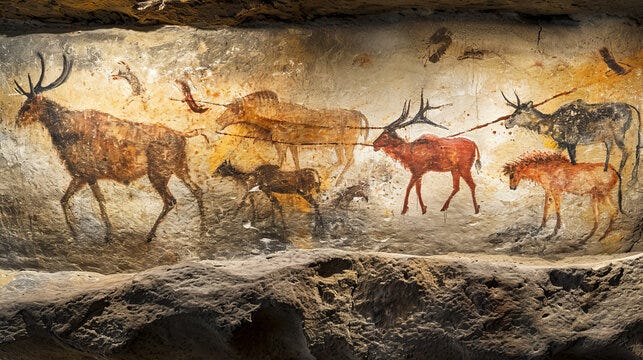
Prehistory was a dangerous place, where a single mistake could cost your life, and tradition was thus crucial. Evolving in a world where they were neither the most important nor the dominant force, humans percieved nature as omniscient.
Belief in magic and animism was rampant, as well as a feeling of interconnectedness with the tribe and Nature at large. Respect for elders and initiation rites were also a common feature throughout the world. The idea of the individual came later on.
For all these reasons, images were magical, as manifestations of spirits, part of nature, and ways to uphold tradition. They were not to be messed with.
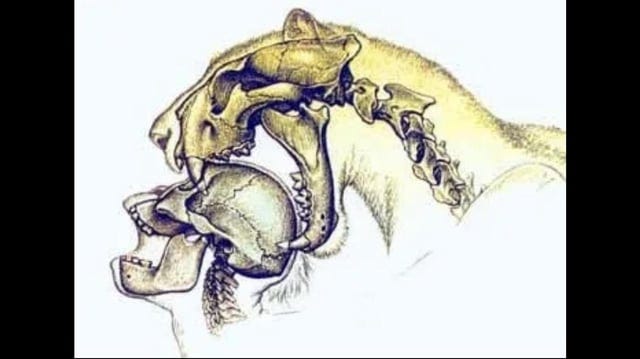
I’ve been deep into barely-expored caves since I was a child. I know just how scary and mysterious they can be. In fact, the insight that we are AI’s mother nature came to me at the bottom of a cave.
To prehistoric humans, they served as both a refuge, a place of spirits and of dangerous, cold, lonely accidents.
What did early humans need ?
Our early ancestors were subject to extreme stress and anxiety about the dangers of nature and the scarcity of prey. They spent a lot of time thinking (and feeling) about it, and looked for any means of increasing their confidence in the face of such odds. In a twisted kind of way, there is also evidence that they felt guilt about killing elements of nature, which was one with themselves.
In this chaotic, storm-and-calm environments, they had a strong need for identity, storytelling — and religion.
And their religions and traditions required many things of them. Some had to uphold the balance of the cosmos. Others had to honor and show gratitude to the clan’s totem animal. Others yet needed to appease evil spirits, compensate for killed game, and so on.
These acts were crucial, and not performing them, they believed, could lead to ruin.
Who was the artist ?
The artist was an initiated individual who performed certain duties for the tribe.
In certain clans, they were shamans, going on lonely “vision quests” — looking for connection to the world of spirits. In other cases, they were worshipping the clan totem through painting-enabled rituals, and deep cave trances.
And they were actually skilled. These lines they drew aren’t beginner lines, and the simplification of shapes is impressive.
In some tribes, the creators of the universe made the first paintings, and taught man how to carry on painting, to keep the balance of the universe. The artists were thus literally holding the universe together, and maintaining a tradition that dated back to before humans even existed !
When Aboriginal people first came to northern Australia, the Mimi taught them how to hunt and cook kangaroos and other animals. […] They also did the first rock paintings through which they taught Aboriginal people their painting skills.
Artists may have been hunting-sorcerers, dooming the game to being caught by painting a bison pierced with a lance. Or, by painting an entire horde, making it more abundant. They may themselves have been a skilled hunter.
Initiation and ceremonies
In various initiation rites, the artist would have led a teen into a cave to reveal to them the secrets of the universe.
Through pitch-black passages and tight squeezes, the teen would be seized with marvel as the origins of the clan, the existence of sacred spirits and the exploits of their forebearers, all presented to them on the cave walls, were revealed to them by the artist.
When coming out of the cave, they may have thought to themselves : “It all makes sense now.”
The artist was also the enabler of whole-tribe ceremonies in front of the paintings. They may have been the only one with the right to paint sacred images and secrets, the sole holder of wisdom about the cosmos and moral laws.
The cave painter was also a recorder. He carried the origin myths of the clan, knew the stories of the totem animal, and held the responsibility of fixing them in memory. In people’s minds, but also in stone. Each painting was an inheritance, a continuation of an ancient line of artists who had painted before them.
The cave walls became a kind of library : how the world began, the secrets of the clan, even practical knowledge. Recent research suggests that the small lines and dots etched beside certain animals may have tracked fish spawning seasons or lunar cycles.
Thus the cave painter is a rare, initiated individual who holds some secret knowledge and access to sacred spaces or worlds. They exert their skill to allow their tribe to prepare for, rehearse, record and invent life, maintain the cosmos’ balance, secure a bountiful hunt, and unite the tribe under an inspired mythology.
It would be wrong to say cave painters painted abstractly because of lack of skill. They did so because their subject matter was abstract and spiritual.
The story of prehistoric art was one of extremely urgent need, and very little means. So many problems were without practical solutions : the capriciousness of nature, finding confidence and identity in the face of an inimaginably scary world, performing our duties to the universe, maintaining traditions, passing down knowledge, and so on. Art was what filled the gap. Artists performed all these duties for their tribes, and they were respected for it.
Today, we have eradicated these needs. As we will come to realise later on in this series, Art is always being supplanted by other disciplines, that perform its duties better than it.
If so, then what has kept it going so far ?
Renewal. In fact, if we don’t reinvent art, because it doesn’t fulfil much of a need among modern populations, it is bound to continue in the current trajectory, receding and letting AI take its place.
So how to reinvent art ?
What we’ve learned from cave paintings is that art responds to very concrete pressures and demands from the environment. The more powerless we are to deal with circumstances, the more it expands into the roles other disciplines can’t fill.
Don’t we feel powerless today in the face of AI ?
My fingers are itching to write a general conclusion about the role of Art today. But I will discipline myself and wait until we’ve learned more about Art History.
So what are the new forms of art that we need ? We will find out together at the very end of this series, when we have acquired the necessary knowledge.
And if you feel like helping out in carving this new notion of art, drop me a comment below !! I’ll be glad to take in your opinion !
(also, this post took a lot of effort so consider restacking ♥)
Until next time.
Sources:
Wikipedia – Cave Painting: Theories and interpretations en.wikipedia.org
Wikipedia – Prehistoric Religion: Initiation rituals and secret society art en.wikipedia.org
Bradshaw Foundation – Rock Art Theories V: Shamanism bradshawfoundation.com
Eric Edwards – Prehistoric Art: Totemic Belief and Shamanistic Practice ericwedwards.wordpress.com
Metropolitan Museum of Art – Essay on Ubirr (Aboriginal rock art) metmuseum.org
Japingka Aboriginal Art Gallery – Aboriginal Art Facts (Dreaming and identity) japingkaaboriginalart.com
Comments
Nothing yet. Say the first thing.
Sign in to join the conversation.