
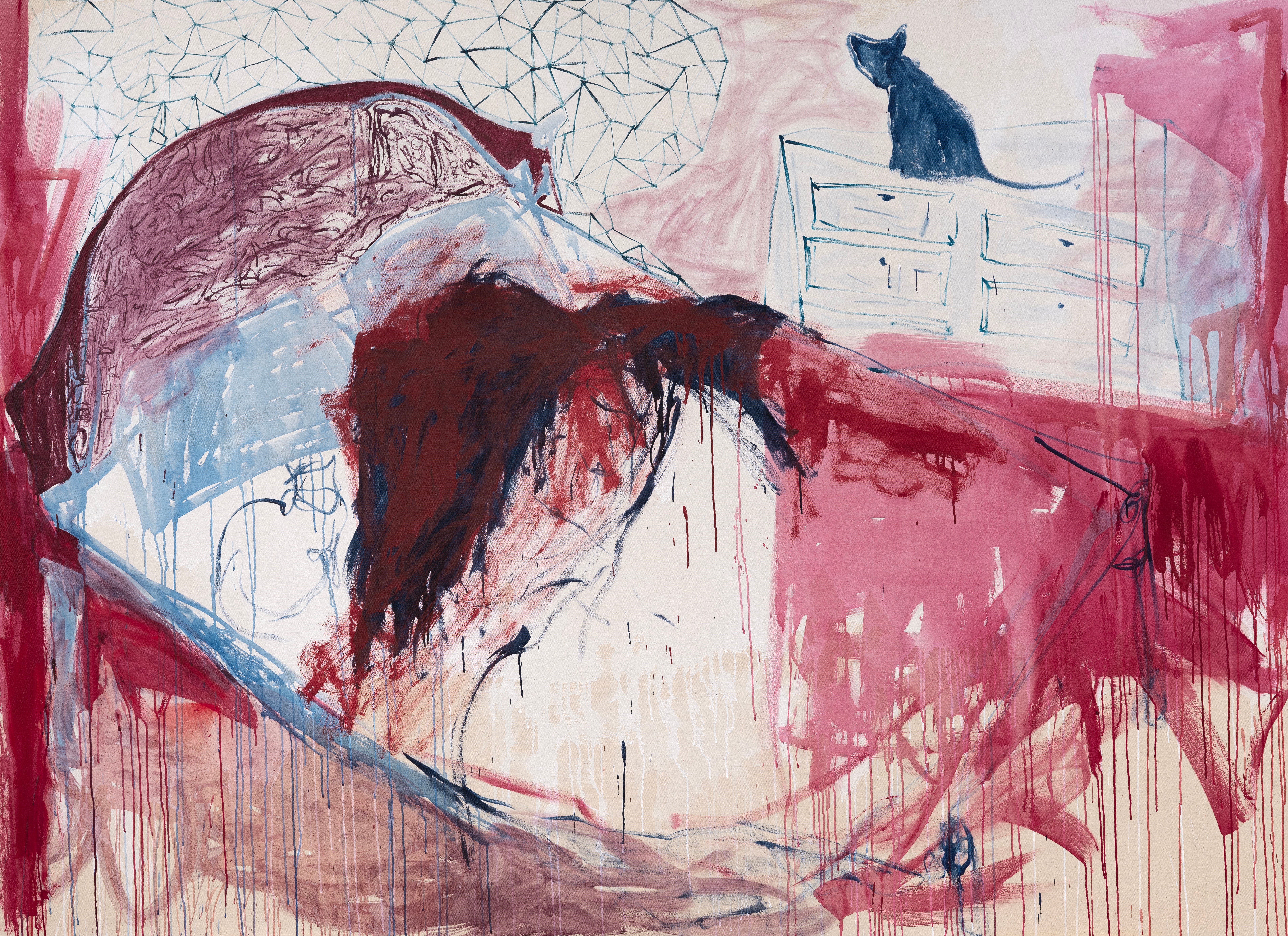
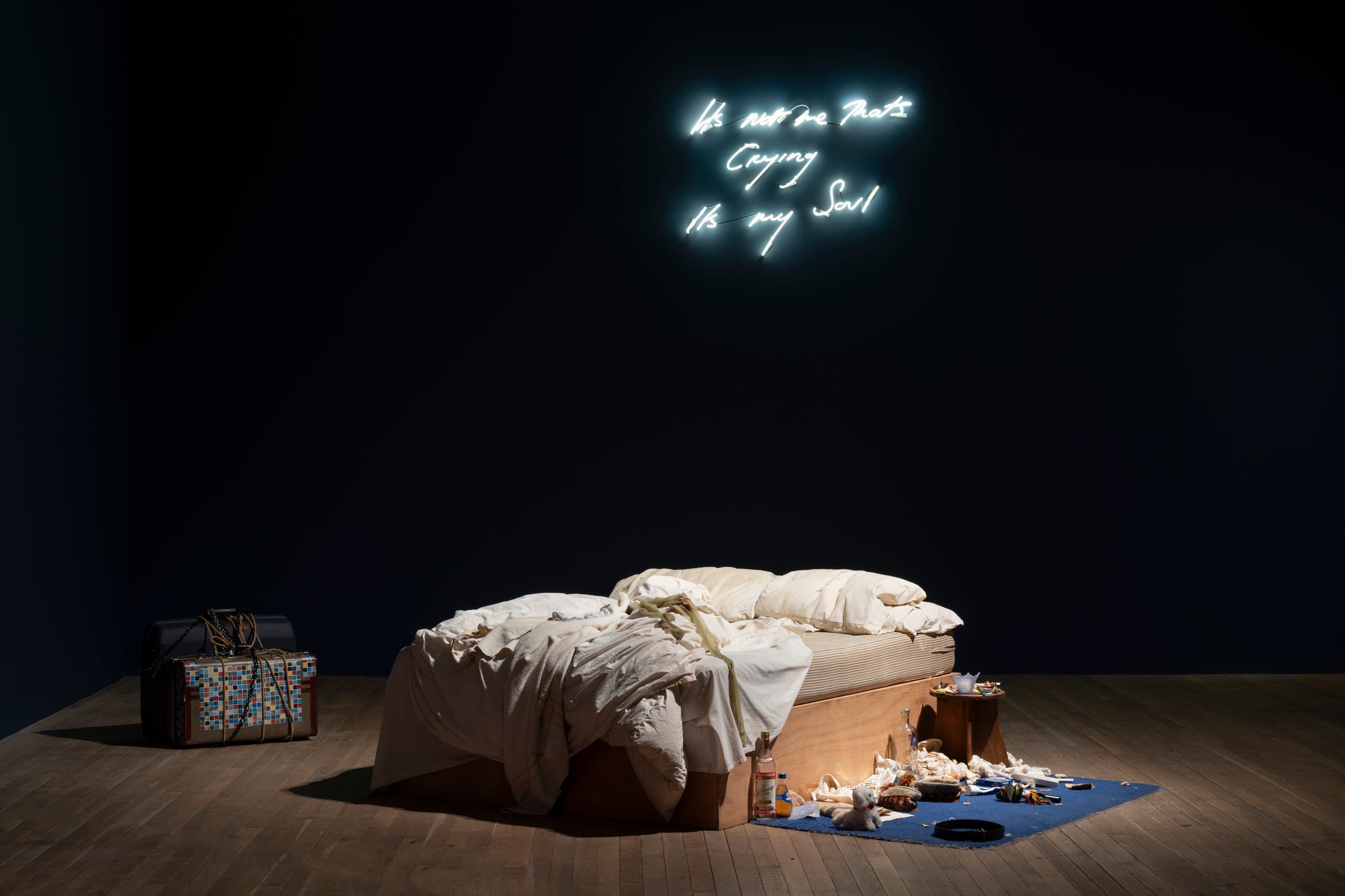
For a little while, when Tracey Emin’s work My Bed was nominated for the Turner Prize in 1999, she seemed to become the British art scene’s enfant terrible. The installation divided the press, and Emin became the target of every would-be critic’s ire. The work featured the artist’s own unmade bed and a small carpet strewn with objects ranging from stuffed toys to used knickers and condom wrappers. Some called it a lazy gimmick. Others said it was salacious and distasteful, laying bare things that shouldn’t be spoken about in public. Emin, they said, was just looking for attention.
More than two decades later, the art world looks different, and so does Emin’s reputation. She looms large in British art today, and the Tate Modern’s exhibition titled Tracey Emin: A Second Life is the largest collection of her work ever shown. It is a blockbuster of a show — a study of growth and survival. And best of all, it culminates in a celebration of her paintings that puts those tired appraisals of her old work to bed.
In the first two rooms, we’re given a kind of overview of Emin’s many approaches — the fabric and quilt work, the sculptures and installations, the films, the photos, the neon, and the paintings. Emin has a tendency to use whatever medium works best at any given moment, and by the end of the show, her touch, her approach, her methods reveal a personality as much as a style.
The work here is as unapologetically autobiographical as always. Emin has been through some things, and she presents them all plainly. Many of her artworks speak frankly about sexual assault. Others give us photos of her post-cancer scars and stoma. Sometimes the work can be hard to stomach, yet there is nothing that feels self-serving in any of it. Emin is not a social-media creator, crying on cue for the sake of engagement. Instead, her work is delivered with the kind of insight that makes it at once intensely personal and nearly universal. This is largely because Emin approaches her own life with a canny acceptance, plain words, and a smattering of joy.
A piece titled My Major Retrospective II 1982-1992 sets up what is to come. It is a collection of photographs of her earliest paintings from art school. Emin has said that “I knew intuitively as soon as I’d come round from my abortion that all the art I’d ever made was a real big bunch of crap and had to be destroyed immediately.”
And so, she did. Those original juvenilia are gone.
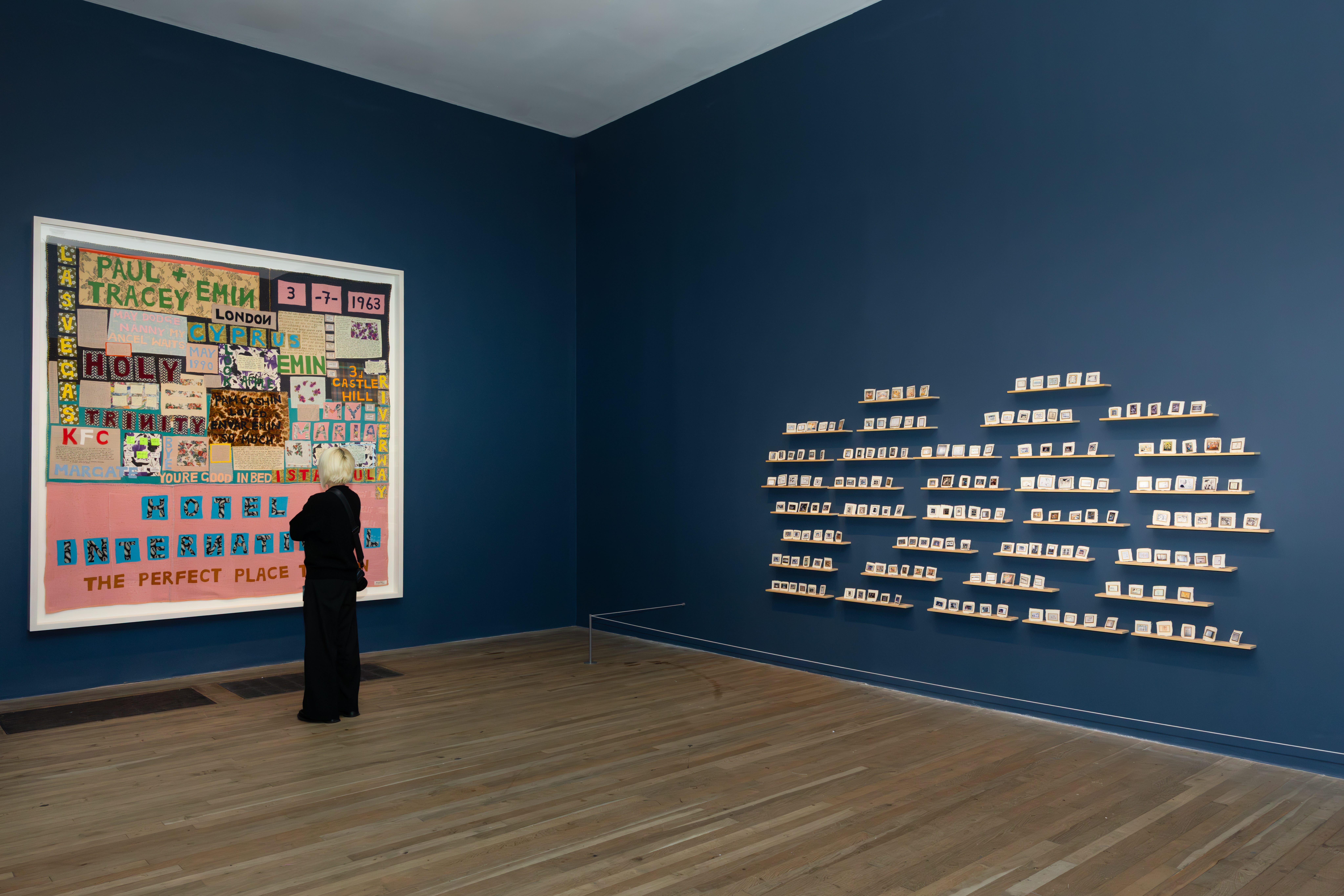
Squinting closely at these tiny photos, you can see the early influences — chief among them, Edvard Munch and other symbolists. She wore her early loves on her sleeve as most art students do, and to destroy her own canvases is an indication of the seriousness Emin places on the personal and emotional side of her work. It is also a reminder that her love of art started with a brush.
Emin gave up on painting until 1996, when she sealed herself into a room inside a Stockholm gallery — naked and visible to patrons only through fish-eye lenses — and vowed not to leave until she had purged herself of her dread of the canvas. That room appears here, too, preserved as if she had just been inside — paint tubes, spatters of colour on the walls and canvases, and yes, an unmade bed. And even though she says the experiment successfully helped bring her back to painting, it would still be many years before she put together a show of painted works.
You might argue that Emin’s disillusionment with painting is exactly what gave us so many of the works that made her most famous. Her fabric works are here in abundance, such as Mad Tracey from Margate, everyone’s been there, and Hotel International — each with its mix of memories and quotes from her life stitched in bold, chaotic patterns. There is a direct contrast between the sometimes painful ideas sewn into the fabric and the fact that many of these are essentially blankets, objects intended to keep us warm and safe.
Then there are Emin’s bronzes — lumpy, deliberately malformed, and decidedly unlovely. But they bear that uniquely Emin touch — a sense that these are golems pressed out of clay in a wild rush of creation. One of her newer sculptures, Ascension (2024), serves as an anchor point for a series of pieces with subtle or sometimes overt religious themes. But along with her very first bronze, Death Mask (2002), they serve best as bookends to two rooms of gobsmacking painting.
I confess — if you had asked me about Emin’s paintings before this show, I would have told you that they did little for me. Until now, I had only seen them on the small screen, where they felt sketchy and incomplete. Emin paints actively, moving quickly but sometimes abandoning a painting for months or years before returning to it. She operates by feel, covering parts of the painting with white when she’s dissatisfied, and leaving what was beneath to bleed through — her mistakes and changes of mind never quite erased. And all of this is lost in photos.
But walking into the final two rooms at the Tate is nothing short of spellbinding. You are struck by the weight of these paintings even though they are so sketch-like. Emin paints almost exclusively in a palette of reds, blacks and blues that drip and wash over the figures. Each one gives us an event, a moment, a feeling. The work is beautiful even when it’s ugly. Light even when it’s heavy. If there had ever been any doubt in my mind about Emin as a painter, this show wiped it away. The images together create a history, a journey of suffering and, if not enlightenment, at least an embracing of life.
Of course, the infamous unmade bed is here, too.
The Tate has deliberately left her most famous installation without an explanation so that its interpretation would not be linked to a single time and event in her life. As a result, it stands almost as a background to the rest. A pause before the grand reveal. It is a fitting moment of quiet in this challenging show — quite the opposite of what it came to represent in Emin’s debut among the YBAs.
Reinterpreted in the light of her illness and recovery, My Bed stands in for any event that might lead us to hiding away in a safe harbour. It’s the scar of a past trauma that you can run your finger over with a kind of fondness. It’s still as clever as it ever was, perhaps even more, because now it feels like the birthplace of an even greater artist.◼️
Tate Modern
27 February – 31 August 2026
£22 / free for members, concessions available
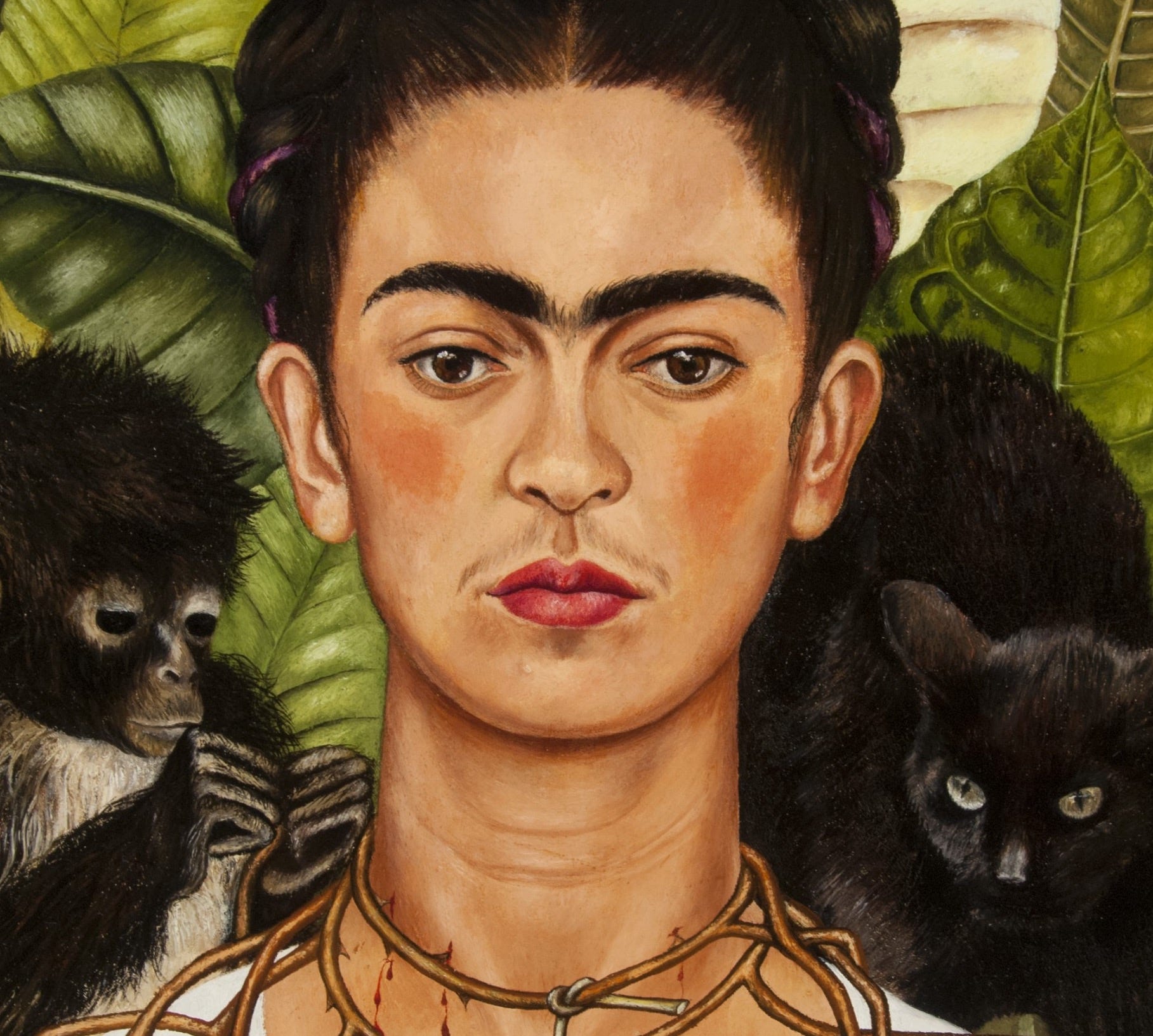
Frida: The Making of an Icon
Tate Modern
25 June 2026 – 3 January 2027
No posts
Comments
Nothing yet. Say the first thing.
Sign in to join the conversation.