
Watching young children interact is watching humanity in its rawest form.
No social conditioning. No polite language. No theories about justice.
Just basic instincts.
My son James is five. He’ll be happily absorbed in whatever toy or imaginary world he’s created. Fully content.
Until Izzy gets something.
A snack? He wants a snack.
A new toy? His toy is suddenly irrelevant.
Something he doesn’t even like? Doesn’t matter — if she has it, he wants the same one. Exactly the same.
Izzy, for her part, is just as vigilant. If James gets ten minutes of screen time, she should get ten minutes too. Or more. Because she’s older. Or because she noticed first. Or because fairness should tilt her way today.
I watch this play out — daily (hourly) — and find myself offering the classic parental explanation:
“Life isn’t always fair.”
But lately, I’ve been catching myself mid-sentence.
Is that actually true?
Or is it just something we say when we don’t have a better answer?
Is it okay for someone to get less than someone else, just because?
Is it unreasonable to ask to be treated the same — even if you didn’t care until someone else had it?
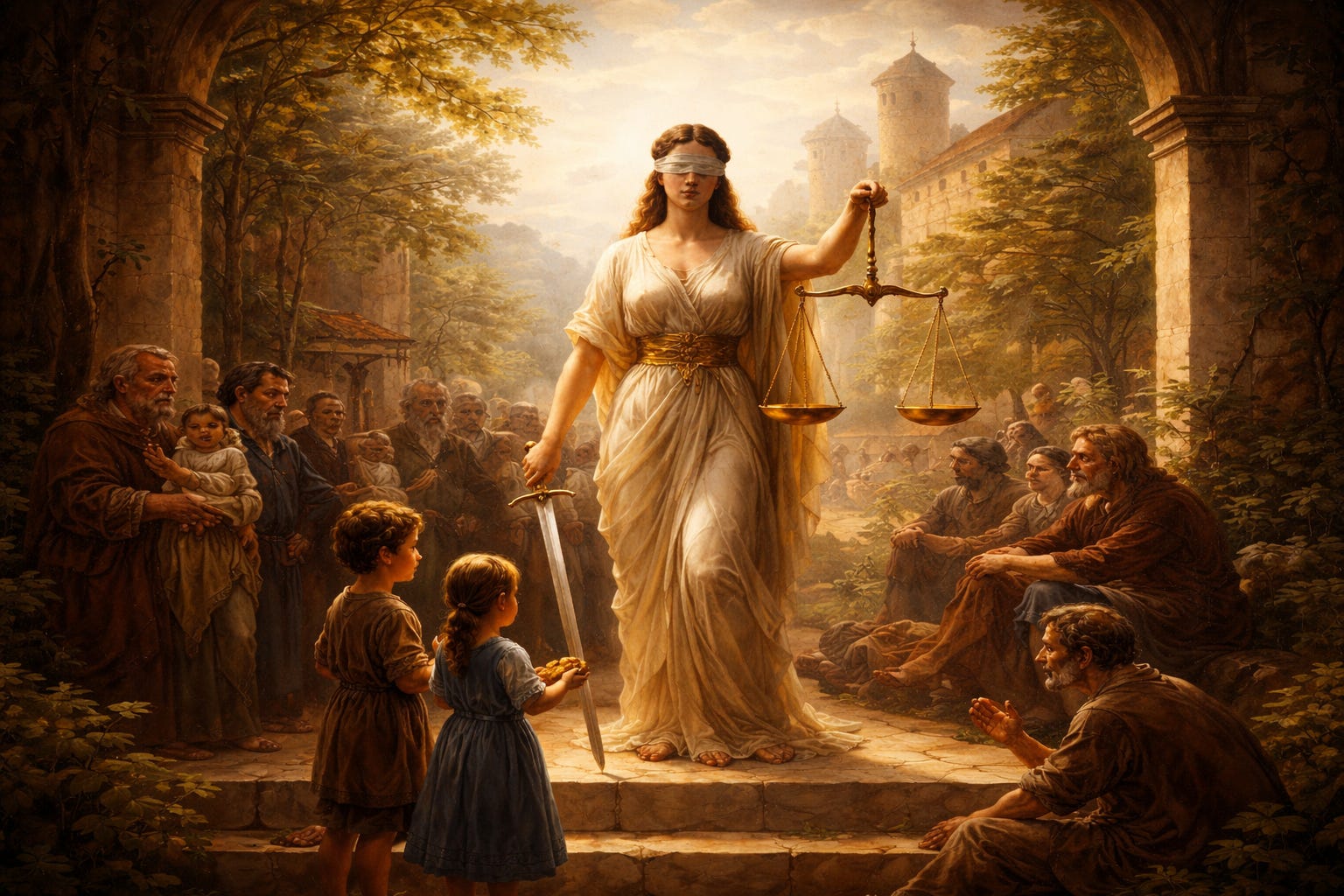
What is fairness?
Zoom out from siblings and snacks and the same pattern is everywhere.
Some people have abundance. Some have nothing.
Some inherit. Some scrape. Some take.
Entire histories, nations, are shaped by disputes over who owns what, who deserves what, and who took what from whom.
Ownership is primal. Biological.
What is mine.
What is yours.
And what I want to take so that I can have it too.
Which makes me wonder: is the human default a zero-sum game?
Or do we actually crave balance — an intuitive sense that everyone should have roughly the same so there is peace?
Nature doesn’t give a comforting answer.
Chemistry says entropy increases. Disorder, not balance, is the natural state of things. Systems drift. Inequality emerges. Equilibrium is fragile and temporary.
Which leads to a slightly unsettling thought:
Maybe fairness isn’t natural at all.
Maybe it’s effortful.
Maybe it’s something humans invented — and continuously fight to uphold — precisely because the world doesn’t bend that way on its own.
If that’s true, then fairness isn’t a given.
It’s a choice.
A muscle.
A negotiation (or fight) we replay again and again — on playgrounds, in families, in markets, in politics.
I don’t have a helpful conclusion here. (shocking!)
Just the image of two kids on the floor, watching each other closely, keeping score — and me realizing that the questions they’re asking with their behavior are the same ones we’ve been wrestling with forever.
Maybe fairness isn’t something we’re born knowing how to do.
Maybe it’s something we spend our whole lives arguing into existence.
Comments
Nothing yet. Say the first thing.
Sign in to join the conversation.