
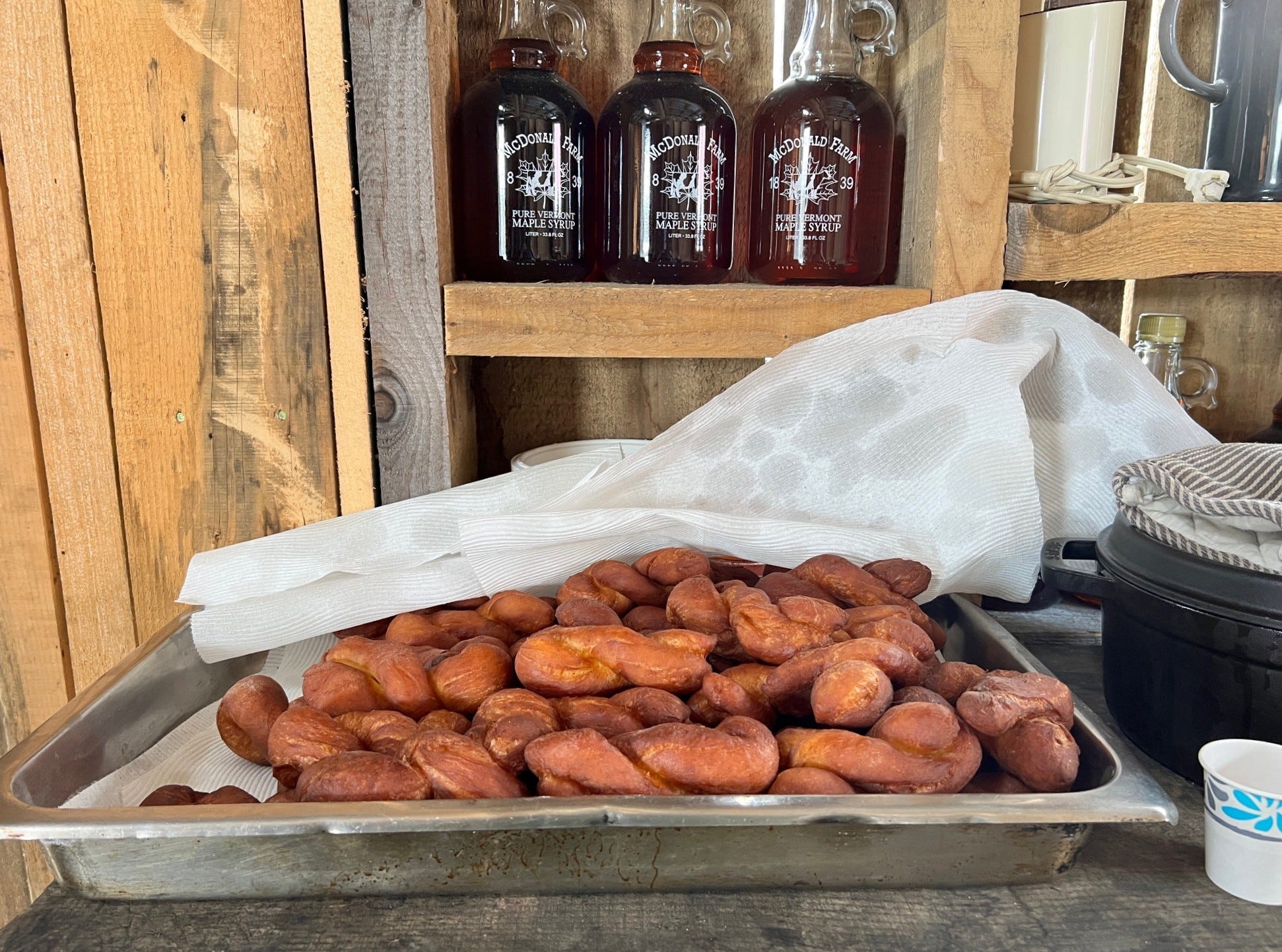
Yesterday we stopped by the sugarhouse where my wife’s cousin was boiling sap, because his mother, Gilly Beattie (my wife’s aunt), had just dropped off several dozen raised doughnuts for dipping in the hot new syrup. The doughnuts had been fried in lard and were still partly crisp on the outside — at their best.
Why lard? “My mother always said that they cooked better in lard,” Gilly responded. They cooked at a higher temperature without burning, and the fat didn’t soak in as much. “She always rendered her own lard. She tried to get the leaf lard.” That comes from around the kidneys and has the most neutral flavor. But now Gilly buys her lard rather than render it herself. “It’s a pain in the ass, and I don’t like the smell in the house. I use the lard two or three times during doughnut season, and then I dump it.”
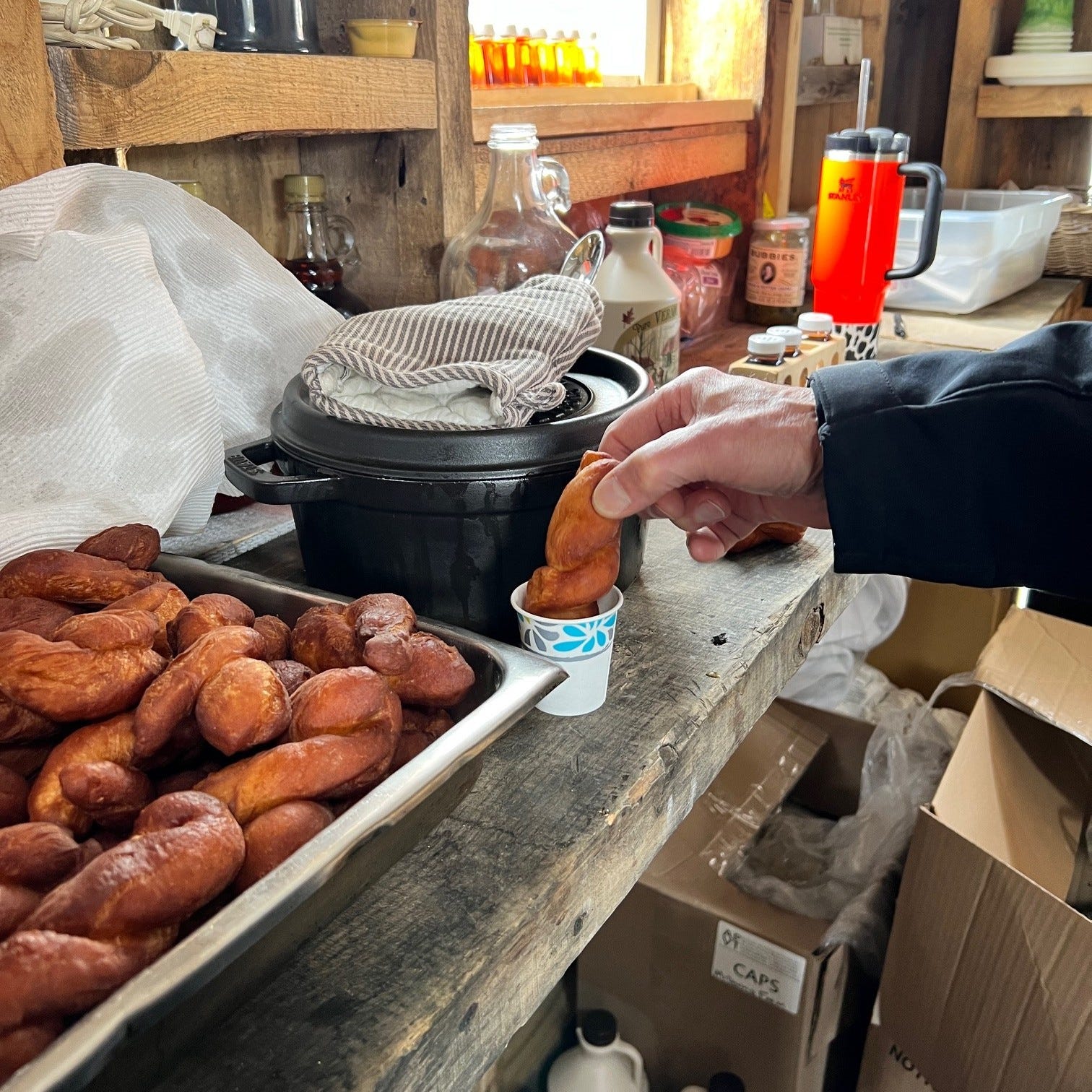
Gilly’s parents ran a dairy farm, and her mother cooked every day for a very large family and whoever else was around at mealtime. The doughnut recipe was hers. Some people use doughnut cutters, but Gilly’s mother said that forming “a twist was the way the old people always did it.”
She scalded the milk for the doughnuts, as cooks had done going back to the time when all milk was raw. Safety wasn’t her concern because, although she used raw milk from the bulk tank, the family drank the same raw milk. Maybe she thought scalded milk made a lighter, more tender result, which is what some bakers say now. I’ve always meticulously avoided giving recipes that call for baking soda and powder because they so often replace the generally more interesting lightness and flavor from eggs or yeast. The recipe below is the exception to my rule: it has eggs, yeast, and also, for better browning, baking soda.
1 pint milk, scalded
1 stick plus a little extra butter
4 eggs
salt to taste
1 tsp baking soda
14 grams (2 envelopes, or 4½ tsp) instant dry yeast
100 to 200 gr (½ to 1 cup) sugar, depending on how sweet you want them
flour (see below)
about 2¼ kg (5 lb) lard
When the milk is cool enough, beat the eggs into it. In a large bowl, combine the salt, sugar, baking soda, and sugar, and mix in the milk-butter-egg mixture and the flour. (How much flour? “I don’t know,” said Gilly, meaning a specific amount.) It’s not a question of measuring. You add enough to make a stiff dough, one that it’s not easy to stir together. “It’s not wet but it’s sticky, if that makes sense.” You stir but you don’t knead.
Cover the dough, and let it rise to about double. Cut it in little sticks, and roll them and make twists. Cover them, and let them rise but not as much as double.
Heat the lard in a Dutch oven to 165° C (325° F), checking the temperature with a candy or deep-frying thermometer. Drop the twists into the lard. They float, and when the top looks bubbly like a pancake, flip them and brown the other side. Makes several dozen doughnuts.

This Substack is reader-supported. To receive new posts and support my work, consider becoming a free or paid subscriber.
Comments
Nothing yet. Say the first thing.
Sign in to join the conversation.