
0:00
-15:12
Welcome, friends! If you are new here, my name is Merideth, and I am an oboist, author, and creative coach. Art’s Open Door is all about exploring how creativity, beauty, and the spiritual life intersect. We are right on the cusp of a big milestone: the official pub date of my newest book, Art is How God Loves Us, is a little over one week away—on July 7!
The book is a deeply personal exploration of the ways music, poetry, visual art, and more serve as an open door, inviting us into a conversation with something much larger than ourselves.
Today, I’ve got a short piece I wrote on a recent transatlantic flight that considers the book’s cover art itself as a spiritual gateway—a lens through which we can hold both deep joy and quiet grief.
I wonder now if she noticed my light come on every morning at 5:07. First, the soft glow above the kitchen sink while I silently made my coffee, then the single lamp to the right of the living room couch where I sat down to write. She was awake too. I knew this because, like clockwork, her brake lights would flash in the dark across the street, backing out of her driveway at exactly 6:18 AM. Every single weekday morning.
My mother used to warn me against being a “Looky Loo”—her term for a nosy shadow peeking through the blinds. I never meant to be one. Mostly because I value privacy— I like to keep to myself, especially at home.
One of the things that surprised me most about moving from the city to the suburbs is that, even with fewer people around, it feels even less anonymous. How was it that in a city of millions, it could feel easier to go unnoticed? There were Looky Loos there, too, to be sure. And yet, something about so many people doing so many things made you feel a little more incognito. In the ‘burbs, the stage is smaller, the lighting a little harsher. You couldn’t pull out of your driveway or walk the trash bins to the street without feeling the eyes of your neighbors.
I didn’t start watching this particular neighbor on purpose. First of all, her house wasn’t even immediately adjacent to mine; she lived alone (as far as I knew), across the street and down a few houses. Hers was a simple brick ranch, like the rest of us in this Metro Detroit neighborhood built during the 1950s Motor City boom; all the houses on our street have more or less the same layouts. (We have all the same problems, too, since we see the same plumbers’ trucks off and on in others’ driveways!) I fell in love with this neighbor’s house because of the oak tree in the front. Each fall, it turns such a bright fluorescent orange that no iPhone can capture it.
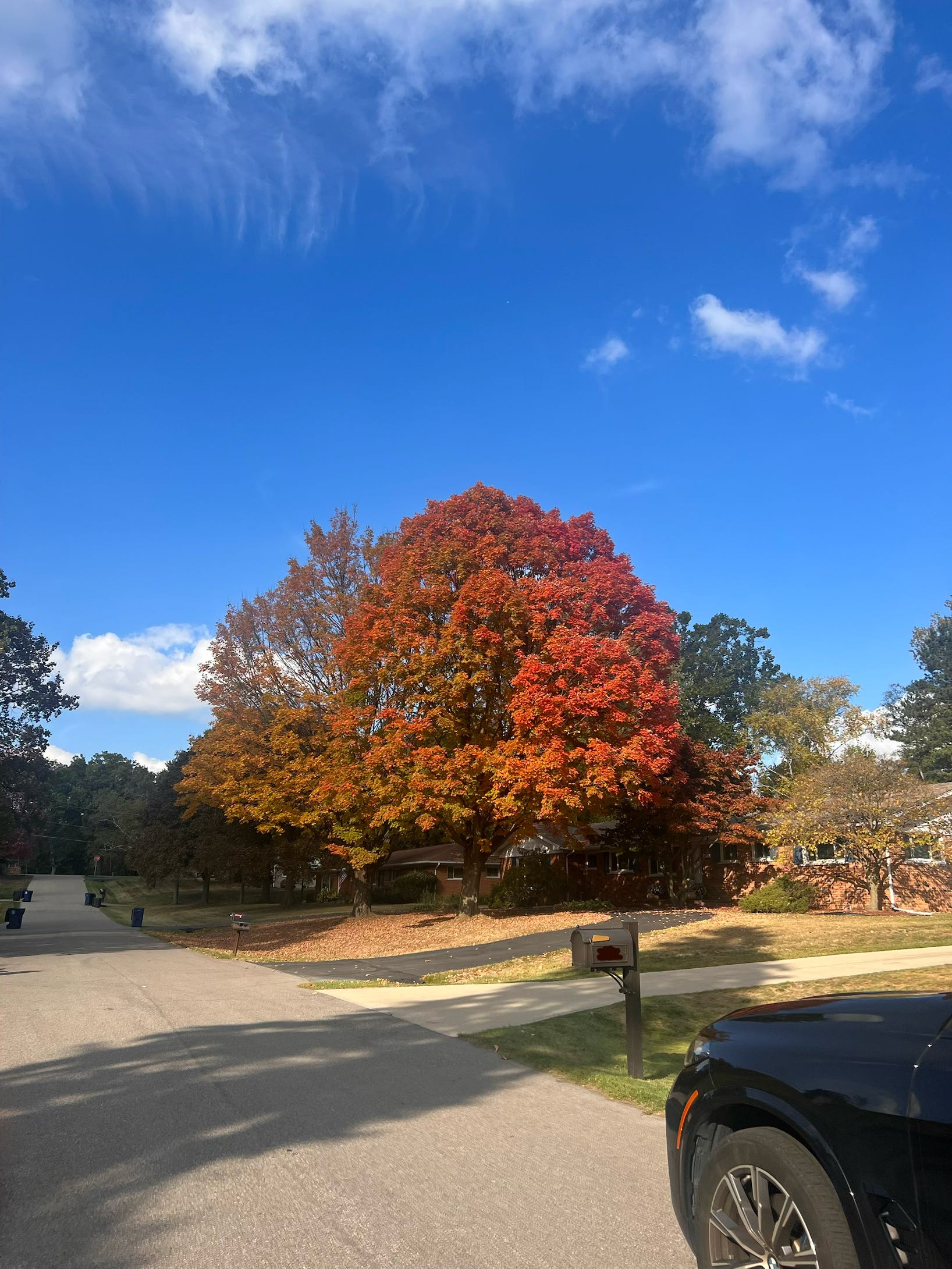
One day last fall, my son, then 4 years old, spoke to her. We were walking to the bus stop to pick up his sister one afternoon, and the neighbor was in her yard, healthy and rosy-cheeked, filling her sixth bag of crispy, dried leaves in time for the compost truck to come in the morning. Eli, who isn’t usually overly chatty with strangers, called out as we walked by, “Wow, you’re doing a great job with those leaves.” She smiled and thanked him.
You might be asking at this point, why I didn’t take that moment to ask my neighbor’s name. I cannot honestly say why. Maybe I felt awkward about the fact that we’d lived there for almost five years and had never introduced ourselves? Have I mentioned that small talk is not my strong suit?
When we left the city, we’d dreamt of having an idyllic suburban life where kids played kick-the-can, and neighbors came over unannounced to borrow eggs. But in truth, our neighborhood is not exactly that kind of neighborhood. When we moved in, no one came with cookies or pies or introductions. We do know those that live in the three houses immediately next door and across from us: the single woman in her 50’s who always has special candy and toys for Eva and Eli on Halloween, an elderly couple living with their one adult son who lent us their extra trash bin once, a retired couple whose grandkids you can hear laughing in the pool from behind their privacy shrubs—we sometimes get their mail or Christmas card, but as much as we’d like it to be otherwise, we are not close with our neighbors at all. They aren’t rude per se, a little cold maybe, standoffish, politely waving from the mailbox (an occasional complaint about the length of our grass, but that’s another story for another time).
Mostly, the people in our neighborhood seem to want to be left alone. And so, we do our best to keep to ourselves, too. On that day last fall, after my son’s sweet compliment, I kept walking. I noticed her habits from the window on occasion. Not in a Looky-Loo way, just an observant person without blinds on that end of the house who wakes up early.
After I finished my manuscript, I let myself sleep in for a while. I didn’t notice when she stopped going to work. It must have been later, in the spring, when we walked the bus, that I saw her pull out at 8:20; this time, her short blond bob was gone. Her now bald head was covered by a scarf. She smiled with weak eyes and waved; we were bundled in winter gear, the oak tree bare.
When the green returned, I watched her lawn get long. One day at twilight, a younger man (her son?) arrived to mow the grass.
The seeming decline of the neighbor with my favorite oak tree happened slowly and then all at once. One Thursday, as I washed dishes, I saw the estate sale signs go up. That weekend, dozens of cars lined the streets as people carried her belongings out into the spring sunlight. I saw her Christmas decorations get thrown into a stranger’s Subaru, a mirror slide unceremoniously into the back of a van. My husband asked me if I wanted to go see what they had at the sale, but I couldn’t do it. “We didn’t even know her name. It feels wrong,” I told him. The artwork, a pair of big red ceramic pots, boxes of what looked like miscellaneous exercise equipment. If we’d had blinds, I would have closed them.
My heart broke when, a few days later, I saw the moving truck, then a donation van for what no one wanted, and finally, a dumpster. Every week after that, it felt like someone new was there—a contractor, a painter, a realtor. Then came the open houses.
I realized I was watching someone’s life dismantle, piece by piece, like the petals falling from a wilting flower.
On the final walk to the bus stop as the school year ended, her house seemed abandoned, empty. I grieved for a house I had never set foot in, someone’s name I never knew.
The book I wrote last winter, when she was still leaving for work at 6:18—I can hold it in my hands now. The oak tree is green; it’ll be orange again in a few months. She won’t be here to see it.
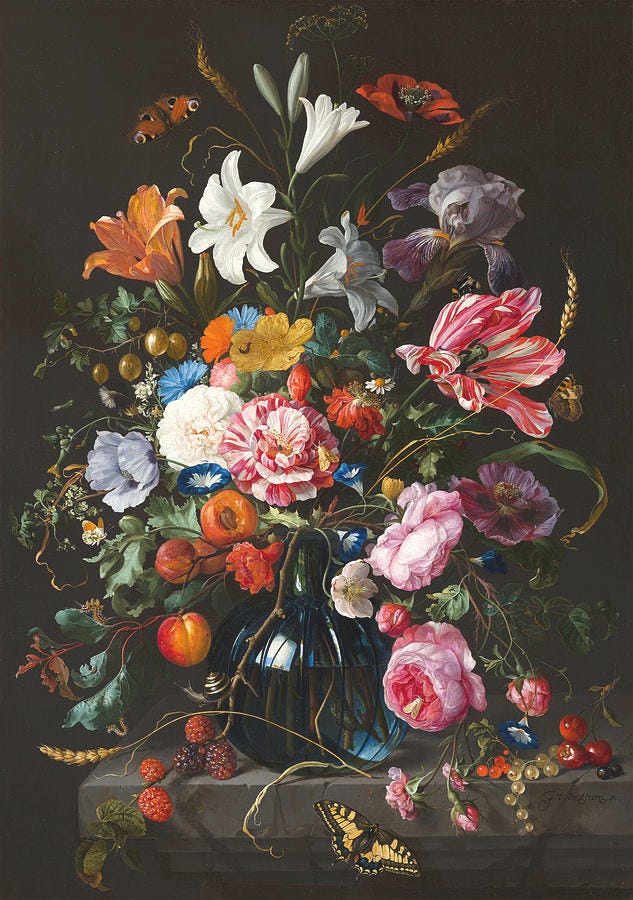
The first few cover images that the publishers suggested were nice, but when I saw the one featuring “Vase with Flowers” by Dutch master Jan Davidsz. de Heem, I gasped. It’s striking—one of the impossible bouquets of the 17th century—when artists painted floral arrangements that could never have existed in real life. Not all those flowers bloom at the same time. It is an artificial wholeness, an aspirational season of abundance that does not exist.
In a way, I had been doing the exact same thing on my couch all winter: weaving together words of new life while a quiet winter of decline withered outside my window.
The dark background makes the colors glimmer, and when you look closely, you’ll see the reflection in the vase—a windowsill. I liked to imagine the painter himself standing at it, watching his neighbors, too.
The book I wrote, while (I think) my neighbor was dying, is full of examples of art that has been a spiritual gateway for me. Works of music, architecture, and poetry that I felt God had used to teach me something, to invite me into a conversation with something larger than myself. And so, it feels right, here as it is finally time to share the book with the world, that the cover itself becomes a spiritual gateway, helping me name something important about life and art and loving and grieving.
When you look closer at the bouquet, you’ll see that some of the fruit is rotting, and some petals are turning yellow. There are bugs and creepy critters. I read that in the Dutch Golden Age—an era of immense material wealth and worldly success—these paintings served a dual purpose. They were a celebration of abundance, yes, but they were also visual sermons. I’m told that the artists of the time included the glory of impossible creation alongside its inevitable decay to make a bigger spiritual statement—something called a vanitas painting, rooted in the ancient tradition of memento mori, Latin for “remember you must die.” Painters like de Heem included a snail on a stem, a caterpillar on a leaf, or a moldy spot on a peach as a gentle, persistent spiritual check. They were reminding the viewer that youth fades, riches spoil, and time catches up to us all. (They were Calvinists, after all!)
In one of my favorite novels, The Goldfinch by Donna Tartt, right before the mother dies, she teaches her son about these moments in Dutch art—she says, “When painters put a bit of mold or darkness into a painting, they’re telling you a secret—it won’t last.”1
Art allows us to hold the beauty and the grief together; the impossibility of one makes the other more poignant, more real.
There is no such thing as a “still life.” As soon as it blooms, it is already dying.
What else, besides art, can allow us to hold life and death together?
What else names them both as beautiful in their time, celebrating the fleeting nature of being alive, whispering the secret—nothing lasts.
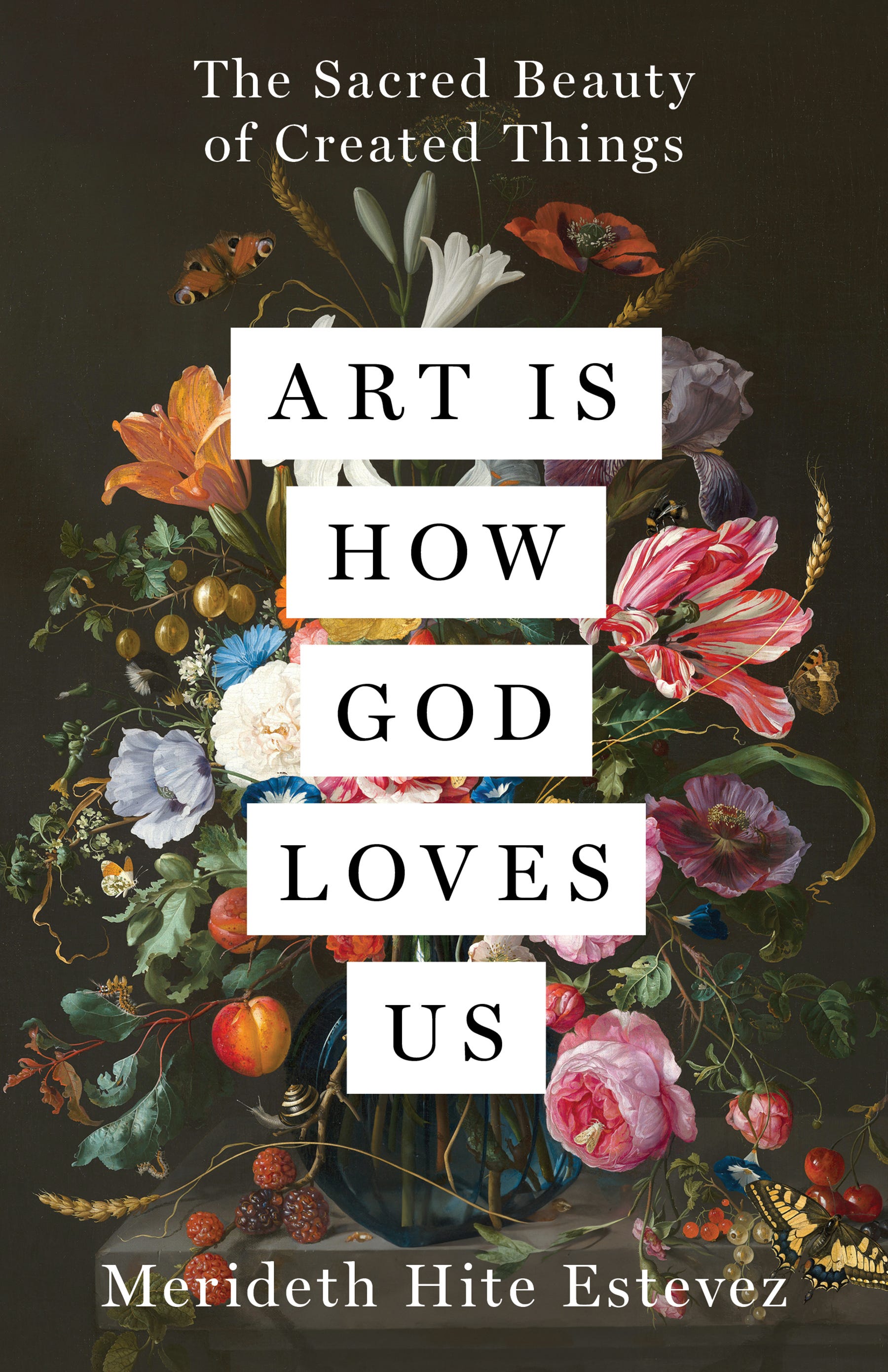
At one point in the cover design process, they removed a small butterfly from the bottom of the painting to make the letters of my name more legible. I agreed that the butterfly needed to be moved, but I was sad to see that when the final edits came, the bug was gone. I remember texting my husband Edwin, asking if a small butterfly was worth fighting for, and without hesitation, he texted back, “New life. Worth fighting for.”
What is the book cover teaching me? If that painting on the cover, painted hundreds of years ago, was an open door, where does it lead me now?
It asks me to hold death and life together.
It invites me to tell you that I think my neighbor died.
To admit with grief and shame that I never knew her name.
It offers a reminder that living and dying are a process. That life is holding both, believing in new life, choosing to fight for it in the face of despair and decay.
They put the butterfly back, just above my name. Every time I look at it, I will think of my neighbor, of all the ways life is not still, that created things, even with their inherent decay, hold a sacred beauty we cannot understand.
This summer, I’m on the road for a multi-state book tour through New York, South Carolina, Ohio, Virginia, Delaware, Pennsylvania, and beyond. It is a strange thing to live out of a bag, moving from city to city, talking to rooms full of beautiful strangers about how art is a spiritual gateway, while carrying the quiet memories of a brick ranch across the street, a beautiful tree, and all of life’s fleeting transitions. But as I look out at the faces in each new city, I am reminded that the people in these rooms carry the exact same weight—each of them navigating their own impossible bouquets of abundance and grief.
Travel, like a Dutch vanitas painting, reminds you of how temporary everything is—the quick flash of a hotel room window, the brief warmth of a new conversation, the inevitable packing up to move on to the next town.
There’s a new family moving into the favorite oak tree house. When we get home from the tour, I plan to bring them a loaf of sourdough and introduce myself. They have a young daughter. Maybe she’ll invite Eli over to jump in the leaves this fall. If they don’t, we may just be bold enough to invite ourselves into their yard, ready to catch the orange before it falls.
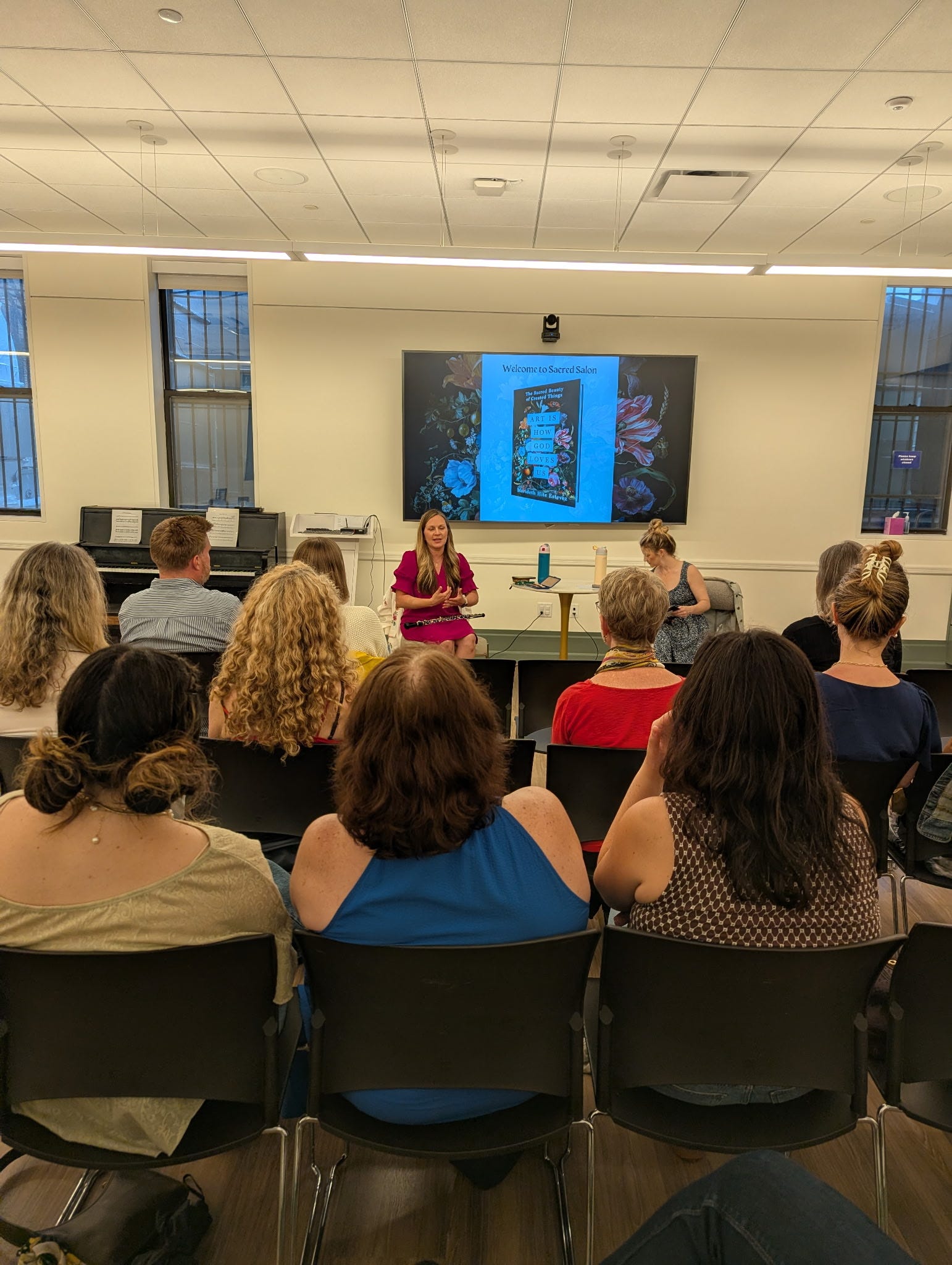
Thanks for reading. If you want to dive deeper into these types of conversations, Art Is How God Loves Us is officially available for pre-order now, ahead of its July 7 release. Pre-ordering is one of the most powerful ways you can support an author, and it helps ensure this message reaches the people who need it most. Grab your copy at these affiliate links here.
I’d love to hear what resonated for you in the comments below. They’re open to everyone!
While researching Art Is How God Loves Us, I wrote down this quote because I found it such a beautiful concept. It didn’t make it into the book, but it feels perfect to use now! It’s almost like the cover art was calling to me before the book was even finished.
No posts
Comments
Nothing yet. Say the first thing.
Sign in to join the conversation.