
If I could interview anyone right now, it wouldn’t be Donald Trump or Marco Rubio and it wouldn’t be Beyoncé or Nicole Kidman (no matter how much I really want to interrogate her about Eyes Wide Shut). It would be journalists.
I want to interview journalists not for exactly the same reasons they want to interview Trump, Rubio, Beyoncé, and Kidman. Not for personal profit, not to associate my name with the names of famous people, not because I want to fawn or bow down, but because I believe journalists, just like public officials, must be questioned and held to account in the way they are supposed to hold public officials to account. And while journalists’ careers exist specifically to hold public officials to account, absolutely no structure or opportunity exists to hold journalists accountable for their accounts.
Don’t read “accountability” as “punishment.” These are not essentially interchangeable terms, even though accountability sometimes means punishment for transgressions.
I ask you to read what follows, consider whether or not it is reasonable and let me know your thoughts, and I ask you to share these thoughts with others, especially including journalists.
In both broadcast and written journalism, standard journalistic practice often is similar.
In television and radio, interviews and gossip generally satisfy anyone’s expectations of journalism. Every Sunday on Face the Nation, Meet the Press, and This Week, and every day on cable TV news, a person who often has a degree in journalism from Columbia University, sits down facing a public official and asks them a question. The public official has anticipated the question and they recite their prescribed answer. If the interviewer is your standard cable news interview, they accept the answer and ask the next question. If the interviewer is Margaret Brennan on CBS’s Face the Nation, this is how the interview goes:
Brennan: Question.
Public Official: Dodge.
Brennan: You did not answer the question. I asked this. Please answer.
Public Official: Accusation, dodge.
Brennan: I will give you one more chance to answer the question.
Public Official: Lies about opponent, disinformation, insults to journalists.
Brennan: You didn’t answer the question, but we are out of time. Thank you for being here today.
Public Official: Thank you, Margaret. It was my pleasure.
In all cases, whether a journalist like Brennan pushes back in a way that viewers either regard as (if it’s a woman) belligerent or (if it’s a man) respectable, the only answers that are delivered to viewers are misleading at best and outright hostile lies at worst. This format serves only one practical purpose: To relay false information to viewers. It’s not useful.
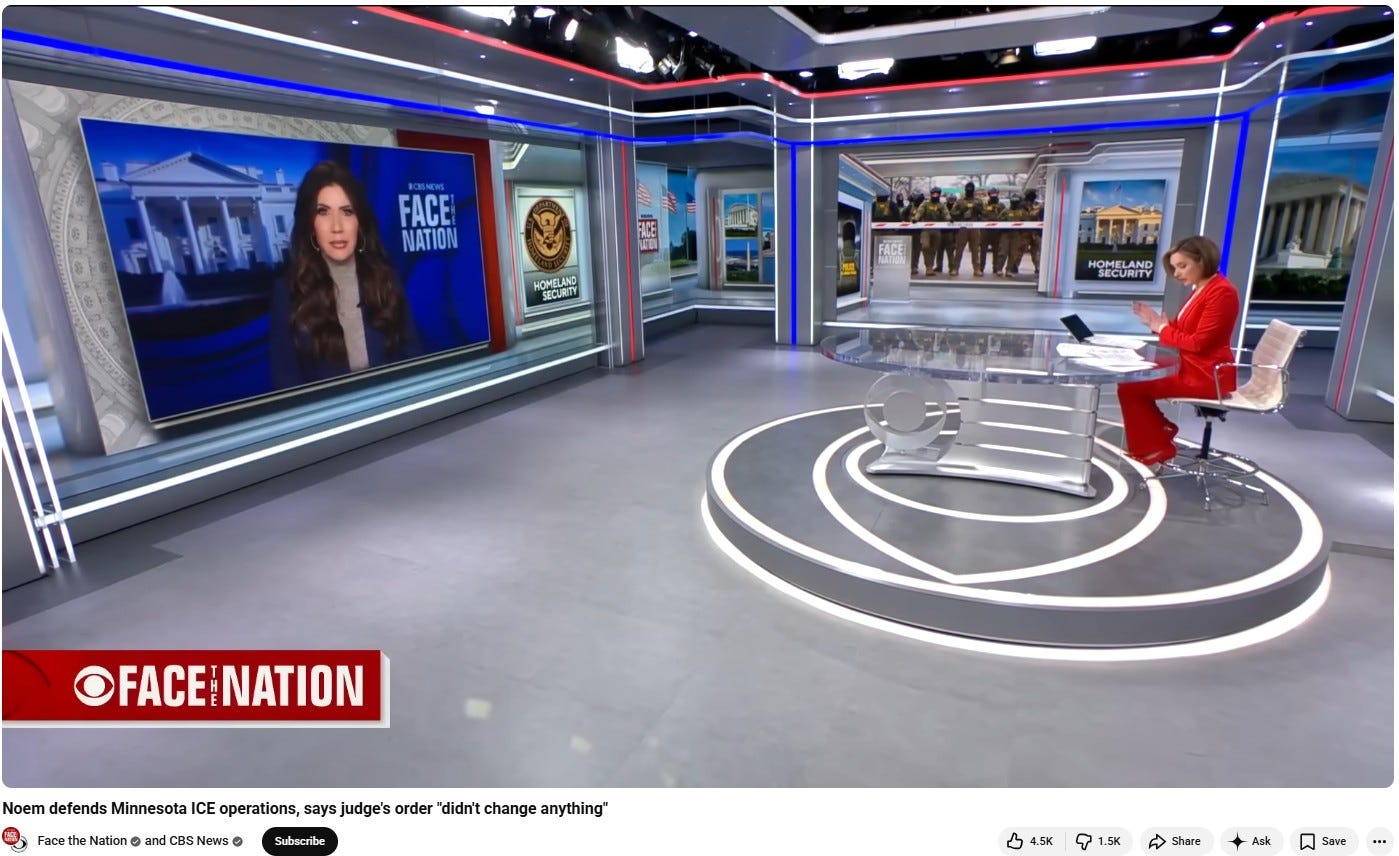
Below, we can see Brennan moving through her list of questions as Kristi Noem looks on, looking quite literally like George Orwell’s gigantic Big Brother staring Brennan down from a gigantic screen. Brennan’s interview of Noem was like all other political interviews: She asked probing questions, Noem either deflected, lied, or accused others in every response, Brennan either pushed back or did not push back, and in no case did Brennan get any semblance of an honest answer or truth out of this farce. So what is the point of it? If your instinct is to say, “There’s no point,” I am sorry to tell you that you are wrong. There is a point; it’s just that the points are being scored by Noem’s side and not by the public-interest side. She wins here not only because she is given a platform for her disinformation campaign, but also because by repeating what she says, Brennan is converting Noem’s lies into perceived truths based on Brennan’s perceived credibility. Does Brennan realize she is serving this purpose?
The same is true of White House and similar press conferences. And this is true of all presidential administrations; it is by design and it is nonpartisan. A gaggle of journalists gathers to listen and record and relay what is effectively propaganda for a federal agency. When called upon, the gaggle goes into a frenzy of desperate people waving arms and calling out to the one person in the room who holds power: Today, that’s Karoline Leavitt. Leavitt has the power to choose or not choose anyone. The person she chooses is The Chosen One for a moment. The Chosen One asks a question, Leavitt is prepared to respond with wild, unfounded accusations against critics, or by demeaning the reporter, and always by fluffing up the portly president’s dense down. The journalists are grateful to be there. They have an important job, you see. That job is to show up and yell “pick me!” and report whatever lies are told.
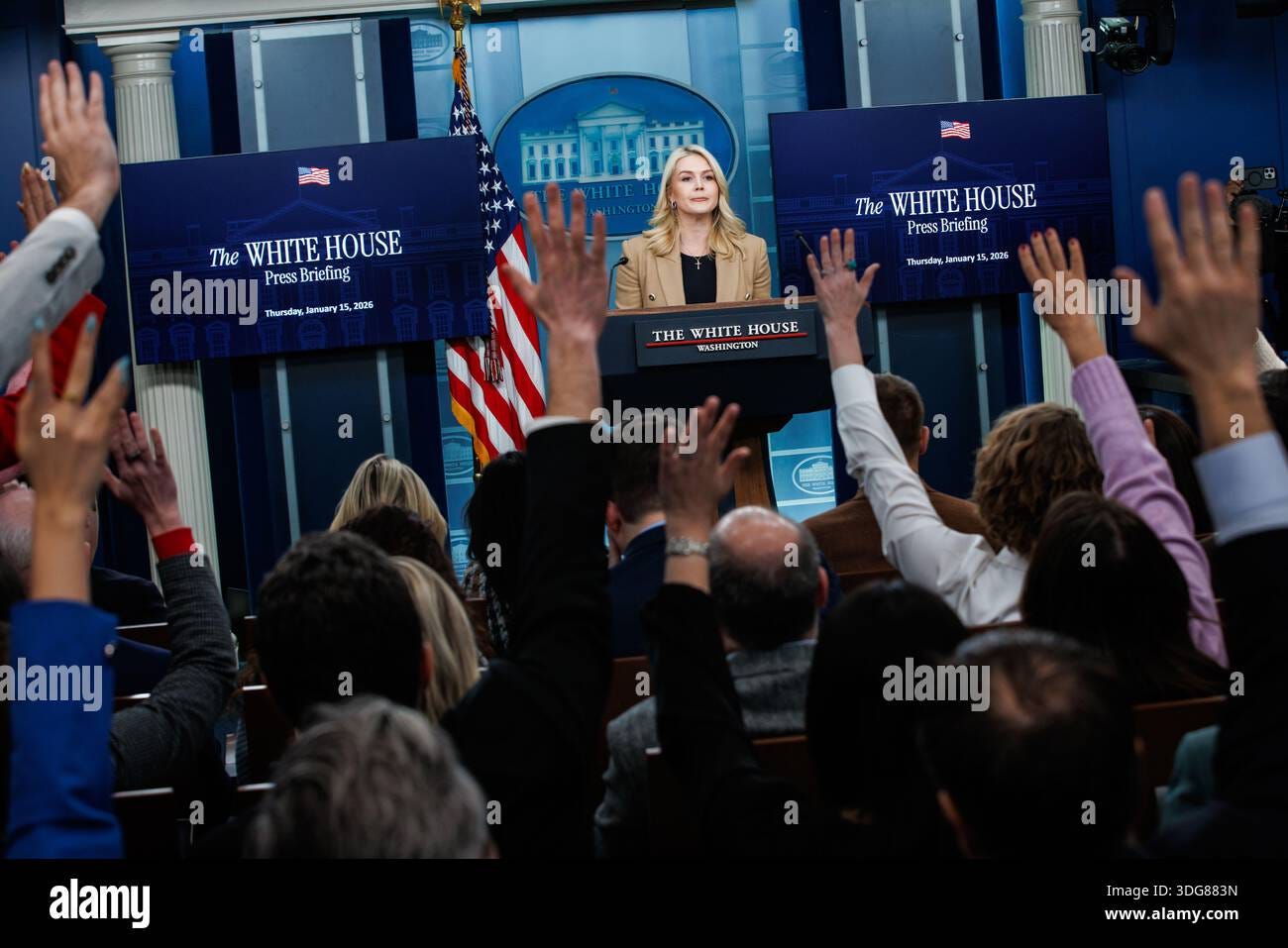
When journalists participate in this farce, they are active participants in a disinformation campaign.
Print/written journalism is not all that different. Standard practice is to plan or even write the framework for an article, coordinate brief phone calls with public officials and/or their spokespeople and/or experts, who often are representatives of lobbying organizations, to extrapolate two- to three-sentence quotes, and to drop those quotes into the prewritten article. Voila—the Pulitzer application has written itself.
No one needs to be in the White House press room to conduct valuable journalism. Showing up to report what propagandist-spokespeople say is fulfilling to one’s ego—they are important enough to be in the room—and it’s not only useful but absolutely necessary to those in power who they are supposedly holding accountable. They’re not holding anyone accountable by relaying propaganda; they are in fact nothing but the dissemination venue for that propaganda, spreading it far and wide under various corporate logos.
Ostensibly, the reason journalists are empowered to be in those rooms is because the First Amendment requires that the federal government allow journalists to investigate and report on them for the sake of keeping them honest, or at least holding them accountable when they’re not.
Has it ever occurred to you, or to anyone, that there is no mechanism by which to keep any journalist accountable? There isn’t.
We expect to see David Muir, Jake Tapper, Kaitlan Collins, Anderson Cooper sit down with public figures and ask invasive questions with impunity. That is the freedom of the press, and although not required by law, participation by public figures is required by public opinion. Kamala Harris was smeared in part because people said she would not participate in interviews with journalists. When she did, of course, she was forced to field diminishing and irrelevant questions such as when Dana Bash inexcusably put Kamala Harris in the impossible and absolutely surreal position of answering to Donald Trump’s charges that Harris “turned Black” for political purposes.
If my empathy-radar is properly calibrated, I sense that Harris seemed to be stunned, not surprised, and regretful of her choice to do this interview, with the kind of dutifully tolerant tone expected of her said, “Same old tired playbook. Next question,” and Bash pressed her with the admonishing tone of “Oh, you’re afraid to answer this honestly, are you?” It was gross. Yet, Harris had to do it and there’s absolutely no mechanism to hold someone like Bash accountable for bad behavior like that. Just as I will always associate Bash’s close-friend colleague Jake Tapper with his crusade-of-convenience against Joe Biden based on Biden’s age and his refusal to acknowledge Donald Trump’s age-related decline, I will always associate Bash solely with this moment. Her attempt to embarrass Kamala Harris for ratings in my view undermined Bash’s entire career. But it was in service of ratings, and she is accountable to no one.
Everyone assumed the “same old tired playbook” Harris referred to was Trump’s racist playbook, but it easily could have been the press playbook of invoking any kind of anger-baiting question, no matter how preposterous and irrelevant to her campaign to serve as chief executive officer of the United States of America, without consequence.
The question resulted in no kind of accountability for Bash. Again, I don’t mean punishment—I just mean pushback. She got some bad press. (The days of journalists being told to avoid becoming the story themselves are long gone.) But no one has had the opportunity to ask Bash, “What in the hell were you thinking? What did you think asking that question in the way you did could have accomplished? Do you regret it or are you proud of yourself? What did you learn?” It is likely that she learned nothing because people who are never held accountable for the effects of their words and actions never learn that their words and actions have consequences. That’s the process that creates monsters like Donald Trump and Elon Musk, and it’s the process that applies to all journalists. Think about that.
Journalists ask questions with impunity. If a journalist ever were interviewed about their interviews, that journalist would probably calculate their questions differently, more in the public interest and less just to bait ratings and attention.
No one got to ask Dana Bash, “What were you thinking? Why would you ask that?” And frankly, no one thought to, because we just accept whatever red meat journalists throw to us and react accordingly. Bash wanted us to be angry because anger converts to ratings; that’s what her employer expects, and that’s what journalism school taught her is proper journalism. She was just doing her job—with impunity.
It probably has never occurred to her, either, that it’s pretty weird that journalists get to interrogate everyone but never have to answer questions themselves.
I will always associate Bash with her choice to ask this question of the Vice President of the United States—talk about disrespecting the office.
It’s astonishing when you think about it that a journalist stared expectantly and irreverently at the Vice President of the United States of America after suggesting that she “turned Black” as a political manipulation, offering no apology for the question after Harris answered it more respectfully and civilly than the question asker deserved, and meanwhile, the current President of the United States tells women journalists to smile or even barks “QUIET, PIGGY!” at them, and he is always treated with respect, rarely challenged, his lies always repeated. Even when the lie is a charge of supernaturally changing one’s race, and even when the lie is about the sitting Vice President of the United States.
The most famous reporting on the White House and the president of the United States was by Woodward and Bernstein’s reporting on the political corruption of Richard Nixon. It’s most famous because it was most effective. It resulted in Nixon being pressured to resign from office, because decades ago everyone understood that Nixon was rotten, and one leader who is rotten at his core has the same effect as one rotten apple at the bottom of a barrel: Rot is contagious.
Woodward and Bernstein’s reporting was consequential because it was investigative. Together, they interviewed hundreds of individuals, including grand jury members, FBI agents, and White House staff, among others. Neither Woodward nor Bernstein was a “pick me” journalist who waved his hands around frenetically hoping to be picked by a White House spokesperson and then reported to the public whatever propaganda that spokesperson uttered. Had they been that type of journalist, Nixon’s rot never would have been discovered and disclosed. The point is that reciting lies is not good journalism, but it is standard journalism. One does not need to be in the audience of a liar onstage to conduct solid journalism in the public interest; time is better spend, in fact, away from that room and investigating intel from confidential sources. But every journalist you and I can name is a public performance artist, not a detective.
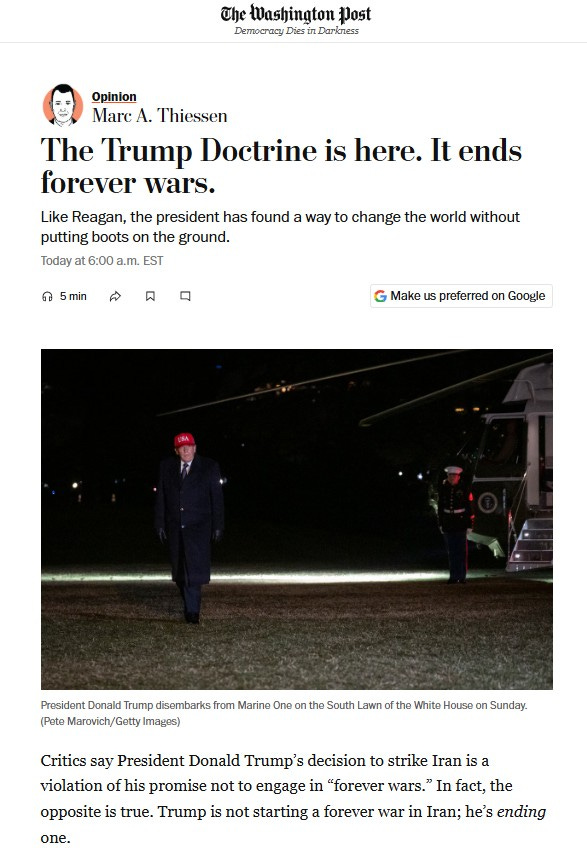
Yesterday, the Washington Post published a couple of consequential articles. One is a North Korea-caliber column from Marc Thiessen that claims Trump’s unprovoked and unconstitutional war on Iran “ends forever wars.” While Trump himself said this week that American soldiers have died as a result of his attack, and that more Americans will die as a result, the Post column tells us that “Like Reagan, the president has found a way to change the world without putting boots on the ground,” and “Trump is taking decisive action to bring this reign of terror to an end. If he succeeds, the impact will be profound, opening up the possibility of enduring peace in the Middle East and beyond.” Yes; it was a mistake not to give that Nobel Peace Prize to Donald Trump because, for one thing, he’s dropping bombs all over the place in toddler-tantrum retaliation for not getting the shiny medal he wanted and, for another thing, by dropping bombs all over the place, Trump is creating “enduring peace.”
Fascinatingly, this column was published alongside the home page’s feature article, under which a caption reads “War escalates in 72 hours, threatening 300 million people in more than a dozen countries.” Got that? Trump is acting out of peace to secure lasting peace by endangering 300 million human beings, and it makes sense. It does.
Because, as we all know, War is Peace, Ignorance is Strength, and Freedom is Slavery.
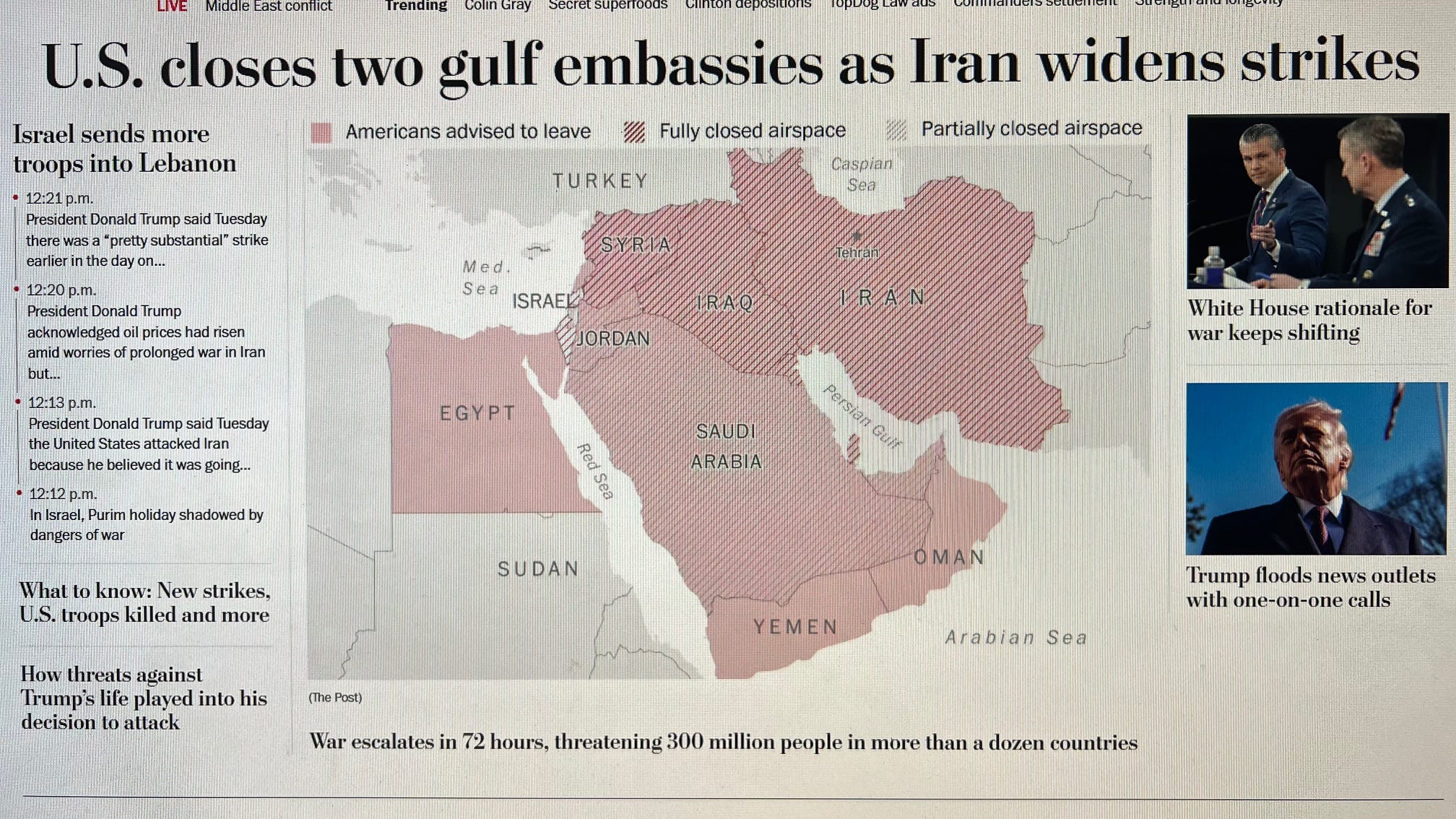
The other article that stood out to me yesterday is visible in the above screen capture: “Trump floods news outlets with one-on-one calls.” The article discloses that Donald Trump made direct calls to propagandize directly to reporters, such as CNN’s Jake Tapper, who put significant effort into redirecting blame away from Donald Trump last year by attacking former President Joe Biden’s crime of becoming elderly. Tapper to date has chosen not to respond to public calls for him to acknowledge Trump’s old age and self-evident cognitive decline—but he did take Trump’s call, and then he relayed what Trump told him as gospel to his audience via Mark Zuckerberg’s/Meta’s Threads platform. Tapper questioned nothing that Trump told him; he simply relayed Trump’s comments uncritically as presumed truth.
Here, we see the effect of the public understanding that when journalists speak to public officials, that is effective journalism, and when a public official—who we understand oftentimes to be liars—tells a journalist something, and then the journalist—who we by default understand to be credible and truthful—tells us what that public official said as if it is true, then it is true. In effect, journalists who practice journalism in this way serve as converters: The politician’s lie, filtered through the journalist’s credibility, becomes truth.
You may remember that during Trump’s first term, rather than repeating everything Donald Trump said as truth, The New York Times, the Washington Post and other once-credible news outlets collected his lies and published them en masse to show the density and relentlessness of his lying. They did this to highlight that Trump’s rhetoric, in fact, was a kind of information war, an assault on truth and critical thinking. They don’t do this anymore. Today, they all just report those lies, and they serve as the legitimizing intermediary.
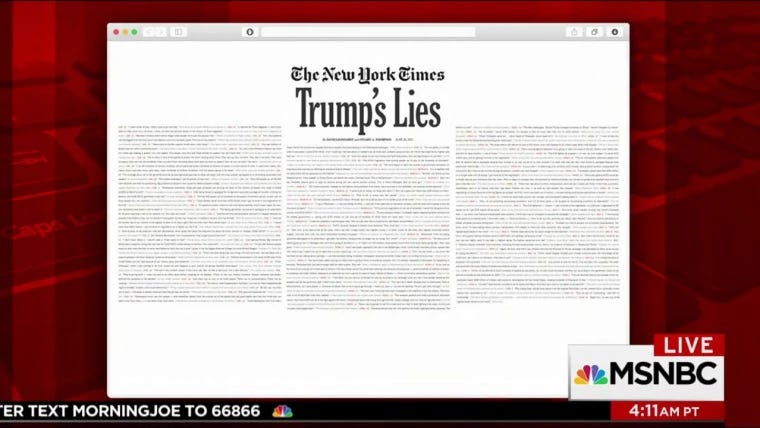
I saw this coming. I’m not the only one who did. But I do wonder if anyone else has thought about how and why this was even possible, much less how and why it happened at all. Yes, the primary reason the media have capitulated and become unyielding servants to Trump is profit-seeking and to shield themselves from Trump’s attacks. But the reason it’s been so easy for the media to empower Trump so effectively is that the media are entirely unaccountable to the public. Hundreds of thousands of people reportedly ended their subscriptions to the Washington Post when it became clear that its owner, Jeff Bezos, had gone to the dark side and was weaponizing the newspaper formerly associated with Woodward and Bernstein against democracy. CBS Evening News ratings have dropped since the program became a propaganda outlet under Bari Weiss’s private dictatorship. This is one kind of accountability. But still, journalists simply never are subjected to answering questions about their decisions, their processes, their outcomes in the way they question all of their subjects. Have you ever thought about this? You should.
Comments
Nothing yet. Say the first thing.
Sign in to join the conversation.