
Labour Party Leader Ivana Bacik argued last week in the Irish parliament that its government must take action on the imprisonment of Irish citizen Seamus Culleton. Culleton has been “detained” in ICE facilities for five months.
The conditions Bacik describes could be scenes from Schindler’s List: “72 men packed into a single tent, filth everywhere, lack of sanitation, violent guards, alleged strangling, three men dead already, and conditions so brutal that detainees are gambling on who will be the next person to take their own life.”
“He calls it a hell, a concentration camp, and he fears for his own life.”
“To describe his testimony as shocking would be an understatement,” Bacik said. She calls it a breach of American “commitments against torture and cruel or degrading treatments.” She chastised Ireland’s taoiseach (the title of the Irish prime minister) for his plans to welcome U.S. President Donald Trump to Ireland and demanded that Ireland intervene to get Irish citizens out of American concentration camps.
Watch her implore Ireland’s leader to save Irish citizens from American concentration camps:
What is being done to Seamus Culleton is no worse than what is being done to every person whose constitutional and human rights are being violated in ICE’s concentration camps. However, this breach of international trust is exceptionally significant because of our country’s unique historic and until-2025 current relationship with the Republic of Ireland.
My mother died eight years ago at age 66. She effectively starved to death, weighing 75 pounds the final time she was admitted to the hospital, because of Crohn’s disease that was not diagnosed until she was on her deathbed.
That spring, my father, sister and I traveled to Ireland as a pilgrimage of sorts. On the west coast, we saw otherworldly landscapes, an ancient lighthouse that my mother’s ancestors once lived and worked in, three family cemeteries, and we met a cousin who had become my mother’s pen pal. They never had a chance to meet.
From the car rental office to every hotel and bed and breakfast, every pub, and every other space we entered, the people we met were truly the friendliest any of us had met anywhere in the world. They welcomed us with open arms. Many told us—making all of us a little uncomfortable—how much they love America. This was in 2018, during Donald Trump’s first presidential administration, and my family were self-conscious about the nation we were representing.
The Republic of Ireland’s total population is around 5.5 million people. Approximately 31 million American people have Irish ancestry. While Irish people today are quick to point out the common American misnomer that Irish Americans “are Irish”—We are separate countries with separate cultures, now more than ever as the Irish are justice oriented and the United States has sacrificed its Constitution to enrich a few dozen corrupt leaders—the country as a whole otherwise presents itself with appreciation for its close ties to our nation.
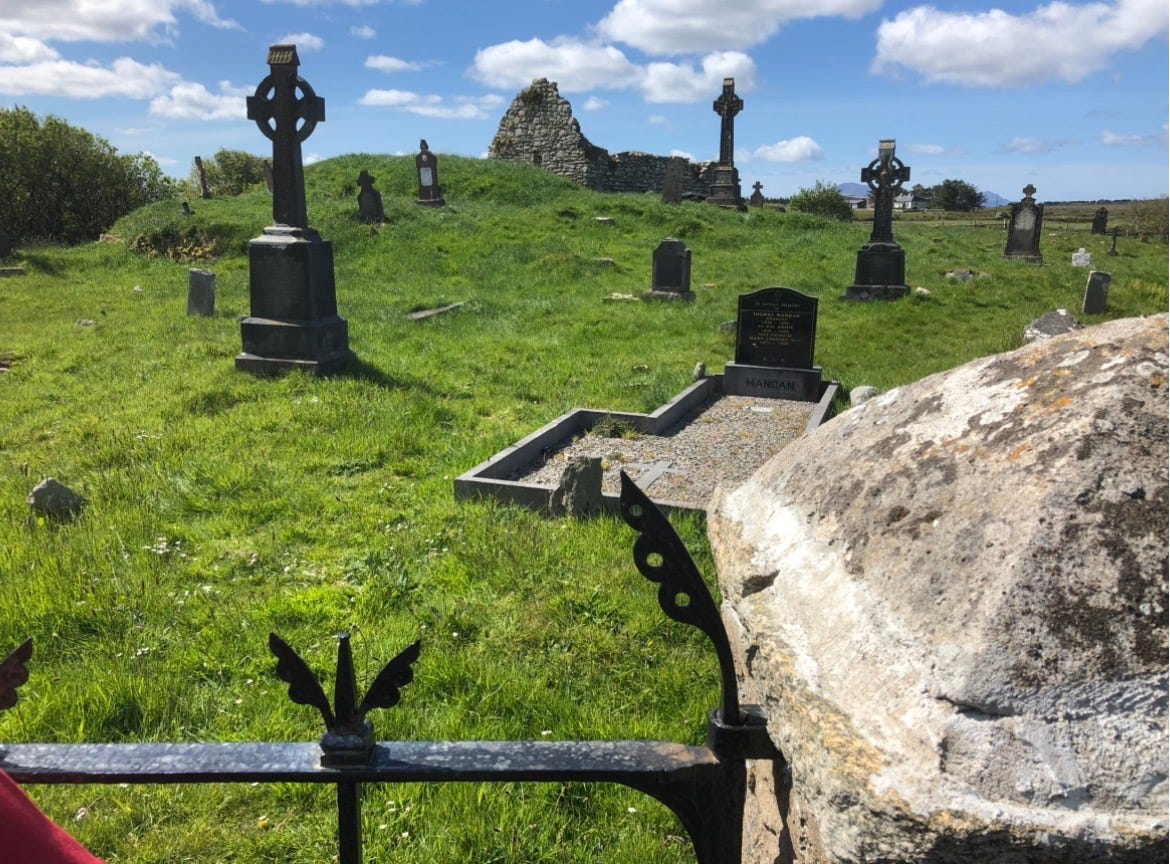
This is in great part because of Ireland’s trauma-rich history.
While many people outside of Ireland see the nation as something like an extension of Great Britain, its history with Britain is no different than that of any nation Great Britain colonized and abused in Africa or elsewhere. Irish people look similar to British people in the eyes of most of the world, but British people depicted Irish people in cartoons as apes and monkeys, as subhuman, just as they depicted people from the African nations they colonized.
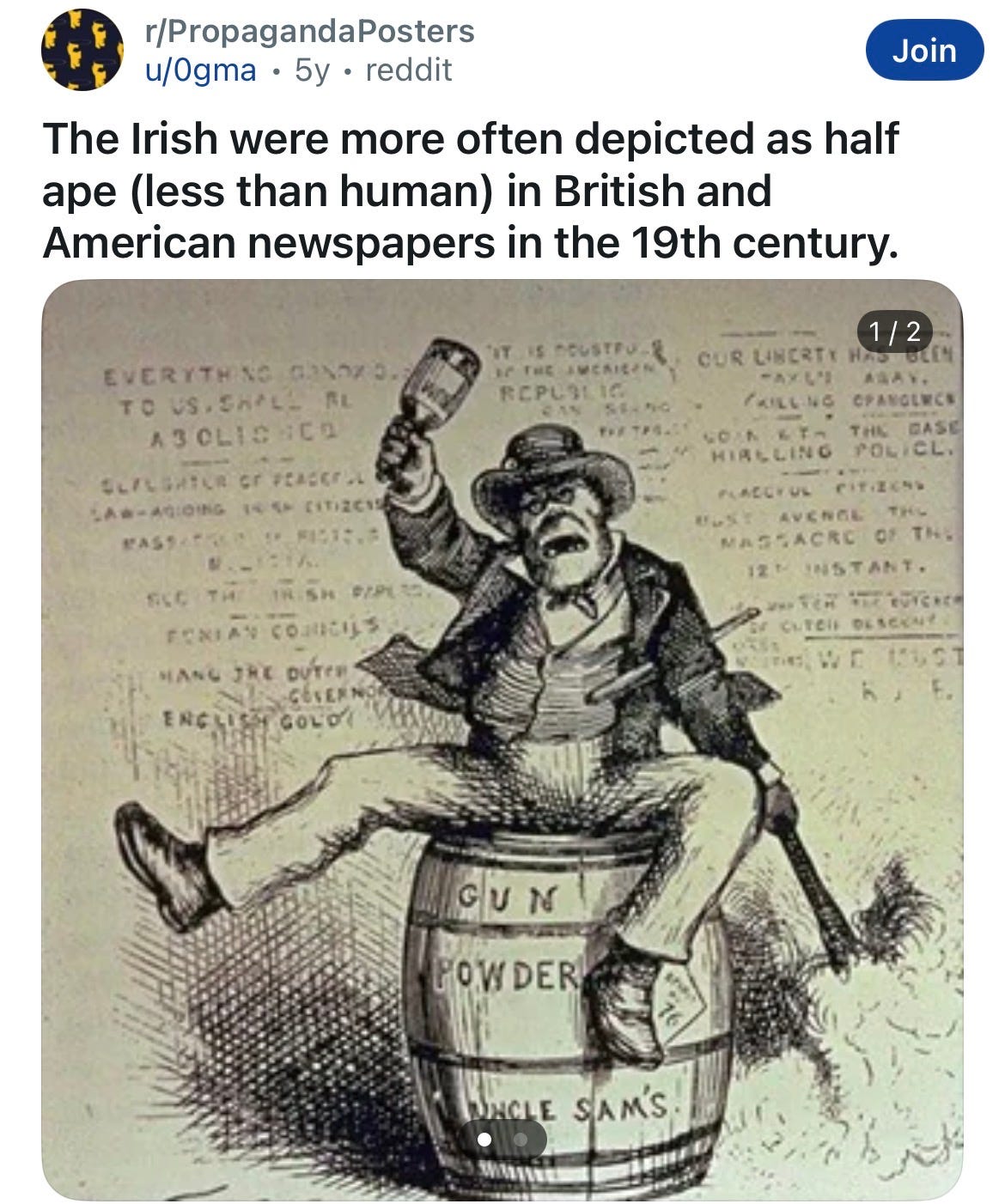
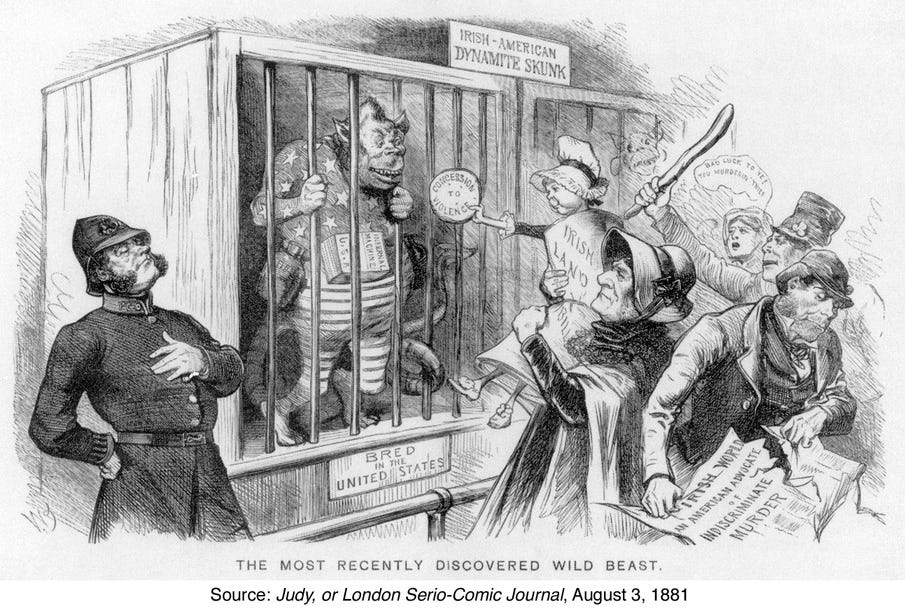
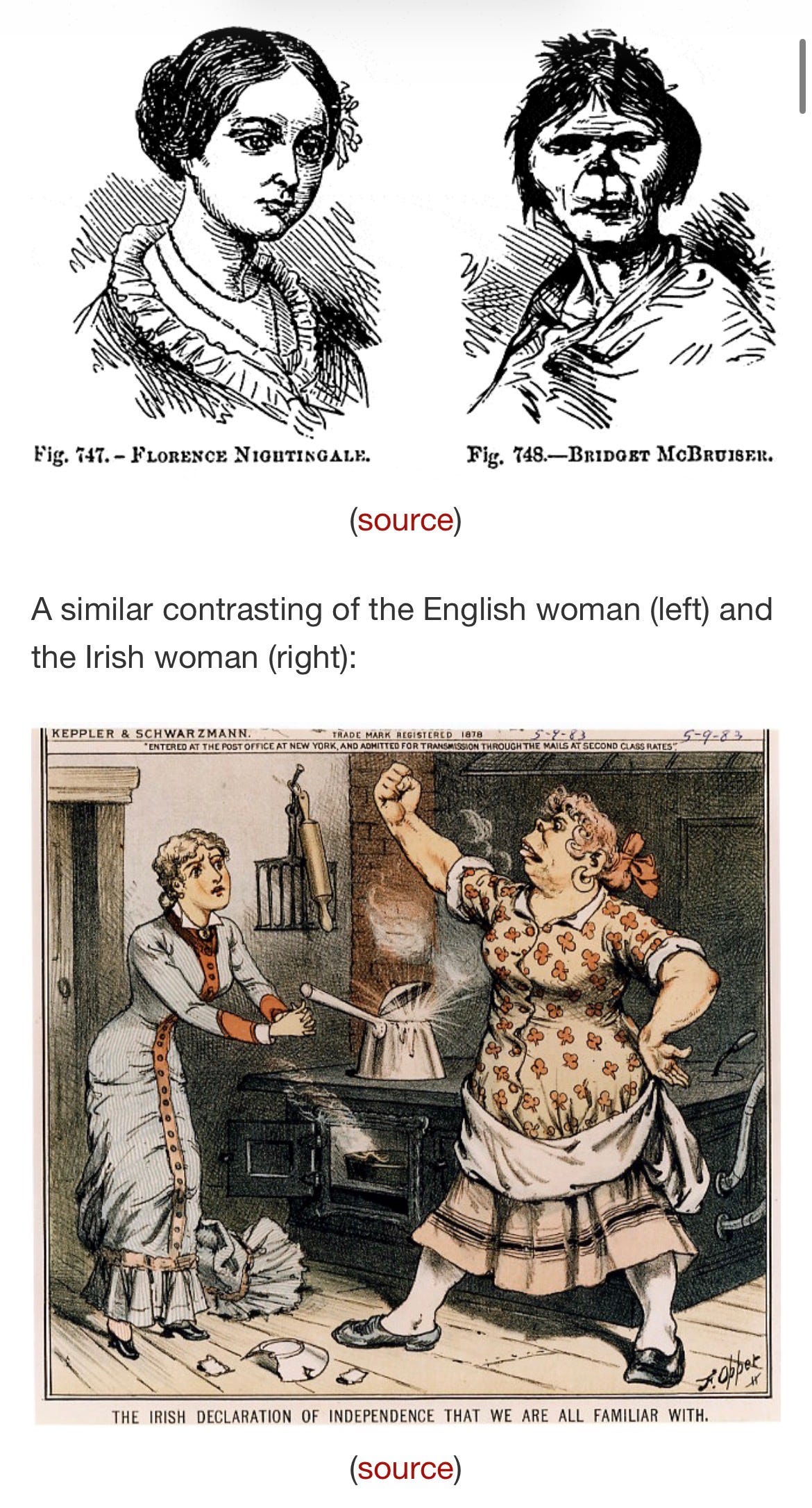
The British stole Irish people’s land, forced them to farm on that land, and took most of the food they grew, selling some back and making them pay rent to landlords. We learned while in Ireland that the Irish regard the great potato famine as an attempted genocide of the Irish by British colonizers—something we were never taught in American schools—because British lords took food from Irish soil as Irish people starved to death. Some British politicians mocked the dying Irish people in newspapers, telling the public that God is punishing them for existing and that if the Irish really wanted to live, they could eat grass and seaweed.
I learned all of this for the first time while visiting Ireland.
I was deeply disturbed and I was irate. These conditions sounded as bad as any I had read about in history books. My father reminded me that the anger I was feeling toward Great Britain was somewhat hypocritical considering that at the time “our country is taking children from their parents and locking them behind bars on cement floors with no beds or blankets.” I was appropriately humbled—but nevertheless, the Anglophilia I had developed during my college semester at Cambridge University evaporated entirely during that trip.

One million Irish population starved to death in the famine, many preventably, and another million fled the country, reducing the population from 8 million to 6 million; to this day, the population size of just over 5 million has not recovered to its pre-1945 height. One of the family cemeteries my mother’s cousin took us to was a large lumpy hill built on the bodies of our family who starved to death too rapidly to give proper burials to. It was an astonishing history lesson.
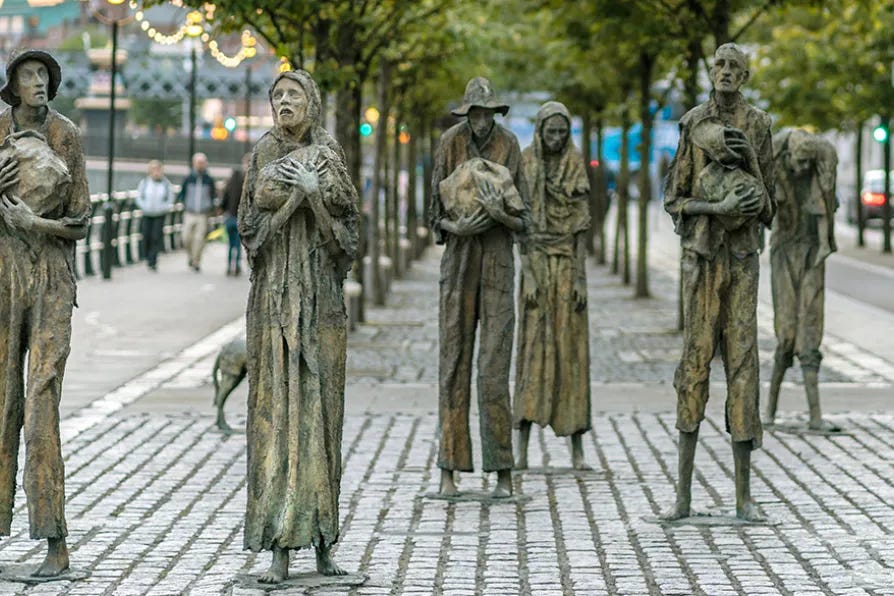
As with most American descendants of Irish people, my family fled that forced starvation. They came to this country as refugees, and they were broadly treated and lived in the same way all refugees to our country to: They faced extreme employment discrimination, despite being the palest people on the planet Irish people were considered by many not to be “white” and to be subhuman, and our ancestors lived in large group houses. As a child, my grandmother was sent to live with her grandmother, who spoke almost exclusively Irish; her children became English teachers.
But from John F. Kennedy to Barack Obama to Joe Biden, descendants of Irish immigrants to the United States flourished over time, and Ireland has claimed their descendants proudly, with a prominent Irish American museum in Dublin, and the home of Ireland’s president—the equivalent to the White House (which was designed by Irish architect James Hoban)—is situated directly across from the residence of the U.S. ambassador to Ireland.
Irish people were proud when I visited less than a decade ago to show off these connection between our countries. I knew nothing I am writing here before my visit, and that is a testament to the eagerness of Irish people to share their feelings about our countries’ connections.
But we are at a crossroads.
This is who we are today—and American media, politicians, and everyday people choosing to sanitize reality does not stop even our closest foreign allies from calling ICE “detention centers” what they are: concentration camps. It doesn’t stop foreign government leaders from explicitly stating as Ivana Bacik states in the video above that the United States is torturing people in violation of international human-rights laws.
This is how we spoke of Nazi Germany. This is how we speak of North Korea, of Iran, and how we spoke of Russia before Trump’s followers began to wave Russia’s flag and Tucker Carlson began to propagandize for the dictatorship and MAGA podcasters including Benny Johnson and Dave Rubin accepted large payments from the Russian government.

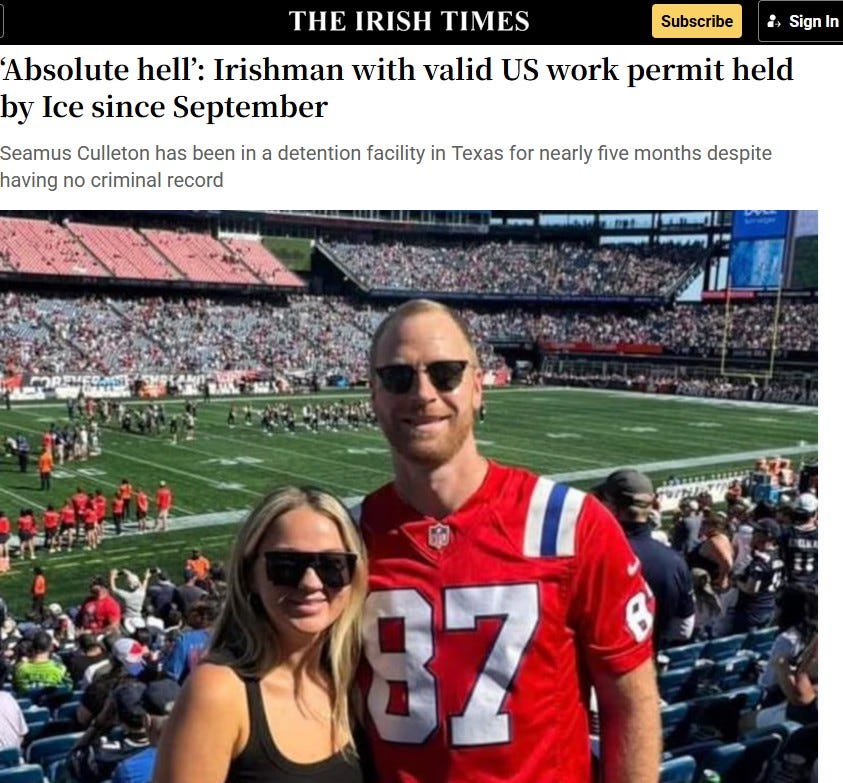
As close as the ties between our countries have been, Irish people are far more politically and culturally engaged than most American people are and their national ethos is one of social justice. Ironically and tragically, many of the people who are choosing today to betray American justice are Irish descendants, and thanks to people like Brett Kavanaugh empowering the Trump regime to shred the U.S. Constitution and all the civil and human rights it was designed to guarantee, Irish citizens today are being imprisoned alongside people from El Salvador, Guatemala, France, Spain, and around the world because ICE agents have been authorized to cover their faces, round up human beings like cattle and treat them like animals in factory farms.
Robert F. Kennedy, Jr.’s great-grandparents arrived in the United States as refugees from the famine during the 1840s and 1850s. His father Robert F. Kennedy and his uncle John F. Kennedy have long been sources of Irish pride. He has single-handedly revived the measles epidemic in a seeming attempt to erase all Irish pride in his relatives’ accomplishments. Cases have been reported in Arizona, California, Colorado, Florida, Georgia, Idaho, Kentucky, Maine, Minnesota, Nebraska, New York City, North Carolina, North Dakota, Ohio, Oklahoma, Oregon, Pennsylvania, South Carolina, South Dakota, Utah, Vermont, Virginia, Washington, and Wisconsin.
I believe this is by design. The federal government and state governments that are choosing to go along with illicit human rights abuses are destroying America’s relationships with all of our allies abroad and destroying the United States itself. Even Thomas Massie, a Tea Party Republican Congressman who by many measures can be called an extremist, now is calling Donald Trump’s MAGA movement not Republican but “the Epstein party” because of the pervasiveness of corruption and cultural perversion that drives the party today. This is an appropriate label—but the press, of course, has awarded attention not to Massie but to Donald Trump, who predictably called Massie “a moron.” We can’t get enough childish name calling in this country.
Michelle Obama famously said about Trump and his name-calling cronies, “When they go low, we go high.” Journalists’ standard practice is, “When they go low, we give them all the attention.”
Ireland is a litmus test for the United States not because it is “special” in any particular way other than its deep ties to U.S. history that historically have led Irish people to view the United States largely through rose-colored glasses and give us the benefit of the doubt. But that benefit is wearing out quickly as Irish people see their fellow citizens treated in the same way Germany treated Jewish, gay, disabled, Roma and other people in its concentration camps. This is too close to the worst times of Irish history for comfort or to tolerate.
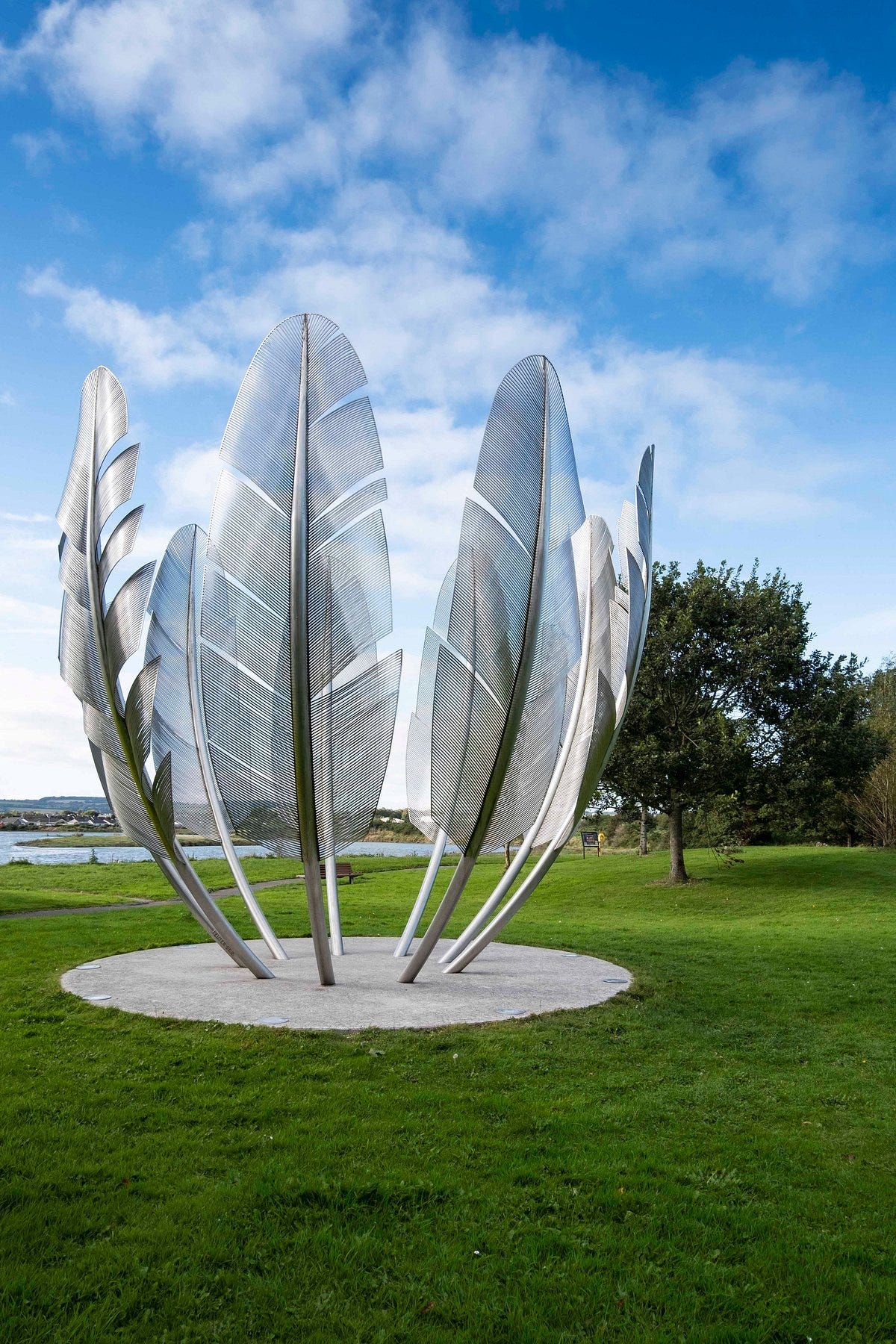
While in Ireland, we were surprised to see a memorial to the Choctaw Nation, an American Indian tribe, in a public park. This monument was erected to memorialize the mutual respect, admiration, and gratitude between the Irish people and the Choctaw people based on a history of common decency. In 1847, just years after being forced through the Trail of Tears ethnic cleansing that displaced, tormented and killed so many at the hands of the U.S. government, the Choctaw Nation of Oklahoma sent emergency funds to help Irish people who were being forcibly starved to death by the British ruling class. During the COVID-19 pandemic, the Irish government sent aid to Native American communities as reciprocal gratitude.

We know the current leadership of the United States has violated trust with many of our truest allies and allied with the most nefarious and lawless nations that always have been our adversaries. We’re seeing our government deploy masked paramilitary killers into our own cities to abuse and murder immigrant people and US citizens alike. Even still, to witness a member of Irish parliament speak about American concentration camps, torture, and violations of international human-rights laws is incriminating beyond redemption.
As a nation of almost 350 million people, we still have the numbers to intervene and stop this after a year that saw six months of total silence and inaction from Democratic leaders and only two mass protests by the people. We still have time to stop the very worst from happening. But we’ve lost much that we will never, ever regain. If the people do not rise up to restore democracy and the rule of law within the year, we will without question go as far as Germany did in the 1930s, and wherever that may lead the country’s future generations, the best-case scenario will be deep shame and guilt for having allowed evil to possess us.
We are all in this together. What we do or do not do is a choice, not fate.
Comments
Nothing yet. Say the first thing.
Sign in to join the conversation.