
1. Forkball
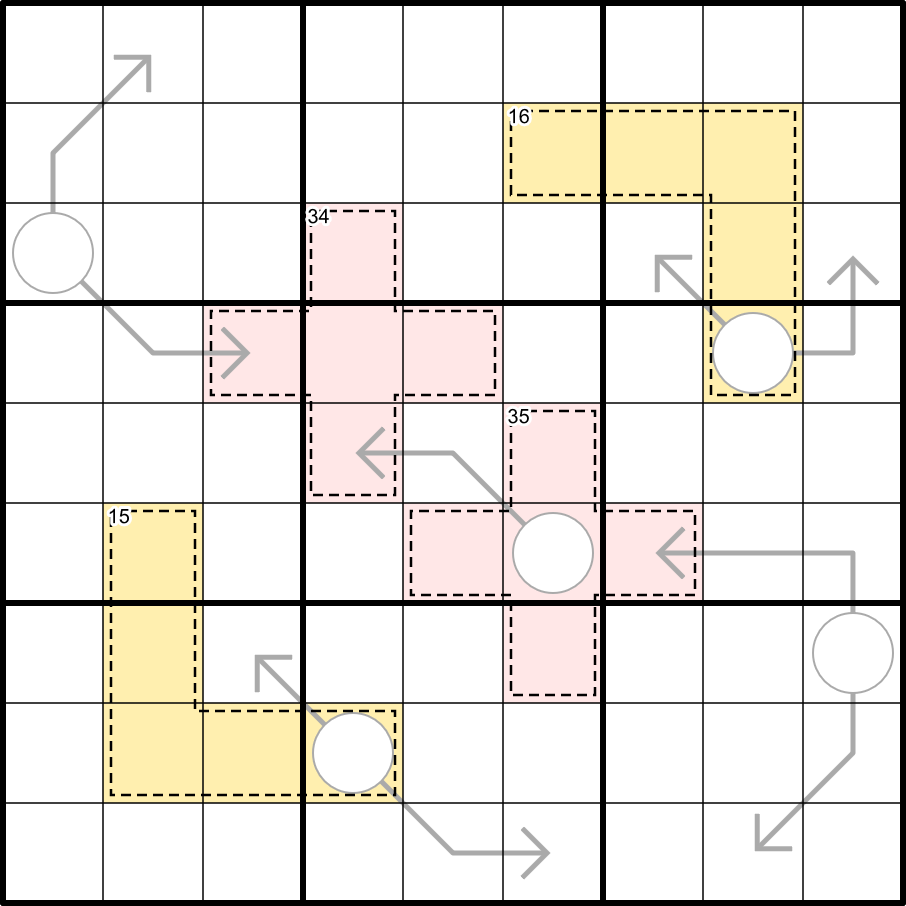
Normal sudoku rules apply (fill each row, column, and 3x3 box with the digits 1-9 once each), and all clues are standard.
Cages: the sum of the digits inside each cage is equal to the small number in the top left corner, and digits cannot repeat within a cage.
Arrows: the sum of the digits along an arrow is equal to the digit in the connected circle.
Very rough difficulty estimate: 4/10
Play online: SudokuPad | unshaded
New to variant sudoku? Check out these beginner-friendly guides to cages and other popular rulesets.
With this volume, we’ve somehow reached five lots of 45, and—just like Volumes 45, 90, 135, and 180—that means the full slate of five puzzles and hints is free for all! If you like the extra puzzles, or the hints, or if you just want to help support this endeavor financially, please consider becoming a paid subscriber. For $5/month, you’ll get bonus content like this every week, plus full access to the ever-growing archive.
If that’s not something you can afford right now, no problem! Enjoy the extra puzzles this week 😀 (and maybe tell a friend about Artisanal Sudoku, if you get a chance). Thanks!
2. Containment
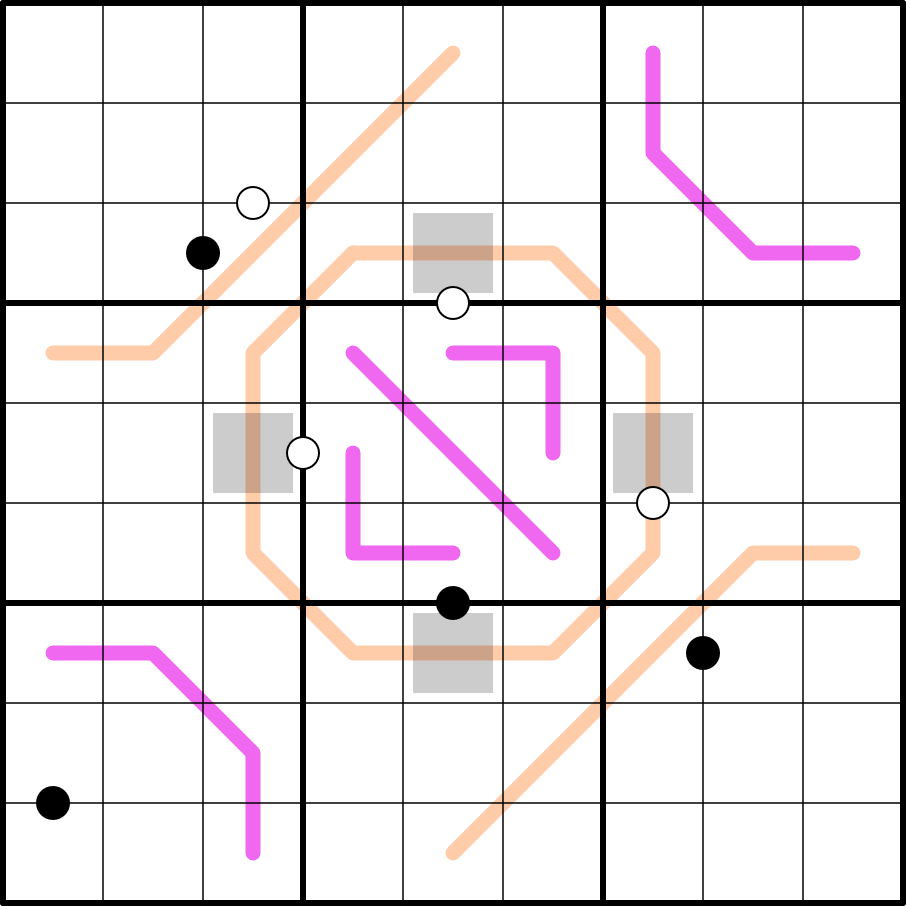
Normal sudoku rules apply (fill each row, column, and 3x3 box with the digits 1-9 once each), and all clues are standard.
Renban lines: purple lines contain a non-repeating set of consecutive digits in any order.
Entropic lines: along orange lines, every set of three adjacent cells contains one low digit (1-3), one middle digit (4-6), and one high digit (7-9).
Digits in cells with a shaded square are even.
Digits in cells separated by a white dot are consecutive.
Digits in cells separated by a black dot have a 1:2 ratio.
Very rough difficulty estimate: 5/10
Play online: SudokuPad | version with labels
A few more announcements:
The Artisanal Sudoku book is available now! Order from Bookshop, Amazon, Barnes & Noble, Target, Walmart, or your retailer of choice. If you’ve already bought a copy, please leave a rating and review to help others find it.
I guess this kind of spoils how my first appearance went, but my second episode of Quizzical, Scott Strosahl’s trivia podcast, is up. Find out if I was able to become the first-ever Quizzical Champion!
This weekend, May 2-3, a number of streamers are taking part in a 48-hour Sudoku Twitch Train to raise money for the continued development and support of SudokuPad. This will feature lots of brand-new puzzles, including one of mine during Scojo’s block…
3. Combined Effort
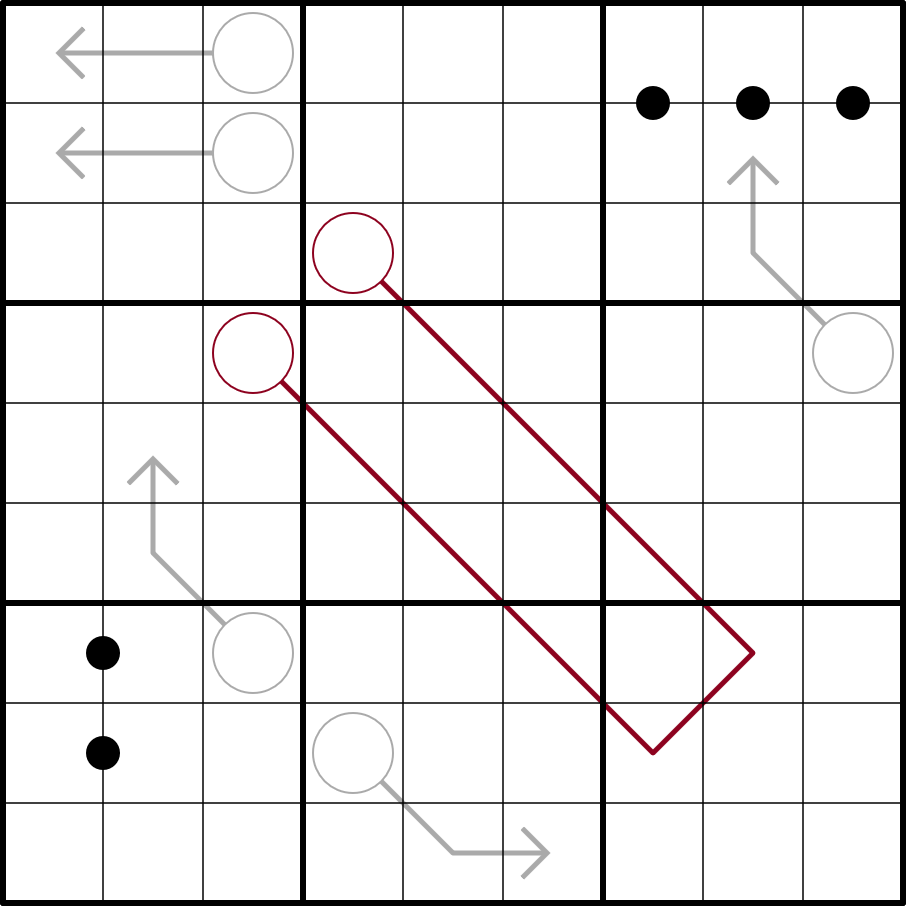
Normal sudoku rules apply (fill each row, column, and 3x3 box with the digits 1-9 once each).
Arrows: the sum of the digits along an arrow is equal to the digit in the connected circle.
Double arrows: the sum of the digits along the burgundy line is equal to the sum of the digits in the circles at each end.
Digits in cells separated by a black dot have a 1:2 ratio.
Very rough difficulty estimates: 8/10, 6/10
Play online: SudokuPad
Extra clues: SudokuPad
Some other puzzles I enjoyed this week:
Counting Whispers, by mimec
X-summeters, by Donatello_86
24 / 4, by Marty Sears
Primary Colors, by Liamhere
4. Parsnip
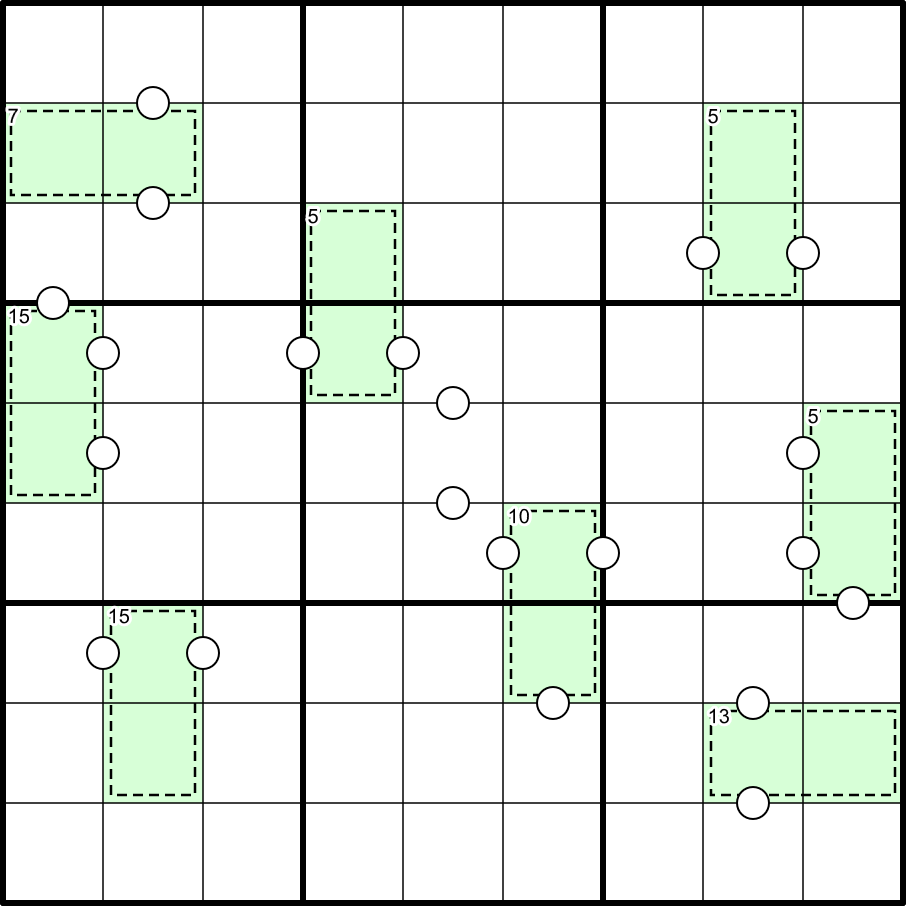
Normal sudoku rules apply (fill each row, column, and 3x3 box with the digits 1-9 once each), and all clues are standard.
Cages: the sum of the digits inside each cage is equal to the small number in the top left corner.
Digits in cells separated by a white dot are consecutive.
Very rough difficulty estimate: 4/10
Play online: SudokuPad | unshaded
5. Ziplock
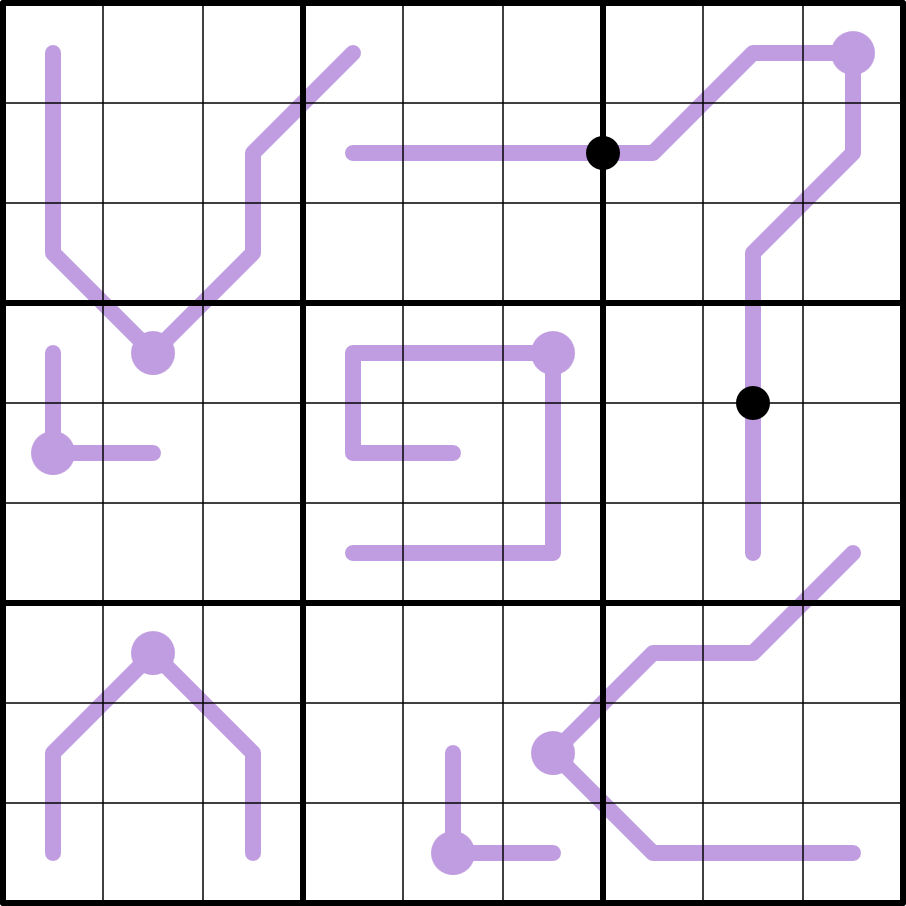
Normal sudoku rules apply (fill each row, column, and 3x3 box with the digits 1-9 once each).
Zipper lines: along lavender lines, each pair of digits that are the same distance from the center of the line have a sum equal to the digit in the center cell.
Example: if the digit in r4c2 is 9, then the digits in r3c1 and r3c3 sum to 9, as do the digits in r2c1 and r2c3, and the digits in r1c1 and r1c4.Digits in cells separated by a black dot have a 1:2 ratio.
Very rough difficulty estimate: 9/10
Play online: SudokuPad
Thanks for subscribing to Artisanal Sudoku! Feedback is always appreciated, just leave a comment, reach out on Bluesky, or reply to this email. If you liked these puzzles, you probably know someone else who’d like them too, so please spread the word. If you’re interested in submitting a puzzle, click here for more information. And if you want to try more of my puzzles—many of which are tougher than the ones you’ll find here—check out my page on Logic Masters Deutschland.
This week’s meta-description:
The multiples of 45 are my favorite posts of the year, so it’s nice that they actually come along every ten months or so.
Forkball
The cages are all forced:
15 = 1+2+3+4+5
16 = 1+2+3+4+6
34 = 4+6+7+8+9
35 = 5+6+7+8+9Neither of the cages that enter box five contain 1, 2, or 3, so those digits are in r4c6, r5c5, and r6c4. Then, consider where 4 and 5 can go in box five: 4 isn’t in the 35-cage, so it’s in r4c4, r4c5, or r5c4, and similarly 5 isn’t in the 34-cage, so it’s in r5c6, r6c5, or r6c6.
This is important for the digit in r6c7, which is now no longer 5, but can’t be greater than 6 because that would make the arrow-sum too high. It must be 6, which puts a 12-pair in r6c8 and r6c9 and puts 9 in the circle in r7c9.The digit in r4c8 can no longer be 6 by sudoku, it can’t be 1 or 2 by sudoku (or because it would make the two-cell arrow impossible) and it can’t be 3 because that would put a third digit from 1 or 2 in box six (on the arrow in r4c9), so it must be 4.
Once you’ve resolved the arrows in boxes three and six, consider where 1 can go in the 16-cage and in box five, and then what can go on the arrow in box eight.
Since 9 is in the circle in r7c9, the 9 in the 35-cage is in box five, and therefore the 9 in the 34-cage is in r3c4 or r4c3—and the latter doesn’t work because 9 can’t be on a multi-cell arrow.
This means the digit in r3c1 can’t be 9, and the digit in r4c3 is now at most 7, so the 8 in the 34-cage is in box five and the 8 in the 35-cage must be in r7c6. (Then, consider where 7 can go in both cages.)Consider where 6 can go in column nine (it can’t be on the arrow in r8c9 because that would put 3 in r9c8, and the 3 in row nine is already accounted for by the arrow in box eight).
Containment
Evergreen hint about entropic lines: a consequence of the “every set of three adjacent cells” part of the rule is that digits form a cycle that repeats over the entire length of the line. For example, if the digit in r3c4 is low, then the digit three positions further along the line (r4c7) will also be low, as will the digits in r7c6 and r6c3.
The even squares appear in every third position along the central entropic line, which (as noted in hint #1) means the digits on the squares are from the same entropic set. They can’t all be the same by sudoku, and the only entropic set with more than one even digit is the middle set (456), so these cells must represent the middle set, with the squares containing 46-pairs.
Meanwhile, wherever 1 is in box five, it’s on a renban, and so is 9, so each three-cell renban corresponds to one of the entropic sets (i.e. one contains 123, another contains 789, and the third is left with 456). This means 4 and 6 are on the same renban, but by sudoku their positions in box five are limited to the four corner cells. The only two corner cells in box five that are on the same renban are r4c4 and r6c6, so that’s where 4 and 6 have to be, which puts 5 in r5c5.Since 5 can no longer appear on the white dots in r4c5 and r5c4, in order to be consecutive with 4 and 6 the digits in those cells must be 3 and 7. This means the digit in r7c5 can’t be 6 (because the digit in r6c5 can’t be 3)—it has to be 4, which puts 6 in r3c5, and that resolves the 37-pair in box five and determines which renban contains 123 and which contains 789.
Once you’ve placed 6 in r5c7, the digit in r6c7 is from a different entropic set (but still consecutive with 6), so it must be 7, which resolves the positions of low and high digits on the central entropic line. This leads to a 789-triple in row four, ruling those digits out of r4c1 and r4c2, so in order to fill the upper-left entropic line there must be a high digit in r3c3. (There is also a 123-triple in row six, which puts a low digit in r7c7 by similar logic.)
The upper-right renban doesn’t contain 6, so its digits always include 234 (along with 1 or 5), and the lower-left renban doesn’t contain 4, so its digits always include 678 (along with 5 or 9).
The digit in r2c4 can’t be high because there is already a high digit in r3c3, and it can’t be low because all three low digits are already accounted for in column four. Similar logic can be used in r8c6.
Combined Effort
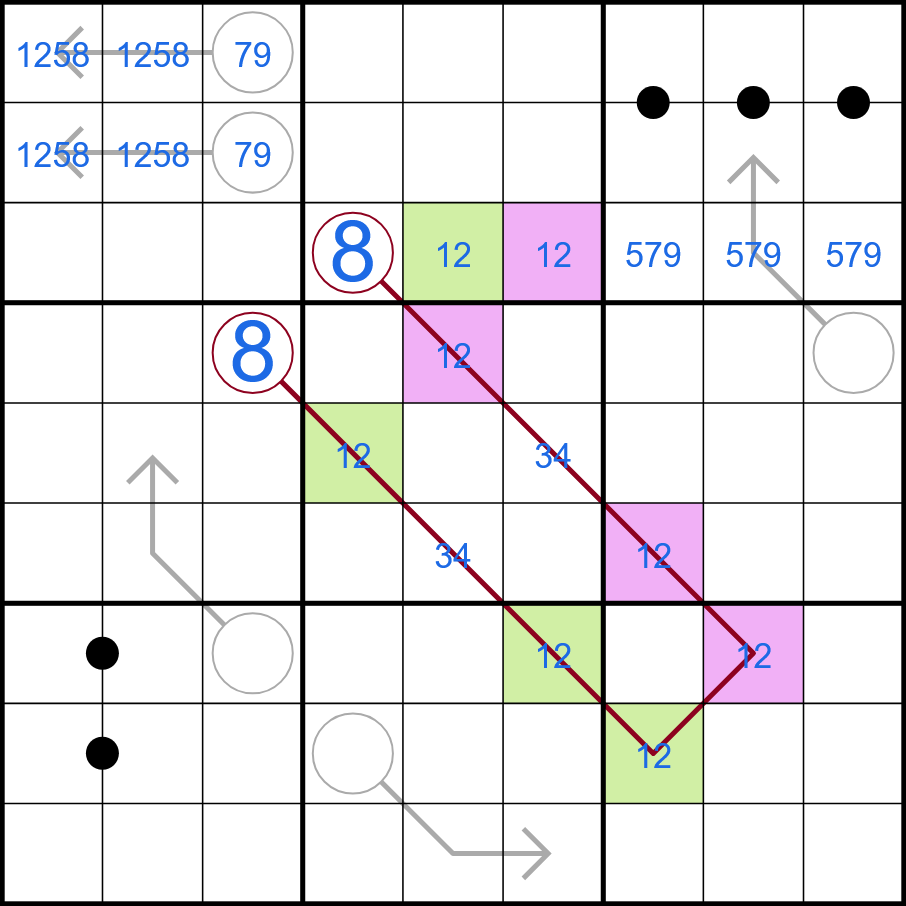
The minimum sum of the digits on the double arrow is 16, which is possible with a 1234-quadruple in box five and 12-pairs in r7c6/r7c8 and r6c7/r8c7. So the digits in the circles sum to at least 16, and are both therefore at least 7.
The three digits that can never appear on a black dot are 5, 7, and 9, so there is a 579-triple in r3c7/r3c8/r3c9. This leaves 8 as the only option for the circle in r3c4, and now the circle in r4c3 can’t contain 7 (because the double arrow would only sum to 15) or 9 (because that would put 9 on an arrow in box one), so it must contain 8 as well, which means the double arrow sums to 16 and its digits have to be minimized as described in hint #1.
The 8 in box one now has to be on an arrow, so one of the arrows contains 1+8, to sum to 9. Then, consider where 7 can go in box one: if it’s on an arrow, the lowest digit that could join it would be 2, and that would require 9s in both circles. So 7 must be in the other circle, creating a 79-pair in r1c3 and r2c3.
The 5 in box one is now on an arrow, and since the arrow that sums to 9 already contains 1+8, 5 must be on the arrow that sums to 7, along with 2.Consider where 1 and 2 can go in row three: the only positions left are r3c5 and r3c6. This creates a 12-pair in column six, and from there it should be possible (with the help of coloring or the letter tool) to identify more cells that must contain 1 or 2. For example, the digit in r7c6 is the same as the digit in r3c5, so in box five that digit has to appear in r5c4. Extending the coloring to the other 12-pairs on the double arrow proves that the digits in r3c6 and r6c7 are the same, so that digit has to appear in r4c5 in box five.

Then, consider where the purple digit can go in box eight.
Since 7 and 9 still can’t appear on a black dot, there is a 79-pair in r9c1 and r9c2. This puts the green digit in r9c3, and it also puts 8 on a black dot in box seven, along with 4. The purple digit can no longer be on a black dot in box seven—it can’t be part of a 24-pair because 4 is unavailable, and it can’t be part of a 12-pair because one of those digits is in r9c3—so the purple digit must be in r8c3. Then, consider where 5 can go in box seven.
Wherever 1 is in box three, it’s on a black dot, so it has to be joined by 2. Since the purple digit is definitely on the right-most dot, this must be the dot with the 12-pair. The digit in r2c8 is now at least 3, so the digit in r3c8 has to be 5 (and the 8 in r4c3 means the digit in r2c8 can’t be 3; it must be 4, which puts 9 in the circle in r4c9).
Once you’ve placed 9 in box nine, note that both 8 and 9 can be ruled out of the circle in r8c4 by sudoku (and also that the digits on the arrow are both at least 3).
The 9 in box four has to be in r5c1 or r6c1, which resolves the 79-pair in box seven and places 7 in r4c2. Then, consider where 5 can go in column two, and then where 2 can go.
Parsnip
If the digits in the 15-cage in box seven are consecutive (i.e. 7+8), then whichever of them is in r8c2 would also have to appear on one of the white dots in r7c1 or r7c3. So they must be 6+9, and 9 can’t be in r7c2 because only one digit is consecutive with 9. Similar logic applies to the 5-cage in box three.
The 13-cage in box nine can’t contain 4+9 by sudoku, and it can’t contain 6+7 because it would create the same problem described in hint #1. So it must contain 5+8, and 5 can’t be in r8c8 because it would put a repeated 4 in column eight. Again, similar logic applies to the 7-cage in box one.
Once you’ve filled the 7-cage in box one, note that the 345-triple in box three means the digit in r3c2 has to be 1. The only digit left to place in row three that can appear in the 5-cage in r3c4 is 2.
Ziplock
If a zipper line contains 9, it has to be in the center. Since there has to be a 9 in box five, and every cell in the box is on the zipper line, the 9 is in r4c6.
Another important point about zipper lines is that the digit in the center can’t appear anywhere else on the line (because that would imply that the corresponding cell on the other half of the line has a value of zero). So the digit in r4c2 has to appear in r1c3 in box one, and the digit in r8c6 has to appear in r7c9 in box nine.
The 9 in box one is in r1c2, r2c2, or r3c2 (it can’t be in r1c3 because that digit is also in r4c2, which sees the 9 in box five by sudoku), which puts the 9 in box seven in r7c1 or r7c3. Then, consider where 8 can go in column two: it may be the digit in r4c2, but if it isn’t, then the 8 in box one has to be in column two, so either way, 8 is in one of the four cells at the top of the column. This means the digit in r7c2 is at most 7, and the 8 in box seven is also in r7c1 or r7c3 (creating an 89-pair).
Consider whether the digit in r1c4 can appear on the zipper line in box one. It pairs with the digit in r1c1 to sum to the digit in r4c2, so if it appears in, say, r2c3, that would imply that the digit in r2c1 is the same as the digit in r1c1. So it must be in r2c2 or r3c2, and more importantly, the seven digits on the zipper line (including the center) are all different, which means the digit in r4c2 must be at least 7.
Similar logic applies to the digits in r6c9 and r8c6—but the digit in r8c6 repeats in r7c9, where 8 is ruled out by sudoku, so it must be 7.If the digit in r4c2 is also 7, it would put 7 on the zipper line in box seven, which is impossible because the digit in r7c2 is at most 6—so the digit in r4c2 must be 8.
There are a few ways to prove that the digit in r1c9 has to be 9. One is to note that since 7 and 8 are unavailable, if the digit in r1c9 isn’t 9 it would be at most 6, and none of the digits from 789 could appear on the zipper line, which is a problem because the 8 in row two would have to be in r2c8, and the 7 in column two would also have to be in r2c8.
Once 9 is in r1c9, the black dots become powerful, in part because they aren’t symmetrically-placed: if, say, the dot in row two contains 3/6, that would put 3 and 6 in r3c8 and r4c8 and there would be no way to fill the black dot in column eight without putting a repeated 3 or 6 in the column.
So the digits on the dots are from 1248, and the digits in r2c6 and r4c8 have to sum to 9—and the only two digits from 1248 that sum to 9 are 1+8 (and the order is resolved by the 8 in r4c2).Consider where 9 can go in row two, and then where the digit in r1c4 can go in box one. Similar logic applies regarding 9 in column eight and the digit in r6c9 in box nine, and from there 8 can be placed in box nine.
Comments
Nothing yet. Say the first thing.
Sign in to join the conversation.