
We keep wrestling with definitions of “complexity” as though saying the word often enough might make us sound realistic and prepared for, you know, “The Future.” It is not simply that there are many moving parts. We can deal with those, having lived through constant and accelerating change for two generations. It is that our maps of where we are, and where we would like to go, keep changing now.
Here is where Art in a Place of Work begins – with the recognition that the conditions of contemporary work call for a lot more than efficiency, more than competence. They call for new capacities of mind and relation, and for people who can think, judge, and act when certainty is not freely available. In short, the conditions of our day call for an understanding of exactly the territories in which artists have been working for a good long time.

Most people know this in their bones. They may not use academic language to describe it, but they recognise the signs - rules drift, context shifts, and the pressures just keep multiplying. The long-established assumptions that helped us make sense of markets, careers, technology, leadership, institutions, value, trust, and even reality itself do not hold steady for long these days, before they need revising. Decisions that once seemed manageable now come wrapped in ethical, cultural, technological, and political consequences that are difficult to disentangle.
The question is no longer simply how to do our jobs well. We now need to learn how to remain oriented when the very landscape around the job keeps moving.
This is where Ronald Barnett’s concept of “supercomplexity” comes in, and helps to get some kind of perspective on what surrounds us. Barnett, a philosopher and education theorist, was not just describing a world that was already becoming busier, faster, or more information-rich thirty years ago – he was pointing to something more unsettling. In a supercomplex world, Barnett said, the very frameworks we use to understand situations are unstable, contested, and liable to be changed at any time. We are not only short of answers but are often unsure which questions make sense, which values should take priority, which interpretation of events is most credible, or which language is even adequate to describe the moment.
Thanks for reading! This post is public so feel free to share it.
While Barnett was researching this new reality in the context of preparing higher education systems for ever greater disruption, we would be well advised to take his language and apply it to the broader field of work, commerce and organisational adaptation.
A complex world can still, at least in theory, be handled by better analysis, more expertise, more information, and better systems. We have highly paid specialists who understand that dynamic well. A supercomplex world is different. It resists understanding, at a level far deeper than to simply deny us easy answers. As we grapple for precision, it unsettles the very terms in which answers might be formed, and strips away the comfort of pretending that a better dashboard or a sharper competency matrix will help improve things. Futile effort, just like the old “one more lane will fix it” argument for motorway expansion.
So a deeper proposition emerges. Barnett is not just describing a difficult world. He is describing a world in which epistemic instability – a state of fluctuating certainty, doubt, and fragmentation regarding knowledge, facts, and truth – becomes the normal operating environment.
Once that is true, the strategic problem for business changes. The goal is no longer merely to recruit and train competent performers for known environments. It is now to cultivate people and cultures capable of judgement when frameworks shift, contrasting meanings compete, and no toolkit can be shown to be “the right one.” That means developing interpretive agility, comfort with ambiguity, reflexivity, embodied awareness, collaborative sensemaking, and imaginative reframing.
In a supercomplex environment, a competency model reaches its limit because competence presumes a relatively settled world: identifiable tasks, agreed standards, recognisable pathways, and a shared understanding of what success may look like.
Barnett’s argument is that we no longer inhabit that kind of world. Disagree? Anyone?
What is now required is a different kind of person and, by extension, a different kind of organisation, to make sense of that world – not a person with a longer list of tools, but one capable of judgement when no tool can settle the issue, not a leader who merely applies finely honed technique, but one able to keep swimming in ambiguity without being drowned by it. And of course not a workforce trained, however well, to solve established problems, but one capable of sensing when the playing field around the problem has itself become part of the problem.
Barnett puts the emphasis not only on knowing and doing, but on being. The question shifts from “What competences do we need?” to “What qualities of mind, perception, relationship, and imagination do we need if the conditions themselves refuse to stay still?”
the very essence of an artist’s work is a disciplined act of drawing sense from supercomplexity
Across multiple strands of research, those are precisely the capacities that arts-based methods and sustained contact with artists appear able to strengthen, and this is the point at which the presence of artists begins to look like an urgent necessity.
You see, the very essence of an artist’s work is a disciplined act of drawing sense from supercomplexity. Out of near-infinite possibilities, a composer finds a sequence of notes and chords that can be heard, felt, and remembered. Out of the unmanageable abundance of language, a writer arranges words into a form that can hold meaning on the page. Out of the noise, overload, contradictions, the unfinished fragments of reality, a choreographer makes a gesture, and a passage that allows something previously diffuse to become perceivable.
This is one reason artists matter so much in a world like ours – they are practised in giving form to aspects of complexity they see as valuable. Their work is not to reduce reality to a simplistic message but to make it graspable and shareable. They help people encounter what is difficult to name, see patterns inside apparent chaos, and make forms that are useful, meaningful, and beautiful.
At Art in a Place of Work we continue to say that artists, and artistic ways of working, are of strategic value because they bring with them forms of discipline that are unusually well suited to unsettled conditions. Yes, we are talking about recognising how artists think and function, not just about celebrating what they produce once it is delivered.
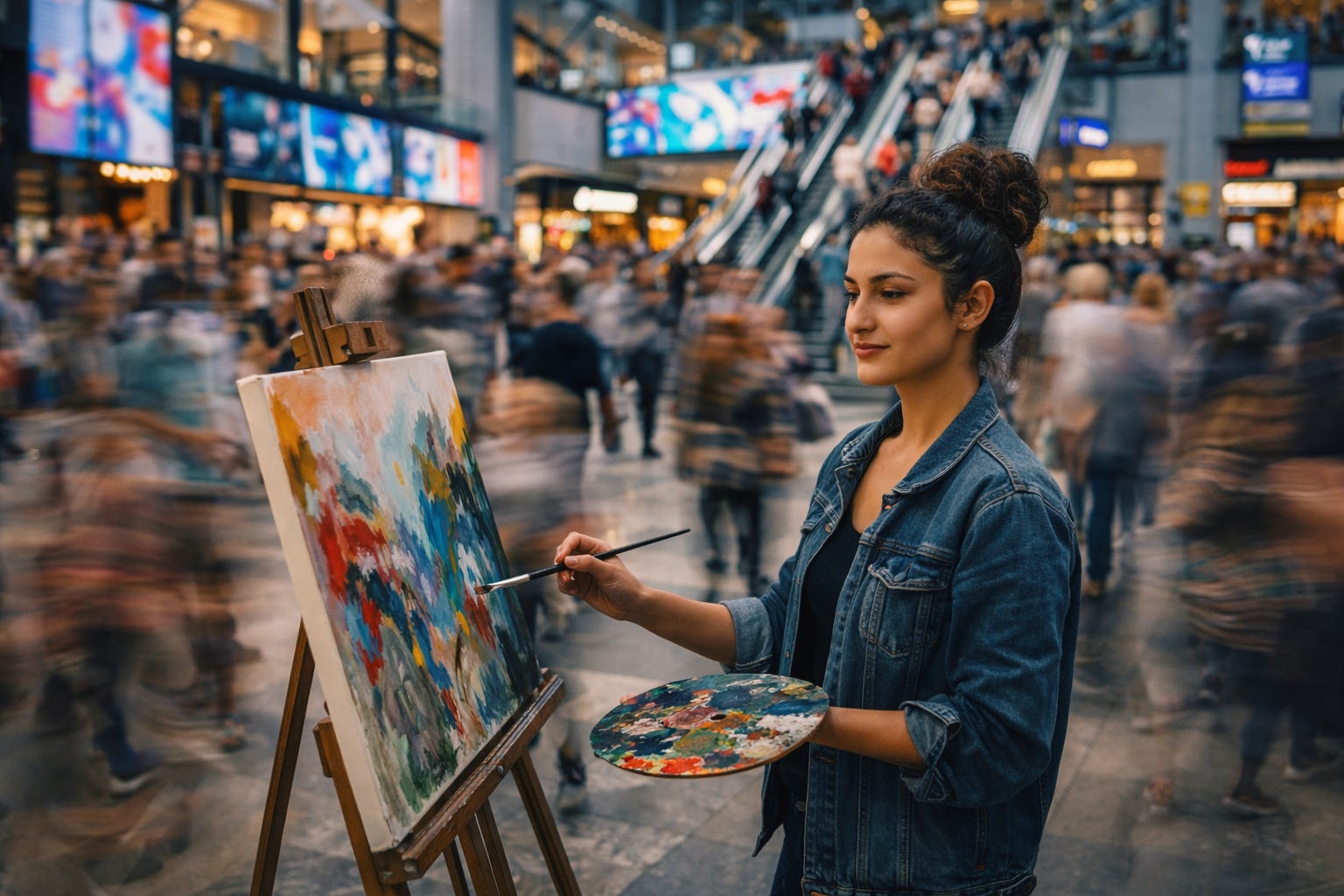
Working with artists can help businesses strengthen a set of capacities that come into their own when conditions are unstable: sharper reflection, better judgement, stronger collaboration, greater emotional intelligence, more comfort with ambiguity, and a greater ability to question stale assumptions before they set and harden into bad decisions.
Much research on art-based leadership development points to gains in reflective and reflexive practice, higher-order thinking, interpersonal competence, and emotional intelligence, while studies of artistic interventions in organisations suggest that artists can help people see routines, assumptions, and possibilities that usually remain hidden.
Of course artists can’t offer a guaranteed business outcome but they can help build a distinctive process: they help people slow down perception, examine the frame around a problem, surface tacit knowledge, tolerate uncertainty for longer, and work imaginatively with what is emerging rather than clinging too quickly to inherited answers.
In practice, that means they do not impose goals on an organisation; the goals belong to the people and the business. What artists can do is help those people become better able to notice, interpret, imagine, and respond, and then work alongside them as guides, provocateurs, and partners as they move towards new ways of seeing and facing reality.
Artistic improvisation, especially in music, and in particular in jazz, of course, is the most direct example, allowing us to see that process of noticing, interpreting, imagining and responding in real time. It is such a powerful example, in fact, that it will be the subject of another essay soon. (And, yeah, we have an immersive executive programme which uses jazz improvisation as a guide and a process.)

Artists are often trained, through their education and by the nature of their practice, to work without guaranteed outcomes or, more precisely, to work while assuming that the outcome will only become clear once the process of arriving at it starts to look more complete than it does today. You would be right in thinking, therefore, that a song is never really finished, a painting is never really done, and so on. The great majority of artists see the process as being as important as the outcome; and probably more interesting. They develop ideas in motion, and work with ambiguity longer than most people are comfortable even stopping to face it.
Creative work often begins without the destination being fully visible; the point is not to wait for certainty, but to proceed in such a way that the shape of the outcome can emerge through the work itself.
Artists notice what others miss. Not because non-artists are mentally deficient but because artists work with emergence as raw material - in all that chipping away at form, relation, tension, rhythm, mood, and contradiction they are looking for something that “works”, using all of the inherent qualities of their craft.
They know that the first solution is rarely the right one so they will keep banging away at the door marked “aaaah, raaaaight” until it swings open. (Or maybe slides just a little. No matter. It does open, eventually, one way or another.) Most importantly, artists understand that how a problem is posed may matter more than how quickly it is “solved.”
That is not woo-woo but disciplined practice - skilled, repeatable, and demanding. And it turns out to be highly relevant in a world where inherited frameworks are all a-wobble.
What Barnett is advocating is the building of conditions in which forms of intelligence that are usually hidden can become visible and usable. Artists are good at making the invisible visible, and turning the odd, the banal, and the crazy into things that are useful, meaningful and beautiful.
This is one reason we have been so insistent, in Art in a Place of Work, that the role of the artist in organisational life must be understood properly. Artists bring methodologies of attention, interpretation, composition, experimentation, and pattern seeking that help organisations strengthen their human capacity under unstable conditions.
Artists do not merely offer new ways to solve old problems. They can do that, but more importantly, they help people become capable of different ways of being at work: more awake, more perceptive, more comfortable with uncertainty, able to collaborate across difference, capable of moving before a formal rulebook has caught up. That shift is deeper than innovation theatre, and more durable than the froth of motivational pep talks. Yes of course it is also harder, takes more effort and actual commitment than either of these.
If the aim is to cultivate different habits of perception and response, then the work needs time, contact, and seriousness. It needs artists as practitioners with their own rigour, and organisations willing to encounter forms of intelligence that may not initially resemble management language.
The work needs structures that allow reflection, experimentation, conversation, and shared making to become part of the fabric of the workplace rather than a brief interruption from it. In other words, it needs exactly the kind of sustained engagement we have been advocating through Art in a Place of Work.
This is why we keep returning to the idea that artistic thinking points beyond problem-solving. Problem-solving is important, of course, but it belongs to a world in which the problem is already known, defined, and waiting to be acted upon. The world in front of us is often not like that. Not any more. Companies need people who can recognise when the frame has shifted, when the categories are out of date, and a system is defending itself against necessary change.
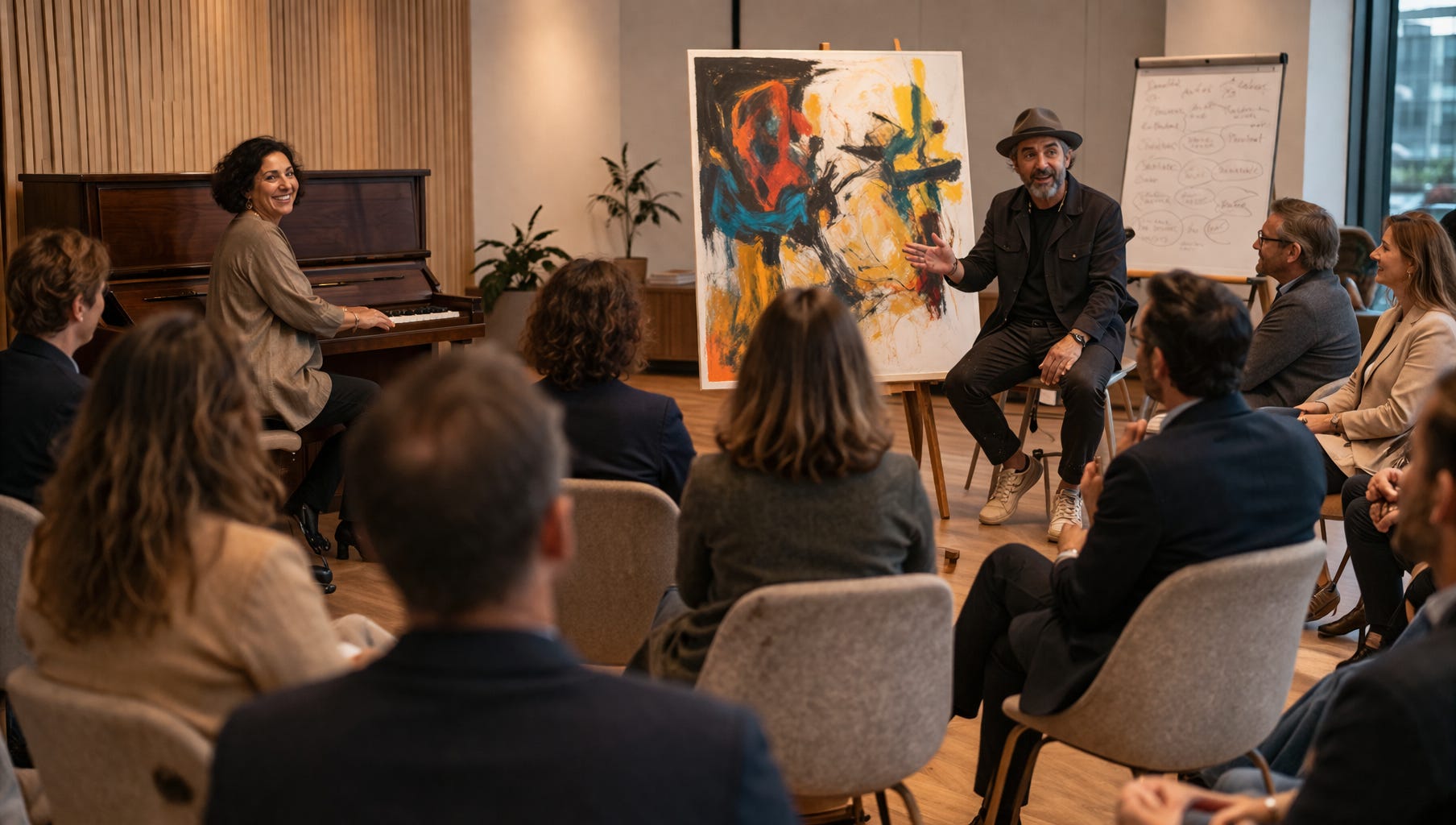
That is the heart of the matter for us. The case for artists in business is not sentimental. (The difference between sentimentality and emotion is another subject for another essay...) The case is a strategic argument about what sort of human and organisational capacity is now required.
If business is prepared to learn from people whose professional lives are built around disciplined uncertainty, form-making, interpretation, and imaginative risk, it may become better able not just to cope with change but to meet it with greater intelligence and humanity. People learn from people - and we believe, of course we do, that when it comes to learning about how to be an experimenter, an improviser, an imaginer, there are no better people to learn from than artists.
Some of the research, and insights that have come from it:
Karl Weick’s foundational work on sensemaking is very useful here. (I’m a fan.) Weick argues that organisations are not simply machines for processing information. They are places in which people are continuously trying to make sense of equivocal situations. Equivocality, as in the presence of multiple plausible interpretations. The problem is not always that we do not know enough. It is that events can mean several things at once, and the wrong interpretation can send a whole system off course.
In those circumstances, the work of leadership is not merely distributing answers. It is helping people notice, interpret, test, and revise meaning together. Artistic practice is often an exercise in disciplined sensemaking. It asks: what is really here? What else might this mean? What are we missing because of the frame we adopted too quickly? Artists are trained to work in the space before meaning settles. That makes them unusually valuable in organisations that need better collective perception, not just faster reaction.
Donald Schön takes us deeper into the daily reality of professional work. His account of the reflective practitioner remains powerful because it focuses on what he called the indeterminate zones of practice: uncertainty, uniqueness, instability, and value conflict. These are not tidy situations for which manuals are written, but circumstances in which the practitioner must improvise, test, respond, and think while acting. Much of what matters in professional life cannot be reduced to the application of pre-set technique. Serious practitioners work by engaging the situation, not simply by imposing a template upon it.
Again, this sounds strikingly close to artistic labour. Artists work through material, through encounter, revision, and reflection in action. They do not wait until uncertainty disappears but make their way through it. (Chuck Close was quoted as saying “amateurs wait for inspiration; professionals just show up and get to work,” or words to that effect.) One might say that artistic practice is a sustained education in how to proceed when certainty is unavailable. That is a strategic capability, not a cultural luxury.
Haridimos Tsoukas adds another dimension. He argues that the firm is a distributed knowledge system, where no single actor can know all that matters. No senior leadership team, however brilliant, can fully specify the knowledge needed across a living organisation. Much of what an organisation knows is local, tacit, embodied, relational, and difficult to formalise. It therefore needs regular help to make the surfacing of all that hard to formalise knowledge.
Nancy Adler brings the argument into management and leadership with admirable clarity. Her work on the arts and leadership does not treat the arts as a pleasant supplement to “real” management but as a resource for enlarging the leader’s imaginative and moral capacity. In a time when organisations can do so much, the question becomes what they ought to do, what they can envision, and what kind of future they are helping to build. That cannot be answered by spreadsheets alone. The arts matter here because they expand perception, deepen reflection, and help leaders resist the shrinking of reality to what is measurable in the narrowest sense.
Berit Sandberg’s qualitative metasummary of art-based leadership development found recurring outcomes in reflective and reflexive practice, higher-order cognitive skills, emotional intelligence, and interpersonal competencies. These are capacities that become more valuable when certainty declines and interaction grows more demanding. Reflection matters because snap interpretations are often unreliable. Higher-order thinking matters because familiar categories fail. Emotional intelligence matters because instability strains relationships and judgement alike. Interpersonal competence matters because meaning is made together, not alone.
Sandberg’s review does not prove that every arts-based intervention is effective. Nor should it. But it does strengthen the case that well-designed artistic processes can develop precisely the kinds of capacities that supercomplex conditions require.
Ariane Berthoin Antal’s work on artistic interventions in organisations helps clarify how this can happen. Her research shows that when artists enter organisational settings, they often create temporary spaces in which people can see differently, speak differently, and relate differently. Hidden assumptions come into view. Established roles loosen. New questions arise. People become more aware of routines they had stopped noticing. The point is that artists alter the conditions of attention. They make it harder for the organisation to sleepwalk through its own habits. Yes it’s vaguely terrifying concept for an executive, but as we have seen, in a supercomplex world, it is actually the safer course. In an age of supercomplexity, organisations do not only need solutions. They need help in becoming more perceptive, more reflective, and more capable of reframing what is in front of them.
Barnett helps us name the condition. Weick helps us understand the interpretive challenge. Schön helps us value professional judgement in indeterminate situations. Tsoukas reminds us that intelligence is distributed and often tacit. Adler argues for the arts as a means of enlarging leadership itself. Sandberg offers growing evidence that art-based methods can strengthen reflection, cognition, emotional range, and relationships. Berthoin Antal shows how artists can open up organisations from within.
The complexity and strategy literature makes the same move from a different angle. Snowden’s Cynefin framework distinguishes between complicated and complex contexts. In complicated situations, expert analysis can still produce a right answer. In complex situations, cause and effect are only clear in retrospect, so leaders must probe, sense, and respond rather than assume that analysis alone will suffice. Keith Grint, drawing on wicked-problem thinking, similarly argues that some problems cannot be solved by authoritative command or routine management because they are not “tame”; they require collective interpretation, experimentation, and adaptive leadership. In other words, many of the most important challenges facing organisations today are not technical problems with hidden answers waiting to be extracted. They are problems whose framing, boundaries, and success criteria are contested. That is pure Barnett territory. It also explains why artistic approaches matter: they cultivate tolerance for ambiguity, skill in reframing, and the ability to work productively without premature closure.
Taylor and Ladkin then help explain how arts-based methods work in practice. Their research suggests that such methods are powerful not because they smuggle in generic “creativity,” but because they engage people through four mechanisms: skills transfer, projective techniques, illustration of essence, and making. The most important of these for your argument may be “making.” When managers draw, perform, compose, stage, move, or narrate, they do not merely discuss leadership or uncertainty; they encounter it bodily, relationally, and materially. They experience ambiguity, exposure, interpretation, and emergence firsthand. That makes arts-based methods unusually strong vehicles for developing reflexivity, emotional awareness, relational sensitivity, and comfort with uncertainty, all of which are central under supercomplex conditions.
*No, these are not Kodachrome 25 photographs, though I do have fond memories of that particular film stock.
Sources and further reading:
https://www.researchgate.net/publication/47724512_The_Arts_and_Leadership_Now_That_We_Can_Do_Anything_What_Will_We_Do
https://pubmed.ncbi.nlm.nih.gov/39199110/
https://scholar.ufs.ac.za/server/api/core/bitstreams/adbffe96-5256-4e40-9601-e600de932a9a/content
https://www.researchgate.net/publication/227010092_University_Knowledge_in_an_Age_of_Supercomplexity
https://admin.hv.se/globalassets/dokument/stodja/paper-theme-2-5.pdf
https://www.htsoukas.com/wp-content/uploads/2014/05/1996-The-firm-as-a-distributed-knowledge-system.pdf
https://raggeduniversity.co.uk/wp-content/uploads/2025/03/1_x_Donald-A.-Schon-The-Reflective-Practitioner_-How-Professionals-Think-In-Action-Basic-Books-1984_redactedaa_compressed3.pdf
https://aura.antioch.edu/facarticles/53/
https://pmc.ncbi.nlm.nih.gov/articles/PMC11351991/
https://www.wzb.eu/system/files/docs/dst/wipo/effects_of_artistic_interventions_final_report.pdf
No posts
Comments
Nothing yet. Say the first thing.
Sign in to join the conversation.