
Across virtually all business sectors the same pattern shows up these days: contexts and tools are changing faster than the language and habits we have been using to interpret them.
Many company leaders invest heavily in artificial intelligence and automation, yet practical adoption can stall and training certainly lags behind the hype. It turns out, extracting value from new opportunities which surround us depends less on algorithms than on the capacity to redesign work and make sense of fast-moving situations.
That widening gap between the world for which organisations have planned, and the world to which they are waking up, forms an attitudinal ravine which will not be closed through stricter reporting or more sophisticated dashboards. Indeed, the attitudinal ravine can but widen if companies invest in pushing for efficiency – which is in direct competition against machines which never sleep, and whose marginal cost of another hour of service is negligible. The gap only closes when teams are given license to explore, and that is where artists, and their different ways of thinking, come in.
New thinking grows when the circle widens and familiar assumptions loosen
Teams who have, historically, shared incentives, vocabulary and constraints are efficient until the moment when those very similarities begin to narrow the field of view, and tighten their horizons. Bringing in people who think along other paths, with different tools and an unorthodox sense of value, opens routes which insiders will probably struggle to see.
A decade of comparative research into artistic interventions in both commercial and public service organisations describes how such encounters expand attention, surface tacit knowledge and shift collaboration into a higher gear. The prerequisite to this lies in leaders treating this work as important practice with appropriate follow-through, rather than as a one-off event. Another "creative thinking workshop", while certainly a welcome and valuable addition to the L&D programme, will not be enough to equip people for the arduous path towards new ideas and new solutions. Something deeper, and more impactful is required.
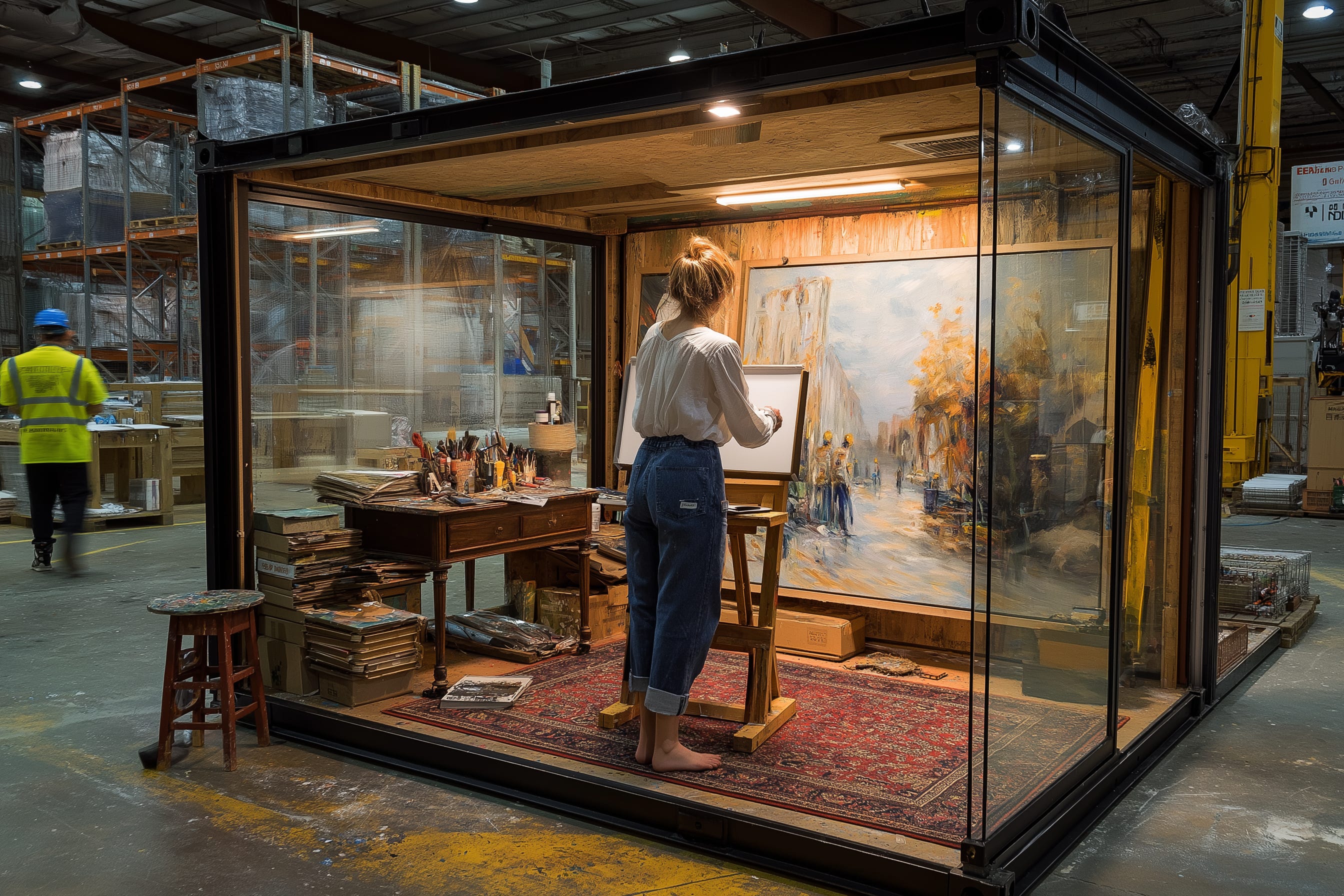
Artists' practice resides in ambiguity, and their output depends on their ability to think elastically. Every artist develops this approach in a different way, from their own, individual perspective, and based in their particular set of experiences. Without this thirst for dealing with the unknown, an artist cannot progress into new territories, and conquer new creative heights.
Artists welcome uncertainty, while for business The Unknown is a risk to be mitigated - a set of circumstances to be avoided if at all possible, or at least circumvented. Further, without "not knowing" and a practice that centers on probing that not knowing, there can be no new art, no interesting performance, and no cultural progress since discovery and wonder are what artists employ in their daily work as a matter of course. That is why we speak of the “periods” of painters (Picasso’s blue period, or pink period) and musicians keep pushing themselves to find new sounds, and new meanings for old sounds. Without having something new to discover, art stagnates, and artists begin to repeat themselves. Some make a career move of it, and head for Las Vegas. There’s a market for that, of course.
Most painters, choreographers, composers and writers work where building blocks are missing and outcomes are unclear. They prototype meaning, test frames of reference, and move between mediums to discover connections others have not yet noticed.
This is why artists can arrive from outside a company’s strategy and operations, step into a burning issue, and help to dig up patterns that invite new lines of enquiry – with facilitation by experts who bridge the chasm between business reality and an artist's sensibilities by speaking the language of both. Studies on arts-based leadership and dance-derived methods report measurable gains in innovative competence, reflective capacity and interpersonal skill, all of which support connecting of dots under pressure,no matter how incomplete the picture may be.
Patronage is yesterday’s contract; practice inside the work is today’s opportunity
This points to new ways of collaboration, new conversations between art and business. Patronage, sponsorship and corporate collections are all long-established, and those traditions very much still matter, yet they sit at a distance from the everyday decisions where business value is created.
A new compact is emerging, in which the artist’s presence and practice enter the organisation’s living tissue. For example, the European “Creative Clash” framework, built from multi-country evidence, documented how well-designed interventions open “interspaces” where people try fresh rules of attention and collaboration, then translate them into routines that last.
Examples now exist in multiple formats and at many scales. Unilever’s Catalyst worked with artists to help bring about leadership reflection and strategic change, with researchers noting the programme’s role in reframing risk, values and creativity.
TILLT, a Swedish artist placement platform, inserted artists into factories, hospitals and public agencies for over two decades. Evaluations demonstrated gains in communication breadth, problem framing and team climate when artistic work was tied to real issues and leaders planned for appropriate follow up.
Bosch R&D ran an artist-in-residence at the fuzzy front end of innovation. Engineers and scientists reported fresh stimuli, new questions and reframing benefits, along with clear lessons about setting expectations and integrating the work into existing research rhythms.
Autodesk Technology Centers invite residents to explore advanced fabrication while the company learns in real time and feeds insights back into tools and platforms. Public documentation spells out “benefits to Autodesk,” turning creative exploration into shared knowledge assets.
Fondation d’entreprise Hermès embeds artists in manufactories where deep craft meets contemporary art, producing mutual learning and exhibition-quality outcomes that also strengthen the pride and curiosity of the ateliers.
Swatch Art Peace Hotel runs a corporate residency that has hosted hundreds of artists in Shanghai, creating a living community and a cycle of exhibitions and collaborations.
None of these examples promise magic. Each shows how value compounds when artistic practice is integrated into real work, given time to breathe, and supported by leaders who care about what happens after the residency ends.
New words are tools, not decorations
Whenever unfamiliar language turns up around art-enabled work, a familiar reflex appears. Terms such as “scenius”, “aesthetic workspace” or “art thinking” sound airy-fairy to some ears and pretentious to others. The reflex makes sense if we consider that this is "jargon" and jargon, of course, can obscure – and threaten. Yet dismissing every new term on sight closes the door on exactly what our times require, namely language that helps groups see emerging realities clearly enough to act. May we suggest, rather than reacting with a kind of automated response, taking a step back and considering new language as possibly being of help?
“Scenius”, invented by the globally respected musician and painter Brian Eno, and crisply popularised by the technology visionary Kevin Kelly, gives a name to the collective intelligence that appears when the conditions of a scene encourage mutual appreciation, rapid exchange and tolerance for novelty. The genius of scenes, not genes, as it were. It shifts focus from the lone visionary to the ecology that enables many people to connect dots faster. In technology and research hubs, and in the best organisational learning environments, this lens describes what actually drives breakthroughs.
Similarly, scholarship on arts-based methods in organisations uses phrases like “aesthetic workspace” to legitimise attention to sense, emotion and embodiment as sources of knowledge, which in turn alters how meetings, labs and learning rhythms may be designed. The words point to practices which teams can adopt. It is not simply cool incense for the slide deck, if we may allow ourselves a prickly side-shot.
Professor Berit Sandberg and others have articulated “art thinking” as a practical complement to design thinking at the fuzzy front end of innovation. The argument is straightforward. When opportunities (and threats) are ill-defined and information is thin, organisations benefit from methods drawn from artistic practice, such as deliberate constraint, material exploration, abductive leaps and structured play. These methods widen the search horizon, generate unexpected connections and make promising directions visible a lot sooner than might be arrived at through sheer perseverance and cold logic. Recent writings in the innovation literature develop this case and connect it to intrapreneurship.
Sandberg’s own Bosch study aligns with this view. Artists acted as modern research muses, not by delivering ready-made answers but by changing the questions engineers asked and by offering other ways of noticing relationships across domains. Expectations needed care, and impact grew when artistic impulses were integrated into established workflows. This is the work Art in a Place of Work designs for. Artists are not brought in to deliver instant solutions; they open a crack that lets in air, and light. (Thank you, Mr Cohen – if you can spot the reference…)
What Art in a Place of Work brings into the room is all that creative experience, and the approaches to thinking and doing that have shaped it.
Art in a Place of Work places artists in direct interface with the living tissue of companies through both time-boxed residencies, and structured programmes. Some of these interventions can sit neatly inside learning and development. Others are deeper cultural conversations that run alongside operational projects.
Formats are designed to build inventiveness as a muscle. Leaders learn to treat the unknown as fuel. Teams practise ensemble problem-solving, translate insights into artefacts, and establish rituals that keep the gains alive after the residency. The philosophy draws on field evidence and on the ideas set out by founder of Art in a Place of Work Ralph Talmont in his writings on the relationship of business and the arts – start with substance, invite different minds, and make the practice repeatable so it compounds.
No posts
Comments
Nothing yet. Say the first thing.
Sign in to join the conversation.