
Welcome to the EU AI Act Newsletter, a brief biweekly newsletter by the Future of Life Institute providing you with up-to-date developments and analyses of the EU artificial intelligence law.
Commission misses high-risk AI guidelines deadline: Euractiv's Maximilian Henning reported that the European Commission will publish draft guidelines later this month to help developers identify high-risk AI systems under the EU AI rules, having missed the 2 February 2026 deadline. Classifying AI systems is essential for companies, as high-risk AI systems face significantly stricter requirements, including additional compliance documentation. The Act relies on the Commission guidance on classification, with a comprehensive list of practical examples. The Commission gathered input last summer and received feedback via the AI Board, a group of national experts. A Commission spokesperson explained that the delay resulted from integrating substantial feedback received over the past month whilst following internal procedures, adding that the priority remains publishing draft guidelines for final stakeholder consultation in February before official adoption. Renew lawmaker Michael McNamara, co-chair of a parliamentary group overseeing the enforcement of AI rules, called the delay “entirely unacceptable”, stating that it undermines the AI Office’s credibility. However, he emphasised that adequately staffing the Office to fulfil its responsibilities was of “utmost importance”.
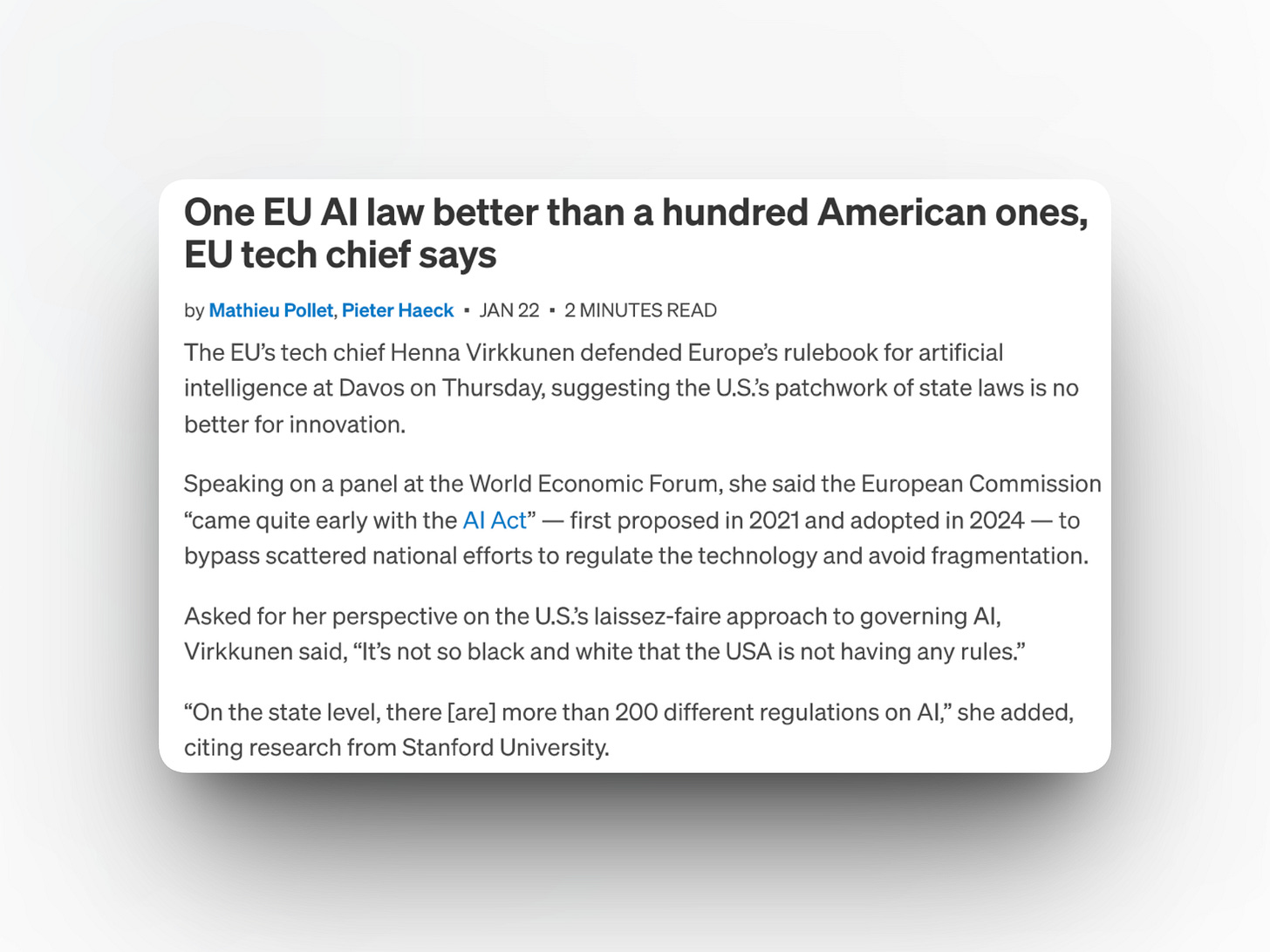
One EU AI law better than a hundred American ones: Mathieu Pollet and Pieter Haeck of POLITICO reported that the EU tech chief Henna Virkkunen defended Europe’s AI rulebook at Davos, suggesting that the US patchwork of state laws is no better for innovation. Speaking at the World Economic Forum, she noted that the European Commission adopted the AI Act early to prevent fragmentation through unified regulation. Responding to questions about US governance, Virkkunen countered that the USA possesses substantial AI regulation, citing Stanford University research showing over 200 state-level AI regulations. Virkkunen emphasised that Europe’s past overreliance on directives, permitting countries leeway to adapt EU legislation as they see fit, created numerous divergent rules, hindering scaling and single market access for European business. She stressed that regulations are preferable to directives in the digital field. While the Act functions as a bloc-wide regulation, several provisions still undergo supervision by national authorities, risking fragmentation in enforcement.
Can Europe still win the other AI race? An article in The Economist discussed that European companies have historically adopted new technologies slowly, yet AI provides a big opportunity. Whilst Europe built only three cutting-edge AI models in 2024 compared with China’s 15 and America’s 40, and lacks homegrown hyperscalers, widespread productivity gains depend more on adoption than model development. Europeans individually rank among the most enthusiastic generative AI adopters at 32%, exceeding Americans at 28% and Chinese at 16%, according to research from Microsoft. A European Investment Bank survey found that approximately 37% of EU firms use generative AI, matching American firms at 36%, though significant variation exists: Finland leads at 66%, whilst Italy and Greece lag at 20% and 19% respectively. Potential impediment to fast adoption includes the EU AI Act. Although it sets a global benchmark for safety and data protection, according to critics it creates too much red tape.
Major AI firms slow to disclose training data under EU rules: Maximilian Henning of Euractiv wrote that several major AI companies that have recently released new models appear non-compliant with the AI Act transparency rules. The legislation requires foundation model developers, such as those behind OpenAI's ChatGPT and Google’s Gemini, to publicly disclose information about training data. These disclosures matter especially for artists, writers and copyright holders, enabling them to verify whether their work has been used to train models and supporting legal action against rights violations. The Commission has provided a template establishing a “common minimal baseline”. However, major AI developers are not rushing to make submissions, potentially requiring the Commission to step in once the compliance grace period ends at the end of summer 2026. Notably, the Commission will only formally supervise and enforce these training data disclosure rules from this August, extending the compliance grace period until summer, though companies may voluntarily comply earlier.
European AI FOMO: Felix Bieker, a Senior Researcher at ULD ( the data protection authority of Schleswig-Holstein), and Katherine Nolan, an Assistant Lecturer in law at Technological University Dublin, published an op-ed in Verfassungsblog stating that the European Commission’s approach to digital regulation has shifted dramatically over the last twelve months amid geopolitical uncertainty and EU competitiveness concerns, moving away from the “Brussels Effect” as a global rule-setter emphasising fundamental rights. AI has become central to this shift, with the Commission's strategy driven by “AI FOMO” (fear of missing out). According to Bieker and Nolan, since the Letta and Draghi reports, the Commission has experienced AI FOMO, applying simplistic regulation-versus-innovation logic which undermines individual protections. The Digital Omnibus proposals exemplify AI FOMO, risking fundamental rights standards and the coherence of digital acquis. The barely-adopted AI Act faces reopening with deregulatory amendments: various rules delayed pending Commission decisions, AI literacy requirements watered down, and existing high-risk models largely exempted. This can encourage developers to flood the EU market with problematic technologies before full AI Act implementation.
Slow down not to water it down but to ensure its proper enforcement: Patrick Grady, the EU Policy Manager at Chamber of Progress, wrote a blog post arguing that the AI Act, nearly double the GDPR’s length with more articles, recitals and 13 annexes, requires substantial guidance for compliance, particularly for smaller businesses navigating its strictest rules. Grady states that the authorities in charge of creating technical standards are two years behind schedule. The Commission proposed a confusing 15-month enforcement pause until December 2027. However amendments allowing this pause could pass months after the rules take effect in August 2026 and the Commission retains the power to end the pause at any time. Grady argues that rather than watering down the AI Act, Europe should establish a clear compliance timeline, providing necessary breathing room to ensure proper implementation.
Comments
Nothing yet. Say the first thing.
Sign in to join the conversation.