
🔗 Learn more about me, my work, and how to connect: maeste.it – personal bio, projects, and social links.
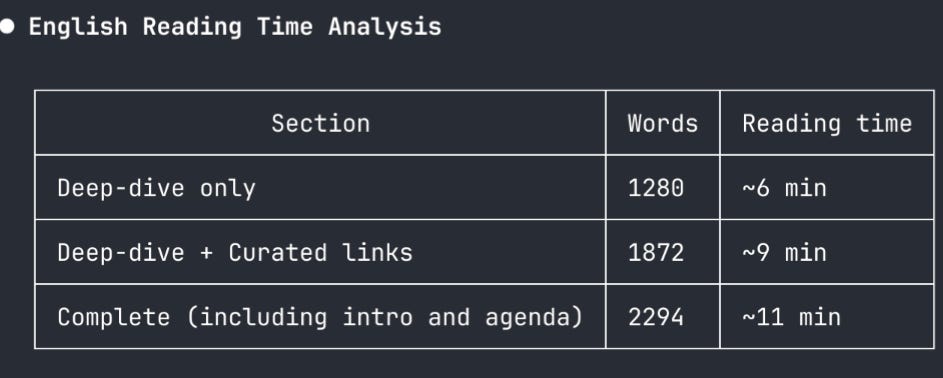
Here we are, at the first newsletter of the second year of this adventure. I’m sticking with the format I started last week, so a deep-dive plus a handful of links that stood out to me. The feedback I’ve received so far is all a little nostalgic of the old format, which seems to have been very much appreciated, but I want to give you the chance to get used to this new one. That said, I listened to the private feedback you sent me and I tried to expand the links section a bit, identifying the main themes of the week within it. A bit like what I used to do in the previous newsletter, but much, much more compressed. I condensed, expressing above all my opinions. I kept the deep-dive anyway because I think it’s important, at this point, to contribute (or at least try to) to the discussion around AI with all the things I’m experimenting with, for work and for passion. This week’s deep-dive is the story of a small personal project built on a flight, a “second brain” inspired by Karpathy’s latest gist, which in New York made me understand why this idea can really change the way we work with LLMs.
Podcast with Alessio and Paolo:
A great interview with Luigi Congedo is out, where he shares his experience in American VCs and tells us about the bold choices he made back in Italy. Don’t miss it.
While I was on a well-deserved vacation (which I’ll tell you about later) Alessio and Paolo had an exceptional guest, Andrea Cosentino, who takes us deep into the world of security and hacking. Bear with the imperfect audio for the first 5 minutes, it’s worth it (and then it clears up).
We’re working on more interviews and episodes with very interesting guests.
By now you know about our GitHub repository with tools and configurations for terminal-based AI coding on Linux. It now has its own site with single-script installation at Lince.sh
We released AntiVocale (Google Play, GitHub), a piece of software to translate voice messages into text
Solo:
The video of the talk I gave with Alessio at VoxxedDay Zurich has been published
On May 30th I’ll have the honor of being one of the PyCon Italia speakers
On June 12th I’ll be in Catania as a speaker at Coderful
A few days ago, on a flight, with shaky WiFi and Claude Code open, I was reading Andrej Karpathy’s gist and the tweet where he talks about how he’s building personal second brains using LLMs. I recognized myself immediately in the organization he proposes: it was already pretty close to how I keep my notes when I’m working on a research topic I want to dig into over time. By the end of the flight I had my own working version, shaped around the way I think instead of someone else’s. This is the story I want to tell you, and above all, it’s the reflection that came out of it.
Karpathy’s idea, simplified, is this: a raw/ directory where you collect your sources (articles, papers, clips taken from the web), an agent that “compiles” them incrementally into a wiki of markdown files with summaries and cross-references, and Obsidian as the frontend to read everything. No RAG, no vector databases, no embeddings. The agent itself maintains indexes, concept pages, and connections between sources. Complex queries become actions of the agent against the wiki, and the outputs of those queries can in turn be fed back into the wiki, enriching it. Karpathy calls this effect compounding: every new thing you add stacks on top of what was there before, instead of getting lost in a chat you’ll close and forget.
The principle isn’t new. An organization based on sources and linked notes has existed for decades, just think of the Zettelkasten. What really changes, and it changes for real, is the ingest phase. When you ask the agent to ingest a new article against an already populated wiki, it proposes connections you hadn’t seen, because it “remembers” all the sources together in its context, something a human does poorly past the first twenty notes. It’s the difference between a well-ordered library and a librarian who has read all the books. The result is not a static archive like NotebookLM, which crystallizes whatever you’ve given it: it’s something that evolves with every addition, and where the connection is worth as much as the content. The more you use it, the more valuable the system becomes. And this changes the way you work: you stop asking the LLM “answer me about X” and you start asking it “update what you know about X with this new source, then answer me”. It’s a tiny difference in the prompt but an enormous one in practice, enough to make a system that yesterday looked like yet another notebook seem like a game changer.
I built my version by chatting with Claude Code for a few hours during the flight. What came out is a bundle with an init script, a CLAUDE.md that acts as a contract between me and the agent, three skills (a fetcher that pulls URLs from an inbox and converts them into clean markdown, a deterministic linter that keeps the wiki honest with checks on dead links, orphans and staleness, and a views builder), session hooks that maintain a “hot cache”, and a few slash commands to save important conversations and generate output. On top of the gist I added a periodic reflection that writes in prose about where I’m converging and where I’m systematically not looking, closing with an uncomfortable question à la Richard Hamming that often hurts. And the views: alternative representations of the same pages, like timelines, comparisons, diagrams, slides, reports, which by default evolve alongside my thinking and only when they need to serve someone else do they become frozen snapshots. The bundle lives in a public repo for anyone who wants to take a look.
The reason I was on that flight was a ten-day trip to New York, and that’s where I ended up actually using the system. I ingested guides, articles, recommendations from friends, fragments of old trips, and the agent started proposing juxtapositions I’d never have made on my own. The Bushwick Collective murals, in Brooklyn, read as the open-air continuation of what Basquiat and Haring had brought inside the halls of the MoMA and the Whitney forty years earlier: same gesture, different temperature, and a visit to Bushwick becomes a chapter of the same story rather than a disconnected side trip. The Sunday gospel service in Harlem linked to the jazz concert we were going to see that same evening in Greenwich Village: not two musical experiences in two different neighborhoods, but two branches of the same trunk, given that Thomas Dorsey, the father of modern gospel, was a jazz pianist first, and African American worship is the crucible from which jazz itself drew musicians and language. The Central Park Reservoir not as a mirror of water for joggers but as the terminal of the Croton Aqueduct of 1842, and therefore as the root of the same water problem that half a century later would give birth to wooden water towers on the rooftops: two answers to the same crisis, forty years apart, both still visible from the same bench. But the truly interesting part is what happened during the trip. Tastes kept changing, timing kept changing, an unexpected experience opened a new direction, and the wiki evolved with me: every question asked in the evening, every morning change of plans, came back into the system and altered the subsequent answers. The second brain wasn’t a frozen itinerary crafted before leaving, it was a travel companion learning alongside me. A deliberate and conscious use of a system like the one Karpathy proposes, applied to something concrete like a trip, is a real game changer. And I understood in practice why he sees in it a foundation for something bigger. I picked the New York example because it makes the enormous potential of this approach concrete, and it’s precisely because of that potential that I’m already using the same system for much more serious research, on agents and memory, where the ability to accumulate sources and make them talk to each other matters even more.
That said, I’m not sure there’s room for a packaged product built on this idea. Plenty of people have already published their version on GitHub in recent months, it takes two minutes to find a dozen. A strong idea, a capable agent and an afternoon of conversation produce a system tailored exactly as you want it, not as someone else’s product manager wants it. The same applies to other cases: last week I was writing about LINCE, my sandbox environment for agents, and quite a few of the things we put into it today are covered by products from big tech. I built it anyway, and I’d make the same choice again.
Then why put the code on GitHub, if not to compete with those products? Not to become famous, not to collect users or stars. To enrich the public discussion. Open source in its essence is shared research: you publish what you found so that someone else can build on it, criticize it, break your assumptions. An imperfect version of my second brain on GitHub doesn’t want to compete with anyone. It wants to contribute to a collective conversation, and whoever forks it won’t be a user to be converted into revenue but someone else thinking about the same problem. That’s something the packaged product can’t do. It can give you a finished solution, but it takes away the research part, the part where you also learn something by doing it. If you build your own version, let me know what you put in it that’s different from mine: that diversity is exactly the point.
There are plenty of memes about the pace of feature releases at Anthropic: from “I wake up and Claude has a new feature” we’ve moved to “I breathe and Claude has a new feature”, and that’s exactly what happened this week. Genuinely important features, because Opus 4.7 is a big step forward in agentic development, but Claude Managed Agents are also noteworthy: agents that can be developed locally as if they were a regular Claude Code agent, and then deployed on the cloud system. But the one that struck me most is definitely Claude Design, because it brings a new capability, that of developing graphical interfaces through text, which until now was the prerogative of specific tools like Lovable. At this point Claude isn’t just a Lovable supplier anymore, it’s a direct competitor.
Google on its end is not standing still, and this week at least, focuses mostly on the consumer side, releasing two important things. The first is the Gemini 3.1 Flash text-to-speech, which lets you read almost any web page, and we’re already seeing the feature land inside Google’s own pages. We’re heading towards a web that becomes multimedia with little effort: we can start listening to the pages we care about instead of reading them, and that’s an interesting direction. On top of that, there are the Skills in Chrome, essentially saved prompts inside the AI version integrated in the browser, very useful to create a kind of mini AI applications living inside Chrome.
You’ve probably heard about Karpathy’s autoresearch. Here I’m linking an article and a repository coming from Shopify to show how powerful autoresearch can be even when used outside Karpathy’s base use case, which was model training. Also very interesting is the paper I cite: are we really heading towards agents capable of improving themselves? I don’t know, but at least we’re trying.
And then there’s Qwen, officially releasing the weights of its latest model. Qwen’s open source strategy continues, even though the free version of their subscription is gone. Fortunately for us, they don’t stop pushing on the open source side of models, releasing weights and training code.
Anthropic did a lot, Google too, but OpenAI was certainly not to be outdone this week, because it released extensions for Codex that allow full use of your computer. I haven’t had the chance to try it thoroughly yet, but from what I see and read the results are incredible. And if you wonder what the point is of having an agent use the computer directly with mouse and keyboard when it can access APIs, remember why we’re chasing humanoid robots: exactly to use all those tools we’ve built for ourselves and our form factor. The same goes for an agent using the computer.
Dwarkesh interviewed Jensen Huang and didn’t go easy: he was very sharp with his questions, so much so that, for the first time I believe, I saw Jensen lose his proverbial calm when they talked about China and Chinese competition.
No posts
Comments
Nothing yet. Say the first thing.
Sign in to join the conversation.