
🔗 Learn more about me, my work, and how to connect: maeste.it – personal bio, projects, and social links.
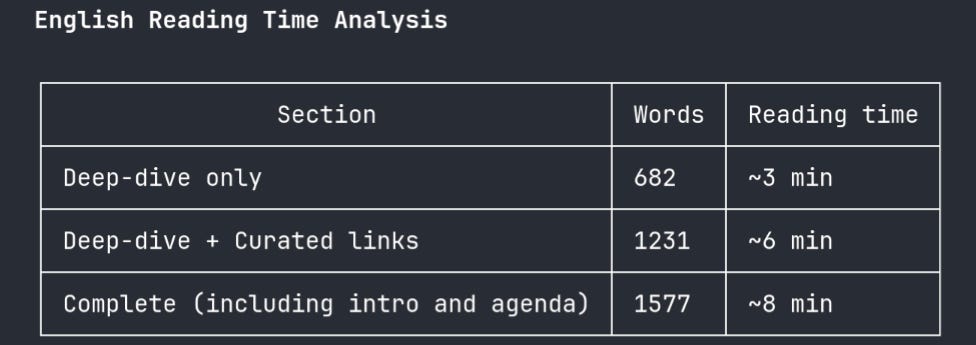
This week in the deep dive I tell you about my experience with the Cyberwave hackathon I did together with Paolo, the other co-host of Risorse Artificiali. It was very interesting to play with a robot and with the Cyberwave platform to have our first real Physical AI experience, and it was a very formative experience even if not as straightforward as we expected, but you’ll find all the details in the deep dive. In the links section, on the other hand, I’m flagging some interesting things that happened this week, from DeepSeek V4 to GLM-5V-Turbo, passing through other news and unexpected points of view. But I’ll leave the reading to you.
Podcast with Alessio and Paolo:
On Saturday episode 50 of Risorse Artificiali came out. Three Chinese open weight models, DeepSeek V4 cutting 78% of compute on the KV cache, and my deep-dive on Hermes Agent (it runs on its own with GLM-5.1 and manages my email and calendar, which I’ll describe in detail next week here in the newsletter). Listen
On Wednesday the new interview with Stefano Gatti came out, his second time with us after being the first guest of the series. Strong thesis at the end: AI today is not an equalizer, it amplifies those in the top 10%. Listen here
By now you know about our GitHub repository with tools and configurations for AI coding from the terminal on Linux. It now has its own site with single-script installation at Lince.sh
We released AntiVocale (Google Play, GitHub), a software to translate voice messages into text
On my own:
The video of the talk Alessio and I gave at VoxxedDay Zurich has been published
On May 30 I’ll have the honor of being one of the PyCon Italia speakers
On June 12 I’ll be in Catania as a speaker at Coderful
On June 24 I’ll be in Milan as a speaker at AIConf
In recent weeks, Paolo (one of my two co-hosts on the Risorse Artificiali podcast) and I had the opportunity to take part in the Cyberwave cohort dedicated to robotics experiments. Cyberwave is an interesting Italian startup focused on robotics, it has just closed a seed round and is looking for feedback from developers: that’s why they created a four-week hackathon open to a group of experimenters. Could we miss it? Of course not, especially because one of the founders, Simone di Somma, had already been a guest on Risorse Artificiali, and the whole thing had piqued our curiosity quite a bit.
The Cyberwave platform is cloud-based and lets you work with physical robots by creating a virtual twin inside their 3D simulation environment, with the goal of simplifying the development experience in the world of robotics. Given our experience in software engineering we started off pretty relaxed, I’d dare say even a bit overconfident, sure we could cover a fairly advanced use case. But robotics, we discovered, is something completely different from software engineering, and far more so than we expected. To begin with, robots need to be calibrated as soon as they arrive: when you open the box and start programming them, you’ll be surprised to find that they don’t necessarily go straight, so a calibration job is required, along with a study of the hardware details of the system you have in your hands. Debugging, then, is physical, complicated, and at times risky for the rover itself.
That said, as the tinkerers we are, we didn’t get discouraged. We started exploring both the robot, a Waveshare UGV Beast, and the platform, discovering the innovative things it offered us and the inevitable bugs of such a young product. Two software geeks who have to go bug hunting, discuss them on Discord with the founders and contribute back with PRs: two kids in a candy store. In the end, instead of a complex use case, we put together a sort of quickstart for working with Cyberwave and the UGV rover: a series of Jupyter Notebooks that let even newbies like us understand all the possibilities a robot and the platform offer for development.
Working on it we realized that some considerations resembled those of traditional software architecture quite a bit: what to put in the cloud and what at the edge looks a lot like the backend/frontend split, and the fallbacks for communication errors must be designed so the robot keeps working even if the network drops. Other things, instead, are new. Basic AI (image, person, and obstacle recognition) is now a commodity, but to make a robot truly autonomous there’s still a lot to do: recognizing an obstacle is one thing, recognizing edges and shadows (as another hackathon competitor did) is something else entirely. And every robot is different: the form factor shapes the design and makes it hard to build truly portable high-level libraries.
We then won the hackathon, and it makes me happy because it rewards exactly the spirit of building something useful for other developers. But the important thing is something else: we had a lot of fun and we got the strong confirmation that the next big thing is robotics. My aha moment came when I implemented a CLI for the rover and fed it to Claude Code: being able to talk to the robot in natural language, telling it what to do and where to look and watching it execute, is a real game changer. It’s a window onto the future, the one in which even non-experts will have well-tested tools and platforms like Cyberwave for a smoother experience than what is possible today. One critical point remains, and it should not be underestimated: the alignment of AI models, both generative and recognition, is essential when you send a physical object out to take initiatives. Everything is still early stage, but the direction is clear, and if you’re young and you have to decide where to invest your time, maybe that’s where you should look.
I’ll start by quoting the other Risorse Artificiali co-host, Alessio, who wrote a great article on speculative decoding, a technique to get better results in the decoding phase of transformers, very very useful when you do local inference.
DeepSeek announced version 4 of its Large Language Model in preview. What does preview version mean? It means Reinforcement Learning isn’t fully complete, so some benchmarks aren’t as brilliant as one might have expected from the new DeepSeek version, but they will likely improve a lot for the final. I’m also citing some great work by Salvatore Sanfilippo (antirez), who, on top of this model, started spending time optimizing local inference. He does a lot of things with DeepSeek version 4, including a hybrid 2-bit and 8-bit quantization, but the thing that struck me the most is the latest one, which I link to in the post: the ability to use the KV cache on an SSD disk instead of in memory. As I commented on X, this could be a real game changer for local inference and beyond. Being able to use long-term storage like an SSD instead of RAM could significantly lower inference costs, or open a whole new path for local solutions.
Roo Code, one of the first agents integrated into VS Code, is shutting down. But that’s not really the news: it happens with open source projects that at some point they get discontinued. What struck me is the founder’s statement, who said that the time of IDEs is over. I’ll leave the reflection to you, I already have mine, which I think my readers know well, since for a long time I haven’t used an IDE anymore but a CLI with multiple agents in LINCE.
My readers know very well that when Karpathy or Demis Hassabis speak, I listen. And this week they both did, in two very interesting interviews. I’ll leave the listening and the judgments to you.
Interesting business news from Google, which is starting to sell TPUs. The Mountain View company, after becoming OpenAI’s main competitor on the consumer side, seems to want to enter the hardware market as well, becoming a direct competitor to Nvidia.
Those who have been reading me for a while or listening to me on Risorse Artificiali know that I’m a GLM user as an alternative to Claude, and that I’ve had their Max subscription for some time, also because it’s very convenient. It also has to be said that GLM has made huge progress, getting very close to state of the art models. With the 5 series of their models, this new 5V-Turbo version comes out, with truly very interesting benchmarks. At the moment it’s only available as an API or for a subset of testers in the coding subscription. Obviously I’m already on the list.
No posts
Comments
Nothing yet. Say the first thing.
Sign in to join the conversation.