
🔗 Learn more about me, my work, and how to connect: maeste.it – personal bio, projects, and social links.
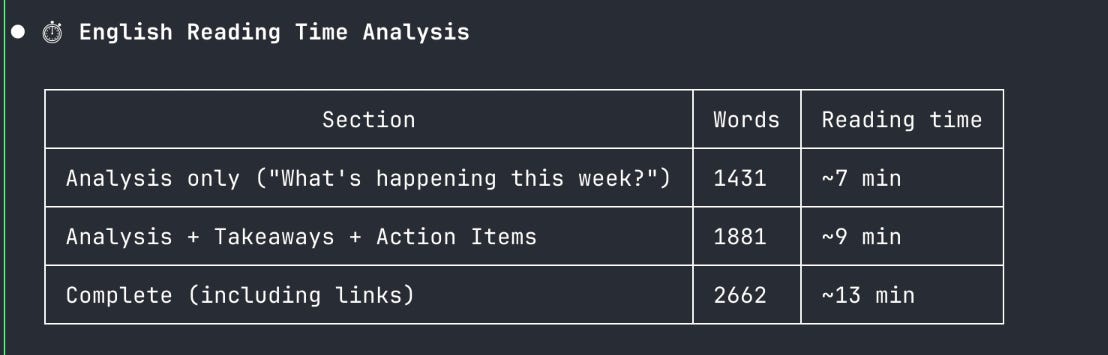
The news of the week, which you surely haven’t missed, is the Claude Code source leak. Certainly relevant news, but definitely not the only thing I’m covering in this newsletter. I also focus on the release of Gemma 4, Google’s open weight models that especially in their smaller versions look very promising with great results. There’s no shortage of deep dives into what we’ve learned from looking at Claude Code’s source, because there are certainly lessons to be learned, given that it remains one of the best agentic coding platforms on the market right now. And the internet went wild, downloading the source code, writing articles about it, and creating ports in Rust and Python.
Before I let you dive into the reading, I recommend not missing Simon Willison’s podcast, which highlights the risks of burnout for developers increasingly caught in the whirlwind of multi-agent orchestration during coding. And of course, don’t miss our podcast and all the initiatives I summarize here in my agenda.
Podcast with Alessio and Paolo:
A great interview with Gabriele Venturi, founder of PandasAI and a true nerd, is out :)
We’re working on more interviews and episodes with very interesting guests.
You already know about our GitHub repository with tools and configurations for AI coding from the terminal on Linux. It now has its own website with a single-script installation Lince.sh
We released AntiVocale (Google Play, GitHub), a software to translate voice messages to text
On my own:
The video of the talk I gave with Alessio at VoxxedDay Zurich has been published
On May 30th I’ll have the honor of being one of the PyCon Italia speakers
On June 12th I’ll be in Catania as a speaker at Coderful
Takeaway 1: Small open weight models like Gemma 4 are making a two-tier agentic architecture concrete: local for simple tasks, cloud for complex orchestration.
Takeaway 2: Qwen demonstrates that native multimodal reasoning (not just multi-format input) is becoming a reality in open models.
Takeaway 3: For European players like Mistral, the niche of specialized and compact models could be the winning strategy against generalist competition.
Action Items:
Try Gemma 4 locally for speech-to-text tasks or lightweight processing: the benchmarks are promising and our experience with AntiVocale confirms it.
Keep an eye on the Mythos leak from Anthropic: if confirmed, it could redefine the benchmark reference for frontier models.
This week’s model news is undoubtedly dominated by the release of Gemma 4 from Google, a new family of relatively small open weight models that give a big push to using models locally, because they deliver truly remarkable performance. More and more, looking at what’s happening with small open weight models, I’m starting to think that an architecture for agents is taking shape that will soon be based on two tiers: a local one, with relatively small models for simpler tasks or for meta-processing information, and then delegating to state of the art models for orchestration and more complex tasks.
But getting back to Google’s models, as I was saying, the benchmark results are truly impressive and on top of that these are fully multimodal models. In one of the open source projects we’re releasing with the Risorse Artificiali group, AntiVocale (Google Play, GitHub), which is software for translating voice messages to text, we’ve also introduced Gemma 4 with good satisfaction. From an initial test, they have performance similar to Whisper for speech-to-text, but with an improvement in the ability to infer punctuation. This is our direct experience, but the articles I’m sharing are very interesting, especially the one that visually presents the architecture: I recommend taking a look if you’re curious about how a model is built internally.
The Chinese are certainly not standing still, because Qwen released two models this week: an omnimodal one (supporting all format types, from audio to text to video as input) and one called 3.6-Plus with advanced multimodal reasoning. I’ve been talking about this possibility in this newsletter for a while, and finally, in such an explicit way, Qwen releases a model with reasoning based on multimodal data, which partially generates graphical data to then use them within the reasoning phase.
It’s with pleasure that I also talk about Europe, because Mistral released Voxtral TTS, a text-to-speech model with only 4 billion parameters that seems to have excellent performance. I haven’t tested it in detail yet, but perhaps it’s precisely in these highly specialized models that Mistral can make its mark: it certainly can’t compete with state of the art generalist models, as it has already demonstrated in the past, but on very specific things this could be their market niche.
I close by talking about a leak from the Anthropic world, and I’m not referring to the Claude Code leak (which I discuss in the coding agent section), but rather the fact that they’re internally testing a new model larger than Opus that appears to have nothing short of impressive performance. Obviously this is a leak, it’s unclear how much it was orchestrated for publicity, and it should be taken with a grain of salt. But for sure, considering how much Opus is already capable of, a larger model coming from Anthropic will be something interesting to try.
Claude Mythos — New Anthropic model tier above Opus, with much higher scores in coding, reasoning, and cybersecurity.
A Visual Guide to Gemma 4 — Visual guide to Gemma 4 model architecture: local/global attention, p-RoPE, Mixture of Experts.
Gemma 4 Open Models — Google DeepMind open model family in 4 variants, multilingual, multimodal, optimized for local use.
Qwen3.5-Omni — Full omnimodal model: text, images, audio and video, with support for 113 languages.
Qwen3.6-Plus — Advanced multimodal reasoning, critical milestone toward native multimodal agents.
Mistral Voxtral TTS — 4B parameter text-to-speech model, 9 languages, expressive, low latency, open-source.
Takeaway 1: Visual agent orchestration (like Cline Kanban) is maturing, but complexity remains a trade-off to evaluate against lighter solutions.
Takeaway 2: Persistent memory is confirmed as a key component of effective agents, from the Claude Code leak to dedicated solutions like Engram.
Takeaway 3: Agent optimization through reinforcement learning (Agent Lightning) and structured training loops is moving from theory to usable frameworks.
Action Items:
Evaluate Cline Kanban if you manage complex multi-agent workflows, but compare it with simpler solutions like Backlog.md for your use cases.
Explore Microsoft’s Agent Lightning if you want to optimize existing agents without rewriting code.
This week in this category I’m focusing on four links that try to identify development and research trends in the AI agent space, and I’m referring here to generic agents, not necessarily coding ones.
I start with Cline Kanban, which was born specifically for coding agents but which, looking at it closely, could easily be applied to more generic agents as well. It’s a kanban board where you can orchestrate agents in a graphical and intuitive way, creating dependencies or workflows. Definitely interesting to look at. Much more evolved, and at first impression a bit too complex for my taste compared to Backlog.md, but certainly worth exploring for more complex use cases.
Then an article about memory, Engram Memory System. I’ve been talking about the importance of memory in agents for a while, and this has also been demonstrated by the attention to memory usage in Claude Code’s leaked source code. In this case it’s a vector-based memory, which is perhaps not the most flexible of all those I’ve seen, but which is promising in how much it can improve the workflow.
The other two articles are somehow connected to each other. One is a research project, or rather a framework from Microsoft, for optimizing agents with reinforcement learning. The other is a more theoretical article about the training loop around the use of the harness by models within an agent system.
The Model-Harness Training Loop — Agent training cycle based on harness engineering, open models, and accessible infrastructure.
Cline Kanban — App for orchestrating multiple coding agents with kanban visualization, dependency management, and live status.
Engram Memory System — Vector memory system for agents, persistent context to improve workflows.
Agent Lightning (Microsoft) — Framework for optimizing agents with RL, prompt optimization, and fine-tuning, zero code changes.
Takeaway 1: The Claude Code leak confirms that the competitive advantage of coding agents isn’t in the model but in the harness: memory management, tool usage, and subagent orchestration.
Takeaway 2: Cursor 3’s hybrid local/cloud approach represents an interesting architectural alternative to CLI-based subagent swarms.
Takeaway 3: Cross-agent review between different agents (Codex on Claude Code, Lince.sh) is emerging as a practice to improve generated code quality.
Action Items:
Read the four articles about the Claude Code leak to extract patterns applicable to your agents, particularly on memory and harness.
Check out Karpathy’s diagram of his personal workflow with coding agents as a starting point for optimizing yours.
When it comes to agentic coding, this week was undoubtedly dominated by Anthropic’s code leak. As many of you will have seen, a developer published a version of Claude that also contained the code for debugging purposes, and the internet immediately went wild. We also discussed it extensively during the latest episode of the Risorse Artificiali podcast, which if you speak Italian I recommend listening to.
I don’t want to dwell too much on the lessons learned here, because they are many and varied. Even though there’s no magic recipe, as you’d expect if you’ve been in this world for a while. It’s a combination of good harness and memory usage practices: that’s what I’d condense into a single sentence. The code has clearly grown a lot on itself, much of it written with AI assistance, and at times has areas for potential improvement with good refactoring. But that’s not the point, because Claude Code works very well thanks primarily to those two aspects I mentioned earlier. I recommend reading the four links I’m sharing, because they analyze the code in an accessible but sufficiently in-depth way to understand the tool and how it adapts to different needs, and maybe give you some ideas for your coding agents and beyond.
If you’re using coding agents, I also recommend not missing Karpathy’s tweet, especially for the attached diagram that clarifies his personal use of coding agents. It may not be perfect for your use case, but it can certainly give you advice, as Karpathy always manages to do.
It’s been a while since we talked about Cursor, but they’re not standing still either. Version 3 of their IDE is out, redesigned for agent-driven and multi-repository development. Very interesting. It integrates both local and cloud agents in parallel, in a broad swarm-type orchestration. They deserve credit for the courage and ability to try new solutions, because this hybrid local and cloud approach is certainly different from the approach taken by Claude Code and all other CLIs, which instead tend to do subagent swarms.
Finally, I’d like to point out a plugin for Claude Code to use Codex within the Claude workflow. It’s curious because it allows for cross-agent review and using two different agents in parallel on the same problem. Lince.sh, the project I’m developing with the other folks at Risorse Artificiali, also lets you do something vaguely similar: use multiple agents on the same code repository and switch between them very quickly, all while staying in the same terminal. If you’re interested, check it out and give us your feedback. I’ll definitely talk about Lince.sh much more extensively in the next newsletter, after we’ve officially launched it on all social media, and maybe I’ll dedicate an entire issue of this newsletter to it. What do you think?
Cursor 3 — IDE redesigned for agent-driven development, multi-repo, local and cloud agents in parallel.
Inside the Claude Code source — Analysis of Claude Code source: 500K lines of TypeScript, harness architecture, divergences from Codex.
Codex Plugin for Claude Code — Plugin to integrate Codex into the Claude Code workflow, cross-agent reviews.
AINews The Claude Code Source Leak — Claude Code source leak via source maps: orchestration, memory, npm security risk.
Practical Lessons From the Claude Code Leak — Architectural lessons from the leak: CLAUDE.md, subagents, worktrees, automatic hooks.
Claude Code’s Real Secret Sauce — The software harness (Grep, Glob, LSP, subagents) matters more than the underlying model.
Karpathy on LLMs and coding — Karpathy’s tweet with related diagram on using LLMs for coding.
Takeaway 1: The compute race between OpenAI and Anthropic will define the AI landscape of 2026-2027, with Google as the dark horse that has closed an enormous gap.
Takeaway 2: The generative AI economy remains dominated by semiconductors (70% of revenue): those selling the shovels continue to earn more than those digging.
Takeaway 3: Burnout from multi-agent orchestration is a real and underestimated risk for developers, as highlighted by Simon Willison.
Action Items:
Read the two economics articles (timelines and economics) to understand the market forces driving the technological choices that impact you daily.
Monitor your own cognitive limits when using multiple agents and adopt tools that reduce context switching.
OpenAI raises another 122 billion dollars in funding, with a monster valuation exceeding 800 billion. Meanwhile, Anthropic, which is currently winning the revenue race, has doubled its compute capacity, nearly matching OpenAI’s. A truly tight 2026-2027 is shaping up between these two competitors who are capturing most of the market, without forgetting Google of course, which has done incredible things recovering an enormous gap it had in 2024 and becoming one of the main competitors at the same level as these two.
Precisely because of this intense competition, it’s interesting to read the articles about the AI timeline update predictions and also how the economics of generative AI works. These are two economics-focused articles, but ones that I think are worth diving into to understand the economic forces behind this industrial revolution.
Simon Willison, on a podcast, talks about something I’ve often addressed in these pages and also in Italian on the Risorse Artificiali podcast: how much in the era of agents, burnout can truly be a risk for developers who find themselves facing their cognitive limits in orchestrating multiple agents. As mentioned, with Lince.sh we’re trying to provide a tool that somewhat limits context switching, at least keeping the developer within the terminal. But undoubtedly, increasing the number of agents to coordinate is on one hand a necessity to increase the capacity to use these tools, but on the other hand presents significant risks. Simon is one of my favorite writers to read, and he proved to be a great surprise on Lenny’s podcast as well.
Simon Willison on Lenny’s Podcast — AI state of the union: human cognitive limits in the era of agents, burnout, new personal limits.
Q1 2026 AI Timelines Update — Automated Coder predictions moved up to mid-2028, Claude Code at $2.5B annualized revenue.
Compute Wars: OpenAI vs Anthropic — Anthropic doubled capacity, nearly on par with OpenAI. 2027 will be a tight race.
OpenAI raises $122B — $122 billion in new funding, $852B valuation, strategy focused on compute and enterprise.
The Economics of Generative AI — Semiconductors capture 70% of AI revenue. The most profitable strategy remains selling the shovels.
No posts
Comments
Nothing yet. Say the first thing.
Sign in to join the conversation.