
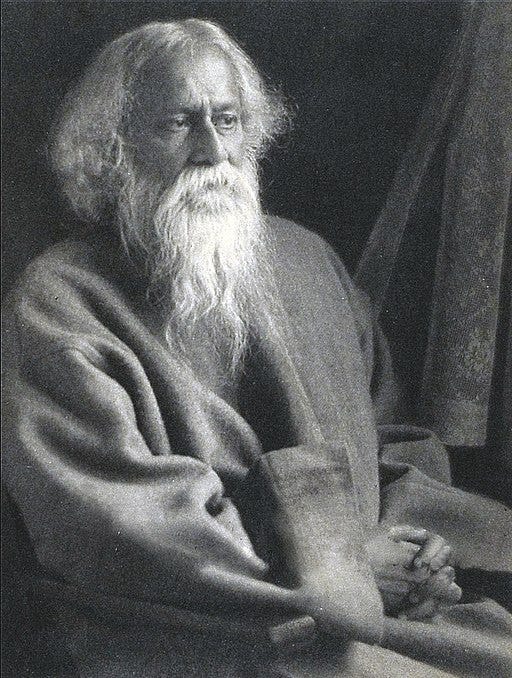
Rabindranath Tagore stands as one of the most luminous figures in world literature and intellectual history. Poet, philosopher, educator, painter, and social reformer, Tagore was not merely a writer of words but a shaper of ideas that transcended geography, language, and time. His life bridged tradition and modernity, nationalism and universalism, spirituality and humanism.
More than a century after his greatest works were written, Tagore’s voice continues to speak, softly yet insistently, to a world still grappling with questions of identity, freedom, and human dignity.
Early Life and Family Background
Rabindranath Tagore was born on May 7, 1861, in Calcutta (now Kolkata), into the distinguished Tagore family, a household deeply embedded in the cultural and intellectual renaissance of nineteenth-century Bengal. The Tagores were prominent figures in literature, music, social reform, and religious thought, and young Rabindranath grew up in an environment rich with debate, creativity, and spiritual inquiry.
Unlike many children of his era, Tagore disliked formal schooling. He found classrooms restrictive and instead thrived under private tutors and self-directed learning. This unconventional education nurtured his imagination and independence of thought, allowing him to absorb classical Indian literature, Sanskrit texts, Bengali folk traditions, and Western philosophy with equal curiosity. The seeds of his lifelong synthesis of East and West were planted early.
Literary Beginnings and the Making of a Poet
Tagore began writing poetry at a remarkably young age, publishing his first substantial collection while still in his teens. His early works reflected the romantic sensibilities of the age, yet even then, his voice carried a distinctive emotional depth and philosophical maturity.
The turning point in his literary career came with Gitanjali (Song Offerings), a collection of devotional poems that fused mysticism with simplicity and emotional clarity. When Tagore translated Gitanjali into English, the work captivated Western audiences, including poets like W. B. Yeats, who recognized its spiritual power. In 1913, Tagore became the first non-European to win the Nobel Prize in Literature, bringing global attention to Indian literature for the first time.
Yet, for Tagore, poetry was never merely aesthetic. It was a spiritual act, a dialogue between the human soul and the infinite.
Tagore’s Philosophy: Humanism and Spiritual Universalism
At the heart of Tagore’s thought lies a profound humanism. He believed that the divine was not distant or abstract but lived within human relationships, creativity, and compassion. Unlike rigid religious orthodoxy, Tagore’s spirituality was fluid, experiential, and deeply ethical.
He rejected narrow nationalism, warning that excessive nationalism could dehumanize societies and blind them to universal values. At the same time, he fiercely opposed imperialism and colonial domination. This apparent contradiction was, in truth, a carefully balanced worldview: Tagore believed in cultural pride without cultural arrogance, freedom without hatred, and identity without exclusion.
His essays and lectures, such as Nationalism and The Religion of Man, articulate this philosophy with clarity and urgency, offering insights that remain strikingly relevant in an era of global polarization.
The Poet of Love, Nature, and the Inner Life
Tagore’s poetry is deeply lyrical, marked by an intense sensitivity to nature, love, loss, and transcendence. Rivers, trees, seasons, and skies are not mere background elements in his work; they are living participants in the emotional and spiritual life of humanity.
His love poems are tender yet restrained, celebrating emotional intimacy without indulgence. His nature poems reflect an ecological awareness far ahead of his time, emphasizing harmony rather than domination. Through simple language and profound imagery, Tagore made the inner life accessible, transforming personal emotion into universal experience.
This ability to speak intimately while addressing humanity at large is what gives his poetry its enduring resonance.
Novels and Short Stories: A Social Conscience at Work
While Tagore is best known as a poet, his contributions to fiction are equally significant. His novels and short stories explore social inequality, gender roles, caste divisions, and the psychological impact of modernity.
Works such as Gora, Ghare-Baire (The Home and the World), and Chokher Bali reveal a nuanced understanding of social change and moral conflict. His female characters, in particular, are complex and psychologically rich, challenging patriarchal norms and asserting emotional and intellectual agency.
Tagore’s short stories, often set in rural Bengal, portray ordinary lives with extraordinary empathy. They examine suffering without sentimentality and injustice without moral preaching, allowing readers to confront social realities through human experience rather than ideology.
Tagore the Educator: Santiniketan and Visva-Bharati
One of Tagore’s most enduring legacies lies in education. Disillusioned with colonial education systems that prioritized rote learning and cultural alienation, Tagore founded an experimental school at Santiniketan in 1901. Here, learning took place in close communion with nature, encouraging creativity, critical thinking, and cultural openness.
This institution later evolved into Visva-Bharati University, envisioned as a meeting place of world cultures “where the world makes a home in a single nest.” The university embodied Tagore’s belief that education should cultivate the whole human being, not merely produce skilled workers.
Santiniketan remains a living testament to Tagore’s faith in education as a moral and spiritual enterprise.
Music, Art, and Cultural Innovation
Tagore was also a prolific composer, creating over 2,000 songs known collectively as Rabindra Sangeet. These compositions blend classical Indian ragas with folk melodies and poetic lyrics, forming an integral part of Bengali cultural identity.
In his later years, Tagore turned to painting, producing a remarkable body of abstract and expressionistic work. Though he began painting relatively late in life, his visual art reflects the same experimental spirit and emotional depth found in his writing.
Two of his songs went on to become national anthems, India’s “Jana Gana Mana” and Bangladesh’s “Amar Sonar Bangla,” a rare and symbolic testament to his cultural influence.
Relationship with the Freedom Movement
Tagore maintained a complex relationship with India’s freedom struggle. While he strongly opposed British rule, he was wary of aggressive nationalism and mass politics that, in his view, could compromise ethical values.
His famous renunciation of the knighthood in protest against the Jallianwala Bagh massacre in 1919 demonstrated moral courage and political conviction. Yet, he also engaged in intellectual dialogue with figures like Mahatma Gandhi, often disagreeing respectfully on issues of nationalism, tradition, and modernity.
This independence of thought reinforced Tagore’s role as a moral conscience rather than a political ideologue.
Global Influence and International Recognition
Tagore traveled extensively across Europe, the Americas, and East Asia, engaging with intellectuals, artists, and political leaders. His lectures on culture, education, and spirituality contributed significantly to cross-cultural dialogue at a time when the world was deeply divided by imperialism and war.
He remains one of the earliest truly global intellectuals from the Global South, challenging Western dominance in philosophical and literary discourse without rejecting Western thought itself. His influence can be traced in fields ranging from comparative literature to peace studies and postcolonial theory.
Death and Continuing Legacy
Rabindranath Tagore passed away on August 7, 1941, leaving behind an astonishing body of work that spans poetry, fiction, drama, essays, music, and art. His death marked the end of an era, but not the end of his influence.
Today, Tagore’s writings are studied worldwide, his songs continue to be sung, and his ideas remain central to debates on education, nationalism, and human values. In a world increasingly fragmented by ideological extremes, Tagore’s call for empathy, creativity, and universal humanism feels not merely relevant but urgent.
Why Tagore Still Matters
Rabindranath Tagore was not content to belong to one nation, one discipline, or one century. He belonged to humanity. His life and legacy remind us that art can be ethical, spirituality can be rational, and identity can be expansive rather than exclusive.
To read Tagore today is not to escape the modern world but to understand it more deeply. His voice, gentle, questioning, and luminous, continues to invite us toward a more humane future, where freedom is guided by conscience and creativity is inseparable from compassion.
In remembering Tagore, we do more than honor a great poet; we reaffirm a vision of humanity that refuses to surrender its soul.
Comments
Nothing yet. Say the first thing.
Sign in to join the conversation.