
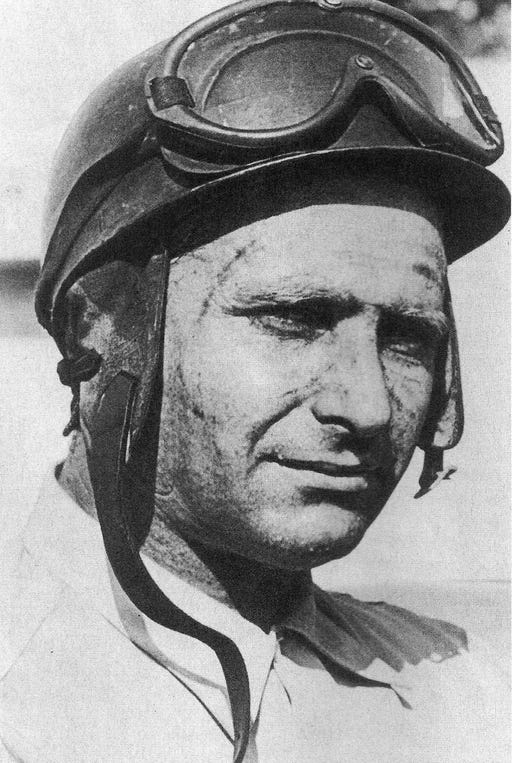
In the long and storied history of Formula One, few names command the reverence reserved for Juan Manuel Fangio. For many fans and historians, he is not just an early champion but the benchmark against which greatness itself is measured. In an era when safety was minimal, technology was primitive, and death loomed at nearly every corner, Fangio combined mechanical sympathy, tactical brilliance, and calm precision to dominate the sport in a way that still feels almost mythical.
Fangio’s story reads like a parable about discipline and patience. He did not begin his Formula One career as a teenage prodigy. Instead, he matured into excellence. His rise challenges modern assumptions about youth and peak performance, reminding us that mastery can be the product of long cultivation rather than early hype.
Early Life in Argentina
Juan Manuel Fangio was born on June 24, 1911, in Balcarce, Argentina. The son of Italian immigrants, he grew up in a modest household where hard work was a necessity. Before he ever touched a Grand Prix car, Fangio worked as a mechanic. This early exposure to engines and machinery would later become one of his defining advantages.
In the dusty roads of Argentina, Fangio began competing in long-distance road races known as Turismo Carretera. These events were grueling and often dangerous, stretching over hundreds of kilometers on rough terrain. Success in such races required not only speed but endurance, tactical intelligence, and mechanical awareness. Fangio developed all three.
Unlike many modern drivers who are groomed through karting academies, Fangio’s path was organic. He built his own workshop, tuned his own cars, and raced through sheer determination. This background forged in him a deep understanding of how a car behaved under stress. It also cultivated a humility that would remain with him throughout his life.
The Leap to Europe and Formula One
After World War II, international motorsport slowly resumed, and Fangio’s talent began attracting global attention. In 1949, backed by the Argentine government, he traveled to Europe to compete against the continent’s best drivers. It was a bold move for a man in his late thirties.
When the FIA inaugurated the Formula One World Championship in 1950, Fangio was already nearly 40 years old. Most drivers today are retiring by that age. Yet Fangio was just beginning his ascent.
Driving for the legendary Italian team Alfa Romeo, Fangio won his first World Championship in 1951. His control, smoothness, and strategic thinking stood out immediately. While others attacked every corner with reckless bravery, Fangio combined aggression with calculation.
His career would see him drive for several of the sport’s most iconic manufacturers, including Ferrari, Mercedes-Benz, and Maserati. The fact that he won championships with multiple teams speaks to a versatility rarely seen in motorsport.
Five World Championships and Statistical Dominance
Juan Manuel Fangio won the Formula One World Championship five times: 1951, 1954, 1955, 1956, and 1957. For nearly half a century, this record stood unmatched. It was not until 2003 that Michael Schumacher surpassed his total.
Even today, Fangio’s statistical record remains extraordinary. He won 24 of the 51 Grands Prix he entered, giving him a win rate of nearly 47 percent. In modern Formula One, where competition is fierce and seasons are longer, such a percentage is almost unimaginable.
His 1957 championship campaign with Maserati is often regarded as one of the greatest seasons in motorsport history. The German Grand Prix at the Nürburgring that year has become part of racing folklore. After a slow pit stop left him far behind the Ferraris, Fangio delivered a series of blistering laps, breaking the lap record repeatedly and reclaiming the lead in dramatic fashion. It was a performance that blended courage, technical mastery, and psychological resilience.
The 1950s: A Deadly Era
To understand Fangio’s legacy fully, one must confront the brutal reality of 1950s racing. Circuits were lined with trees, stone walls, and spectators. Drivers wore cloth helmets and minimal fire protection. Fatal accidents were tragically common.
Several of Fangio’s contemporaries lost their lives on track. The dangers were not abstract. They were immediate and personal. Fangio himself survived serious accidents, including a near-fatal crash at Monza in 1952 that left him with a broken neck.
Yet he did not return to racing with recklessness. Instead, he refined his approach. Fangio believed in preserving both car and self. He rarely overextended beyond what conditions allowed. His style was smooth and measured, conserving tires and brakes while waiting for opportunities.
In this sense, Fangio was not merely fast. He was intelligent. He treated racing as a strategic contest rather than a gladiatorial spectacle.
Driving Style and Mechanical Sympathy
Modern Formula One drivers rely heavily on telemetry, engineers, and computer simulations. Fangio relied on feel. His mechanical background gave him a sensitivity to vibrations, engine sounds, and tire behavior that bordered on intuitive.
Teammates and rivals often remarked on his smooth steering inputs and controlled throttle application. He avoided unnecessary strain on machinery, which was crucial in an era when mechanical failures were frequent.
This mechanical sympathy translated into consistency. While others pushed their cars into failure, Fangio often finished races by balancing speed with preservation. In academic terms, his driving can be described as an optimization strategy under high risk and limited reliability conditions.
Sportsmanship and Character
Greatness in sport is measured not only by victories but by conduct. Fangio was widely admired for his humility and sportsmanship. He treated rivals with respect and avoided public feuds.
In 1958, after retiring from Formula One, Fangio continued to serve as an ambassador for motorsport. Even decades later, younger champions spoke of him with awe. When Ayrton Senna met Fangio, he reportedly described the encounter as meeting a hero.
Fangio’s demeanor reflected his upbringing. He never embraced arrogance despite his dominance. Instead, he emphasized teamwork and gratitude toward mechanics and engineers. In a sport often driven by ego, his modesty became part of his legend.
Kidnapping in Cuba: A Remarkable Episode
One of the most extraordinary chapters in Fangio’s life occurred in 1958, when he was kidnapped in Havana before the Cuban Grand Prix. The abductors were associated with revolutionary forces opposing the regime of Fulgencio Batista.
Fangio was held captive for roughly 24 hours but was treated respectfully and released unharmed. The incident drew global attention and underscored his international stature. It also demonstrated his composure. Upon release, he expressed understanding rather than anger, maintaining a calm perspective that matched his on-track temperament.
Retirement and Later Years
Fangio retired from Formula One in 1958 at the age of 47. Few champions have exited the sport so decisively and with their reputations intact. He chose to leave at the top rather than linger in decline.
In his later years, Fangio remained connected to the automotive world, particularly through his relationship with Mercedes-Benz. He served as an honorary president of Mercedes-Benz Argentina and represented the brand at international events.
He passed away on July 17, 1995, in Buenos Aires. Tributes poured in from across the motorsport community. For many, his death marked the passing of a living bridge to the sport’s most perilous and romantic era.
Comparing Fangio to Modern Legends
Comparisons between eras are inherently complex. The sport has evolved dramatically in terms of technology, safety, and competition structure. Yet Fangio’s achievements remain compelling even when viewed through a modern analytical lens.
Drivers such as Michael Schumacher and Lewis Hamilton have amassed more championships and victories. However, Fangio’s win percentage and multi-team success in a volatile era remain unique. He proved that adaptability and intelligence could overcome technological limitations.
From a performance metrics standpoint, Fangio’s dominance relative to his peers was extraordinary. In economic terms, he operated in a high-variance environment with limited safety nets, yet consistently maximized outcomes.
Cultural Impact and Argentine Pride
In Argentina, Fangio is more than a racing driver. He is a national icon. The Museo Juan Manuel Fangio in Balcarce preserves his legacy and celebrates Argentina’s contribution to global motorsport.
His success also paved the way for future Argentine drivers and strengthened Latin America’s presence in Formula One. Long before global marketing and social media amplified driver brands, Fangio represented his country with dignity on the world stage.
For many Argentines, Fangio symbolizes perseverance, discipline, and international achievement. His story resonates beyond sport, reflecting the aspirations of a nation seeking recognition in global arenas.
The Enduring Legacy of Juan Manuel Fangio
Juan Manuel Fangio’s legacy rests on three pillars: statistical excellence, intellectual mastery, and personal integrity. He conquered Formula One during its most dangerous phase and did so with composure and grace.
In the broader history of sport, he exemplifies a form of greatness rooted in discipline rather than spectacle. His approach reminds us that mastery often lies in restraint as much as aggression.
When modern fans debate the greatest Formula One driver of all time, Fangio’s name inevitably enters the conversation. That alone is remarkable for a man whose prime occurred more than half a century ago.
Ultimately, Fangio’s life illustrates that true excellence transcends era. Technology changes. Rules evolve. Circuits become safer. Yet the qualities that define greatness, intelligence, courage, humility, and strategic insight, remain constant.
Juan Manuel Fangio embodied them all.
Comments
Nothing yet. Say the first thing.
Sign in to join the conversation.