
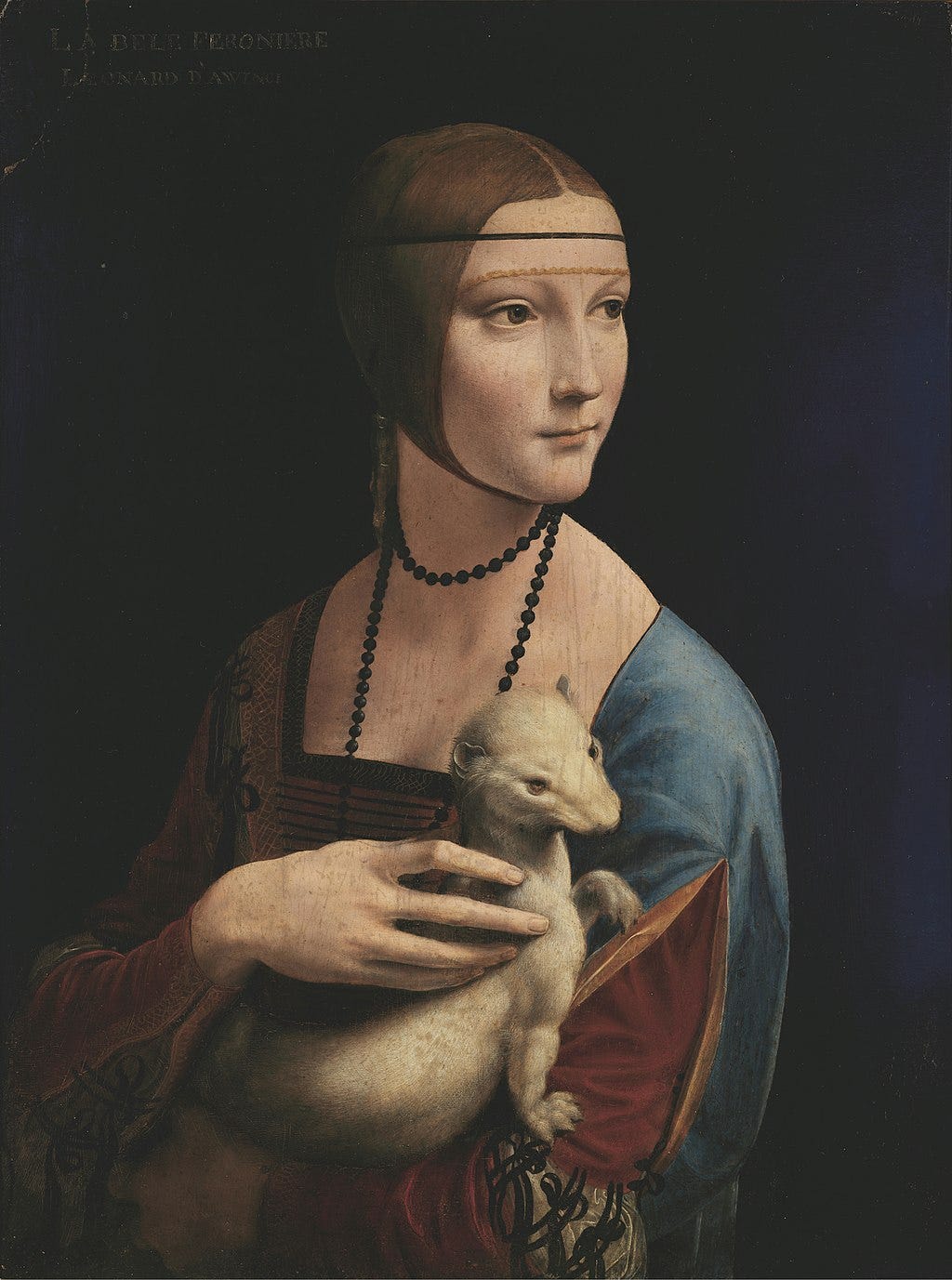
Lady with an Ermine is one of the most captivating portraits of the Italian Renaissance. Painted by Leonardo da Vinci around 1489–1491, the work depicts a young woman holding a white ermine in her arms. The sitter is widely believed to be Cecilia Gallerani, a cultured young woman at the court of Milan. Today, the painting is housed in the Czartoryski Museum in Kraków and is regarded as one of Leonardo’s finest portraits.
Unlike many portraits of the period, this painting feels alive. Rather than presenting a rigid profile, Leonardo turns Cecilia’s body in one direction while her face looks toward something beyond the frame. This subtle twist creates a sense of movement, as though the viewer has interrupted a living moment rather than encountering a static image.
A Revolutionary Portrait Style
Leonardo transformed portrait painting by introducing psychological depth. Earlier Renaissance portraits often focused on status and outward beauty. In Lady with an Ermine, however, the young woman appears thoughtful and alert. Her expression suggests intelligence rather than simple elegance.
The lighting also demonstrates Leonardo’s mastery. Soft shadows shape Cecilia’s face and hands, giving them a natural presence. This technique, later perfected in the Mona Lisa, allows flesh to appear almost lifelike. Instead of hard outlines, forms dissolve gently into shadow, making the portrait feel intimate and human.
Her hand, delicately resting on the animal, reveals Leonardo’s close observation of anatomy. Even the smallest details, from the tendons in her fingers to the texture of the ermine’s fur, show his scientific curiosity and artistic precision.
The Meaning of the Ermine
The ermine itself has fascinated viewers for centuries. In Renaissance symbolism, the creature often represented purity and nobility. It may also have referred to Cecilia’s patron, Ludovico Sforza, who had adopted the ermine as a personal emblem. Some scholars believe the animal acts as a visual connection between the woman and the powerful man who shaped her life.
The animal is not merely decorative. Its posture mirrors Cecilia’s own movement, as both seem to turn toward the same unseen presence. This shared motion creates a visual harmony that gives the composition unusual sophistication.
Enduring Power
What makes Lady with an Ermine unforgettable is its emotional subtlety. Leonardo does not simply paint a beautiful woman; he captures a moment of awareness. Cecilia seems poised between thought and reaction, inviting endless interpretation.
More than five centuries later, the painting still feels modern because it suggests inner life. It reminds us that Leonardo’s genius was not only technical but deeply human. In this quiet portrait, he turned paint into psychology, and a noblewoman into a timeless presence.
Interested in learning about other iconic artworks?
Check out the following articles:
Comments
Nothing yet. Say the first thing.
Sign in to join the conversation.