
In this workshop Adam and Katie guide you through five exercises designed to do one thing: give you a direct, personal encounter with your own style.
Not a lecture about style or a draw along session.
An encounter; meaning you leave the workout with actual drawings, actual discoveries, and at least one moment where you look at something you made and think I didn’t know I could do that.
You’ll study three of the most commercially successful illustrators — and draw tigers informed by each of their styles. Then you’ll build a paper mannequin of a tiger from cut shapes, pose it, and use everything you’ve learned to draw a final tiger in your own style.
By the end you’ll have at least four tigers. Each one different. Each one yours.
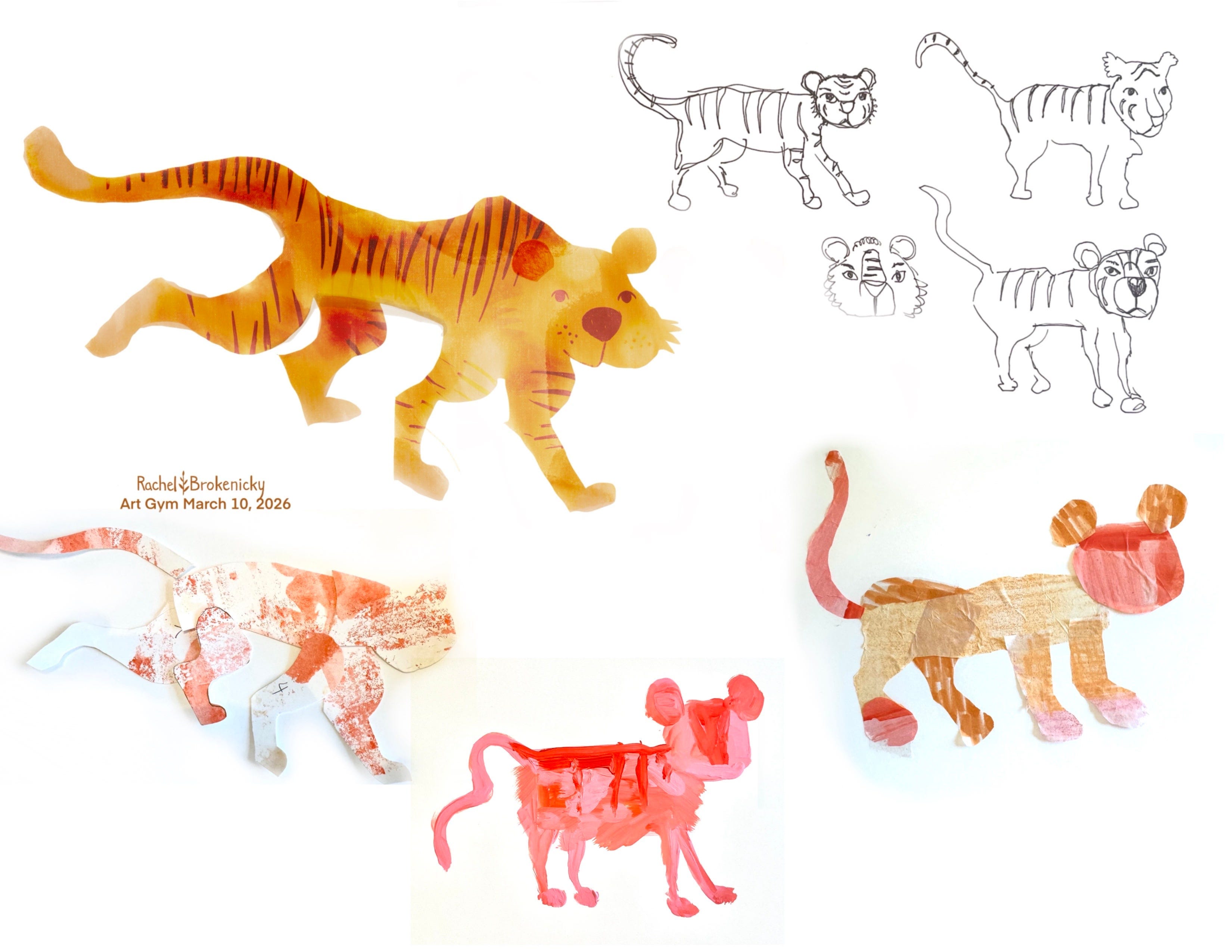
Here’s a look at all the tigers arthlete RachelBrokenicky drew during the workshop.
She worked with a variety of materials including collage, ink, and paint. How fun to use all those materials in just one hour!
Now Rachel has 4 different styles that she can use when drawing tigers or when she’s not drawing tigers… the beauty of this workshop is that it applies to any subject!
Subscribe to catch the replay so you can sketch with new styles, too:
Eric Carle — painted paper, texture, collage. He selects rather than creates. His hands work first, his eye chooses after.
Quentin Blake — loose expressive line, big paper, whole arm movement. What looks spontaneous might be the fifth attempt.
Oliver Jeffers — simple shapes, big brush, essential gesture. Constraint in one direction creates freedom in another.
Experience three of the most enduring styles in picture books — study, borrow, and combined to your own unique visual voice.
Here’s what three participants said after this session:
Shipra arrived late — her toddler had just gone to bed. By the end she was drawing tigers that danced, inspired by Indian folk art traditions she grew up with. She said the session started tentative and ended joyful.
Jill discovered something she didn’t know she needed: animals with tiny feet. “I would have never known how much I needed that without this Art Gym.” She giggled through the whole session and left with drawings she loved.
Brenda tried butter paper for the first time and found herself in completely uncharted territory. “It’s like I was on a new machine — and tomorrow I’m going to hurt a new muscle.” That’s exactly what a good workout feels like.
Use the chapter markers below to jump to any section:
Welcome and materials prep
Studying Eric Carle — texture and painted paper
Exercise 1 — painting tiger textures on butter paper
Studying Quentin Blake — loose expressive line
Exercise 2 — drawing a tiger in Quentin Blake style
Studying Oliver Jeffers — simple shapes and big brush
Exercise 3 — drawing a tiger in Oliver Jeffers style
The paper mannequin method explained
Exercise 4 — cutting and posing your paper mannequin
Exercise 5 — drawing your final tiger in your own style
Gallery share — participants show their work and reflect
Total runtime: 1 hour 56 minutes (including sharing)
You can’t pick a style the way you pick a pair of shoes — it has to emerge from doing
“You can’t find your own voice without being influenced by other artists” - Lisa Congdon
Style has layers — the materials you use, the way you draw a line, and most importantly, the way you think
Finding the right material often unlocks your style — once the material feels right, the style follows
Your failed copies of other artists’ styles become your own style anyway
When looking at an artist’s work, note: the lines, the shapes, the colors, the textures, and the attitude
Quentin Blake works really big — moving his whole arm, not just his wrist — try it
Quentin Blake makes multiple attempts — what looks spontaneous may not be the first try
Oliver Jeffers recommends using a bigger brush — it forces simplicity and captures essence over detail
Eric Carle selects rather than creates — he makes painted papers first, then chooses shapes from them
On the Paper Mannequin Method
Break your subject into 7 simple shapes and cut them out with scissors
“Draw with your scissors” — the irregularities become part of the style
Pose your shapes before drawing — you’ll find poses you’d never imagine from your head
The inefficiency of working with paper is what makes it good — it slows you down in the right way
Butter paper (baking/parchment paper) is slightly transparent — overlapping colors create depth automatically
Working with a limited palette forces interesting decisions — constraints create style
Spoiled brushes with hardened bristles create great texture
Leftover paint? Create texture papers — paint scraps become future collage material
If you feel tight, work bigger — bigger paper, bigger brush, bigger movements
Things don’t have to be right the first time — do drafts, throw paper away, try again
The collage forces commitment — once you cut, that’s the cut. It removes overthinking
Flattening your digital layers can help you get into flow — fewer decisions, more drawing
“Make a mark and let that determine the next mark” — stop planning, start doing
Set up your sketchbook with notes on one side, artwork on the other — three artists, six pages
Share your work even when you don’t like it — other people see things you can’t
Try something you hate — knowing what doesn’t fit you is valuable style information
The goal isn’t to finish — it’s to fill pages and pick up what works
Share your work in the Art Gym Gallery!
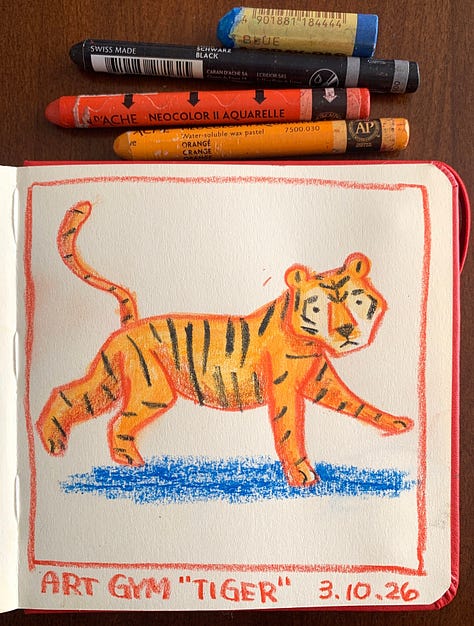
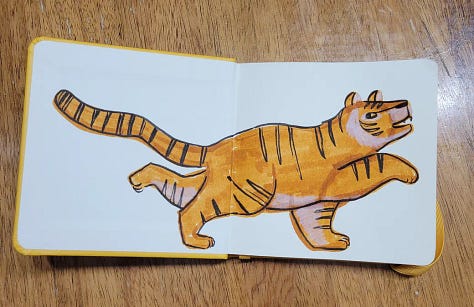
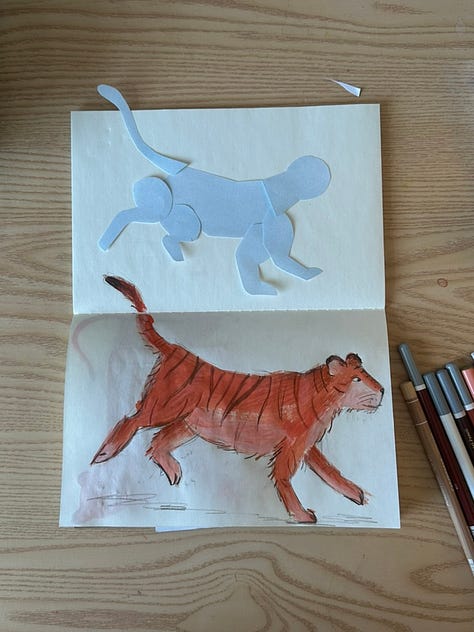
Here’s some work by Yumiko Kitazono, Alicia Fairbourn, and Katie Stack
Want your art featured in the gallery? Join the next live session or watch this replay and submit your work. You can showcase your art here:
Add your art to the Tiger Gallery
Art Gym publishes a new live workshop every month.
Strengthen your art muscles with monthly, skill-based workouts!
When you subscribe to art gym you will get instant access to this workshop PLUS
Upcoming live workshops
12 workshop recordings
All the galleries
A community of artists committed to their practice
See you at the Art Gym! 💪✏️
Live workshops are scheduled every month, and replays are available for past sessions.
Monthly — $25/month
Annual — $125/year (equivalent to $10.42/month — you save $175 vs paying monthly)
Comments
Nothing yet. Say the first thing.
Sign in to join the conversation.