
When I first started drawing regularly, in 2020, I would position each sketch on its own page, or even within little penciled-in squares on a single page. These strictures kept things oppressively tidy, and — honestly — a bit boring, both to make and to look at.
The choice to draw between the lines was in part driven by my avoidance of sketchbooks that looked like books. Meaning, ones that were stitch-bound. These seemed like such serious places to create, and like they should only be used by real artists. I stuck mostly to spiral-bound pads.
As I drew more and got braver about taking up space in my sketchbooks, it started to feel so interesting to me to begin a drawing on one page and have it end up on another. It helped that I had begun using my first ever Art Creation sketchbook, which afforded me the experience of a bound book without the pressures of something expensive.
And as I discovered how I liked to work with multiple media, and transitioned to some of my all-time favorite sketchbooks (made by Stillman & Birn), the trend continued:
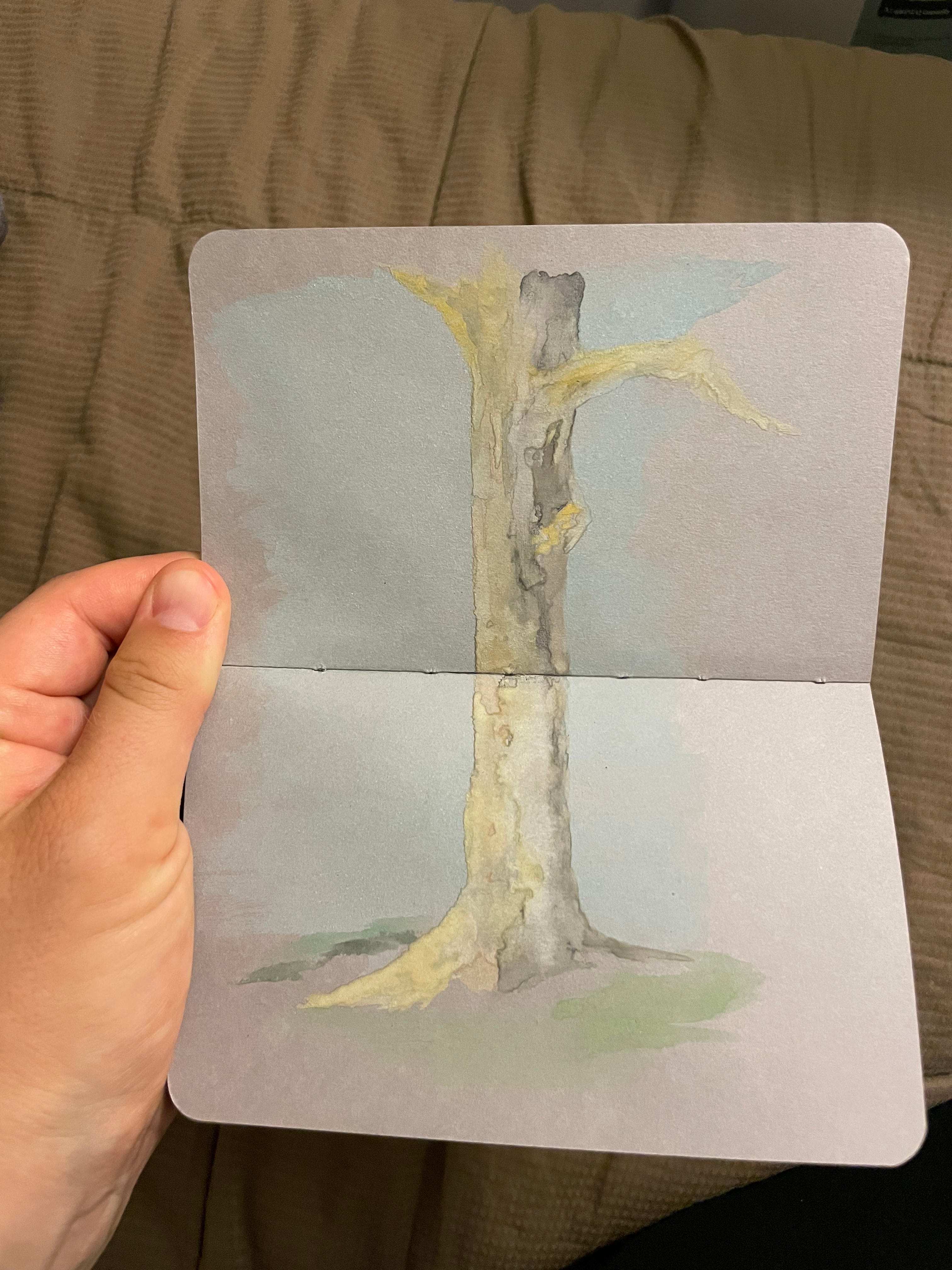
You can even use the gutter as part of the composition, as I did with this watercolored marestail. In this case, it looks like it’s growing out of the sketchbook’s center in the same way you might see an industrious plant growing out of a sidewalk crack:
Of course, using the gutter in these ways isn’t just a me thing: start looking for it, and you’ll see artists doing it all the time.
But why is this so pleasurable? Is it the rebellious thrill of literally crossing a line? Or the satisfaction of filling a whole spread? Was it the different orientations of sketches that become possible outside the boundaries of a single page?
I asked about this on Substack Notes. had similar questions to the ones I’d been asking: Maybe it’s that “bigger drawings seem impactful?” she asked. Or that we finish sketchbooks more quickly, filling two pages with one drawing?
brought up the sad fact that pages made in this way will rub together when the sketchbook is closed, or when more art is made further in the book. This is definitely a downside. (Whether materials transfer, though, also has to do with what you’re using, how you’re using it, and if you seal the pages or put paper between them when you’re done.)
It was ’s comment, that working across the middle “makes the illusion more real,” that really got me thinking.
In the beginning, a lot of us want our work to be “realistic” — like photographs, even — to prove to others, and ourselves, that we can do what we think artists are supposed to be able to do: reproduce images from life.
But this isn’t what I want art to do, or what I want to do as an artist. It is making the illusion real that matters to me, and I’m so glad Joseph brought this up.
Let me explain: What I think art should do (whether visual or not), is convey for the person receiving it a bit of the experience of its making, as well as a narrative born of a very specific way of seeing. Let’s look at the drawing I shared at the start of this post, zooming in on some specific aspects:
When I take the above sketch apart, it doesn’t look like much. There are pleasing marks (the bendy-ness of the pine’s trunk, for example), but I don’t think they’re the big reason that making this drawing brought me so much pleasure.
I was out on a walk when I drew that little pine, interesting myself in my very ordinary surroundings—apartments, overused landscaping plants, bark-covered soil. This is what I do most days: go out for ten minutes or so and take little mental notes about who else is out with me (recently: cedar waxwings), what’s changing, how the sky looks. Then, I try to convey that interest on paper.
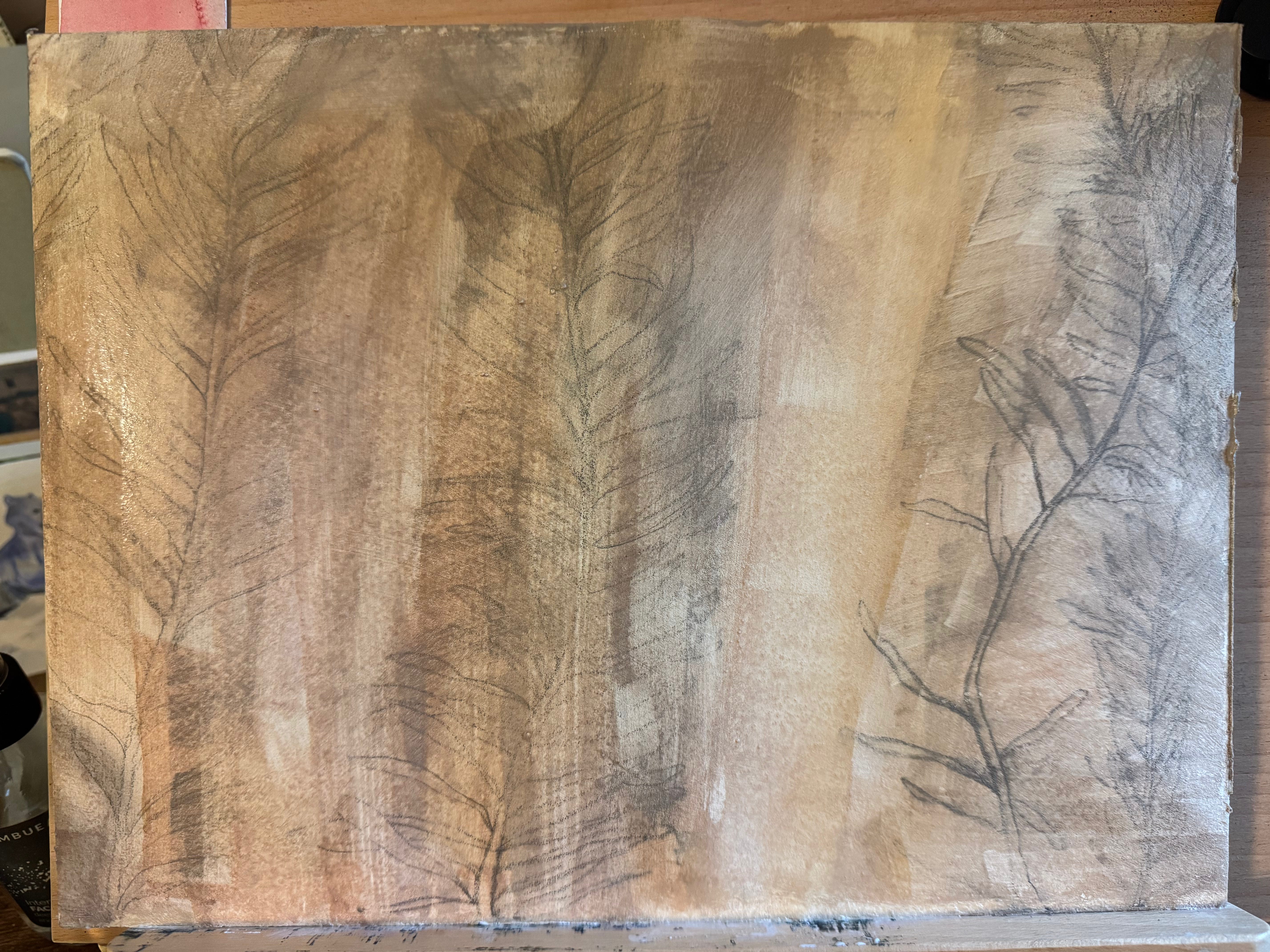
It’s the quality of open interest, the let’s just see where this ends up, that pulls me into the acts of making and looking, and into drawings that span multiple pages. It’s the illusion of something real that comes from pairing marks on a page with feeling.
Using the gutter, either as part of your composition or as an obstacle to cross in order to make a larger or more interesting image, is just one way to create interest for yourself and for others. What’s important is finding the processes that give you that feeling of, oh, wow, I have to see where this ends up!
What acts of crossing, whether figurative or actual, keep you interested in your work? I’d love to hear in the comments!
Comments
Nothing yet. Say the first thing.
Sign in to join the conversation.