
Lately I’ve been thinking about the question: Is it necessary to have a personal brand as an artist? Mostly, I’ve been thinking about it in relation to myself: On Substack, I notice the most successful newsletters are constantly promoting themselves through notes, Instagram posts, TikToks, and chats that allow their audience to get to know them and, in turn, grow.
I often think, I should do that. And then I don’t when I realize the amount of hard work, confidence, and perseverance it takes. I was taken by how pertinent Nadine at The Stanza’s recent newsletter was on the subject. She wrote:
Therefore, posting videos of myself talking to the camera and writing a newsletter felt massively cringe! I remember feeling my stomach sinking whenever I heard that an old colleague was gossiping about me behind my back or when I would receive hateful comments. If I could tell anything to my former self in those moments, it would be this: “It’s cringe until you’re successful.”
Is it necessary as an artist to have a personal brand? Not at all. There are many successful artists who make it on talent alone. But it’s also a competitive market, meaning if you have what it takes to push through the trepidation—the feeling of being cringe—and craft a personal brand, your career might flourish.
I’m going to keep fleshing out these thoughts in upcoming newsletters. In the meantime, I want to share an essay I wrote last year for The Walrus on the subject, exploring how Anna Weyant, Jeanine Brito, and Chloe Wise have carefully crafted online personas that blend into their paintings and become performances in their own right. I respect what they do so much.

How Instagram Upended the Art World
Sex, blood, and perfectly lit fruit
When you google the wunderkind painter Anna Weyant, the suggested searches are as follows: “Anna Weyant Larry Gagosian relationship” (referring to her dalliance with the now eighty-year-old world-famous art dealer and gallerist her detractors say launched her career); “Anna Weyant Jason Isbell” (the more age-appropriate singer she’s moved on with); “Anna Weyant age” (only thirty); “Anna Weyant net worth” (somewhere in the millions, it’s speculated); “Anna Weyant art for sale” (certainly unaffordable and unavailable). It’s notable that when I looked her up, it wasn’t until the fourth or fifth suggestion that art was included. The flurry around Weyant has become less about her paintings and more about her.
It’s rare for a contemporary painter to get enough attention to garner online gossip, but Weyant stands out as an anomaly with an outsized place in the public imagination. Not only is she the youngest artist to be represented by Gagosian, the mega gallery owned by Weyant’s former beau, but her paintings have sold for millions of dollars at auction. (While Weyant grew up in Calgary, she’s never had a commercial gallery show on home soil. Instead, with a hop, skip, and a jump, she landed in the biggest art markets in the world in New York City.) On Reddit, posts about Weyant usually invoke mixed feelings: either “right place, right time” or “her art wouldn’t be selling for millions if she wasn’t sleeping with Gagosian.” People don’t know how to feel about the artist. There’s a tinge of misogyny to all of this discourse—sometimes overtly and other times more insidiously.
Weyant has been part of a recent shift in the art world to figurative, representational painting—which aligns with the rise of identity-based art that gained prominence at the turn of the twenty-first century. Artists like Jennifer Packer, Jordan Casteel, Salman Toor, and Jenna Gribbon paint their everyday lives, capturing intimate scenes of their friends and lovers. This marks a return to the realist paintings of the nineteenth century—think Gustave Courbet and Jules Breton—combined with some conceptual strategies borrowed from postmodernism, like self-reflexivity and identity politics.
It’s a style also informed by Instagram: just as the app’s algorithm rewards images of people and faces, paintings of these subjects also tend to do well. Instagram has upended the way the art world operates, accelerating the speed at which an artist’s career can grow and allowing artists to gain visibility. It’s also changed the content of the work itself: images must be flattened from a living, breathing piece of art into a collection of pixels to ensure they look good in the tiny real estate of a grid.

In the past few years, I have noticed a new talking point in the art world. For the first time, when viewing a painting, people are concerned with how it compares to its online counterpart. “The painting looks better online,” gallery goers will often say to me, if not: “It’s so much better than on Instagram.” For artists, this means a certain amount of opting in to the game determined by tech companies.
Painters like Weyant blur the line between influencer and artist, and she is equally adept at both. The roles of artist and influencer—one antiquated and one just emerging—feed off and inform each other. Artists currently must ask themselves: How do I ensure my paintings hold up when looked at in person? And what will my painting look like next to a Dove ad?
I follow Weyant on Instagram, where she has amassed a following of over 175,000—not only for her paintings but for people to see her outfit pictures, where she’s dining out, and snaps of her similarly successful group of friends. The latter are often her muses. Eileen Kelly, the podcast host and sex educator, often sits for Weyant’s paintings. For one of the December 2024 covers of Vogue, edited by Marc Jacobs, Weyant painted model Kaia Gerber. Weyant herself could be a model: thin, beautiful, and blonde. She wears designer clothes. Her teeth are perfectly straight and white.
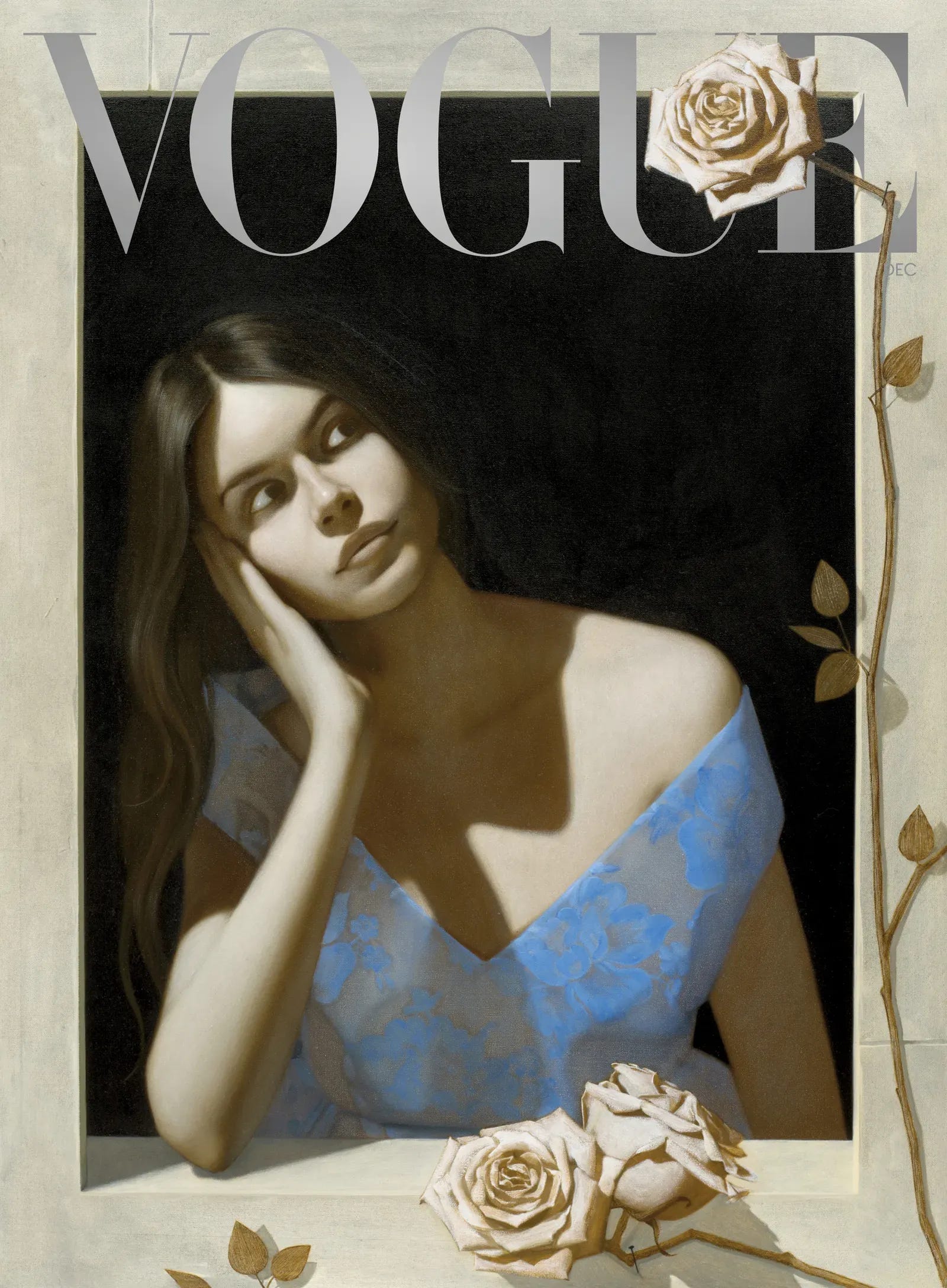
Weyant’s paintings are similarly traditional and flawless. They take after the seventeenth-century Dutch masters—a contemporary version of Vermeer with stark chiaroscuro, anatomical accuracy, and deftly painted fabrics. The subtle colour palette is executed with precision, and the texture appears to have aged over time, so that looking at her work makes it feel as if you were looking at a painting at the Met. Weyant often sticks to painting realistic vignettes of everyday life: a rendering of a string of pearls on a monotone backdrop, a woman behind a window with the curtains pulled so only her perky breasts are visible, her side profile, mid-conversation, titled Loose Screw. In other paintings, Weyant drops her exacting style and paints the figures like cartoons. Throughout her work, there’s a specific thread of feminine melancholy that’s relatable, if not hyperbolic. By using her life as content for her paintings, Weyant reclaims the attention she receives for her benefit.
Weyant isn’t the only artist who imbues her paintings with autobiography. Chloe Wise and Jeanine Brito, both painters on a steep upward trajectory who happen to be Canadian, straddle the line between artist and public persona—digitally savvy in a way that allows their work to transcend the art world and enter the mainstream. People follow them without necessarily being part of the art world—each artist has collaborated with fashion brands, the likes of which include Jacquemus and Dior, and Brito and Weyant have had their paintings on the covers of books (Weyant has also painted a cover for The Paris Review).

The success has taken the form of tens of thousands of Instagram followers each—at current count, Weyant has 179K followers, Brito has 15.9K, and Wise rounds in at 212K—solo exhibitions around the world, and features in publications like Vogue, Maclean’s, and GQ. The focus of these features often extends past their art and into their personal lives—with commentary about who they’re dating or what their favourite snack is. By inserting themselves into their own work, artists are able to appropriate people’s fascination with their personal lives and create a meta commentary. This type of agency has the added benefit of often increasing the market value of their work in an industry that prioritizes the artist as a celebrity.
…
Comments
Nothing yet. Say the first thing.
Sign in to join the conversation.