
When Gustav Klimt was beginning work on “The Maiden” (his main masterpiece from the year 1913) - there was a rumour circulating around his home city of Vienna that the Devil was wandering the streets.
And in fact, there may well have been more truth to this story than anyone at the time could ever have believed.
You see, for a few months in 1913, the city of Vienna was also home to Joseph Stalin and Leon Trotsky - both of whom were in their mid thirties and currently on the run, but each plotting a revolution that would change the course of Russian history.
And at the same time - only a mile north of all the cafes and bars that Stalin, Trotsky, and Klimt himself would have known so well - a 24 year old failed art student by the name of Adolf Hitler was also living in Vienna- battling a familiar sense of humiliation because, once again, his recent application to the Vienna Academy of Fine arts had been rejected.
_
So it is crazy to think of these men all in the same place at the same time - perhaps even sitting with their backs to each other in the same bars, or passing each other on the streets without even a second glance.
And incidentally, it’s also worth throwing into this mix names like Egon Schiele, Sigmund Freud, Josip Broz Tito, and Archduke Franz Ferdinand too (the Man whose assassination would be a key catalyst for the outbreak of World War I only a year later) . . . all of whom were also residents of Vienna in 1913.
_
Thus, in this unbelievable melting pot of art, science, philosophy and politics - and with all these unconscious influences of beauty, anger, ambition, passion, hope and fear . . . we have a city where revolution (in every sense of the word) really was on the air.
But while it would take an entire book to fully explore every character and every element of this one year in Vienna . . . I can’t help thinking that Klimt’s masterpiece captures the unique energy of that time so powerfully.
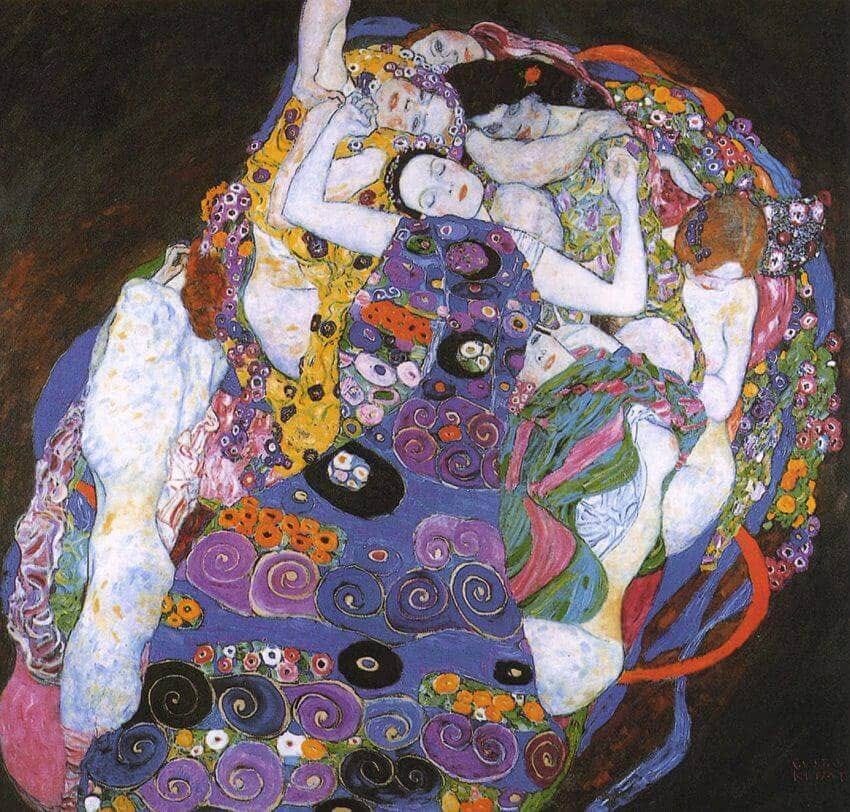
Beautiful and grotesque.
Graceful and awkward.
Bright and dark.
Erotic and yet somehow repressed or stifled too.
In short, The Maiden seems to embody every contradiction of its era. And while some may see it as the ultimate symbol for idolizing beauty and purity . . . for others, it has a strangely foreboding feeling too, as if predicting the death and destruction that was about to come to Europe.
But of course, this ability to evoke an entirely different emotion in every viewer is at the very heart of what makes the work so powerful.
And even if we know nothing at all about the time it was created in, or the city Klimt called home. . . still, this feeling of ethereal and psychological elements combined are what make this one of Klimt’s most captivating visions.
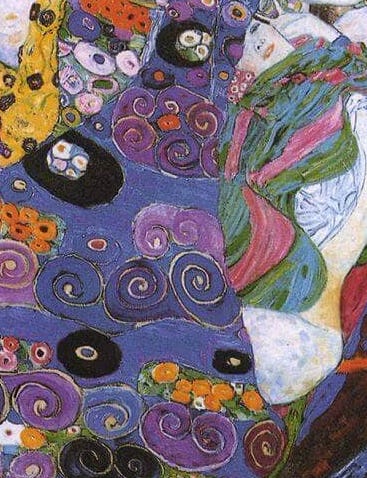
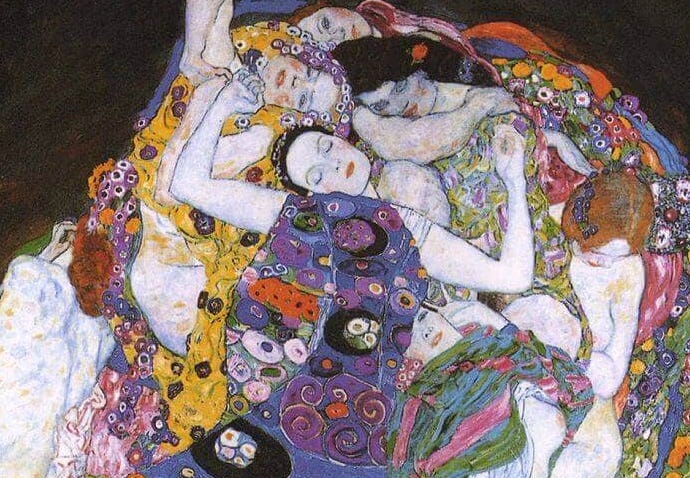
In essence, we are given a story of change and of expansion. Only, it is up to us as individuals to decide what kind of change we are actually seeing.
Is it physical or spiritual?
Are we seeing the stages of human life - or the expansion of the universe itself?
Are the figures embracing these colours and patterns - or drowning in them?
Are the surrounding dark corners being pushed away - or are they closing in on us?
Is this a beautiful dance - or a story of fear, as the world passes from one generation to another?
And, perhaps the most fundamental question of all . . . is this a change for the better - or for the worse?
_
As always, there is no right or wrong answers to any of this. But please do feel free to leave any of your own thoughts and interpretations in our friendly comments again today.
Thank you for reading Art Every Day. All comments are welcome as long as they are shared in our usual spirit of kindness and respect.
If you enjoy my work, and want to help support the future of this newsletter, please do consider becoming a free or paid subscriber for as little as $5 per month ($50 for the entire year)
As a solo writer with no other support, all your contributions really do help immensely. And a special thanks again to all of you who do subscribe / donate / support in any way.
Comments
Nothing yet. Say the first thing.
Sign in to join the conversation.