
Hey there — I’m Colin, writer at The So What and co-founder and CEO of Artemis Ward. Welcome to my column, where I write about brand strategy and adaptability. Read on for the “so what” of the Knicks championship and the World Cup.
About a week ago, a Bronx-born woman, the daughter of Puerto Rican immigrants, sat on a New York City subway car and proclaimed that you can’t be a New Yorker unless you were born there. Half the Internet agreed. Half absolutely lost their minds.
Why did J.Lo’s hot take hit so hard?
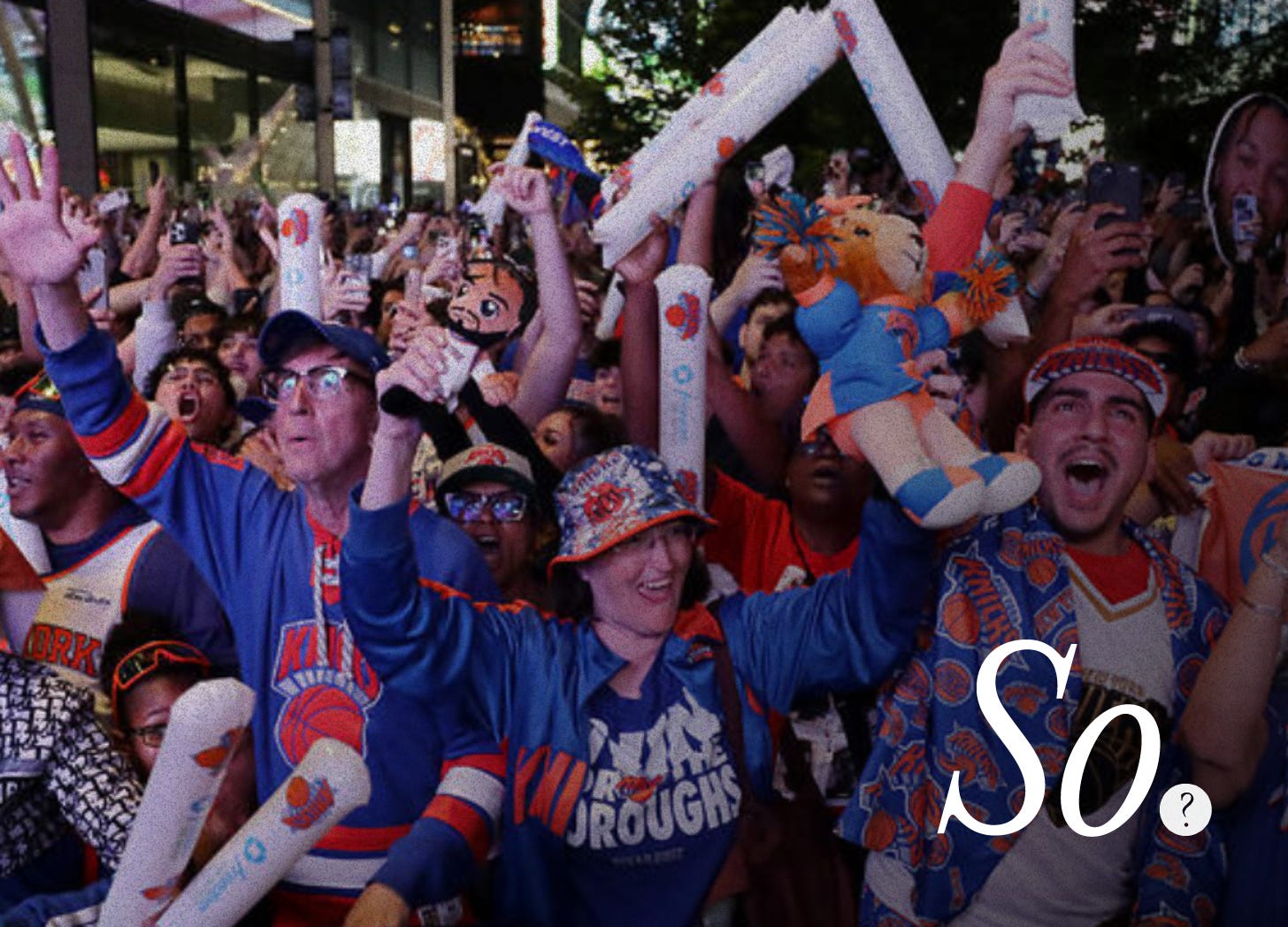
First of all, we need to understand the context of the moment. This video dropped days before the New York Knicks were set to play game three of the NBA finals back in New York. The Knicks hadn’t been in the finals since 1999, so tensions were naturally high. At the same time, this conversation was playing out amidst the backdrop of the FIFA World Cup, where 47 nations visiting North America are playing 104 matches over the coming weeks. If you were looking to celebrate or mourn some part of your identity, this summer is certainly a good moment for it.
Especially since we are currently living in what some are calling a “connection recession.” The institutions, places, and narratives that have always given us a sense of belonging have been eroding faster than they can be replaced. National identity can be confusing or complicated. Church membership continues to drop. And the post-pandemic workplace is a shambles. This leaves people searching for connection, that all-important feeling of belonging. And where’s an easier place to find connections than sports teams?
Connection can often come from shared suffering, too. Speaking of, let’s go back to the Knicks for a second. Twenty-five years of shared agony is something that is endured together. It can become a big part of your shared identity, and it’s a long enough period of time for it to be passed down to the next generation. A gift of suffering generously handed from parent to child. It’s also why J.Lo saying you have to be born in one of the five boroughs to be a New Yorker can resonate with people. Identity is more powerful when there is scarcity to it. It’s even more special when not everyone can claim it. Especially in a larger cultural moment that feels so contentious and confusing, for better or for worse, people look for the hard edges to bind themselves together. If you didn’t wallow in yearly disappointment for a quarter century, you didn’t earn inclusion into the club.
Connection can be about defiance, too. This is evident in Boston ahead of the Scotland group stage World Cup games. The Tartan Army has arrived with their kilts and bagpipes and have joyfully taken over the city. Not content with winning their first game, 5,000 Scots also took over a Red Sox game and essentially sang in unison for nine innings. Scotland never makes it out of the group stage and everyone knows it, but they know the party is the point regardless. Meanwhile, in Mexico City, Mexican team fans easily sold out Azteca Stadium for their first game. Their fans had no problem paying high ticket prices to represent their team at a historic site that hosted one of the most mythic moments in World Cup history — Maradona’s Goal of the Century in 1986. Meanwhile, the US Men’s National Team game was sitting with thousands of unsold tickets days before kickoff. Scottish and Mexican fandom is inherited, but the U.S. fandom is still being built.
So what does this summer of sports really mean for brands — and how can they join the party? Because we’re in a connection recession, people are searching for belonging, but simultaneously scrutinizing it as well. Whether connection is built on suffering, defiance, or shared identity, communities develop a sharp instinct for who belongs and who just showed up for the highlight reel. This especially applies to brands. You can choose to glom onto cultural moments for your own benefit or you can find synergies between your brand and communities that already exist.
A great example of this around the Knicks was the collaboration between the team and the beauty brand Saie, an official sponsor of the Knicks and the New York City dancers and the first-ever beauty brand to become an exclusive sponsor of the team. At first glance, it’s a surprising pairing, a clean beauty brand stepping into the center of basketball culture at Madison Square Garden. So what right does it have to be there?
You could argue, like J.Lo, that Saie earned it on geography alone because they’re a New York brand. But I’d argue that’s not enough.
What Saie did was dig past the surface and find the part of their identity that genuinely mapped onto who was actually in that building. Women have been in the stands at Knicks games forever, consistently present, yet consistently overlooked. In a way, that fanbase is not so different from the Knicks themselves, a team that had been there, waiting, long before their championship moment arrived.
Take it from the Saie team themselves:
Laney looked around at the crowd — all these women, completely locked in, completely lit up — and realized: not a single brand was talking to them directly. That realization became a lightbulb moment.
That lightbulb moment, I’d guess, was that the women in MSG had been through their own kind of drought — waiting for a brand to pay attention to them. Saie understood that Knicks fans were a community, not just an audience. That distinction matters more than it sounds. Audiences are assembled, but communities organically exist. Typically, brands build audiences, not communities, but they certainly can discover them, recognize them, and find authentic ways of lending them a hand.
The Knicks just won the NBA Finals for the first time since 1973. If you’ve been a fan throughout the drought, you don’t need anyone to explain what that means to you. And if you haven’t, no amount of explanation will suffice. That connection — between people who lived it and people who watched it — is exactly what brands need to understand about the moment.
This summer of sports is really a stress test for belonging. Who’s here, who’s earned it, and who’s just showing up for the highlight reel. In a connection recession, people aren’t just hungry for belonging; they can also be protective about it. They notice who shows up in important moments, and why. In Saie’s case, they looked around MSG and noticed women in the crowd that every other brand was ignoring. So they celebrated them.
So, if we return to J.Lo’s hot take, no, you don’t have to be born in New York to be a New Yorker. Or to be a Knicks fan. Or even to be a Knicks sponsor. But you do have to know what it means to show up and belong.
The brands that break through culturally this summer won’t be the loudest or the most clever — they will be the ones that understand that the celebration only means something because of everything that came before it.
✉️ If you haven’t yet subscribed, hit that button below so you don’t miss the next one with Chris Maier.
Read more from Colin:
And don’t miss last week’s post from Quinten:
Comments
Nothing yet. Say the first thing.
Sign in to join the conversation.