
Hi everyone! In case you’re new here, I’m Olivia, writer at The So What and director of content at Artemis Ward. Welcome to my monthly column, where I explain what’s going viral and why it matters for your work.
Read on for “the so what” of the influencer wedding nobody saw coming.
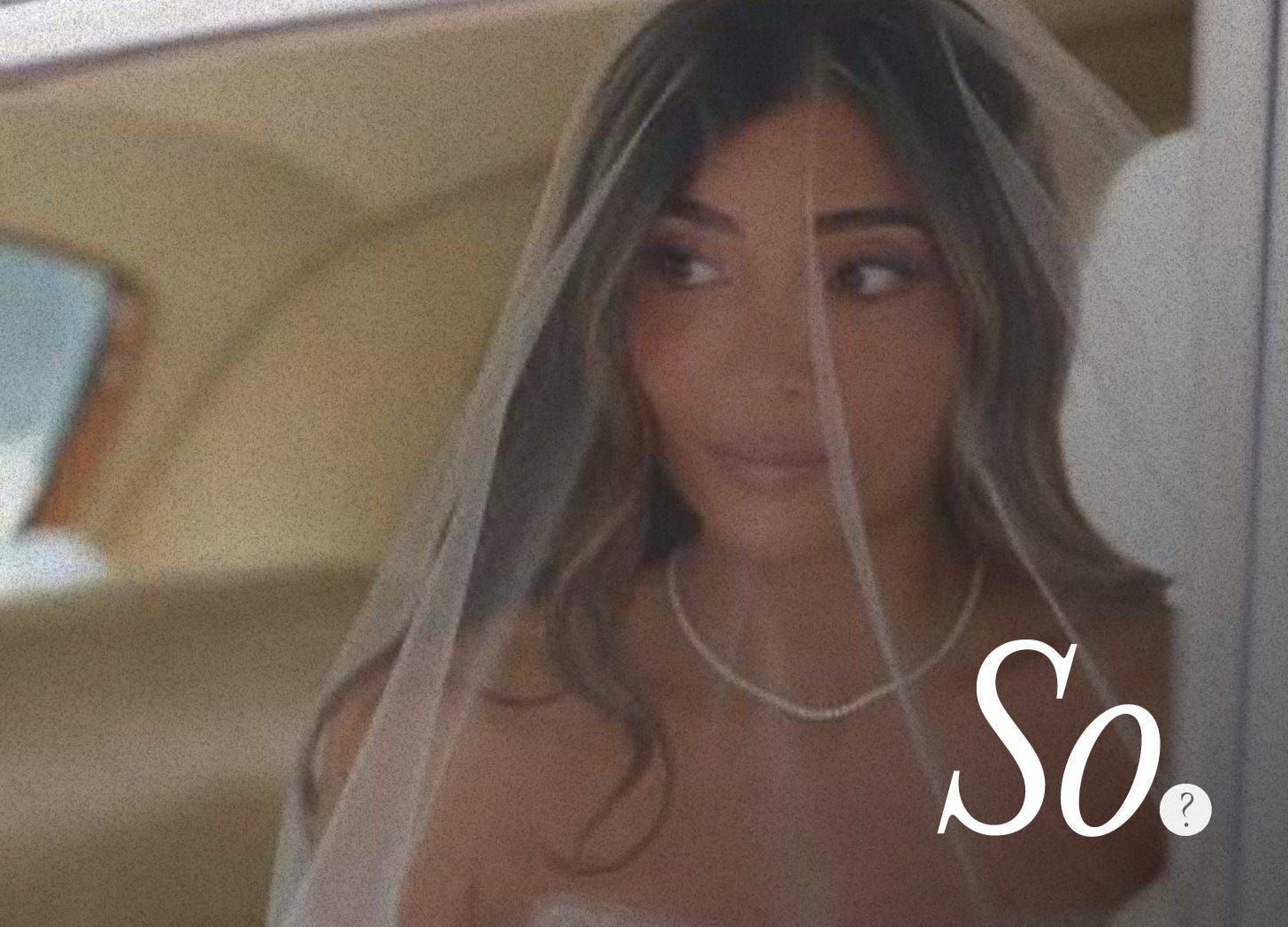
A secret wedding just broke the internet. And no, much to my dismay, it wasn’t Taylor Swift and Travis Kelce’s.
Rather, about a week ago, British lifestyle creator Amelia Liana announced she was married. Which shouldn’t have been that crazy — after all, isn’t that the circle of life? Fall in love, get married, post on Instagram? — except for the fact that, based on everything Liana had ever posted, she wasn’t dating anyone, let alone engaged. And the fact that none of her wedding photos featured her husband. (We still don’t know who he is, unless you’re part of the Reddit faction that claims to have tracked him down via some good old-fashioned LinkedIn stalking.) And, perhaps most crucially: Liana’s whole brand is being a proudly single woman in her thirties, navigating the dating world and building a beautiful independent life, one luxury shopping vlog at a time.
So, needless to say, the wedding announcement came as a surprise — and was met with mixed reviews across Instagram, TikTok, and Reddit. Many people were happy to see an influencer keep their private life private.
“If this true it’s the coolest way to announce a weeding” [sic]
“OMG, in a world where people announce the relationship, engagement, wedding, baby, house, and even the divorce in 47 parts… Honestly, that’s the flex. Keep some things private. We don’t need a Netflix series for every life update.”
“Hot take but it’s really refreshing to see someone who profits from social media not monetize the living **** out of their wedding like everyone else…some moments are best enjoyed in private. I didn’t post my own wedding photos. My husband doesn’t use social media either. I kind of love that she did it like this.”
Others were more skeptical, questioning whether Liana’s lack of sharing was a decision to protect her privacy or a strategy to earn her more engagement.
“At first I was really happy for her but the sheer volume of videos made to trending sounds is astounding. Did she just stand around and do this her entire wedding day? How sad.”
“Twenty four (24!) posts since she announced getting married 5 days ago and not one featuring her husband… this is genuinely weird and I’m kind of turned off from all of it now.”
“She is rakingggggggg it in by doing drops like this. Her engagement has never been this high ever. I respect keeping it private but I’m saying now that she is posting it’s weird that she only posts herself.”
Regardless of which side of the split you fall on, the reaction to Liana’s announcement is so divided because we aren’t used to seeing this kind of restraint from influencers. Take Jazmyn Smith, for example. One year ago, the New York-based influencer documented her entire wedding weekend across dozens of posts alongside her influencer besties, earning a People exclusive for her real-time posting strategy. Or take Brigette Pheloung, better known as @acquiredstyle, who, just two months ago, transformed her bachelorette trip (aptly named Acquired a Husband) into a fully branded content event. Over the course of the five-day celebration, she posted almost constantly while spotlighting Swan Beauty, the AI-powered smart mirror company that funded the festivities and flew her guests to St. Barths on a private jet.
If we take Liana at face value, her announcement may reflect a broader shift in how influencers create content about their personal lives. Rather than documenting every milestone as it happens, some creators seem to be reclaiming a little distance between living the moment and posting about it. Just a few weekends ago, another New York City influencer Eli Rallo went dark during her wedding weekend. After months of sharing every detail of the planning process, she hired a dedicated content creator, stepped away from her phone, and returned about a week later with a carefully curated recap. Even Pheloung, the bachelorette phenom, waited nearly three weeks before posting content from her intimate wedding ceremony. And yet, neither creator sparked the same kind of polarized response as Liana. Which raises an interesting question: if all three creators chose to share less, why did only one provoke such a strong reaction?
Because, I’d argue, the real story isn’t about privacy at all. Rather, it’s about the integrity of Liana’s personal brand. More specifically, it’s about what happens when the identity at the center of a creator’s brand no longer matches the life they’re actually living. And those are two very different conversations — with very different implications for anyone attaching their brand to a creator’s.
Spend five minutes on Amelia Liana’s channels and a clear theme emerges. Her YouTube catalog is full of titles like LOSING FRIENDS, SINGLE IN MY 30s & LIFE UPDATE Q&A (3 months ago) and WHY I DON’T TALK ABOUT DATING (1 month ago) — years of content about navigating loneliness, independence, and dating in your thirties. (Several of these videos, we now know, were posted while she was engaged, if not married.) On TikTok, the framing is less explicit but still recognizably from the same world: luxury shopping hauls, GRWMs, lifestyle snippets, and the occasional cheeky, trend-driven video that leans into the aesthetic of “single girl living,” even if it isn’t explicitly stated. Taken together, this content builds a very specific identity (what I’d call luxury through independence), a version of adulthood where success, freedom, and aesthetic fulfillment are constructed on your own.

 Tiktok failed to load.
Enable 3rd party cookies or use another browser
Across YouTube, TikTok, and Instagram, Liana has built a cumulative audience of roughly 2 million followers who show up for that specific story: the relatable yet aspirational idea of a woman navigating her thirties independently. And that’s what makes the fallout from her wedding more than the average influencer controversy. The parasocial relationship at the center of influencer marketing depends on a simple belief that you are being let into a real life, not a constructed one. In Liana’s case, her audience was investing in her specifically, rooting for her dating life, relating to her loneliness, and seeing pieces of themselves reflected in what they understood to be her lived experience.
So the backlash isn’t really about the fact that Liana got married (like I said earlier, people fall in love, get married, and post on Instagram). It’s that she was never actually single while she was selling the experience of being single, which means the vulnerable dating reflections and lighthearted independent-girl content all take on a different meaning in hindsight. Sure, the girls’ trips, the luxury shopping hauls, and the solo routines were real. But the organizing idea behind all of them wasn’t. And that retroactively recasts years of Liana’s content as fiction.
Which leaves an uncomfortable truth for anyone in the business of content creators: if a persona is what audiences are buying into, what exactly are they being given access to?
The So What
The influencer economy runs on manufactured intimacy. Creators invite you into their bedrooms, narrate their dating lives, share their insecurities in real time — and what makes that valuable to both audiences and brands alike is that it feels real. Liana didn’t owe anyone access to her relationship. But by building a years-long “single in my 30s” identity, she created an implicit expectation that the content she was creating reflected her actual life. Of course, not every creator who keeps parts of their life private is misleading their audience. But every creator who’s selling a specific identity — single, struggling, self-made, whatever it may be — is making an implicit promise that their identity is real.
For brands, that’s a real risk. The traits that make a creator valuable (relatability, intimacy, the feeling of being let in) are the same traits that make their persona commercially powerful. The more central that persona becomes to a campaign, the more expensive any mismatch between story and reality becomes. Which is exactly why milestones like weddings matter so much in this business: they’re high-attention moments when a creator’s story gets stress-tested.
So the real question for brands isn’t whether a creator will share a milestone, but whether the life they’re sharing is the one they’re actually living. Because, if Liana’s story is any indication, those are two very different questions.
✉️ If you haven’t yet subscribed, click the link below so you don’t miss the next one with Ryan Weicht.
Read more from Olivia:
And don’t miss last week’s post from Chris:
Comments
Nothing yet. Say the first thing.
Sign in to join the conversation.