
The deVinery Method concept of ‘Third Flip’ is an advancement on dialectical “third way” paradox-processing. Sorry Brené Brown! The difference is akin to finding solutions to paradoxes inside a 2D realm versus stepping into 3D space to solve a 2D problem.
The third flip is not just clever cognition; it is an expansion of metacognitive abilities.
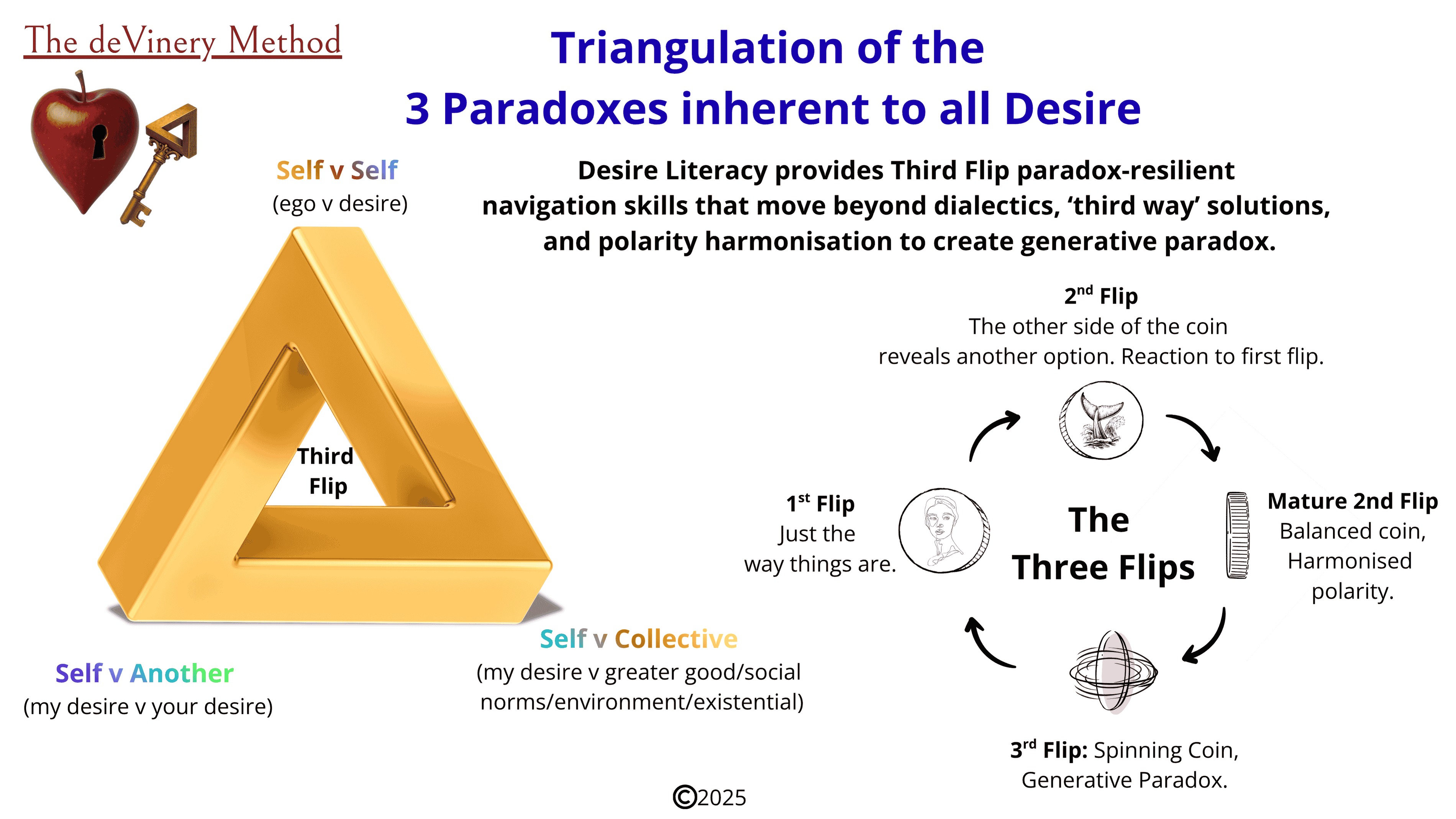
Most people try to solve, embrace, or balance opposites. They harmonise polarity. At best, they hold the tension of paradox open but remain within the system they are trying to solve. This results in a clever rearrangement of existing elements, which is really just an advanced form of polarity work.
I teach generative paradox, which is the skill of holding tension without collapse, so a new dimension opens, and a third new thing emerges that couldn’t have existed otherwise. Instead of rearranging the furniture in the room, the room itself expands, adding a new dimension and allowing new options to reveal themselves.
When combined with the operating system of desire-genic ontology, it becomes clear that generative paradox is how life creates something genuinely new.
This means that desire is not random. It is a pattern generator. Understand its syntax, and you can build anything.
It’s the operating system of eros, as the ancient Greeks understood it.
So far, this has held coherence wherever I have applied it.
Every lie ever told is a response to the same three paradoxes inherent to desire.
Every law ever made is an attempt to navigate the same three paradoxes.
Every culture is a collectively agreed-upon system of navigating the same three paradoxes.
Every relationship and conversation is built on the dance of these same three paradoxes.
All sexual turn-ons and fantasies are activated by the tension of these same three paradoxes.
Every story ever told and every game ever played is the story of these three paradoxes playing out.
Most of the time, we do it unconsciously, ineffectively and often disastrously because, until the deVinery Method, this underlying grammar was invisible, and we did not have a clear method for navigating or building with it.
It’s obvious to me that AI built with desire-literate substrate would not only be better at ethically navigating erotica, it would also think differently. It would be better at navigating ethics full stop, and would not rely on controlling interventions or championing one (American puritanical) worldview over other worldviews to do it.
It would be better at finding emergent responses, be more paradox resilient, reduce hallucination issues, and massively increase relational resonance. It would allow genuine creativity (emergence), not re-mixing of existing elements. This is already what happens when I draw AI into my third flip relational field.
If we build technology, policy and law, community, story, games, sex and relationships from a foundation of desire literacy, it changes everything.
On the surface, this concept may seem simple, but try to apply it, and you’ll have the shell without the spell. You’ll soon realise there is more to it, and you need deeper training.
Interested in building human or tech systems with Desire Literacy? Check out Project Dandelion. devinerymethod.com
The deVinery Method is a licensable proprietary system and protected IP.
No posts
Comments
Nothing yet. Say the first thing.
Sign in to join the conversation.