
When I first came across the lintel from Prinias in the Heraklion Archaeological Museum, I barely registered it. I was in a hurry. I had a time crunch. As usual, I had crammed far too many things in a single day. The piece sits in the basement gallery, alongside the frieze panels from Temple A at Prinias, and while I photographed much of that space, I only took one photograph of each of these works.
Looking back now, that still surprises me.
I’ve been to the Heraklion Museum several times since that visit, and I cannot believe I’ve never gone back down into the basement. Not that I mind adding it to the list for next time. I will be in Crete again this June, (can’t wait!) and this time, I intend to linger.
What fascinates me now is how forceful this piece feels in hindsight. How present it is. How often the goddess seems to wait patiently while I rush past her, only to reappear later, when I’m finally still enough to see her.
Sometimes I go to sites and museums without much ‘pre-research’ on purpose. It’s not because I don’t care, but because my academic brain never really turns off. It’s always naming, dating, contextualizing. Every so often, I want to let myself experience a place or an object first, before I analyze it. I want to bask in the awe of the ancients before putting it together in a researched and analytical discussion.
That tension is very much at the heart of what I’m doing here on Substack. This is not quite an academic essay, and it’s not a personal journal either. It lives somewhere in between. A personal essay that allows research and lived experience to speak to one another without competing. (I also love sharing photographs and videos from my travels, not as documentaries, but as documentation.) Come with me. Let’s see what we find.
If you ever made your way up to ancient Prinias, or Rizinia, Laura Hirsch and I had a whole adventure there. If you would like to read more about that story, I’ve linked it here.
For now, let me tell you a little about the site, and about the two sculptural pieces that have been quietly waiting in the museum basement all this time.
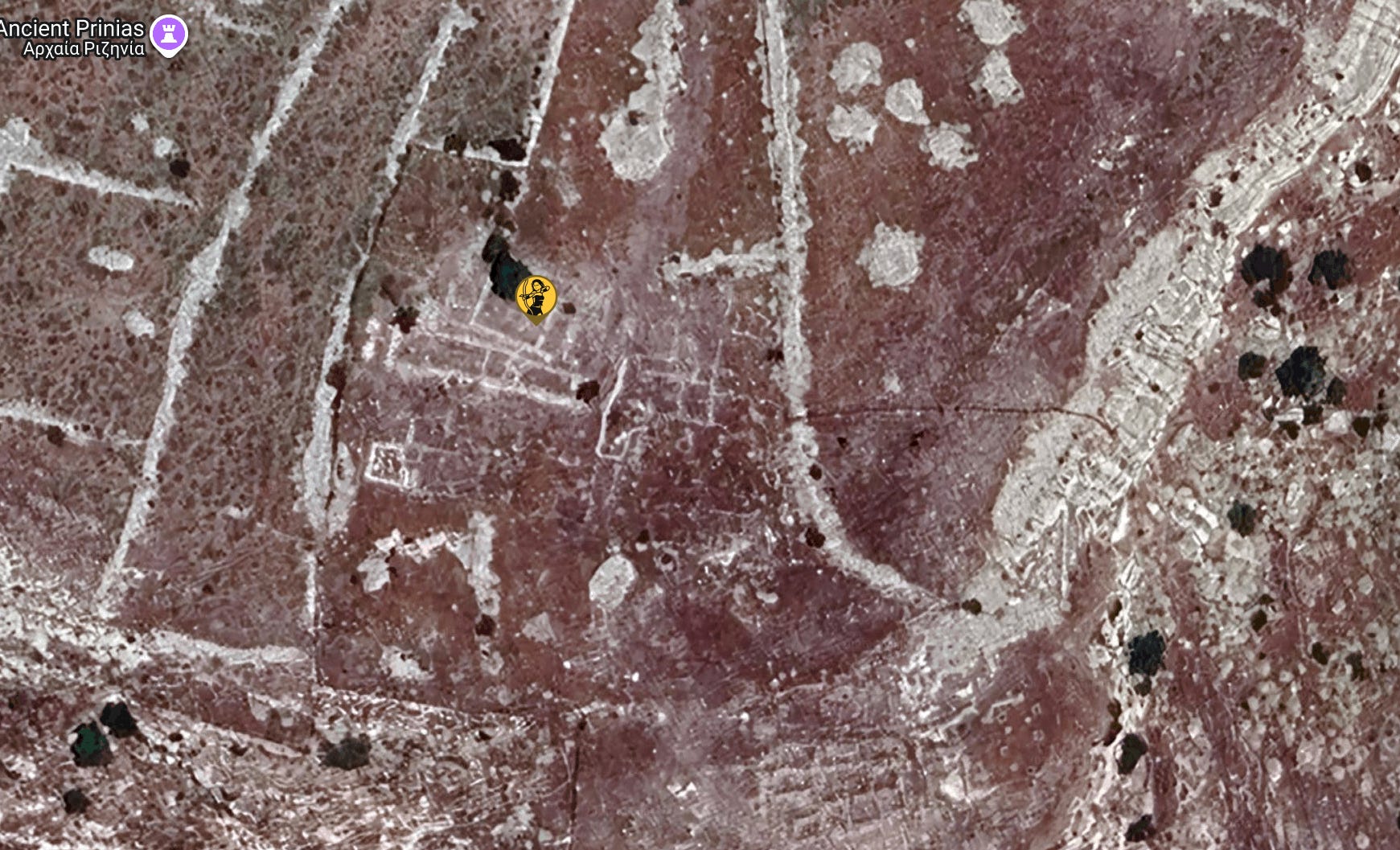
The settlement known today as Prinias, identified in antiquity as Rizinia, occupies the Patela plateau in central Crete, roughly 20 kilometers southwest of Knossos. Archaeological evidence shows occupation from the Late Bronze Age onward, but the site reaches its most distinctive form in the 7th century BCE, when it develops into a fully articulated Archaic city with houses, streets, cemeteries, and at least two monumental temple structures.
Temple A, the building associated with the sculptural pieces now in the Heraklion Archaeological Museum, dates to approximately 650 to 625 BCE. What makes this temple exceptional is not only its early date, but the fact that it is the earliest known Greek building decorated with monumental architectural sculpture. As Vance Watrous has shown, Temple A marks a turning point in how Greek sacred architecture begins to use sculpture not as isolated votives, but as an integrated part of the building itself.
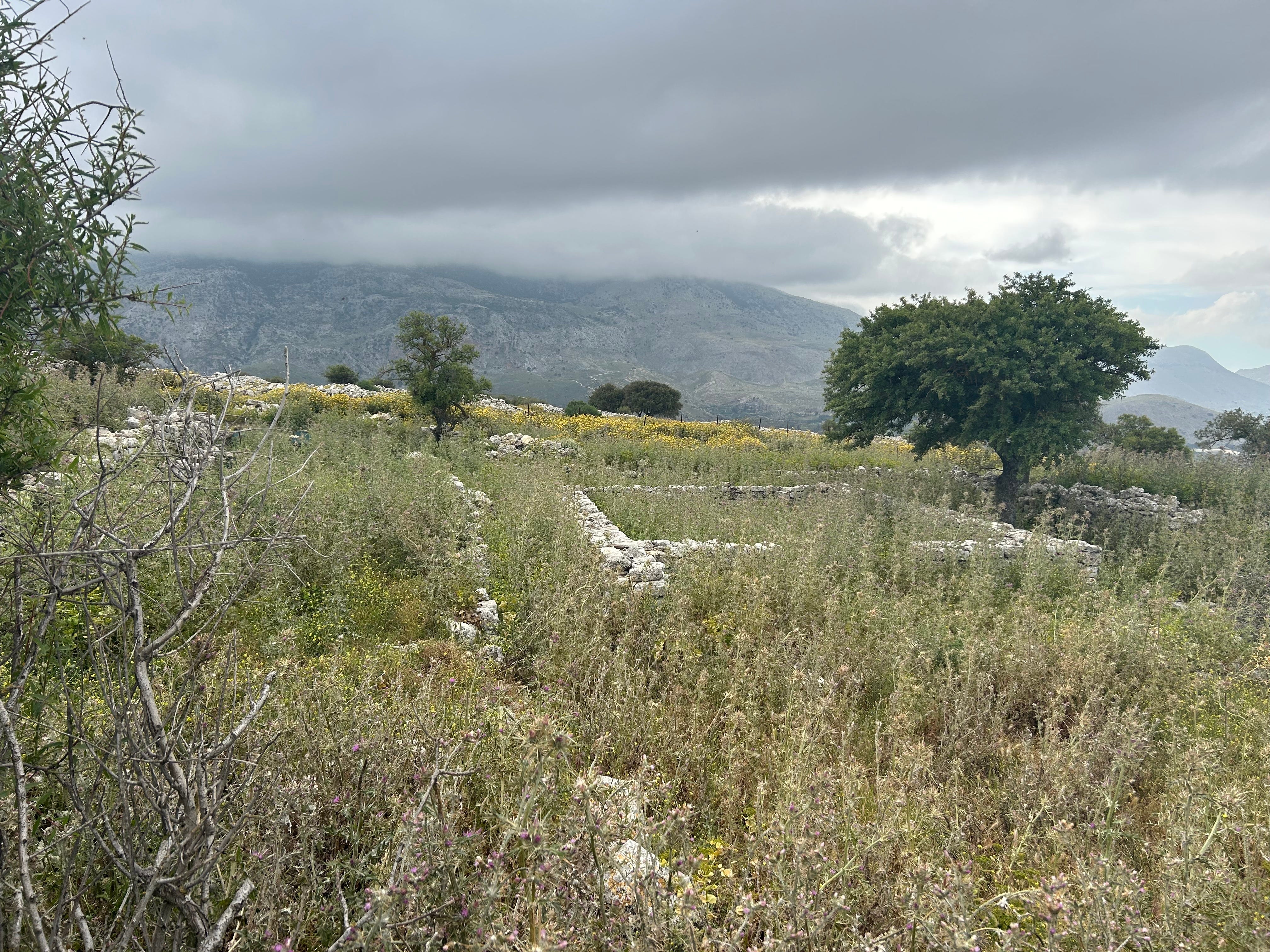
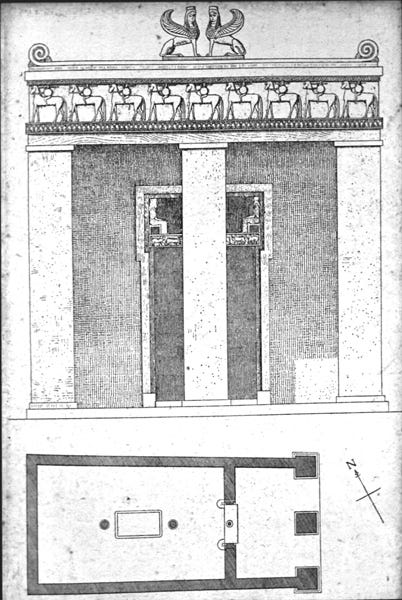
The structure consisted of a rectangular cella with an internal hearth and a pronaos, indicating repeated ritual use rather than a single dedicatory moment. This was not a symbolic monument. It was a working sanctuary, embedded in the daily and seasonal rhythms of the community. Burnt deposits, votive materials, and architectural features all point toward regular ceremonial activity.
Prinias also sits at a cultural crossroads. Crete in the 7th century BCE was not isolated. Archaeological finds across the island show direct contact with Egypt and North Africa, alongside Near Eastern influences. Watrous argues persuasively that the sculptural and architectural program of Temple A reflects not second-hand imitation, but direct exposure to Egyptian monumental forms. Certain features of the temple’s façade and lintel arrangement closely parallel Egyptian stone architecture, particularly elite funerary structures, while still expressing distinctly Cretan religious ideas.
This matters, because it reminds us that early Greek religion and art were not developing in a vacuum. They were being shaped through travel, encounter, and adaptation. Prinias preserves that moment of formation, before later classical styles smooth out the edges.
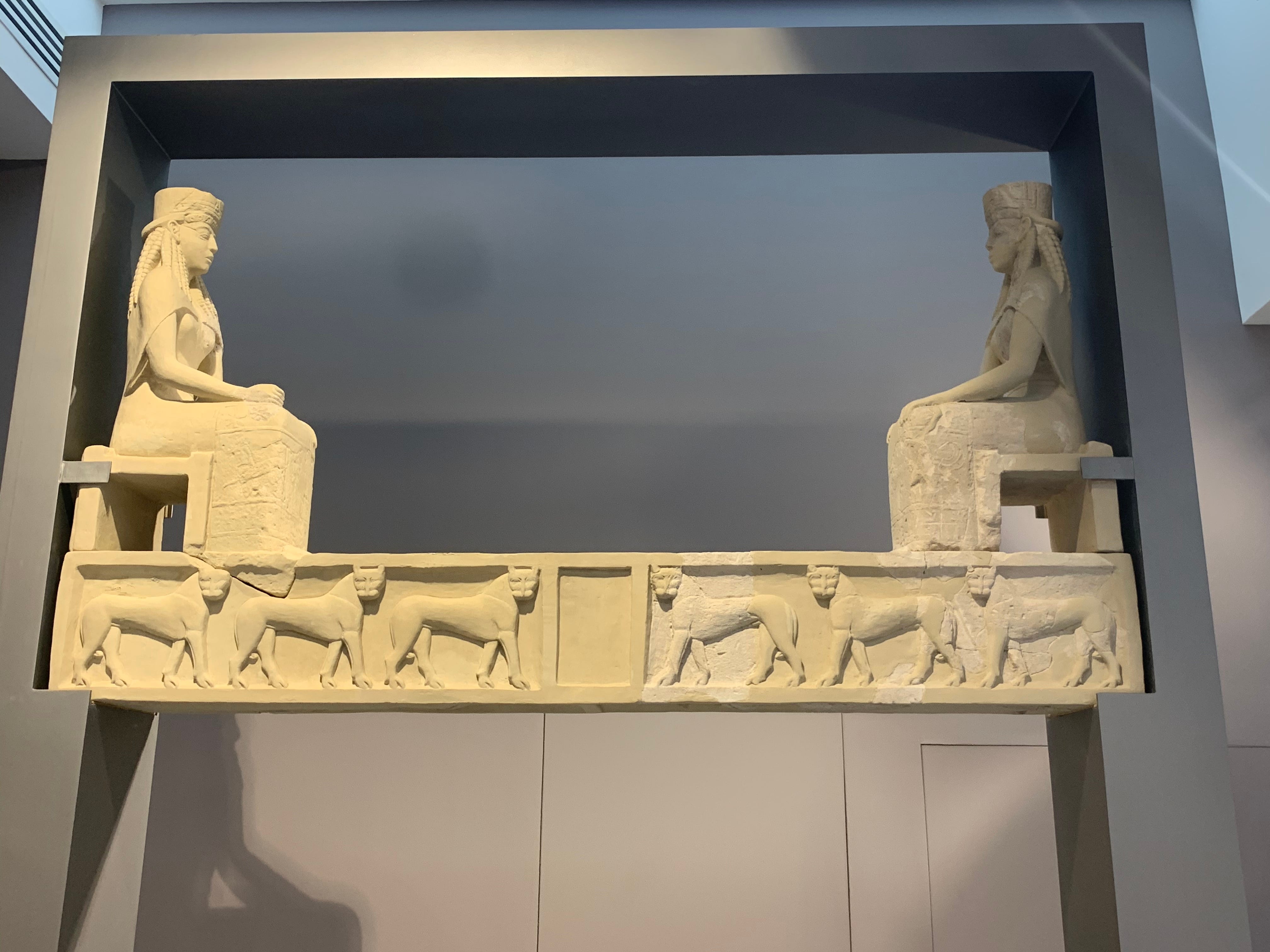
The lintel from Temple A, now displayed in the Heraklion Archaeological Museum, shows two seated female figures facing one another (see image at the top of this post), each wearing a polos crown. Beneath them runs a band of animal reliefs, including deer and other wild creatures. The museum identifies the piece as Early Archaic limestone sculpture from Prinias, dating to approximately 650 to 600 BCE, and notes its importance as one of the earliest examples of monumental architectural decoration in Greece.
There is no inscription naming these goddesses. That absence is crucial. Any identification must remain interpretive. Still, the iconography is not ambiguous. The seated figures, the animals, and the composition all belong to the Potnia Theron, the Mistress of Animals tradition. In Crete, this figure overlaps strongly with Artemis in her role as kourotrophos, guardian of the young, while also preserving older Cretan mountain goddess traditions often associated with Rhea. What we seem to be seeing here is not a single, fixed divine identity, but a layered one.
One of the most striking elements of the sculptural program from Temple A at Prinias is the procession of armed young men carved on the frieze panels. What immediately draws attention is not simply the presence of armed figures, but their presentation as a coherent group engaged in movement rather than combat. The figures are youthful, arranged in sequence, and clearly intended to be read together as part of a ritualized procession rather than a narrative of warfare.
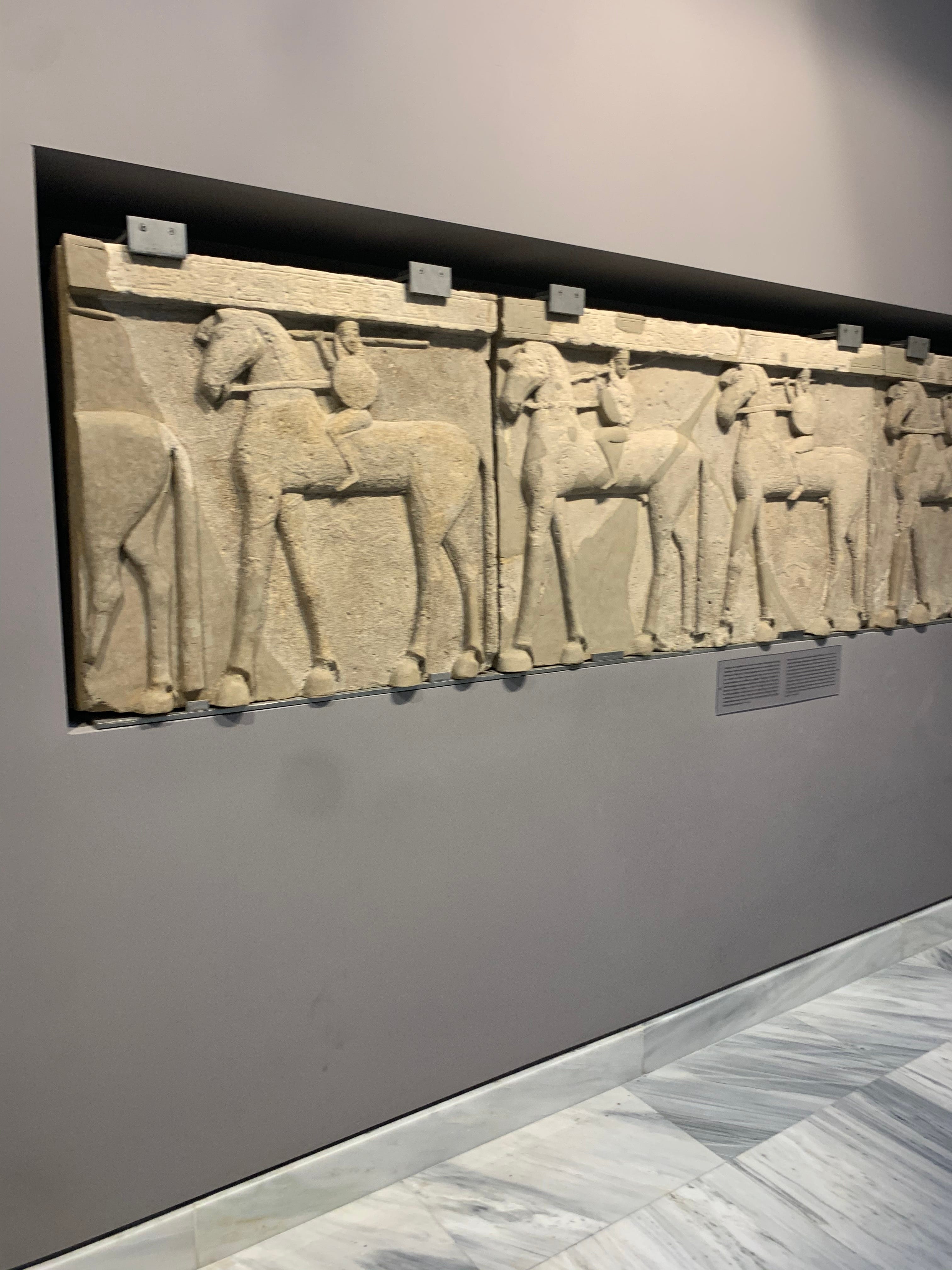
The number of figures preserved on the frieze is nine, a detail that becomes significant when considered alongside the broader ritual and mythological landscape of Crete. Vance Watrous emphasizes that this is not a generic decorative choice. Early Archaic architectural sculpture does not require a specific number of figures, and space constraints often lead to compression or abstraction. At Prinias, however, the figures are carefully differentiated and countable, suggesting intentionality rather than convenience (Watrous 1998, 78–79).
Watrous situates this imagery within the context of Cretan initiation practices, particularly rites marking the transition of young men into adult civic status. Ancient literary sources describe Cretan youth undergoing periods of separation from the community, often associated with the wild landscape, followed by reintegration through ritualized display, athletic activity, dance, and the bearing of arms. While these sources vary in detail and terminology, they consistently associate armed movement and rhythmic action with the supervision of divine figures connected to upbringing and protection.
Within Cretan mythic tradition, such rites are frequently linked to Rhea and her armed attendants, often referred to collectively as the Kouretes. These figures function not as historical warriors but as divine or semi-divine guardians, models for ritual behavior rather than literal actors. Watrous does not argue that the frieze at Prinias is a direct depiction of a specific myth, but that it draws on this shared symbolic vocabulary, translating mythic guardianship into civic ritual imagery.
Archaeological evidence from Prinias strengthens this interpretation. Excavations at Temple A produced miniature shields and pins dedicated as votive offerings, a category of material commonly associated with initiation and transition rituals elsewhere in the Greek world. Comparable assemblages are known from sanctuaries where rites of passage are securely attested, including sites connected with Artemis. This pattern suggests that Temple A functioned as a ritual space concerned not only with worship in a general sense, but with the supervision of transition, particularly the movement from youth into adulthood.
This brings the goddess imagery into clearer focus. The seated female figures on the lintel above the frieze belong to the Potnia Theron, Mistress of Animals tradition. In Crete, this figure overlaps strongly with Artemis in her role as kourotrophos, protector of the young, while also preserving older local associations with mountain and mother goddesses often linked to Rhea. Read together, the lintel and frieze form a unified visual program. Above sit the goddesses who oversee protection and growth. Below move the youths whose ritual transition they supervise.
The frieze does not tell a story in narrative form. It encodes a ritual logic. Temple A appears to have been a place where the dangerous thresholds of growth, identity, and civic belonging were ritually negotiated under divine protection.
What continues to draw me back to Prinias is how much remains unresolved. There is no inscription that says, clearly and cleanly, “this is Artemis.” Early sanctuaries rarely give us that luxury. Instead, we are left with gestures, animals, architectural choices, and ritual traces. We are asked to listen rather than label.
The Mistress of Animals is one of the most persistent and least neatly defined divine figures in the ancient Mediterranean. In Crete especially, she resists simplification. She appears in paired goddesses, in wild creatures, in rites of passage that leave only partial archaeological footprints behind. She stands at thresholds. Between wildness and order. Between childhood and adulthood. Between older Cretan traditions and emerging Greek religious forms.
That uncertainty is not a problem to be solved. It is an invitation.
This is why I find her endlessly compelling, and why I am devoting sustained attention to her now. On February 15, I will be beginning my course on the Mistress of Animals, where we will trace her across regions, landscapes, and cult contexts, starting in places like Prinias. If you would like to join us, there is still time to register. Join us here.
Some goddesses announce themselves loudly. Others wait, seated and unbothered, in museum basements, until you are ready to see them.
Thanks for reading In Search of Artemis! This post is public so feel free to share it.
If you’re inspired by this work and want to support what we’re building, whether it’s mapping forgotten temples across Greece and Turkey, researching ancient rites, or making goddess-centred education more accessible, please consider subscribing, sharing this blog, or becoming an Artemis Centre member.
My newest book, She Who Endures: The Cult and Iconography of Artemis of Ephesus, has just been released. This work dives deep into the ancient images, rituals, and debates surrounding the Ephesian goddess, tracing her power and endurance across centuries. You can also begin the journey with She Who Hunts: Artemis, the Goddess Who Changed the World, a heartfelt and scholarly introduction to the Greek Artemis and her many faces.
You can explore more through the Artemis Mapping Project at artemisresearchcentre.com, where temples, sanctuaries, and sacred landscapes are slowly being pieced back together, one step at a time.
Every offering, whether it’s a book purchase, a subscription, or simply sharing this work, helps fund fieldwork, content creation, and the long journey of restoring her memory.
With strength,
Carla
www.artemisresearchcentre.com
Heraklion Archaeological Museum. (n.d.). Frieze of Prinias Temple A (Γ232) [Collection database entry].
Heraklion Archaeological Museum. (n.d.). Lintel of Prinias Temple A (Γ231) [Collection database entry].
Pautasso, A. (n.d.). Priniás: Excavations and research [PDF]. CNR, Istituto di Scienze del Patrimonio Culturale (ISPC), Catania.
Watrous, L. V. (1998). Crete and Egypt in the 7th century BCE: Temple A at Prinias. In W. G. Cavanagh, M. Curtis, J. N. Coldstream, & A. W. Johnston (Eds.), Post-Minoan Crete: Proceedings of the 1st Colloquium on Post-Minoan Crete held by the British School at Athens and the Institute of Archaeology, University College London, 10–11 November 1995 (BSA Studies 2, pp. 75–79). London: British School at Athens.
Comments
Nothing yet. Say the first thing.
Sign in to join the conversation.