
After I published my last Substack on The Ethics of Wearing the Ancient Dead, a reader sent me an email in which they questioned my negative approach to going to see Christopher Nolan’s film The Odyssey (I’ll be heading out to see the film this afternoon). We don’t agree on everything, but they raised several questions that are worth thinking about. Rather than replying point by point, I realized there was a much bigger conversation here, one that extends far beyond a single film.
One of their questions was whether my criticism was fair given that stories like the Odyssey have always evolved. Homer himself, assuming there was even a single historical Homer, was part of an oral tradition. Greek tragedians changed myths. Roman poets reimagined them. Every generation has found new ways of engaging with these stories.
So why should Christopher Nolan be any different?
It’s a fair question.
As I thought about it last night, I realized that my concern isn’t really about Christopher Nolan (mostly). Nor is it about whether ancient stories should be adapted. Of course they should. Great stories survive precisely because each generation finds something meaningful within them.
What concerns me is something that feels more insidious and colonialist in nature.
It’s true that as historians, we don’t wait until we’ve excavated an entire site before making observations. We identify pottery fragments before the vessel is complete, we recognize architectural styles from a single fallen column, and we can often tell the difference between a Mycenaean helmet and a Classical one from a photograph. That isn’t prejudice. It’s training.
The same is true here.
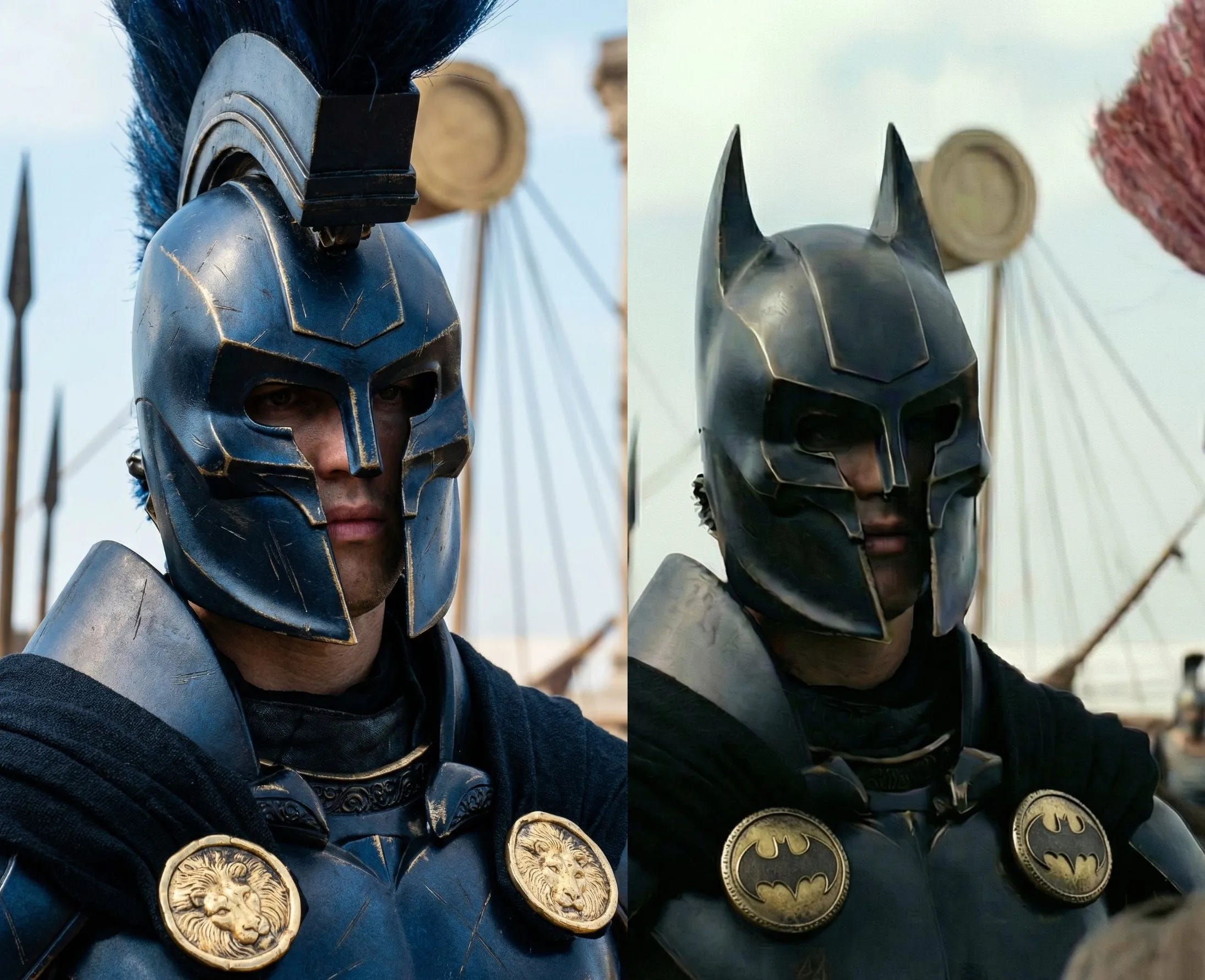
The promotional material for The Odyssey has already revealed countless artistic choices. Costumes, armour, architecture, hairstyles, weapons, visual language. None of these are neutral (at all). They tell us something about how Nolan is choosing to present the ancient world. Whether these choices ultimately serve the story remains to be seen, and I’ll happily revisit my conclusions after I’ve seen the film.
But before I walk into the theatre, I wanted to write down the principles that shape my thinking as an ancient historian.
Because I don’t believe adaptation is the issue.
Every generation adapts myths. The question is whether an adaptation remains in conversation with the culture that produced the story or whether it simply uses the story as raw material.
That, I think, is the real conversation.
Stories Have Always Changed. That Isn't the Question.
One of the first points raised in the email was that the Odyssey itself was never fixed.
I completely agree that Homer was working within an oral tradition. In fact, we cannot even say with certainty that "Homer" was a single historical individual, and the texts we possess today have their own long editorial history. No classicist would argue that the Odyssey arrived fully formed, unchanged, from the mouth of one poet. The epic evolved, and later authors continued to reinterpret it. Vase painters, tragedians, Hellenistic poets, Roman authors, Byzantine scholars, and modern translators have all participated in that conversation.
Greek tragedians reinvented myths all the time. Euripides’ Helen is radically different from the version most Greeks knew. Sophocles, Aeschylus, Ovid, Apollonius, they all changed details, motivations, chronology, and emphasis.
The question isn’t whether stories change.
The question is how they change, and from what tradition they are changing.
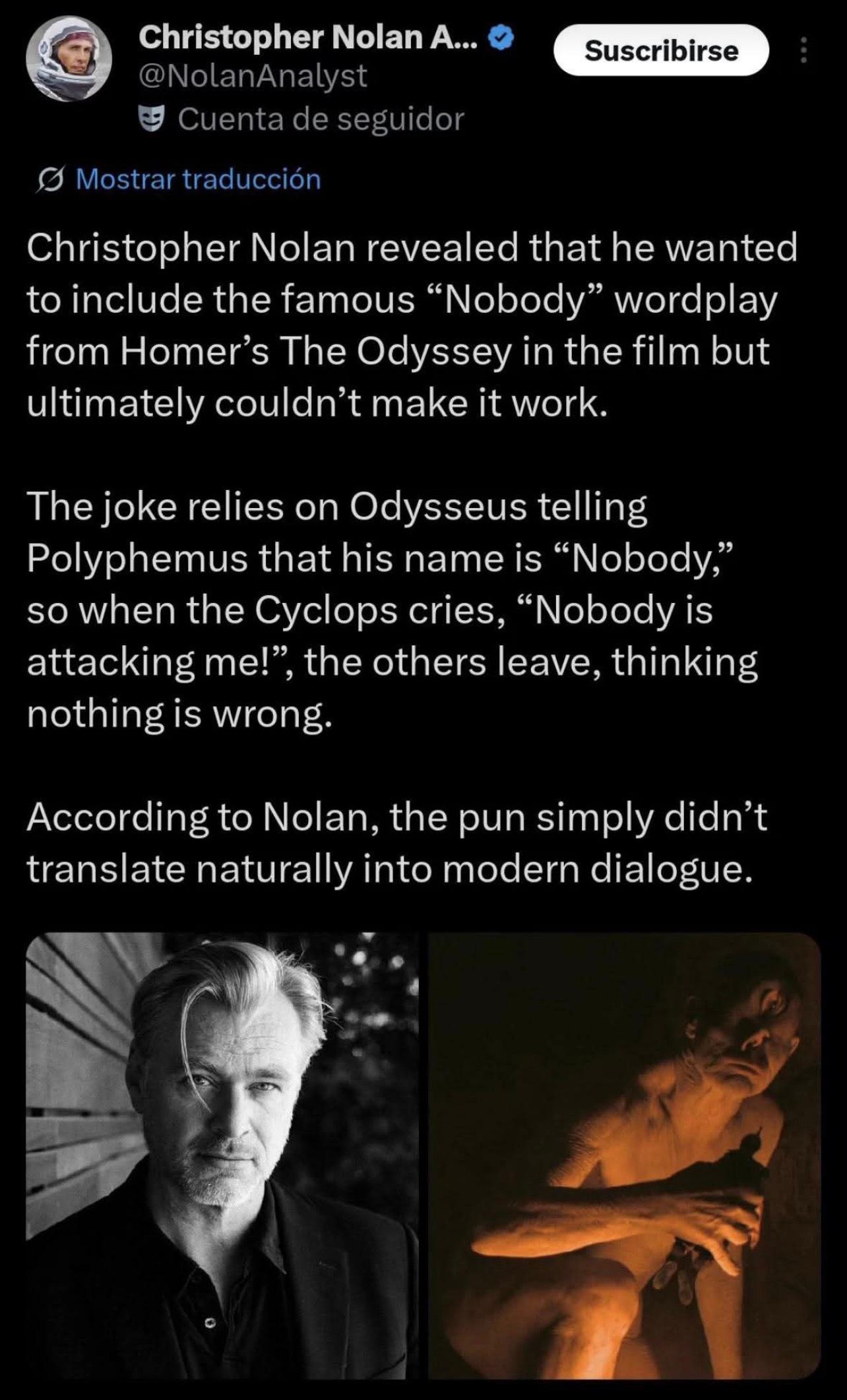
The evolution of the Odyssey within the ancient Mediterranean is not the same thing as a 21st century filmmaker creating a blockbuster for a global audience. When Homeric poetry developed, it did so within the world that created it. The people telling these stories shared a language, a religion, a geography, and a cultural memory. Later Greek writers weren’t simply inventing whatever version suited them. They were participating in an ongoing cultural conversation.
But I don't think that is quite the same thing as what Christopher Nolan is doing. Oral tradition is not simply endless reinvention. It is a conversation within a cultural tradition. Nolan is creating a modern film inspired by the Odyssey, and that is a perfectly legitimate artistic endeavor. My concern is not that he is adapting the story. My concern is with the particular choices he appears to be making while presenting the film as The Odyssey. Those choices are open to criticism in exactly the same way that Homer's choices, Euripides' choices, or Virgil's choices are open to criticism.
My reader’s email claims that stories should engage “new cultures.” But the Odyssey isn’t just a story in the abstract. It is one of the foundational literary works of an actual historical culture.
If someone adapted the Epic of Gilgamesh while removing virtually everything recognizably Mesopotamian, or made a film about the Popol Vuh without consulting any Maya traditions, we would probably recognize that something important had been lost. Ancient Greece deserves the same respect. Greek culture is not simply a backdrop for universal storytelling. It is a historical civilization whose literature emerged from a particular language, religion, geography, and worldview.
If a director changes relationships, alters historical settings, introduces entirely new themes, or removes elements that were fundamental to the ancient story, those decisions become part of the work itself. They are artistic choices, and artistic choices deserve to be discussed.
That is what literary criticism has always done.
These Are Not Fairy Tales
People often talk about Greek mythology as though it's interchangeable with Cinderella or Jack and the Beanstalk, where every generation simply invents whatever version it likes. But Greek myth isn't simply folklore floating free of history. It is embedded in religion, ritual, politics, geography, literature, and lived cultural identity.
The Odyssey didn't emerge from nowhere. It emerged from a particular landscape, a particular language, and a particular way of understanding the world. It belongs within the history of the ancient Mediterranean just as Egyptian literature belongs within ancient Egypt or the Icelandic sagas belong within medieval Scandinavia. These stories were never simply entertainment. They reflected religious ideas, social expectations, political realities, and the values of the communities that told them.
That doesn’t mean they can’t be retold.
But I do think we have a responsibility to recognize that there is a difference between engaging with a culture and simply using that culture as a source of inspiration.
One of the things I find interesting is that we’ve become much more thoughtful about this in other contexts. We generally recognize that Indigenous traditions, African oral histories, or the sacred narratives of other cultures deserve to be understood on their own terms before we reinterpret them through our own modern perspectives. We acknowledge that those stories belong to real historical communities and that those communities deserve to have a voice in how their traditions are represented.
For some reason, we rarely extend that same consideration to ancient Greece.
Instead, Greek mythology has become cultural shorthand. It has become something that can be detached from its historical setting, stripped of its religious and cultural context, and then reassembled into whatever story we want to tell.
I find that deeply unsatisfying because I think something important gets lost in the process.
The ancient Greeks were not simply telling exciting adventure stories. And even even if they were, they were telling stories about themselves. About their relationship with the gods. About kingship, family, hospitality, justice, memory, grief, homecoming, and what it meant to live in their world.
When we remove those stories from that world entirely, I think we lose far more than we gain.
What Do We Actually Learn from a Retelling?
One of the points brought up in the reader’s email was that they always learn something new from someone else's interpretation of a myth, that even if they don’t entirely agree with it, it allows them to see the story in a new light.
One of the things I’ve been thinking about is this idea that every interpretation teaches us something new.
I actually think that’s true.
But I also think we have to be honest about what we’re learning.
If I watch a 21st century adaptation of the Odyssey, I may learn a great deal about the filmmaker. I may learn about modern ideas surrounding gender, war, trauma, power, love, or heroism. I may even come away thinking, “That’s a really interesting way of looking at the story.”
But that doesn’t necessarily mean I’ve learned something new about the Odyssey.
Those are two completely different things. I think we’ve started collapsing those two conversations into one, and I don’t think we should.
A retelling can teach us something about the ancient story, or it can teach us something about the modern storyteller. Those are not the same thing.
Most people are not reading Homer.
They’re watching films. They’re reading novels. They’re listening to podcasts. They’re scrolling through social media.
For many people, this becomes the Odyssey. This becomes Mycenae. This becomes Odysseus. This becomes Penelope.
That’s why I don’t think historians can simply shrug and say, “Well, it’s just another interpretation.”
No.
It isn’t just another interpretation.
For millions of people, it becomes the interpretation.
And that’s a responsibility.
I think somewhere along the way we’ve convinced ourselves that because these stories are old they somehow belong equally to everyone, and therefore anyone can change them however they like. I don’t think that’s true.
These stories came from a real civilization.
They came from people who spoke a particular language, lived in a particular landscape, worshipped particular gods, and understood the world in ways that were often very different from our own.
If we’re genuinely interested in those stories, shouldn’t we be just as interested in understanding the people who created them?
Otherwise, what are we doing? Are we engaging with ancient Greece? Or are we simply using ancient Greece as a backdrop to tell stories about ourselves?
Why Historians Have to Say Something
This is usually the point where someone says, “It’s just a movie.”
And they’re right.
It is just a movie.
Christopher Nolan doesn’t owe me a historically accurate film. He isn’t making a documentary, and I’m certainly not suggesting that every adaptation has to reproduce Homer line for line. If that’s the argument people think I’m making, then they’ve misunderstood me.
What I do think is that historians have a responsibility to point out where a film departs from the ancient evidence and to ask why those changes were made.
That’s our job.
When I write about Artemis, I don’t get to invent inscriptions because I think they make a better story. I don’t get to rewrite myths because I prefer a different ending. I don’t get to remove the parts of ancient religion that make modern audiences uncomfortable simply because they don’t fit my worldview. My responsibility is to understand the evidence first, to understand the people who produced that evidence, and only then to begin interpreting it.
I don’t see why films should be beyond that same conversation.
Nobody gets upset when Shakespeare scholars compare a modern production to Shakespeare’s text. Nobody accuses art historians of gatekeeping because they point out that a Renaissance painting isn’t historically accurate to the biblical world it depicts. Nobody tells Egyptologists that they should stop correcting popular misconceptions because “it’s only entertainment.”
In every other field, we recognize that criticism and appreciation can exist together.
Why is Greek mythology different?
…
And here’s the other thing that keeps bothering me.
People often say, “Well, if it gets someone interested in Greek mythology, then that’s a good thing.”
Maybe.
But interested in what?
Because if someone’s first encounter with the Odyssey is a version that changes major relationships, rewrites characters, invents scenes, and removes important parts of the culture that produced the story, then what they’ve really been introduced to isn’t Homer.
It’s someone else’s version of Homer.
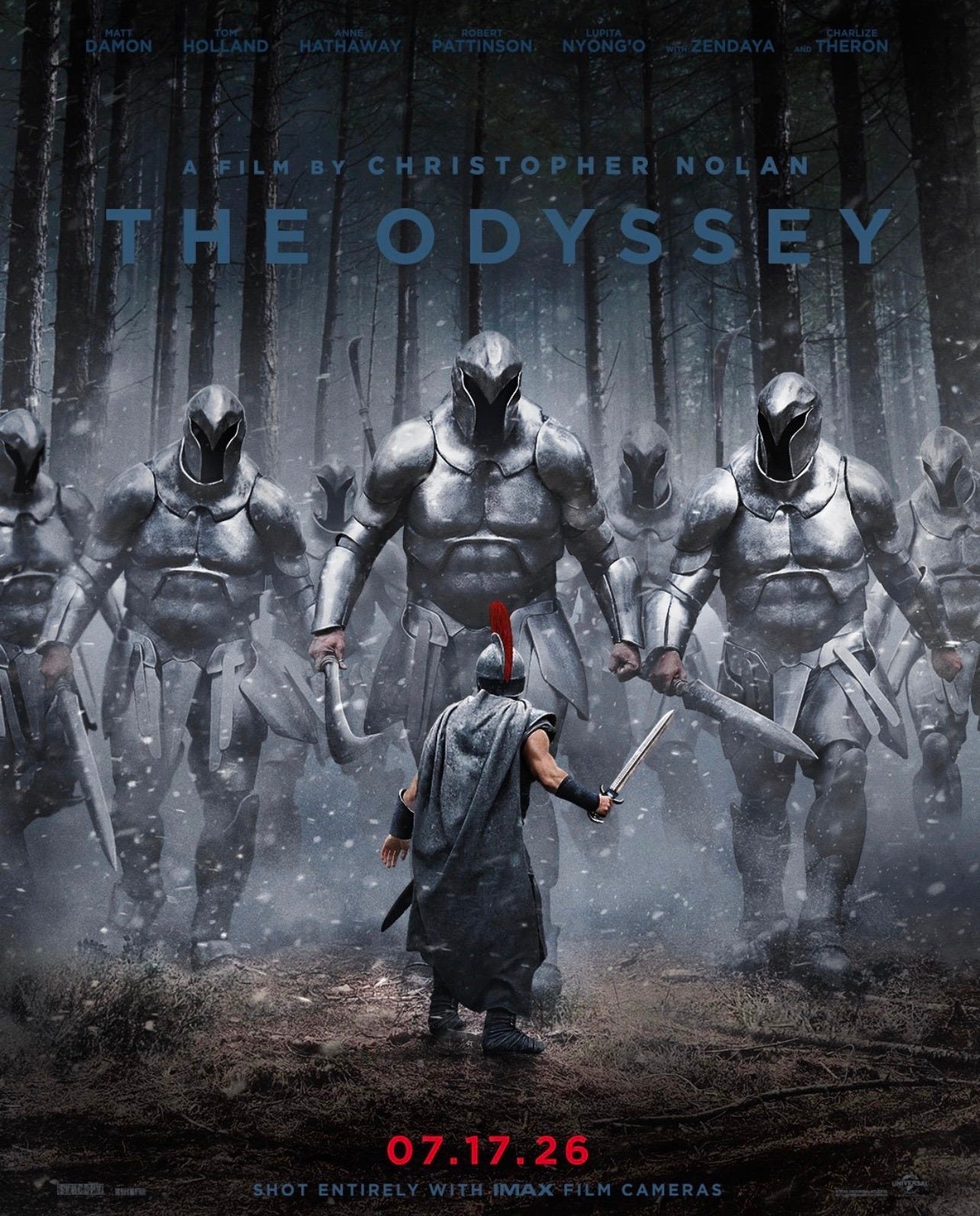
Maybe that’s really what I’ve been trying to articulate all along.
I don’t object to creativity. I don’t object to reinterpretation. I certainly don’t think ancient stories should be locked away in museums where no one is allowed to touch them.
What I object to is the growing assumption that because a story is ancient, it has somehow become detached from the people who created it, and that we can reshape it however we please while still claiming we’re simply retelling it.
I don’t think that’s how culture works.
I don’t think that’s how history works.
And I don’t think that’s how we should approach this ancient narrative.
Perhaps I’ll change my mind after I see Christopher Nolan’s The Odyssey. I certainly hope to be surprised.
But before I walk into that theatre, I wanted to be honest about the questions I’m taking with me (along with pen, paper, popcorn and a ton of candy comfort).
Follow me on social media for my reactions to the film, behind-the-scenes thoughts, short videos, and plenty more discussion as we continue exploring The Odyssey together.
Instagram: @ artemisexpert
Facebook: @ artemisexpert
TikTok: @ artemisexpert
Thanks for reading In Search of Artemis! This post is public so feel free to share it.
If you’re inspired by this work and want to support what we’re building, whether it’s mapping forgotten temples across Greece and Turkey, researching ancient rites, or making goddess-centred education more accessible, please consider subscribing, sharing this blog, or becoming an Artemis Centre member.
My newest book, She Who Endures: The Cult and Iconography of Artemis of Ephesus, has just been released. This work dives deep into the ancient images, rituals, and debates surrounding the Ephesian goddess, tracing her power and endurance across centuries. You can also begin the journey with She Who Hunts: Artemis, the Goddess Who Changed the World, a heartfelt and scholarly introduction to the Greek Artemis and her many faces.
You can explore more through the Artemis Mapping Project at artemisresearchcentre.com, where temples, sanctuaries, and sacred landscapes are slowly being pieced back together, one step at a time.
Every offering, whether it’s a book purchase, a subscription, or simply sharing this work, helps fund fieldwork, content creation, and the long journey of restoring her memory.
With strength,
Carla
www.artemisresearchcentre.com
Comments
Nothing yet. Say the first thing.
Sign in to join the conversation.