
Hi everyone,
I’ve been wanting to write this one for a while. Not just because Sofia Coppola is one of the most visually referenced directors of our generation, that part is obvious, and honestly a little overdone at this point, but because what I find genuinely fascinating is everything that exists around the films. The publishing imprint, the fashion collaborations that span three decades, the lo-fi TV show she made with her best friend in the ‘90s, the opera she directed for Valentino, the photography curation, the wine. Today’s post is about everything but her films, because that analysis has been done millions of times. It’s simply about the world she built.
There’s an entire creative ecosystem here that rarely gets examined as a whole, and I think when you see it laid out, it tells you something important about how a singular visual identity can extend across every possible medium without ever diluting itself. I like to think that she is the reason I got into art direction in the first place, as a pre-teen I discovered film stills of Virgin Suicides on Tumblr and then rolled into the Marc Jacobs followed by Meadham Kirchoff and Rookie Mag world. This was my first step into knowing I wanted a creative career when I was around 11/12 years old.
I’ve been a big fan ever since so just really wanted to do this Substack one day. I do really love Sofia Coppola, but I also want to mention that I do definitely agree that there is a representation problem within casting. As someone with mixed heritage, I do feel like there is a lack of presentation but as someone who loves to deepdive into the female gaze within image-making and am genuinely fascinated by subcultures, Sofia Coppola is a big role model.
For those who are a free subscriber, consider upgrading to paid to join the class of 2026 of the Visual Curriculum. It’s a program in image history, visual culture and literacy over 8 months. Last week we discussed everything over 5 lessons + a quiz about how to look at an image, but on Tuesday the next issue is going live. This is one of my favourites, it’s everything about the female gaze. A super important piece of knowledge for everyone who works with visuals. You can upgrade to paid to get access to this program, or read more about it linked below. Next to that, a paid subscriber also gets access to two other courses: From Idea to Issue, 30 Days Art Director DNA and over 250+ posts of deepdive and frameworks.
Anyways, let’s get into the Sofia Coppola universe.
Before we talk about the empire, we need to talk about the eye. Because the thing that makes Coppola’s work so magnetic to art directors, photographers, and creatives isn’t really the storytelling, it’s the way she sees. There’s a particular quality to her gaze, it’s soft, intimate, always a little melancholic, always bathed in natural light or warm artificial glow. It’s a look that feels like memory itself.
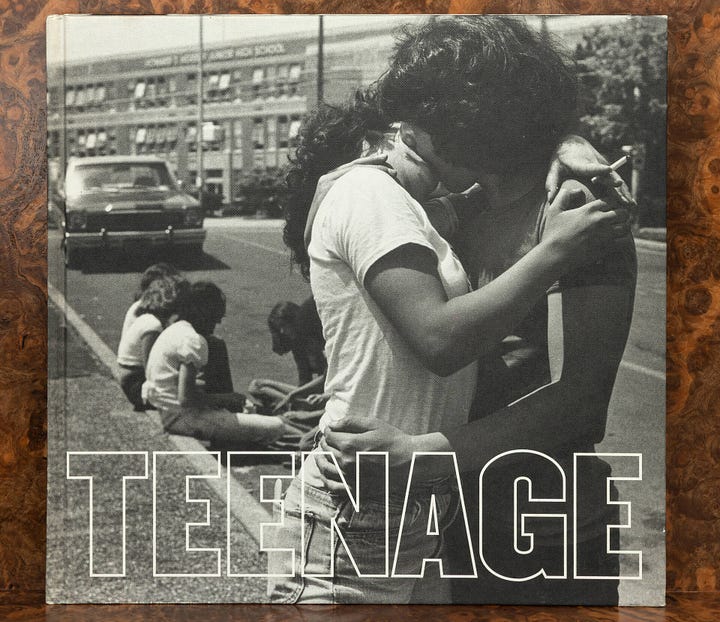
What’s interesting is where that eye was trained. It was never taught in film school, she actually dropped out of CalArts where she was studying painting. In a 2018 interview with Aperture, Coppola described how her relationship with photography started in the ‘80s: looking through fashion magazines, going to art fairs with her mother, discovering Bill Owens’ suburban photography series, which would later become the direct visual reference for The Virgin Suicides. She’s spoken about how for every single film, she creates reference binders of photographs for her cinematographers. Not mood boards in the Pinterest sense, it was the 90’s after all! Real physical binders. Actual images, torn from books, printed from archives. You can read more about this in her Archive book that I read word by word and I’d die to see her physical binder for Lost in Translation!
This is why she matters to us specifically, not just as filmmakers appreciate her, but as people who think about visual direction as a discipline. Her process is art direction.
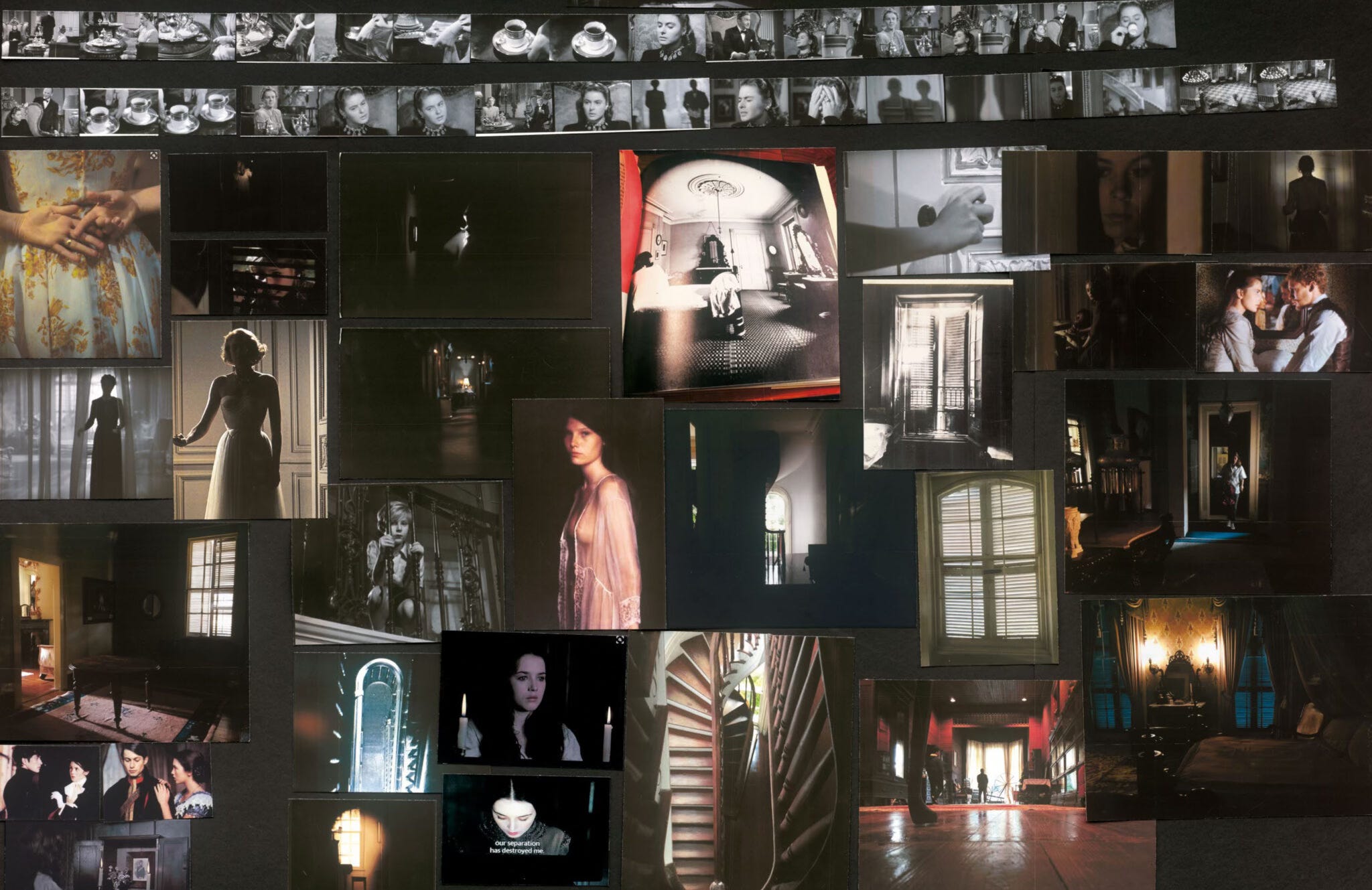
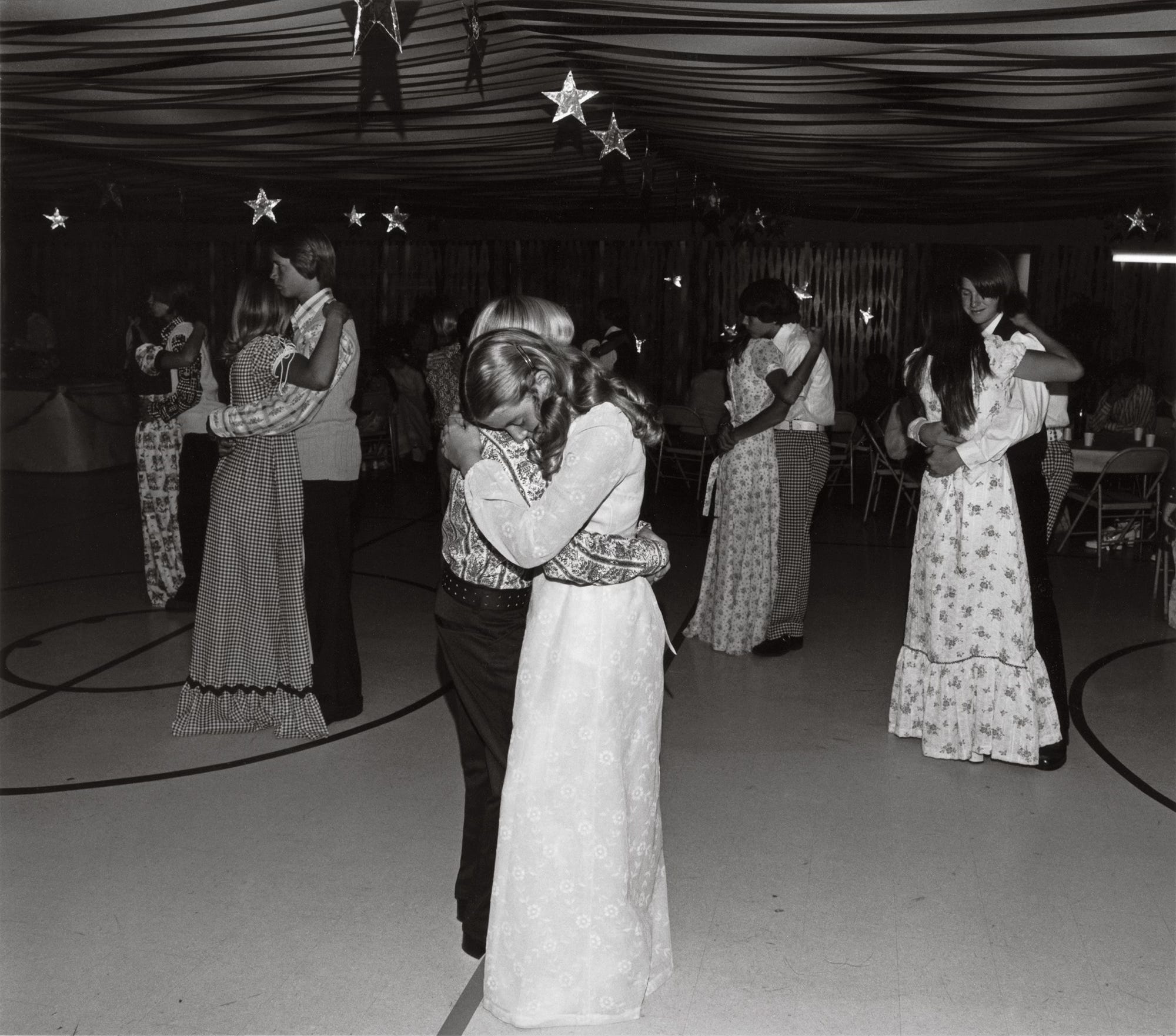
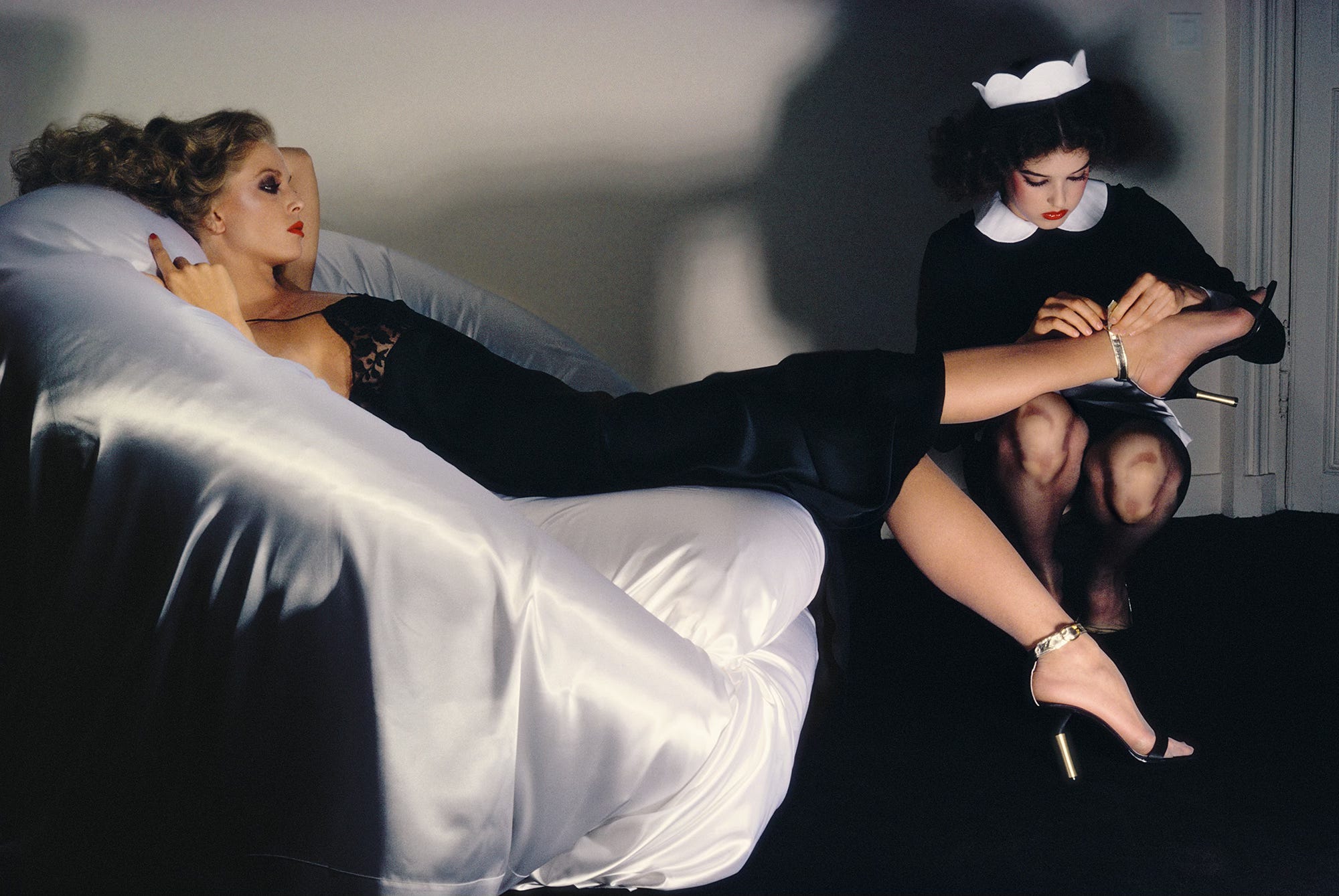
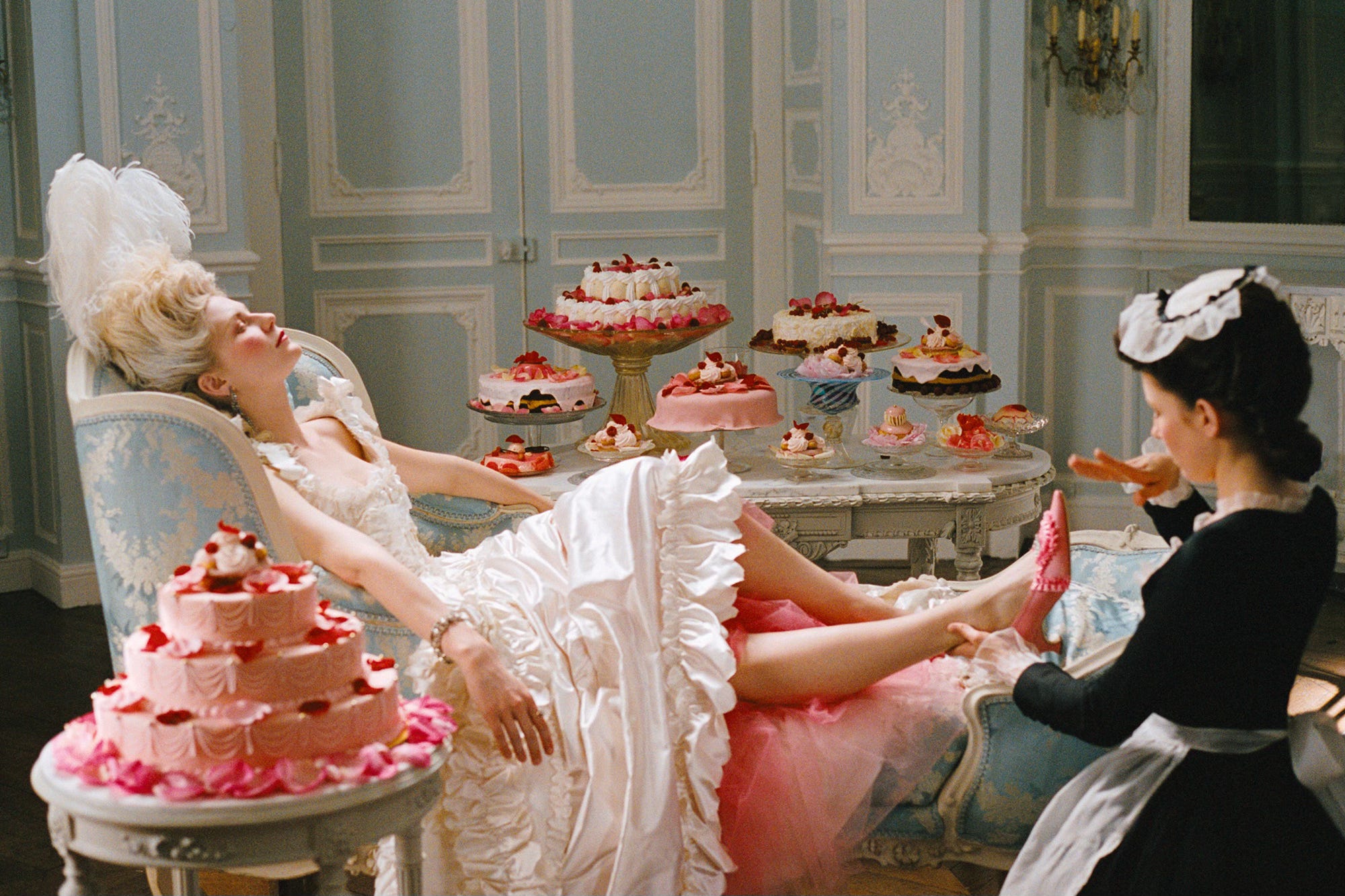
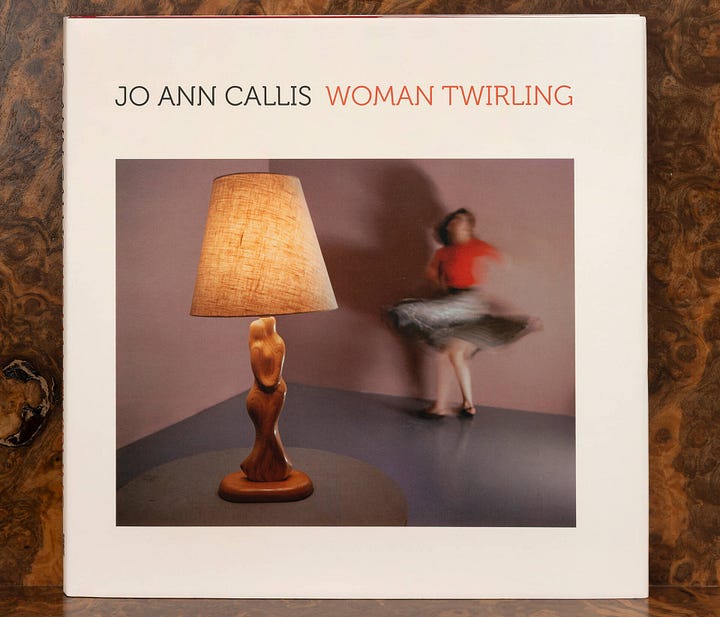
You can also currently view Sofia Coppola’s bookshelf at the Victoria & Albert museum, but ofcourse also have a peek online.
Here’s where it gets fun, and where most profiles skip ahead too quickly.
Before her debut film The Virgin Suicides (1999), Coppola was already deeply embedded in a very specific cultural moment, that early-to-mid ‘90s intersection of downtown New York, independent music, fashion experimentation, and lo-fi media. And she wasn’t observing it from the sidelines, she was very obviously in it.
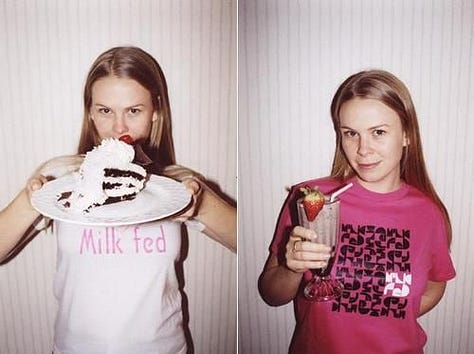
Sofia Coppola co-founded a clothing line called Milk Fed in 1994 with her friend Stephanie Hayman, in collaboration with Kim Gordon of Sonic Youth. Think baby tees with screen-printed faces of Che Guevara and Steve McQueen, nylon nightie dresses, hip-hugger skirts. It was sold in about 50 stores across the U.S. but became massive in Japan, where it eventually got exclusive stores in Osaka and Tokyo. Coppola later stepped away from the label and it continued under Japanese ownership, but the sensibility it represented, that mix of girlish and subversive, soft and knowing, is essentially the aesthetic DNA that runs through everything she’s done since.
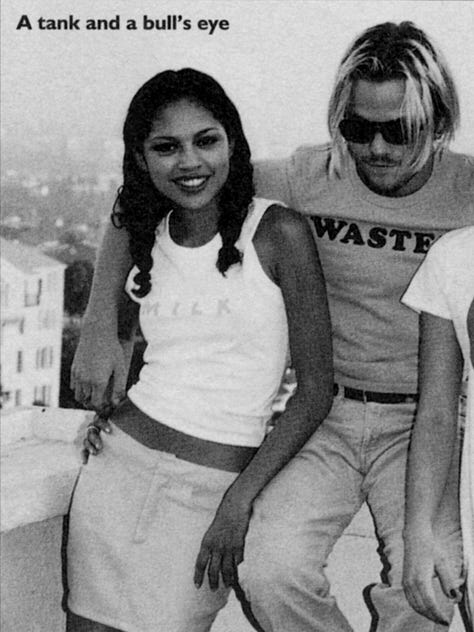
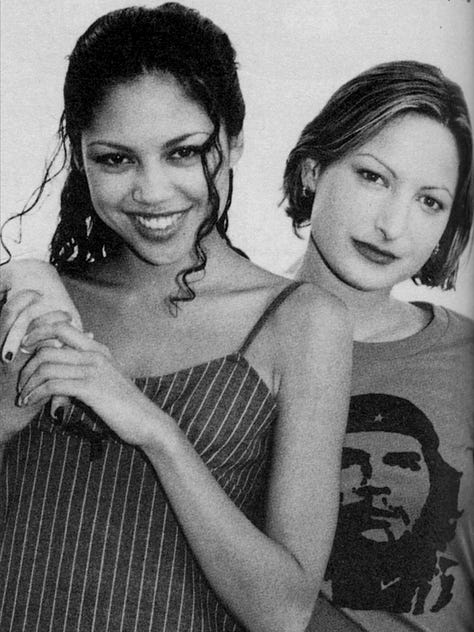
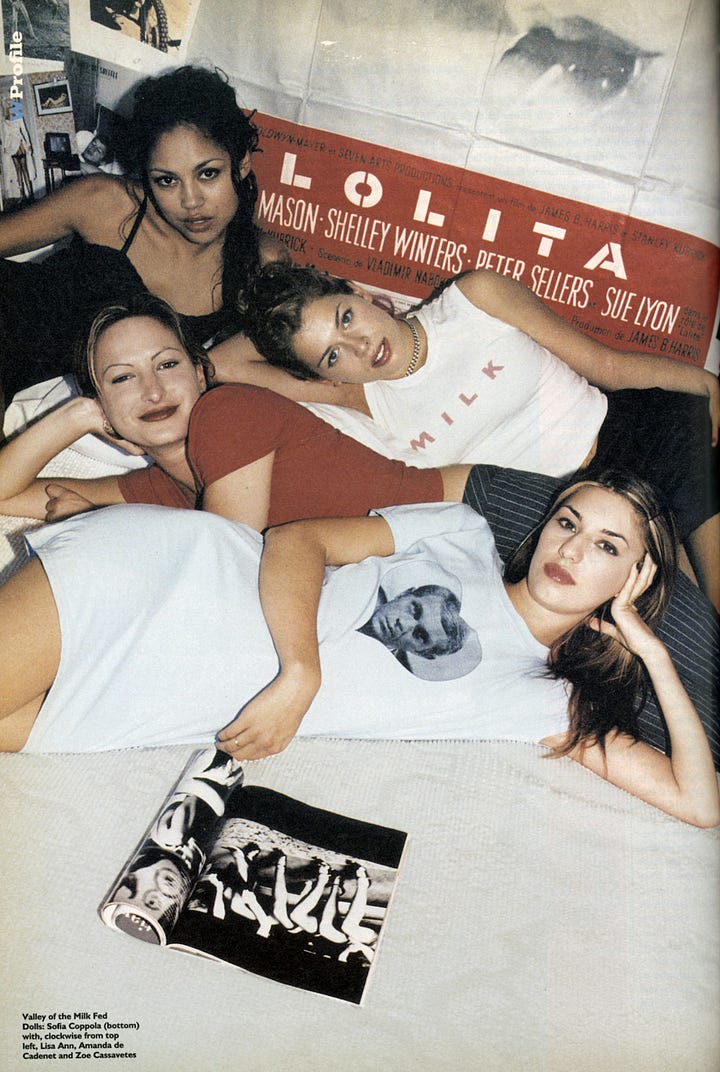
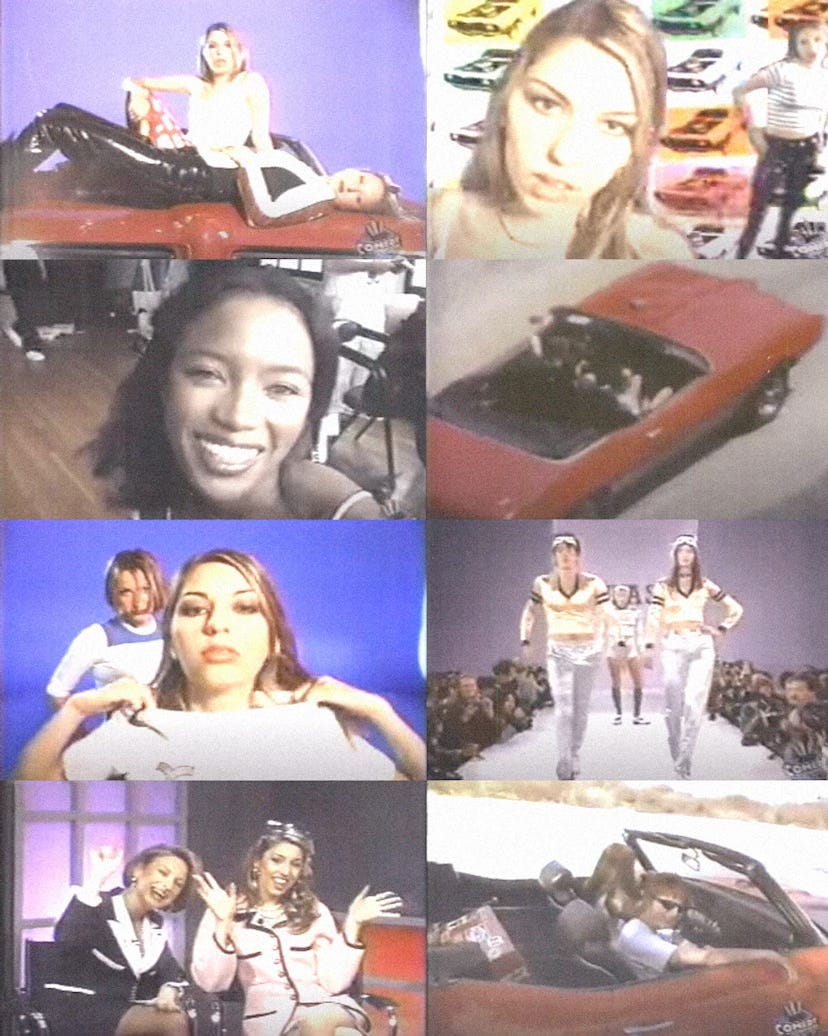
This one is genuinely wild. In 1994, Coppola and her best friend Zoe Cassavetes co-directed and co-hosted a television show called Hi Octane on Comedy Central. Only three of four recorded episodes ever aired. It was low-budget, experimental, quick-cut, completely chaotic and the guest list reads like a fever dream: Martin Scorsese, Naomi Campbell, Kim Gordon, Debbie Harry, Beastie Boys, Karl Lagerfeld, Thurston Moore, Keanu Reeves, Christy Turlington, Gus Van Sant, Anna Wintour, and Nicolas Cage.
The whole thing has a handmade, almost zine-like quality that tells you everything about the world Coppola was moving through at 23. It’s worth tracking down.
Before directing anything herself, Sofia appeared in a string of music videos that trace the exact cultural circle she inhabited. She played a manic, wild-eyed Joan Crawford in Sonic Youth’s “Mildred Pierce” (1991, directed by David Markey). She appeared in The Black Crowes’ “Sometimes Salvation” (1992, directed by Stéphane Sednaoui). She showed up alongside Madonna. And later, she starred in The Chemical Brothers’ “Elektrobank,” directed by her then-husband Spike Jonze.
These are documents of a specific creative community and era, and they show how deeply Sofia Coppola’s sensibility was shaped by music, fashion, and the people around her before she ever picked up a camera herself.
From 3:47
This is where Sofia Coppola’s influence on visual culture gets really tangible, and where most people underestimate the depth of the relationships.
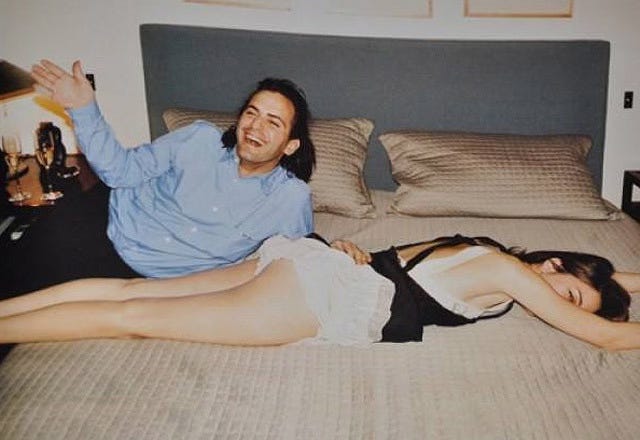
The Coppola-Jacobs relationship is one of the longest and most creatively productive friendships in fashion. It started in the early ‘90s and has produced: the “Sofia” handbag (2008), the SC Carryall bag she designed when Jacobs was creative director of Louis Vuitton (2009), her being the face of his original eponymous fragrance (2002), directing the Daisy fragrance campaigns (2013–2015), the Heaven by Marc Jacobs × The Virgin Suicides capsule collection (2021), and now — her first documentary, Marc by Sofia (2025), an intimate portrait of Jacobs that premiered out of competition at the 82nd Venice Film Festival.
That’s a creative conversation spanning three decades, and it culminated in a feature-length film distributed by A24 instead of simply a brand partnership. Despite the mixed reviews on the Marc by Sofia film, I visited the premiere a while ago in Soho House and genuinely really enjoyed the film.
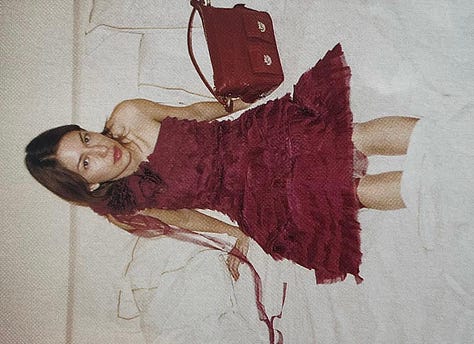
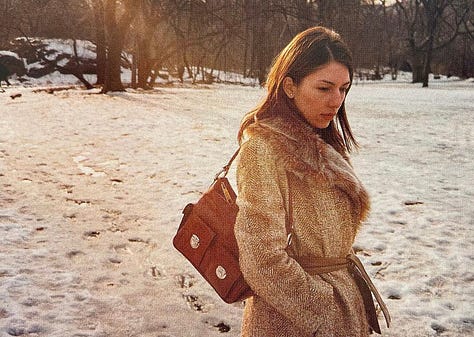
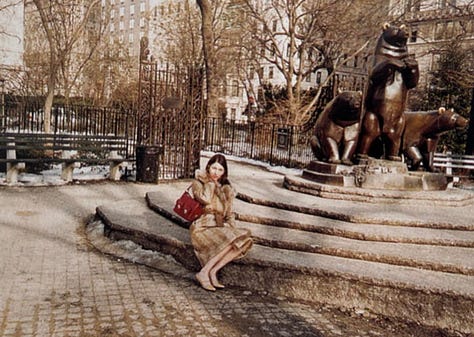
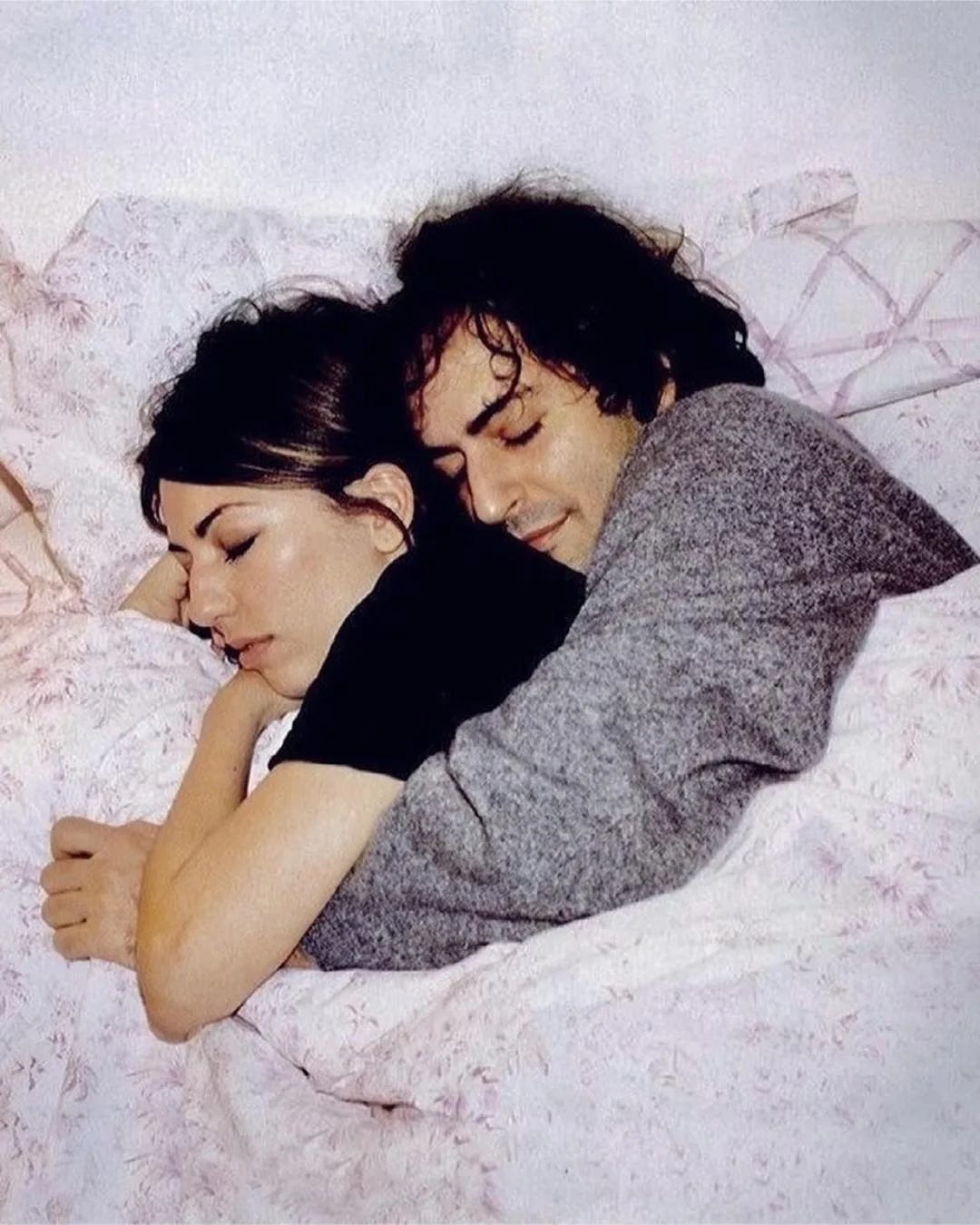
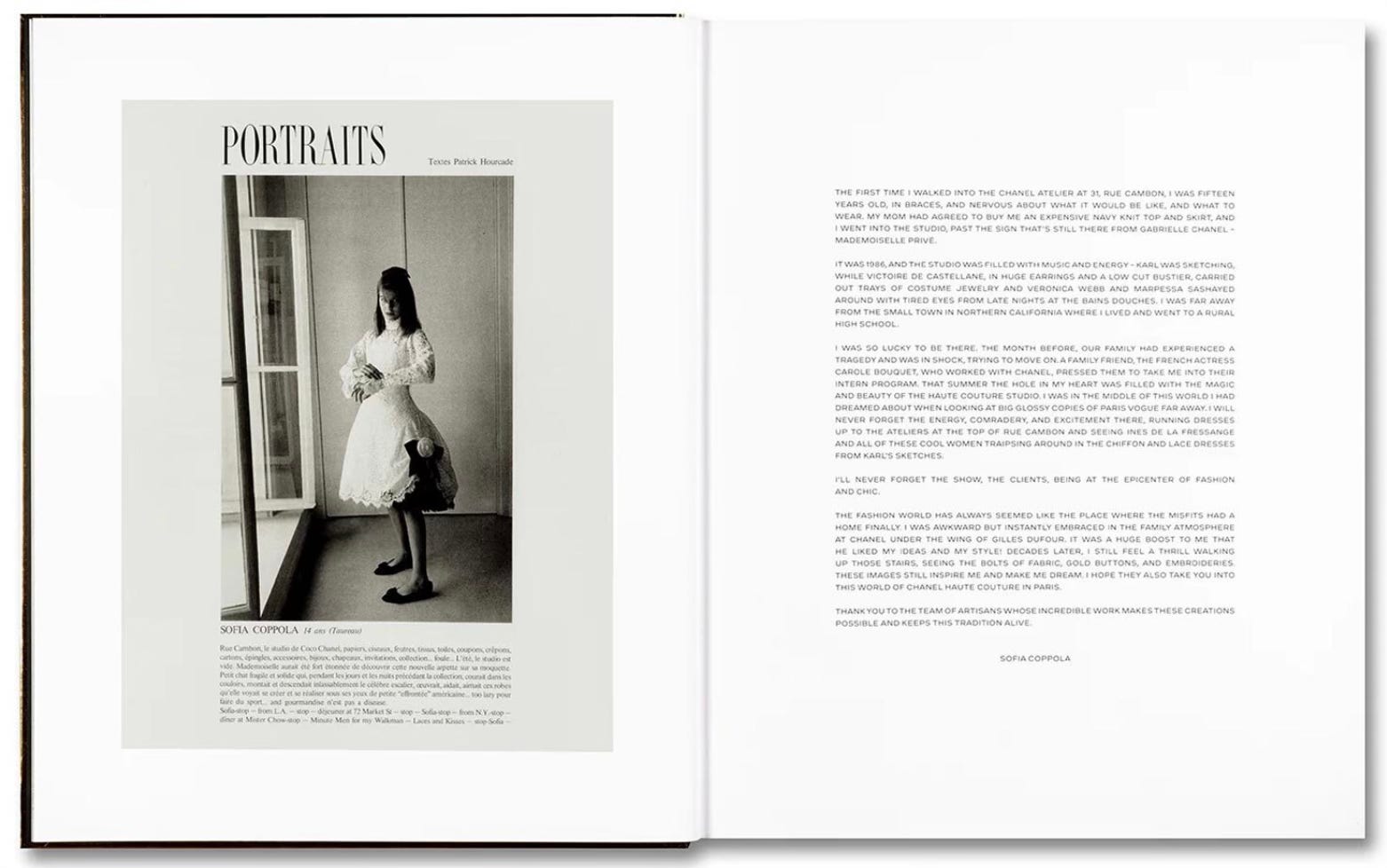
Here’s a detail I love. When Sofia Coppola was 15, following the death of her brother Gian-Carlo, family friend Carole Bouquet, a Chanel ambassador, arranged for her to do a summer internship at the Chanel studio in Paris. She’s described this experience as formative, a kind of emotional and creative refuge during the hardest period of her adolescence. That relationship with the house has never ended.
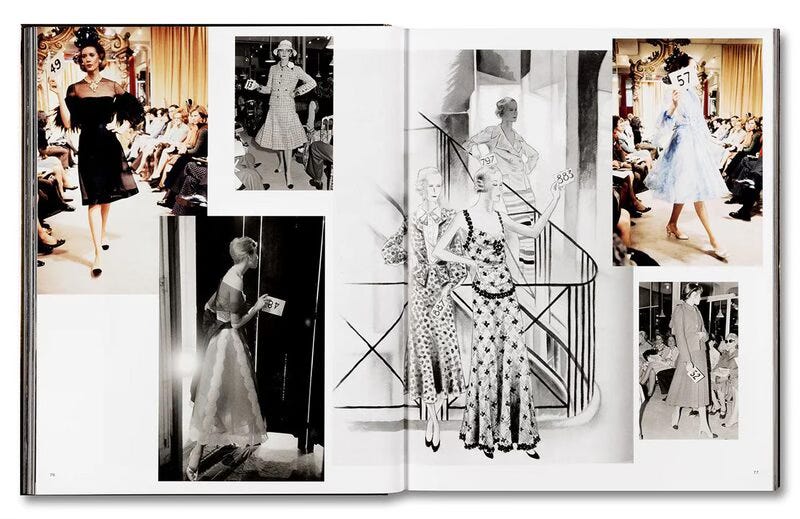
In recent years, she’s directed campaigns for the CHANEL 19 bag featuring Gracie Abrams, hosted a Chanel podcast for the Fall/Winter 2025 Haute Couture show (conversations with Géraldine Sarratia, Ramata-Toulaye Sy, and Carole Bouquet herself about their memories of 31 rue Cambon), and edited a 450-page volume on Chanel Haute Couture publishing through her own imprint in Autumn 2025. The through-line from a grieving teenager to the person entrusted with the house’s visual history is extraordinary.
Beyond the deep partnerships, Coppola has quietly built one of the most impressive commercial directing portfolios in fashion and luxury. Miss Dior Chérie with Natalie Portman. Calvin Klein Underwear SS17 — those grainy, black-and-white films celebrating women aged 18 to 73, featuring Kirsten Dunst, Rashida Jones, Laura Harrier, Maya Thurman-Hawke, and Lauren Hutton. Marni for H&M, shot at a villa in Marrakech starring Imogen Poots. The Cartier Panthère watch film, a dreamy 1980s-inflected short set in Los Angeles with a Donna Summer soundtrack. Gap holiday campaigns. A Suntory Whisky centennial commercial with Keanu Reeves — which, yes, is as Lost in Translation-coded as it sounds.
Every single one of these maintains her visual signature: warm tones, intimate framing, a sense of being let into a private world. She directs commercials the way she directs films. The brand adapts to her, not the other way around.
This feels like a natural evolution of everything we’ve been talking about, and it might be the most exciting chapter of the Coppola world right now.
In December 2024, Coppola launched Important Flowers, a publishing imprint with MACK Books. The name alone tells you something — it’s soft, specific, a little whimsical, completely her. The imprint publishes photobooks and art publications designed by Joseph Logan Design studio, and the first titles are deeply personal: a 25th anniversary edition of The Virgin Suicides featuring never-before-seen set photographs by Corinne Day, and the aforementioned Chanel Haute Couture volume.
But the imprint also produced something smaller and more intimate, a yearly planner with monthly spreads, wish lists for restaurants, movies, books, and hotels, and curated photography from her personal collection. It’s the kind of object that makes you understand what Coppola means when she talks about the importance of tangible things. I bought the 2025 version, but have to say that physical planners are not for me (or planners in general) as much as I would like to be that person..
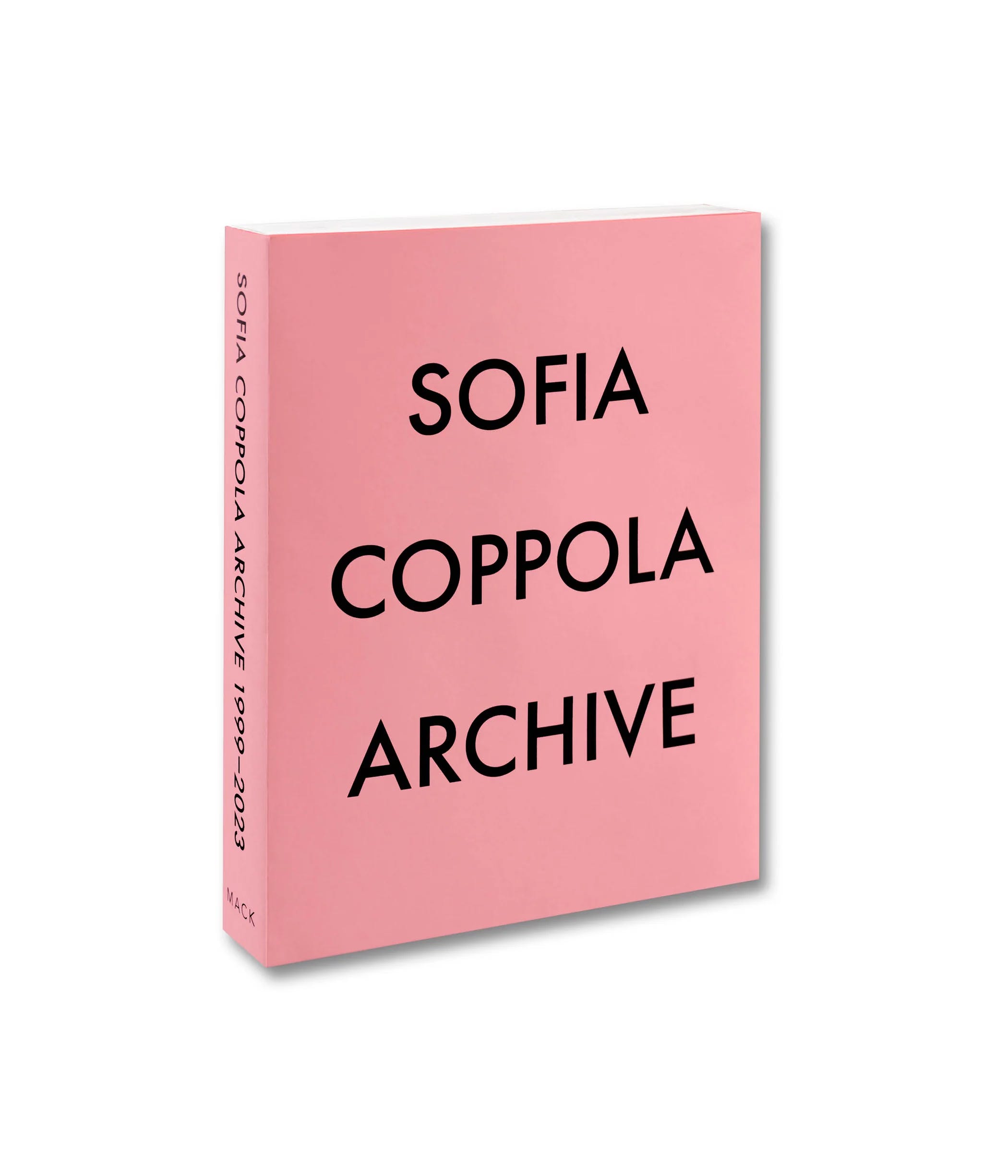
And this isn’t her first publishing project. In September 2023, MACK released Archive, her personal collection of photographs, development work, reference collages, annotated scripts, and behind-the-scenes ephemera spanning her entire filmmaking career. If you work in visual direction and you haven’t spent time with this book, you’re missing something genuinely valuable.
Sofia has always positioned herself in relation to photography, even when she’s not behind the camera herself. In Winter 2011/2012, she curated a Robert Mapplethorpe exhibition at Galerie Thaddaeus Ropac in Paris and what’s fascinating is what she chose. Not the confrontational work. Not the famous portraits. She selected rarely seen landscape and still life images, presenting a quieter, more contemplative Mapplethorpe that most people didn’t know existed. The curatorial choice itself was a kind of art direction and she reframed an entire artist’s legacy by choosing what to show and what to leave out.
More recently, as mentioned in the beginning of this post, she curated a display of her favourite photobooks at the V&A in South Kensington (on view until March 2026). Her selections such as Eggleston, Szabo, Modica, Deanna Templeton, Lee Friedlander, Luigi Ghirri, read like a masterclass in the kind of image-making that prioritises atmosphere over statement, feeling over concept.
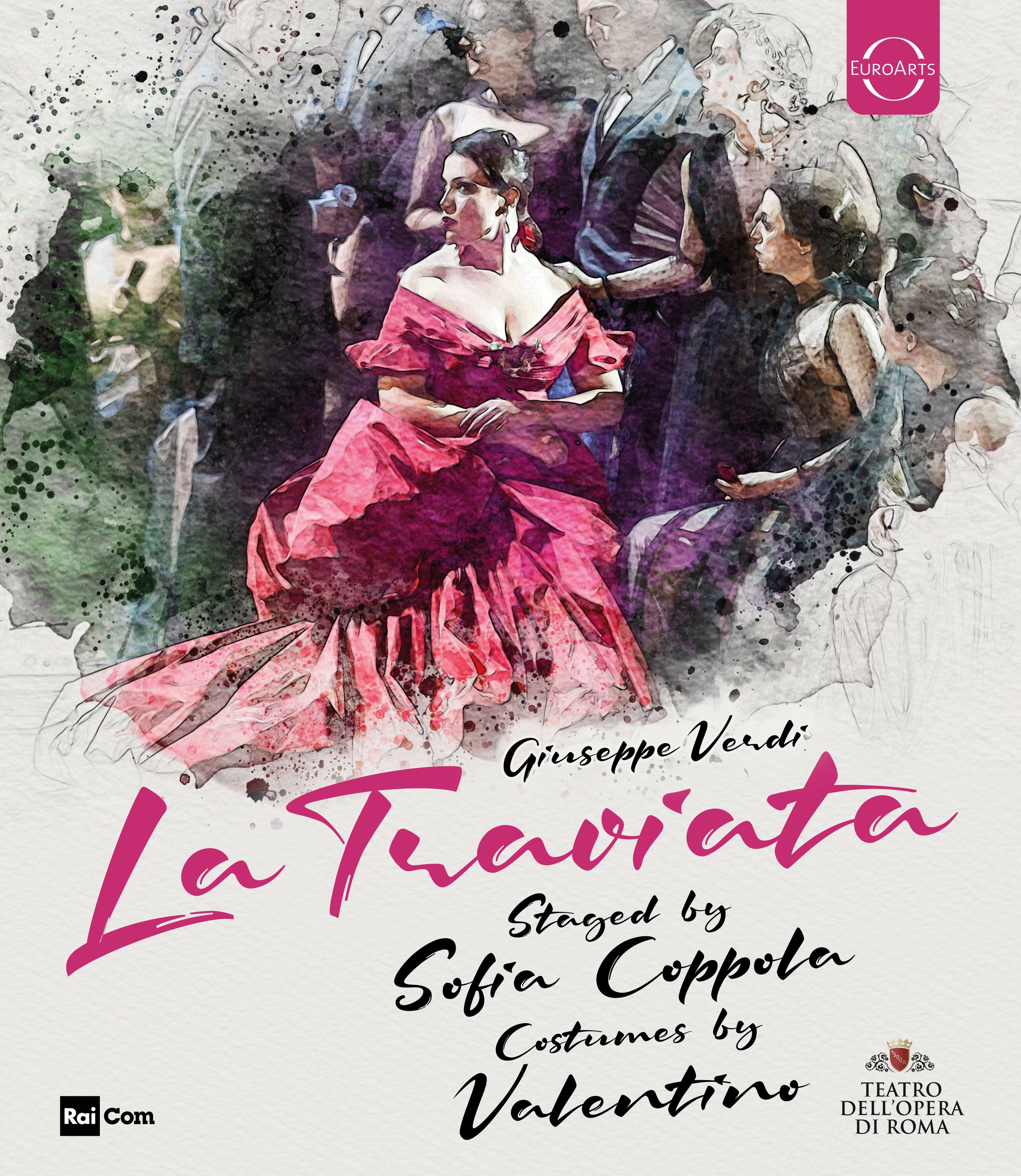
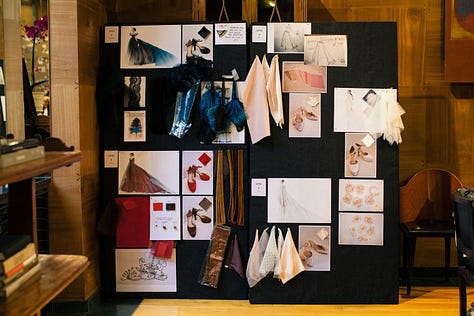
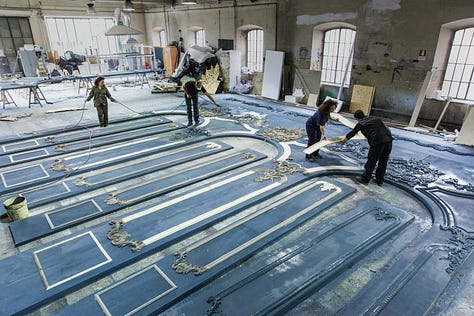
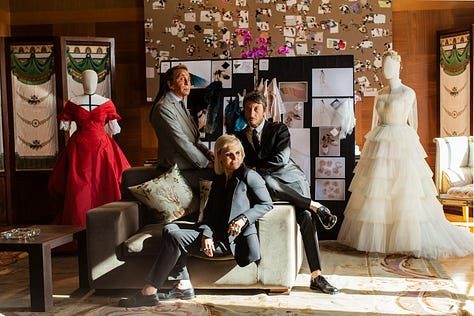
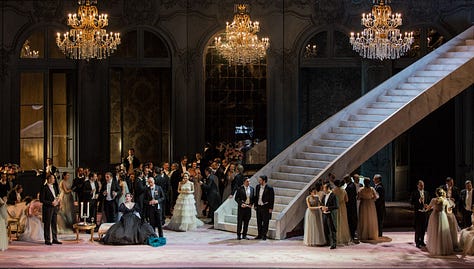
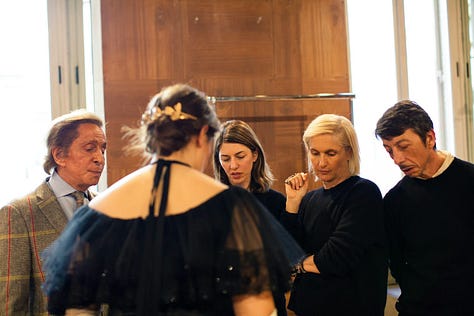
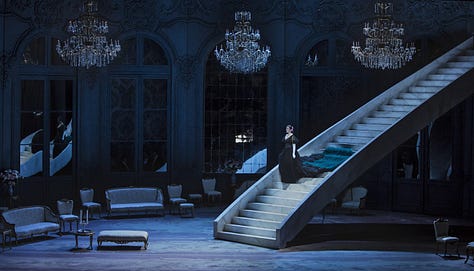
In 2016, Valentino Garavani personally invited Sofia Coppola to direct La Traviata at the Teatro dell’Opera di Roma after watching Marie Antoinette. He saw in her something that could translate the emotional excess and beauty of his couture into live performance. Valentino designed the costumes for the lead character; Maria Grazia Chiuri and Pier Paolo Piccioli dressed the chorus.
All 15 performances sold out immediately. The production was filmed by Arte/ZDF for broadcast in Germany and France. Coppola’s directorial approach brought the same intimate, emotionally specific quality she brings to film, the camera (or in this case, the audience’s gaze) always felt close to the characters, always invested in the interior emotional experience rather than the spectacle.
I can’t write about the Coppola world without touching on Phoenix. Sofia actually married Thomas Mars, the band’s frontman, on August 27, 2011, at Palazzo Margherita in Bernalda, Italy. They met during the production of the Virgin Suicides the soundtrack and Thomas Mars sang and played drums on Air’s “Playground Love” under the pseudonym Gordon Tracks (fun fact!)
Since then, Phoenix has contributed to every single Coppola feature. They appeared as 18th-century lute players in Marie Antoinette. Thomas Mars, the lead singer and her husband, composed the scores for Somewhere, The Beguiled, and On the Rocks. Their daughter Romy Mars launched her own music career in 2024. The creative exchange between Coppola and Mars is one of those partnerships where it becomes impossible and unnecessary to separate who influenced whom.
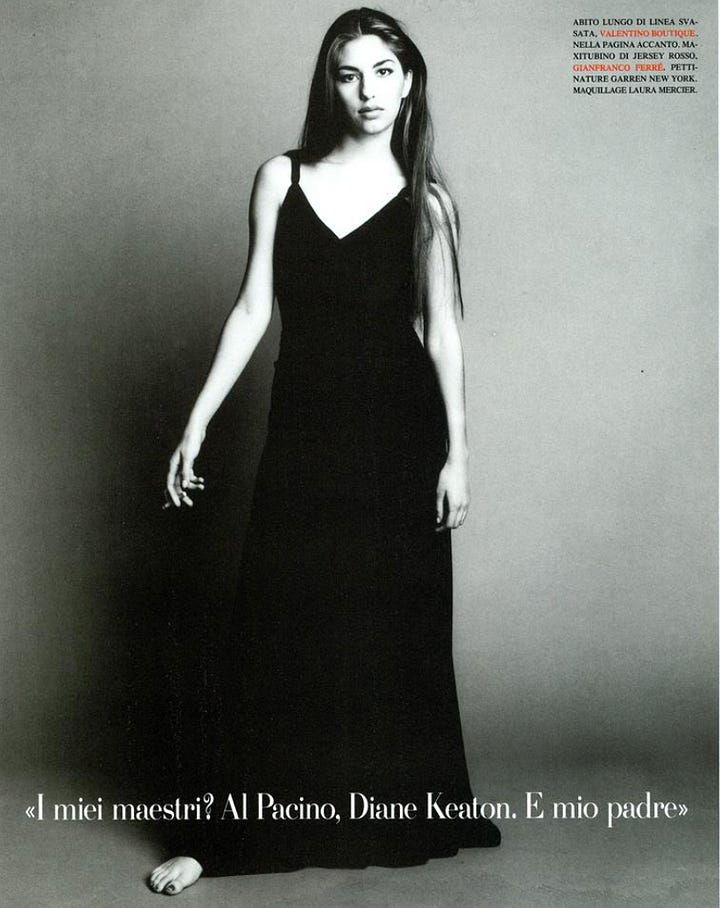
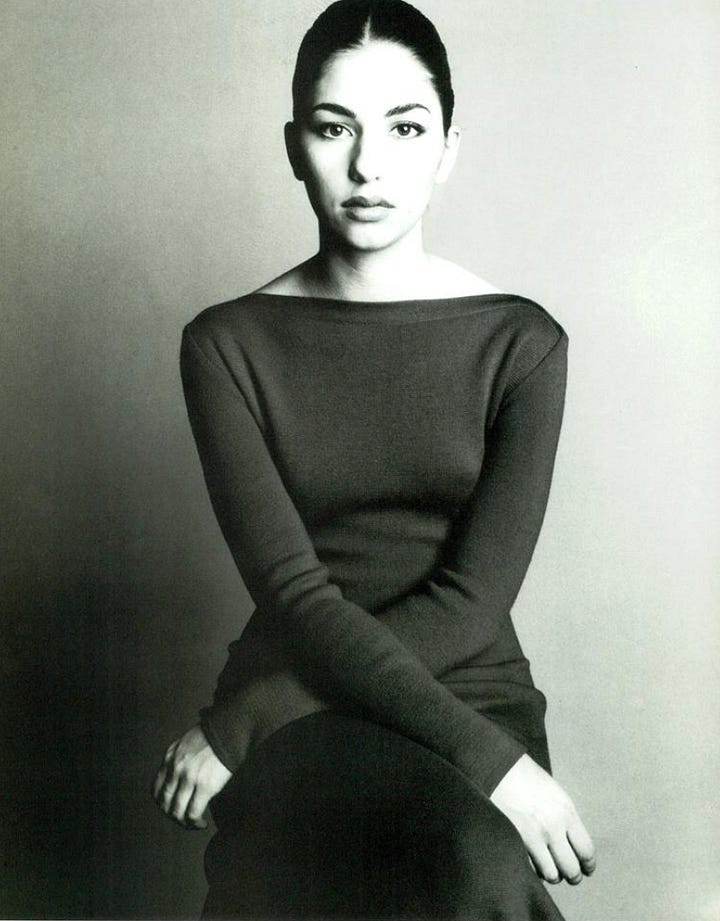
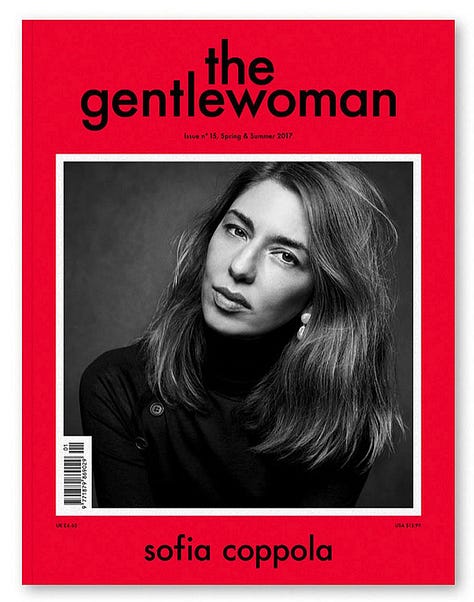
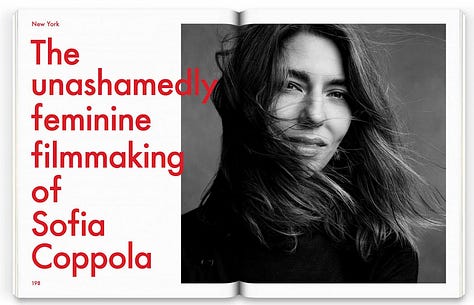
Part of understanding the Coppola world is seeing how she’s been seen and by whom. Here’s a visual archive of key magazine appearances and features:
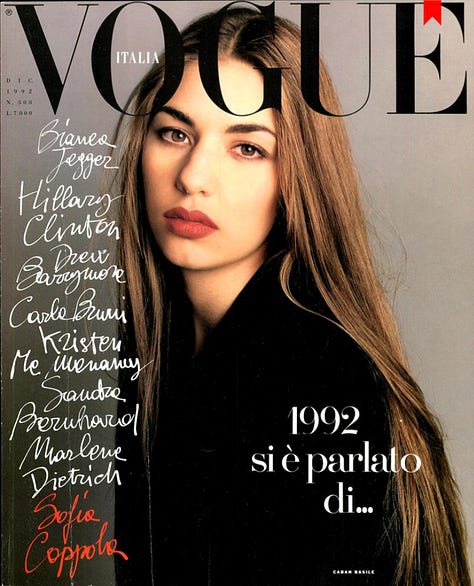
Vogue Italia — December 1992 cover photographed by Steven Meisel, styled by Lori Goldstein. Sofia was here just 21 years old.
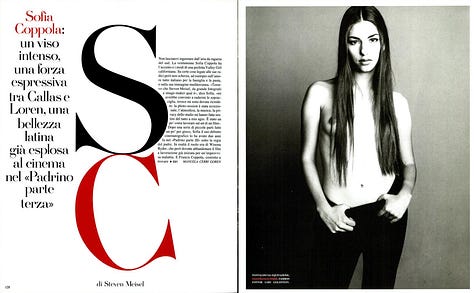
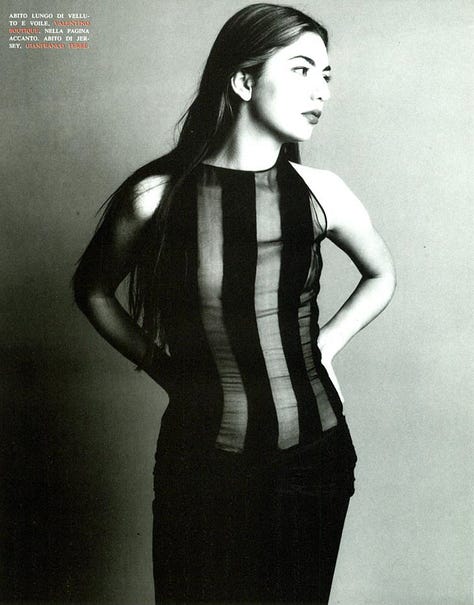
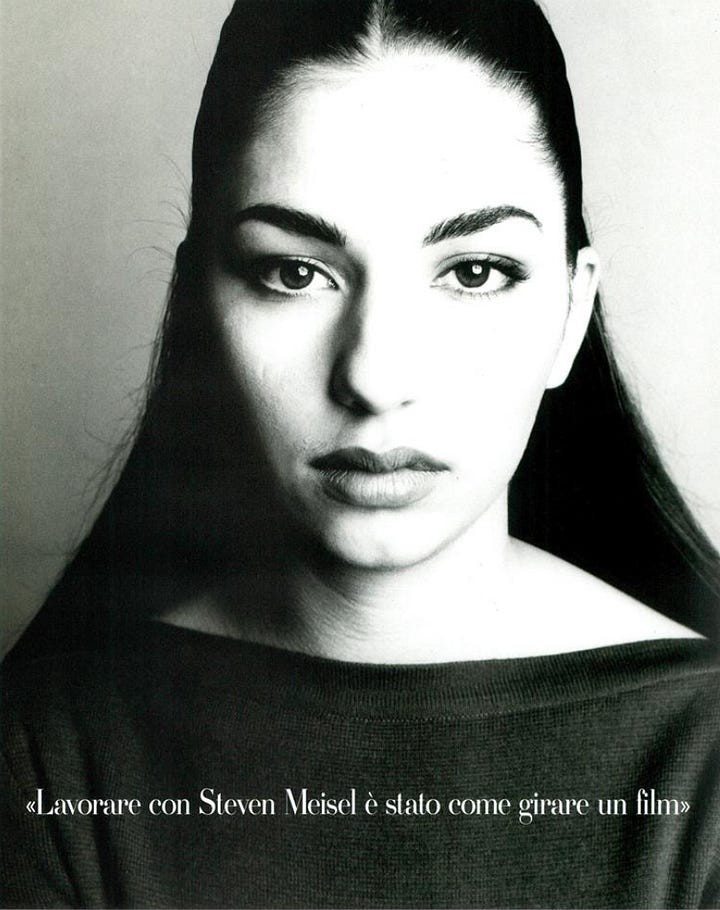
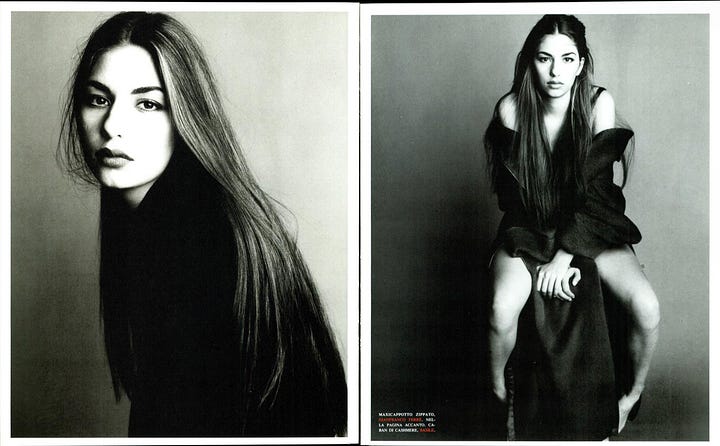
Dazed & Confused — November 2006 cover, photographed by Yelena Yemchuk at the Pierre Hotel. Six-page editorial. Also Summer 2017 cover with major interview. I recently covered this on my other Substack, the Art Direction Library.
The Gentlewoman — Issue #15, Spring/Summer 2017. One of the best profiles.
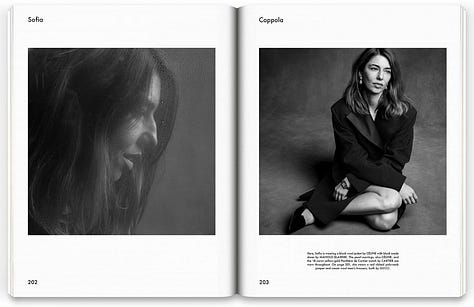
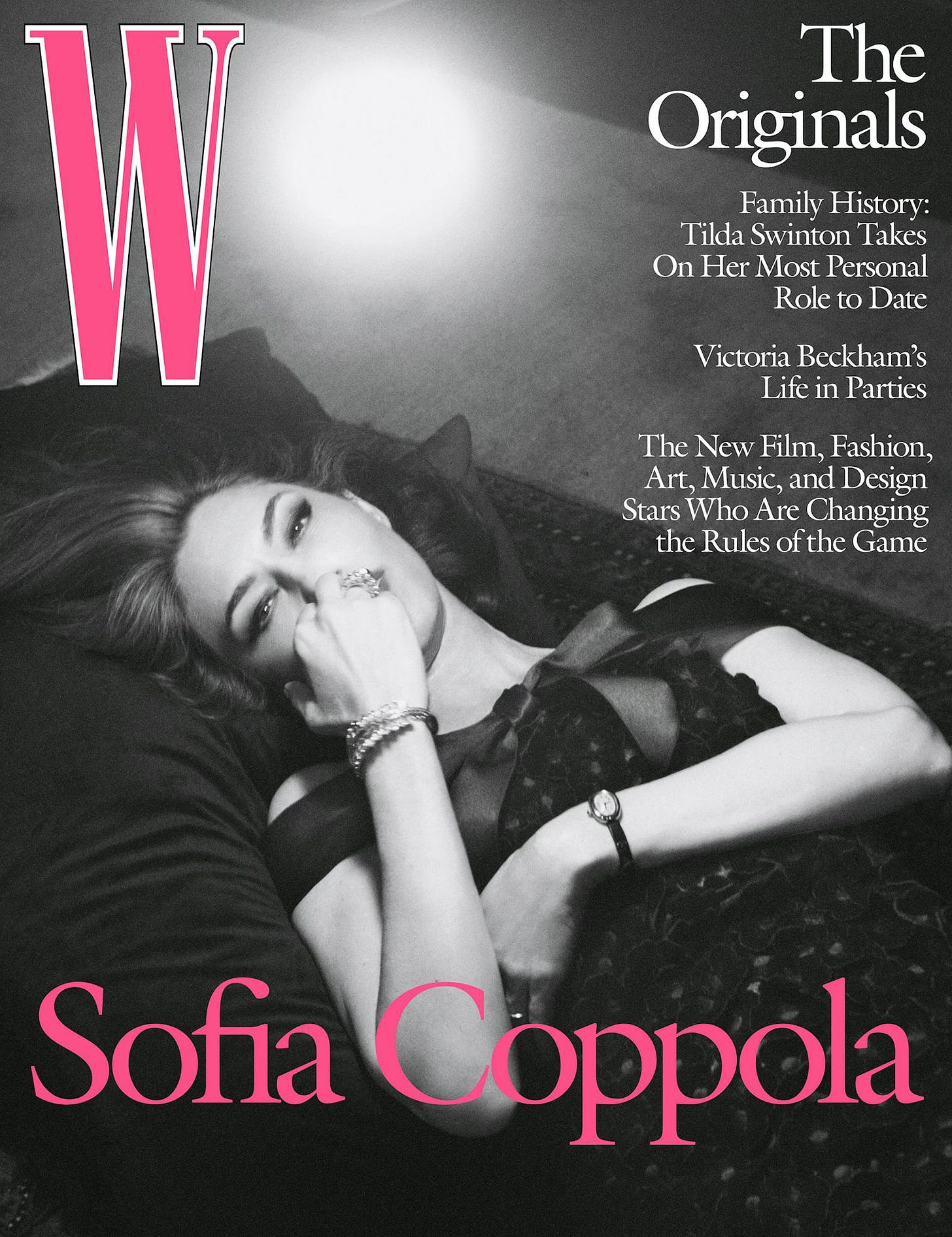
W Magazine — Multiple features including the September 2023 Priscilla cover story and Directors Issue.
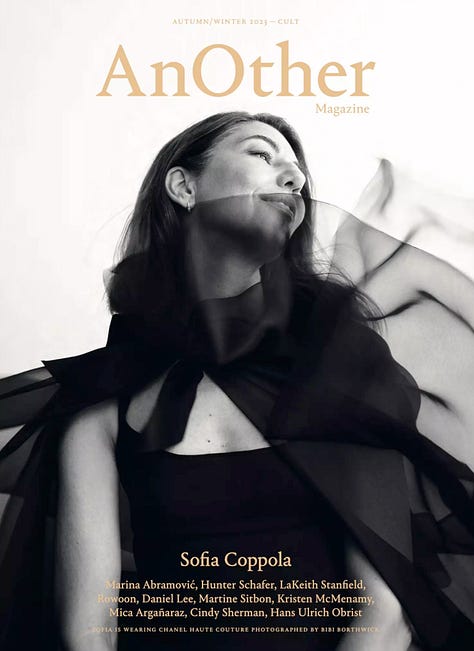
AnOther Magazine — Autumn/Winter 2023 feature, plus a conversation with Cindy Sherman.
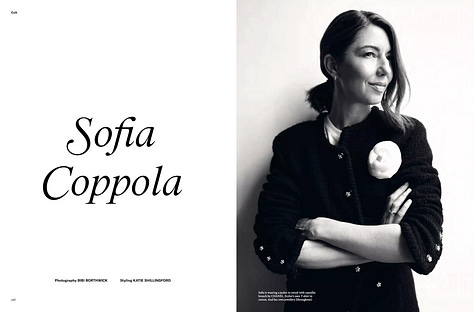
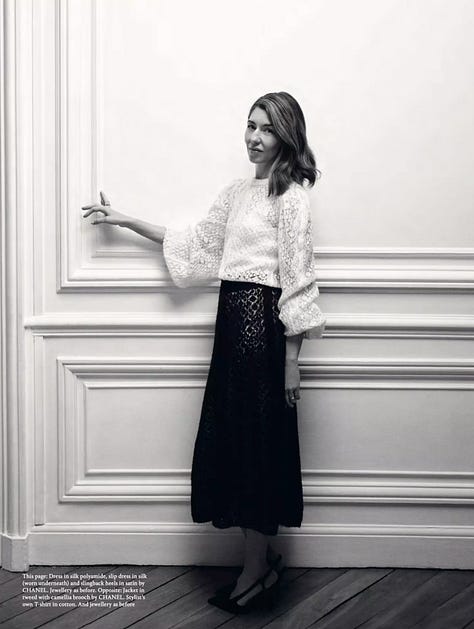

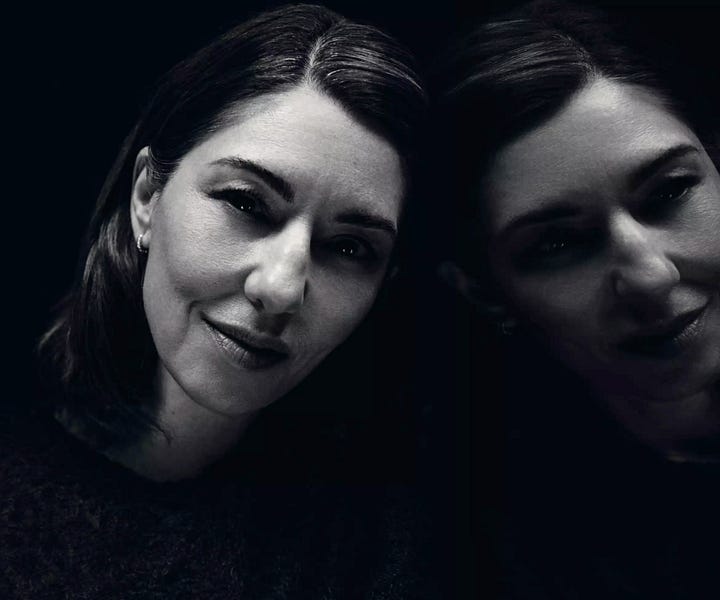
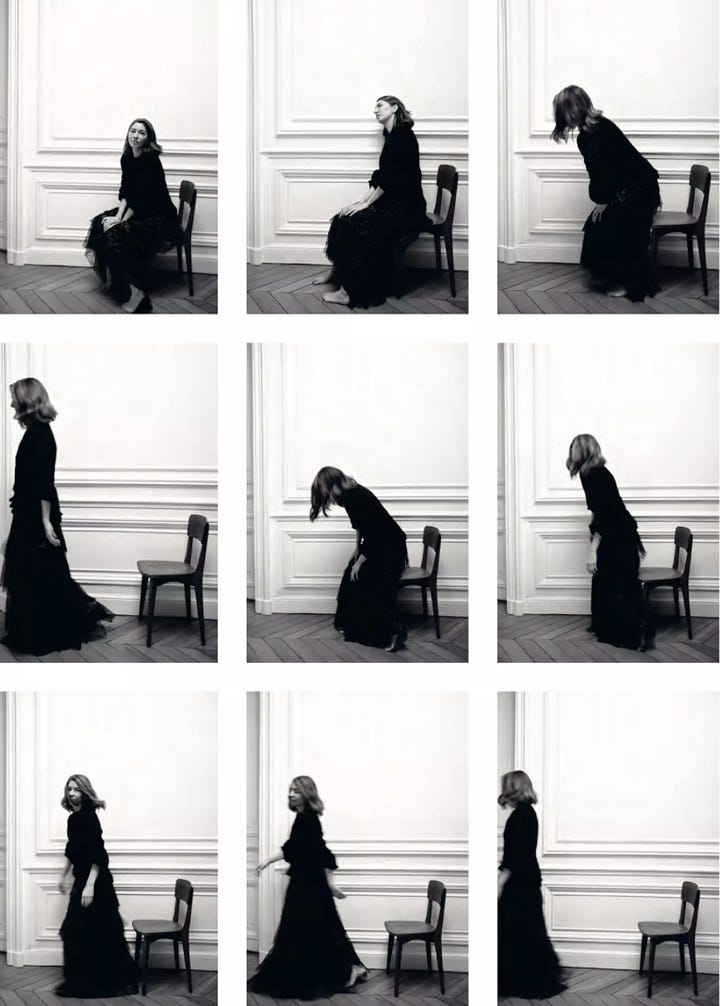
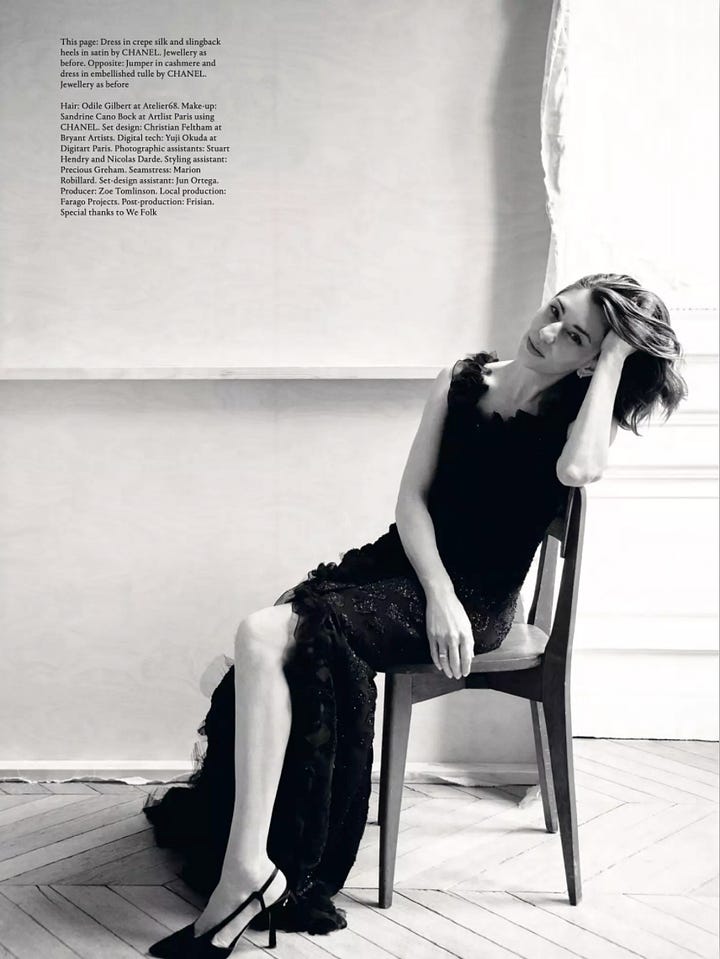
Interview Magazine — Recurring presence including their "Legends" series.
Aperture — Summer 2018 "Film & Foto" issue, in-depth interview about photography's influence on her filmmaking.
i-D — Coverage of her style, influences, and Virgin Suicides book.
I think the reason I keep coming back to Sofia Coppola isn’t really about fandom, it really is about method. She demonstrates something that I find increasingly rare and increasingly important: the ability to maintain a completely coherent visual identity across every medium, every collaboration, every decade, without it becoming rigid or self-referential.
She publishes books that look like her films. She directs commercials that feel like her photographs. She curates exhibitions that reveal her influences. She designs planners that have the same intimate, considered quality as her movie sets. Nothing she touches feels like a departure because everything she does comes from the same place — that specific, soft, melancholic, intimate way of seeing.
For art directors, the lesson isn’t “be like Sofia Coppola.” It’s that a genuine creative point of view, one rooted in real research, real influences, real emotional specificity that can extend infinitely without ever thinning out. The world she’s built shouldnt be simply seen as an exervise of personal branding. It’s the natural result of someone who has spent 30 years looking very carefully at things and knowing exactly what she thinks about them.
I’d love to hear what resonates with you from this — which parts of the Coppola universe you’ve explored, which ones surprised you. Drop it in the comments.
Love, Zoe
Comments
Nothing yet. Say the first thing.
Sign in to join the conversation.