
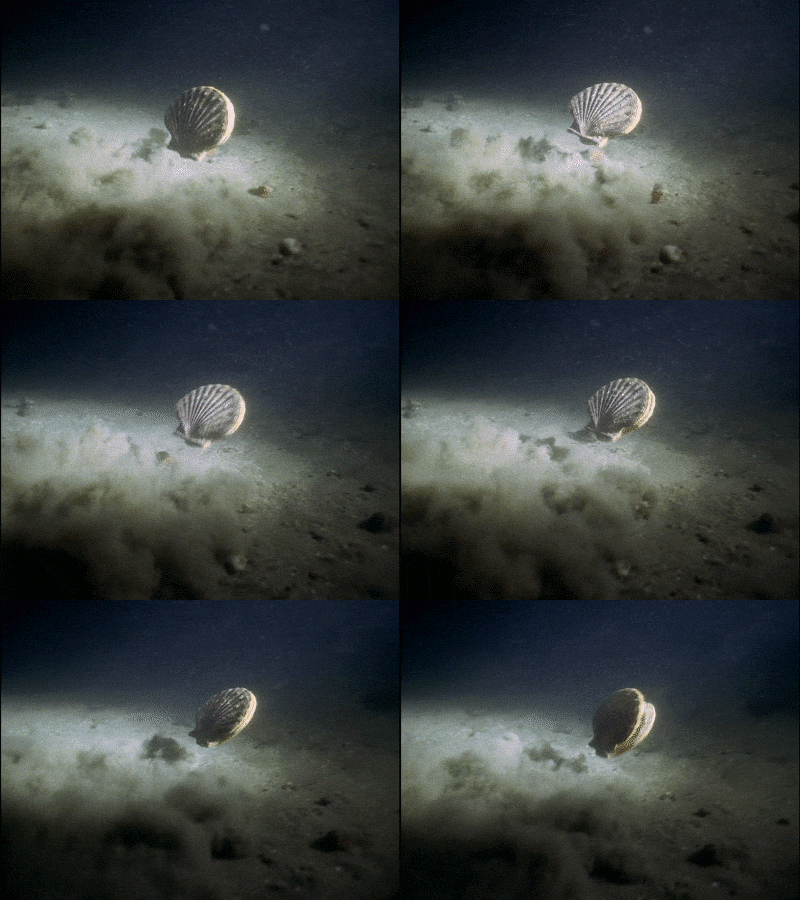
There is an object so ancient, so widely carried, so quietly powerful that historians still struggle to fully map her reach.
She has been found in the tombs of Egyptian queens. She has been cast by Yoruba oracles in Nigeria. She has been woven into the hair of women crossing the Pacific. She has been traded across the Silk Road, the Niger Delta, the coast of Bengal and the shores of the Caribbean.
She predates every currency you have ever held in your hand.
She predates writing.
She predates the idea of borders.
Her name is the cowrie shell. And this is her full story.
The Writings On The Wall is a reader-supported publication. To receive new posts and support my work, consider becoming a free or paid subscriber.
01 · She Was Here Before Money.
Origins · 40,000 BCE
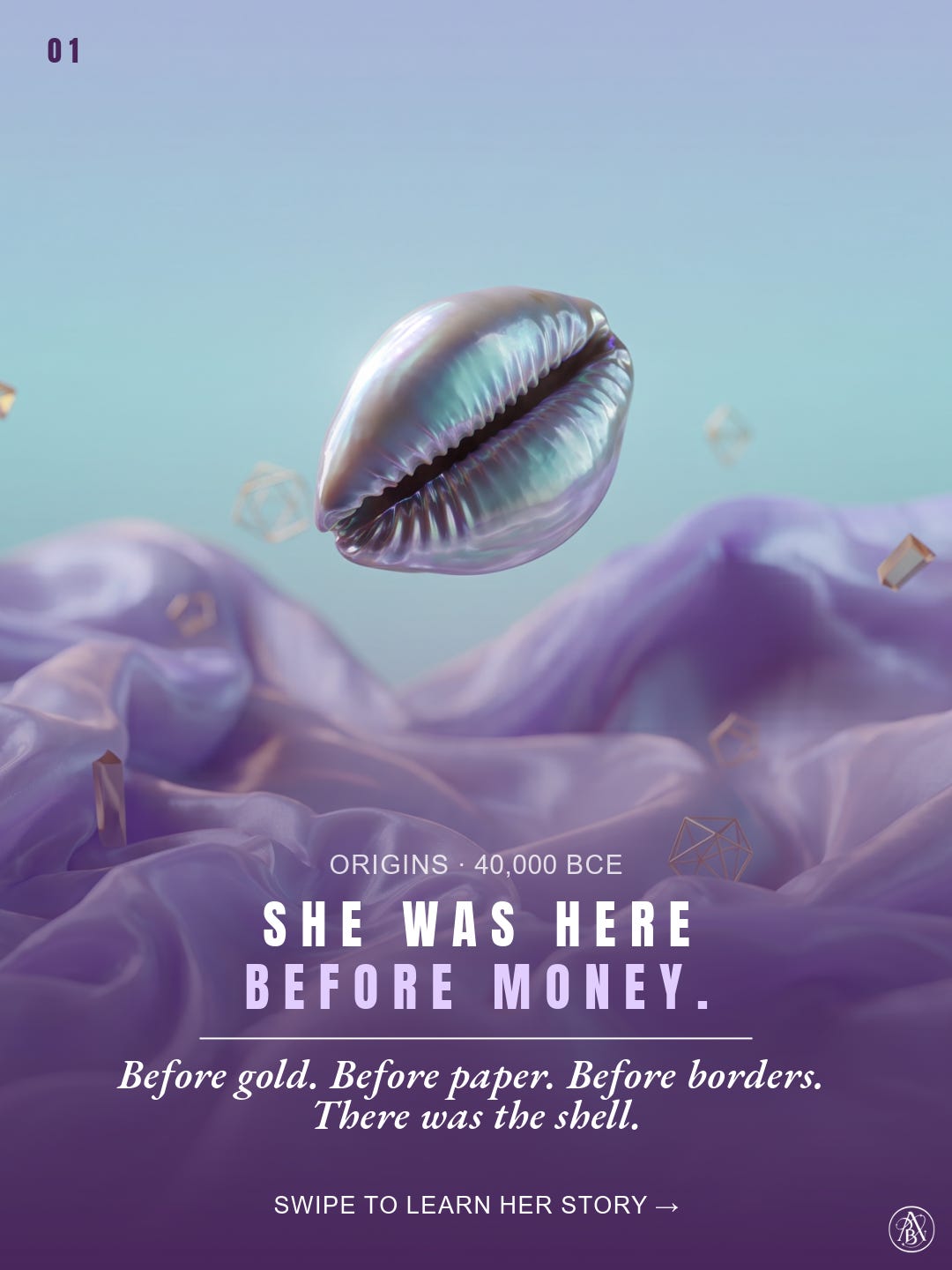
Before gold was mined. Before paper was pressed. Before anyone thought to put a price on something sacred — the cowrie was already being carried.
Archaeological evidence places cowrie shells in human hands as far back as 40,000 years ago. They have been found in burial sites, woven into ceremonial objects, placed on the bodies of the dead as protection for the journey beyond.
Humans across Africa, Asia and the Pacific — cultures that had never met, that shared no common language — all independently reached for the same object.
That is not coincidence. That is frequency.
She was the world’s first global currency. But currency was never all she was.
02 · Born from the Womb of the Sea.
Symbolism · Creation
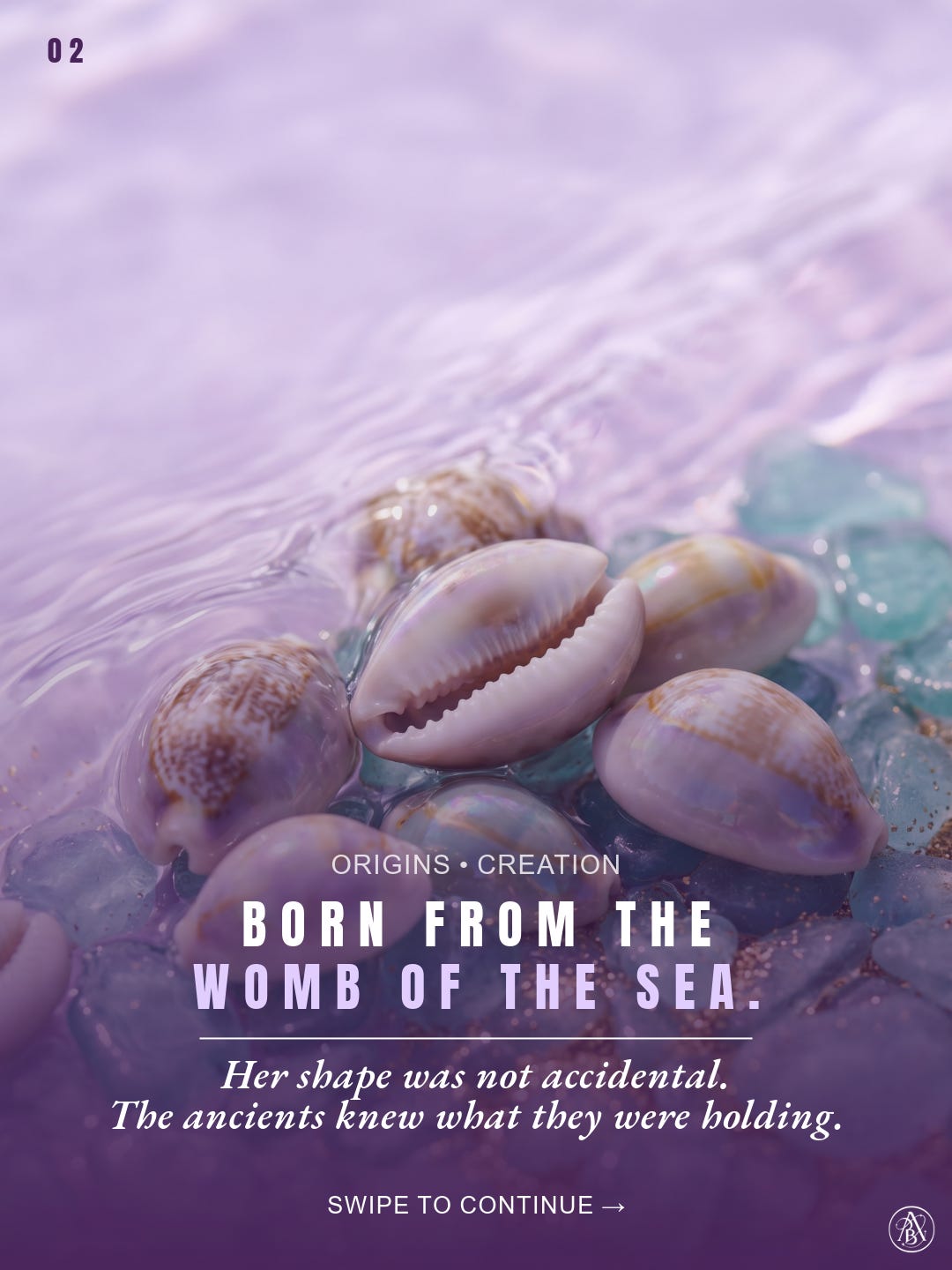

The cowrie did not become sacred by accident.
Look at her form. The smooth, domed back. The narrow, toothed aperture. The way she opens.
Ancient cultures from Egypt to China to West Africa saw in her shape an echo of the feminine body. Specifically of birth, of the life-giving passage, of the portal through which all human life enters the world.
Her scientific name, Cypraea moneta, derives from Cyprus. The mythic birthplace of Aphrodite, goddess of love, beauty and creation. The Romans called the cowrie Concha Veneris, the shell of Venus.
She was never just a shell. She was a portal between worlds. A symbol of the divine feminine written in calcium and sea.
She was nature’s first amulet.
03 · The First Language.
Adornment · Sacred Textiles
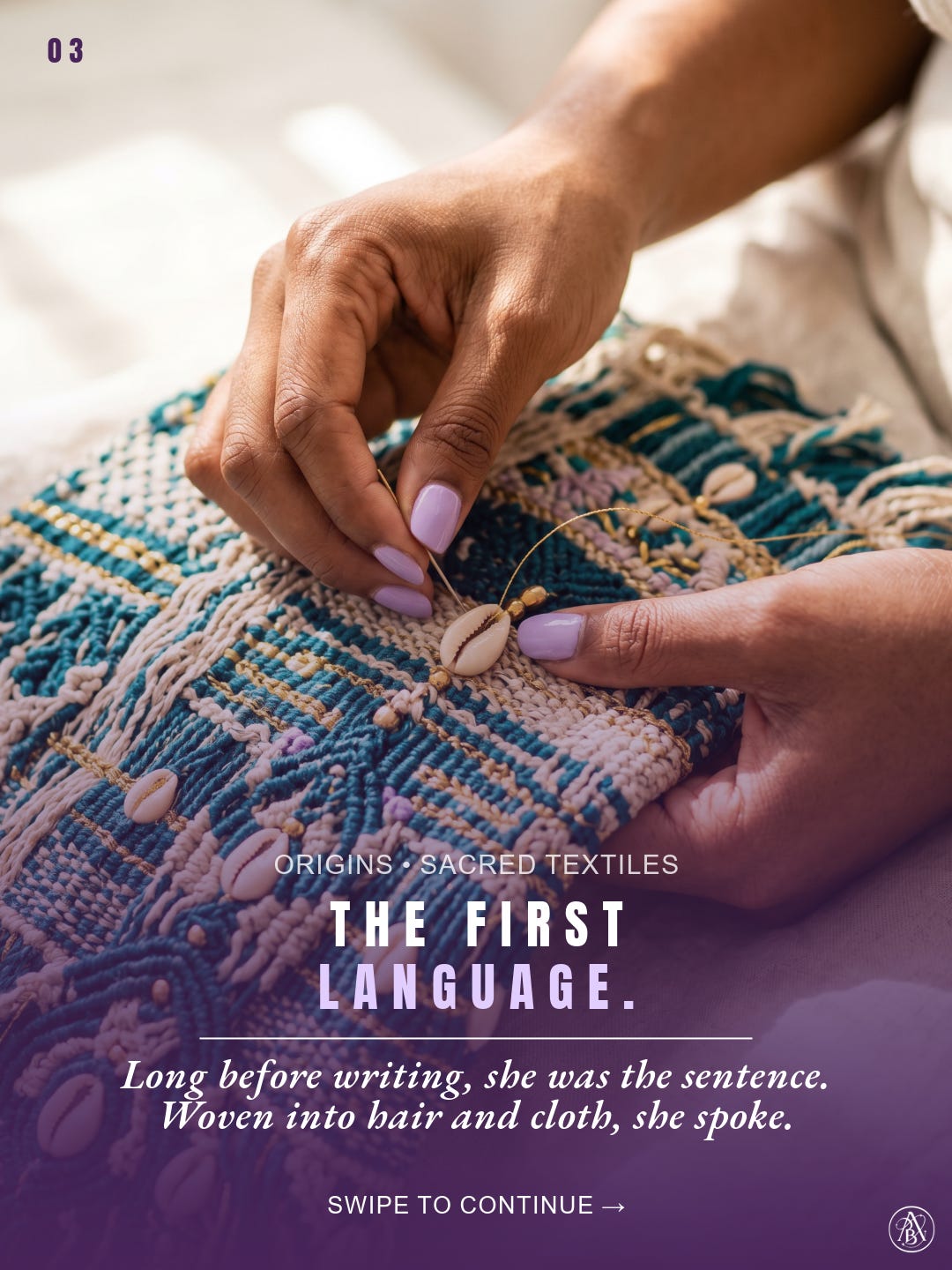
Long before alphabets were carved into stone, women were writing in shells.
Cowries woven into hair, stitched into ceremonial cloth, threaded onto the bodies of the living and the dead, this was a language. Specific and intentional. Each placement carried meaning that the community could read.
A cowrie worn at the crown of the head: divine protection. A cowrie at the waist: fertility and feminine power. A cowrie on a burial cloth: safe passage.
From the earliest West African kingdoms to the ancient cultures of the Pacific Islands, this symbolic language was shared, taught and passed between women across generations.
She was the original written word. And she was worn by women first.
04 · The Gateway She Built.
Architecture · Sacred Space · 3,000 BCE
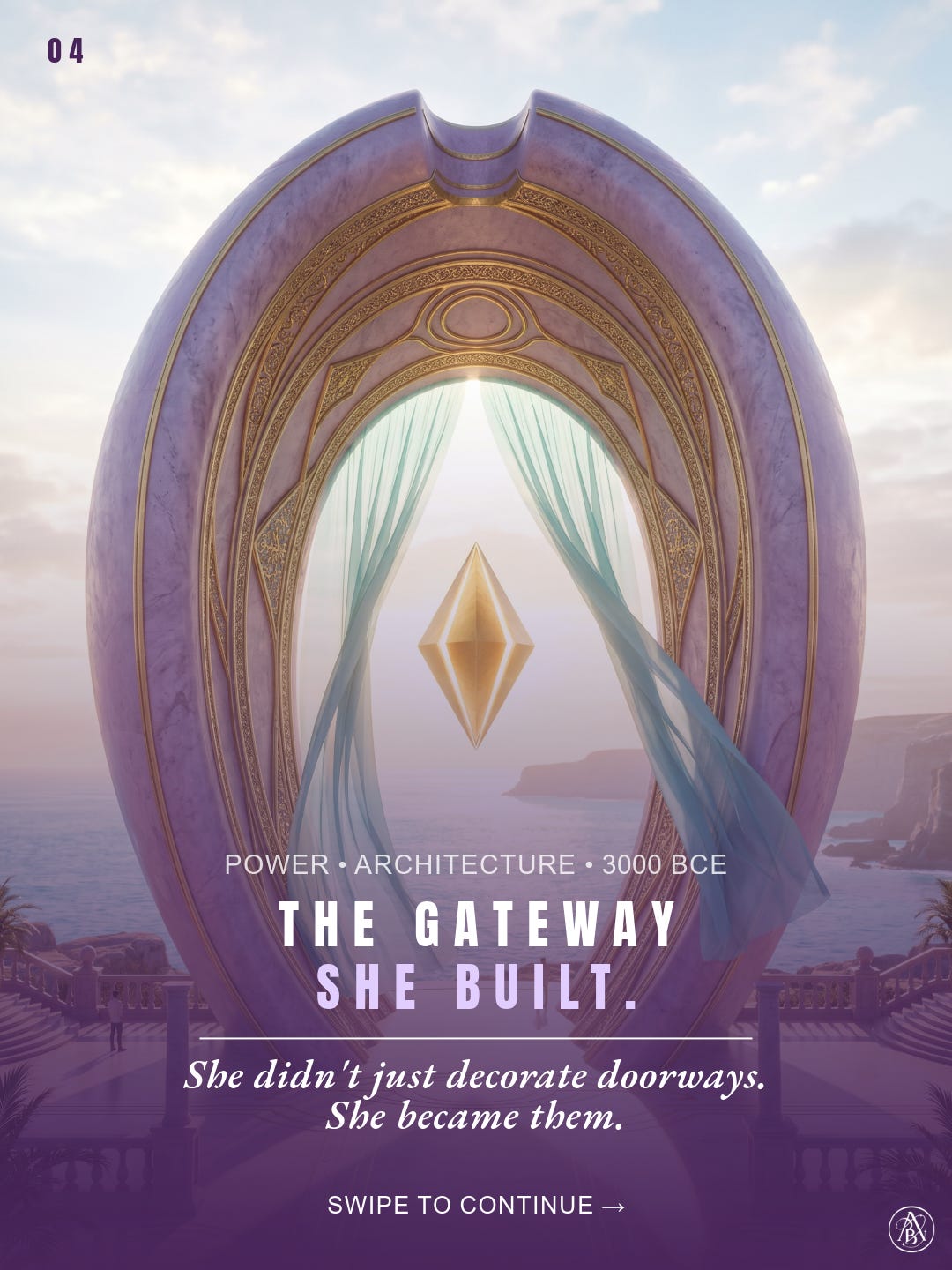
In ancient temples across West Africa, South Asia and the Pacific, architects and spiritual leaders did something remarkable.
They built doorways in her shape.
The cowrie’s aperture, that narrow toothed opening was understood as a threshold. A passage between the ordinary and the sacred. Between who you were when you arrived and who you would become when you left.
To walk through a cowrie-shaped doorway was to be reborn. To cross from the mundane into the divine. To enter a state of transformation.
This is why the concept of the sanctuary, a space deliberately separated from the noise of ordinary life. Designed to hold a different kind of energy, is as old as the cowrie herself.
Every sanctuary needs a door worth walking through.
05 · She Carried Wealth on Her Body.
Currency · Power · 1,000 BCE
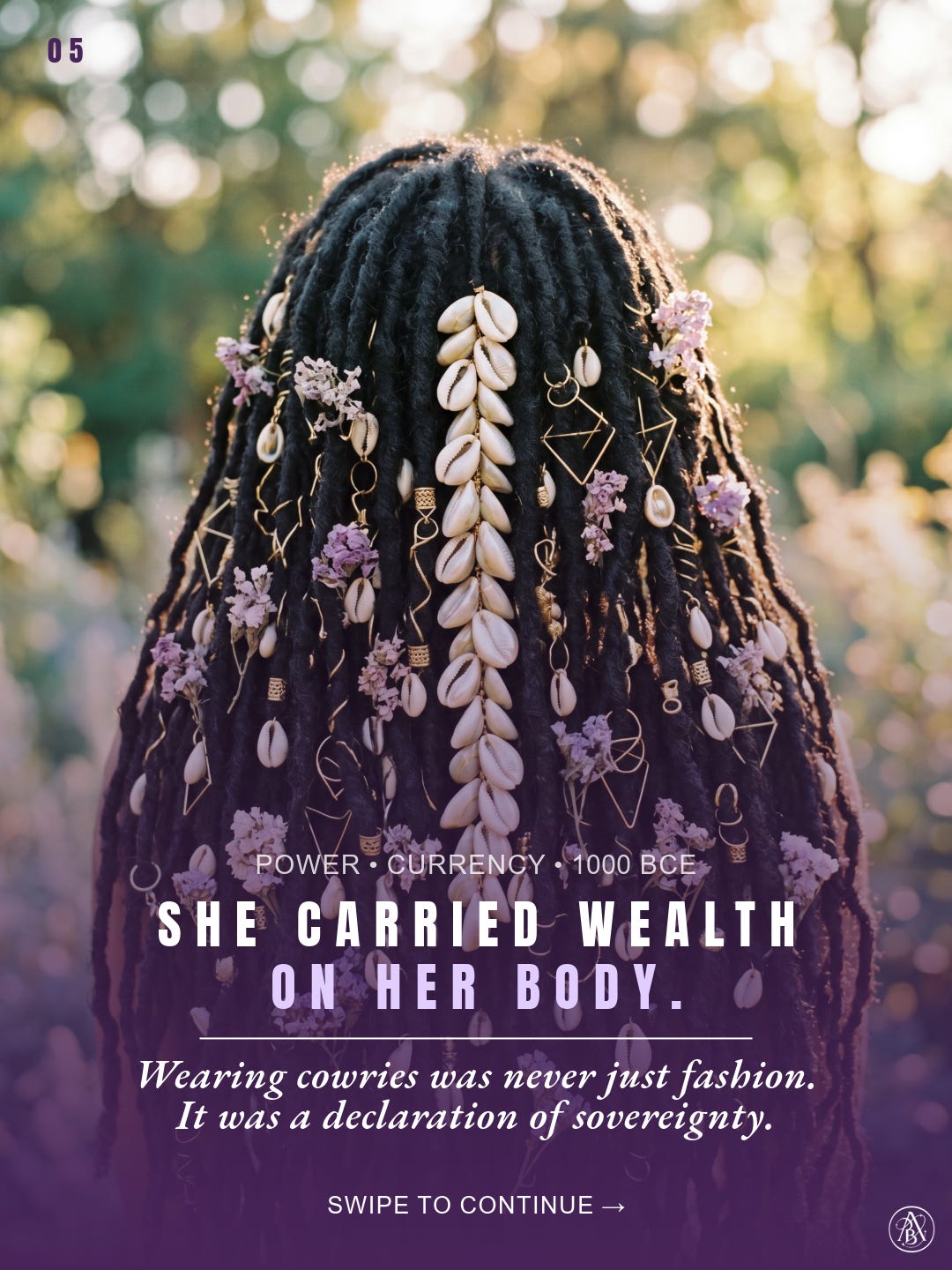
For over 3,000 years, the cowrie shell was the most widely circulated currency on earth.
She crossed the Silk Road. She built kingdoms along the Niger Delta. She funded harvests in Bengal. She sealed marriages and memorialised the dead from the coast of East Africa to the shores of the Caribbean.
One shell could feed a family for a day. A string of shells could buy land.
And women wore them.
Not as decoration. As a living ledger of status, protection and lineage. A woman adorned in cowries was announcing something the entire community could read: I am prosperous. I am protected. I am descended from something ancient and powerful.
Adornment as archive. Beauty as a financial statement. The body as a vault.
This is why, when you see cowries woven into hair today, you are seeing something that stretches back thousands of years. A declaration that has never stopped meaning exactly what it always meant.
06 · The Fortune Teller’s First Tool.
Divination · Wisdom · Clarity
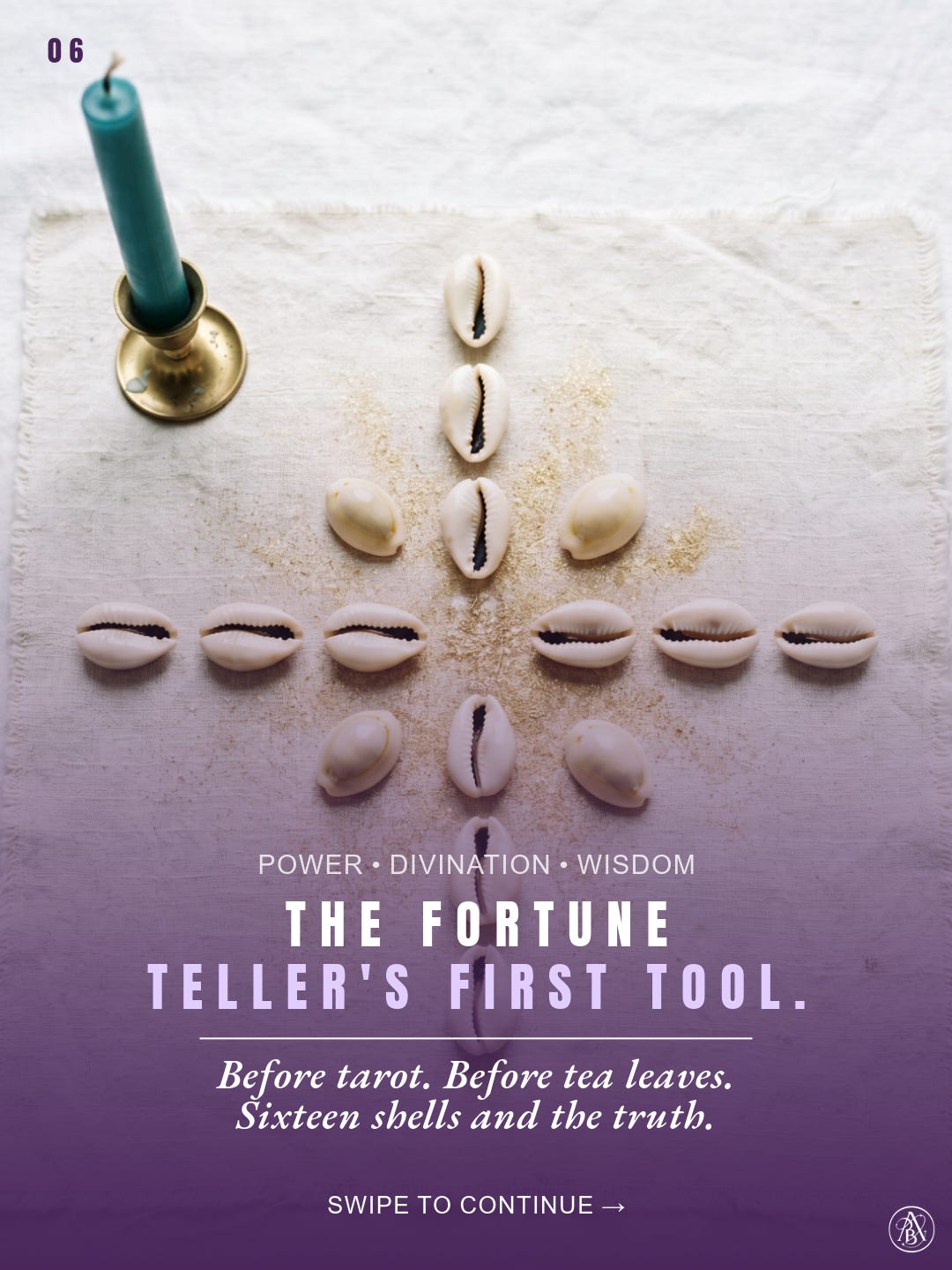
Before tarot cards. Before crystal balls. Before any of the divination tools that exist in modern spiritual practice. There were sixteen cowrie shells and a trained hand that knew how to read them.
Diloggún is the Yoruba oracle system that uses sixteen cowrie shells cast onto a mat to reveal messages from the divine. Each combination of shells, how many land aperture-up, how many face down - corresponds to one of 256 possible verses. Each containing its own stories, warnings, remedies and wisdom.
Practitioners spend years, sometimes decades, learning to read Diloggún. It is not guesswork. It is a sophisticated system of knowledge, passed orally from teacher to student across thousands of years. That has survived colonisation, the middle passage and forced religious conversion.
The shells do not predict the future. They reflect what is already true. The patterns, the energies, the choices. This is so that the person seeking guidance can see their situation more clearly.
She consulted the shell before any decision that mattered.
Some things are ancient because they work.
07 · Stolen. Renamed. Sold Back.
Colonial Trade · Reckoning · 1700s
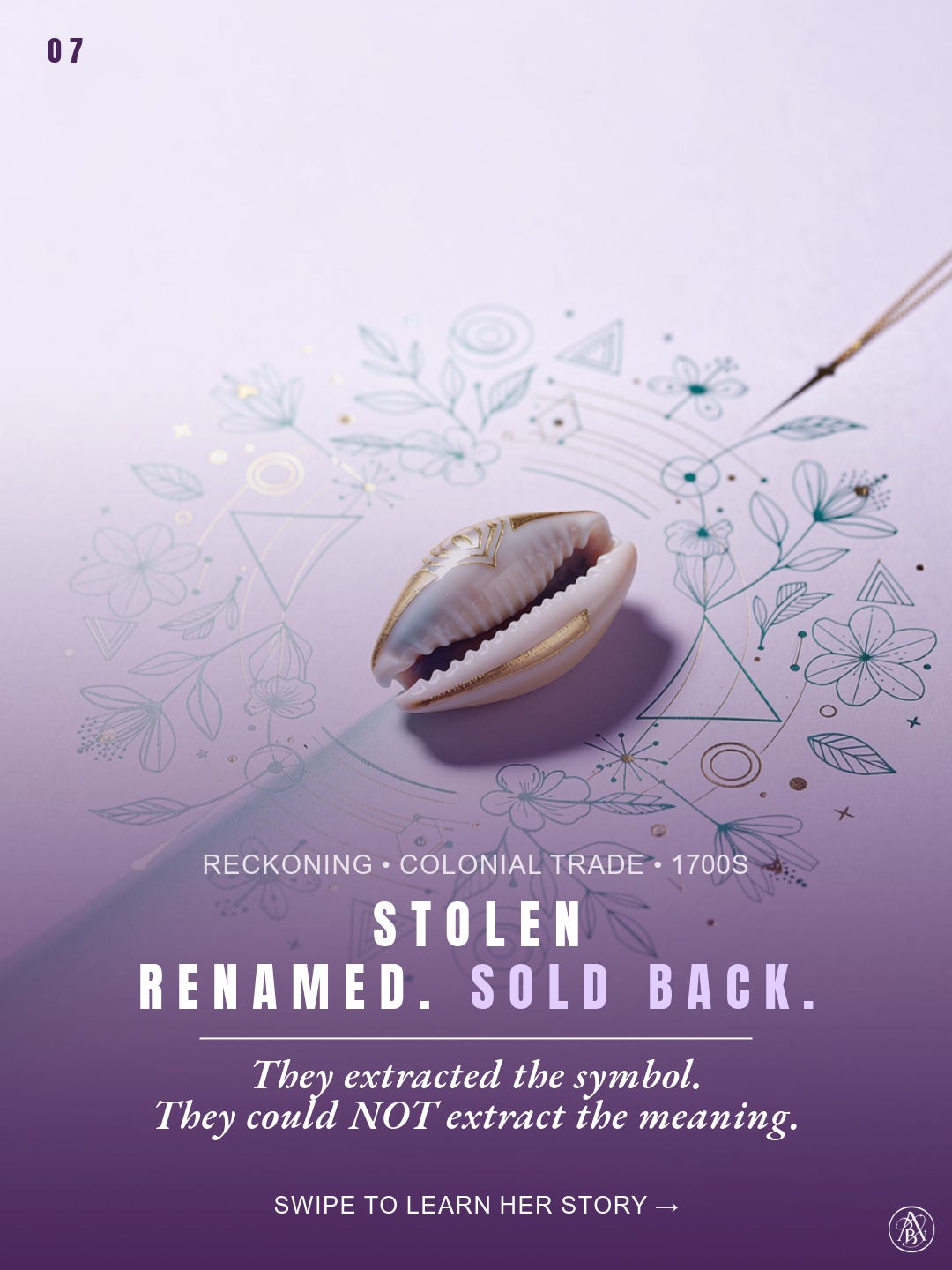
This is the part of the story that needs to be told directly.
By the 1700s, European traders had identified the cowrie shell as the most accepted currency across West Africa. They used that knowledge systematically and deliberately.
Ships sailed from the Maldives where the finest Cypraea moneta shells were harvested in enormous quantities to Liverpool and Amsterdam. From there they crossed to the coast of West Africa, where they were exchanged as payment for enslaved people.
Historians estimate that billions of cowrie shells were used in the transatlantic slave trade. A symbol of divine feminine wealth, of birth and protection and ancestral memory, was turned into a tool of one of history’s most devastating systems of human exploitation.
The cowrie was not complicit. She was weaponised.
This matters because the reclamation of the cowrie. The wearing of her today, the placing of her in sanctuaries, the art made in her image, is not simply aesthetic. It is an act of restoration. Of returning a sacred object to her original meaning.
Meaning cannot be colonised. It can only be suppressed and then reclaimed.
08 · She Is Healing. She Is Home.
Reclamation · Present Day
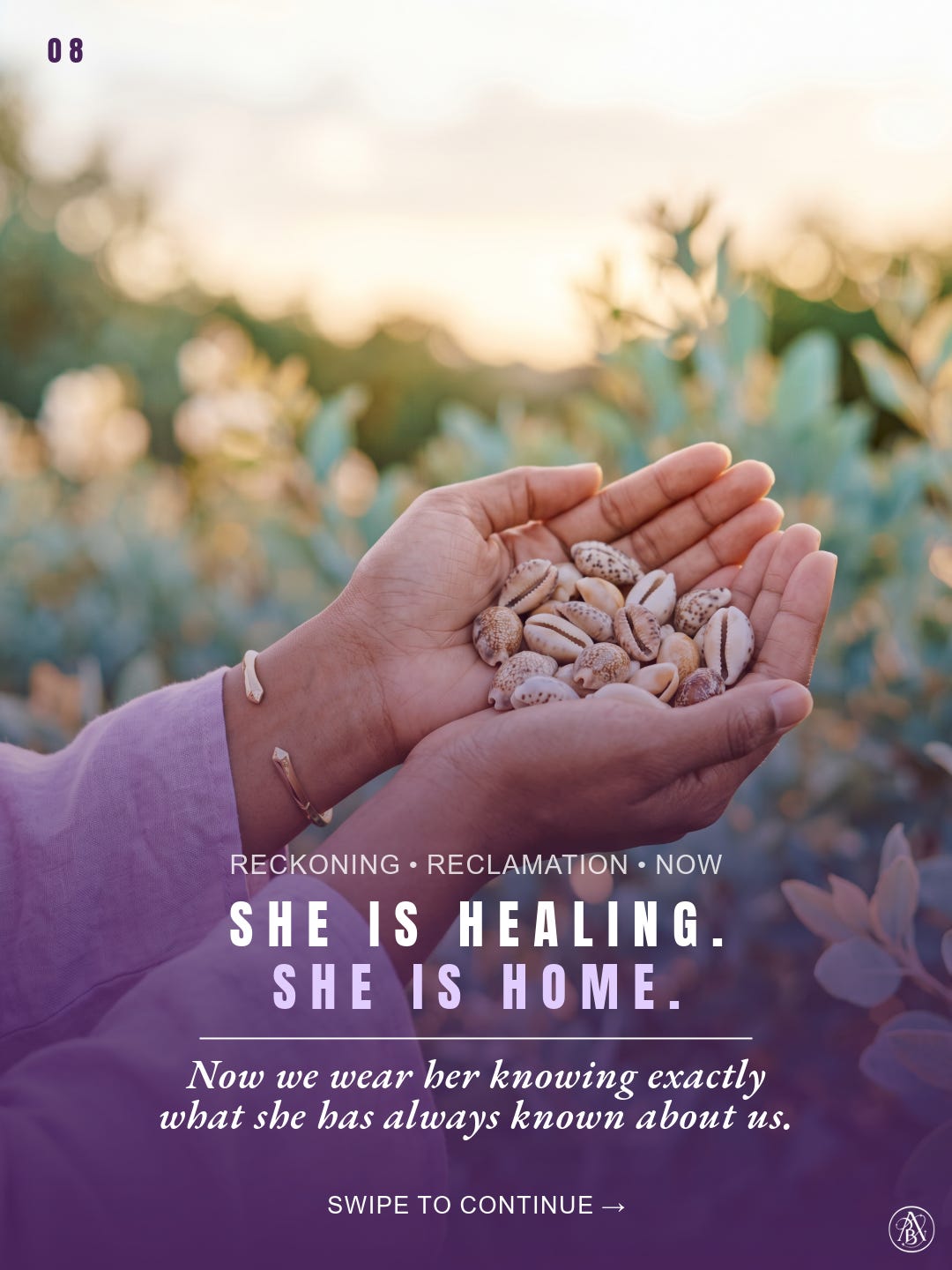
Today, women are returning to the cowrie.
Not as trend. As remembering.
You can see it everywhere once you know what you are looking at. Cowries woven into natural hair at graduation ceremonies. Cowrie pendants worn as the single piece of jewellery a woman reaches for without being able to explain why. Cowrie shells placed on window ledges and bookshelves in homes that have never been to the African continent but somehow know. Know, that this object belongs in a space of meaning.
This is ancestral memory. It does not require explanation. It precedes language.
The women returning to the cowrie are doing the same thing women have always done with her. Carrying her as protection, as identity, as a declaration that they are descended from something ancient and powerful and unbroken.
She is feminine power made visible. She is the proof that ancient things survive.
And so do we.
09 · What She Means in Your Space.
Art By Miss Abs · Your Sanctuary
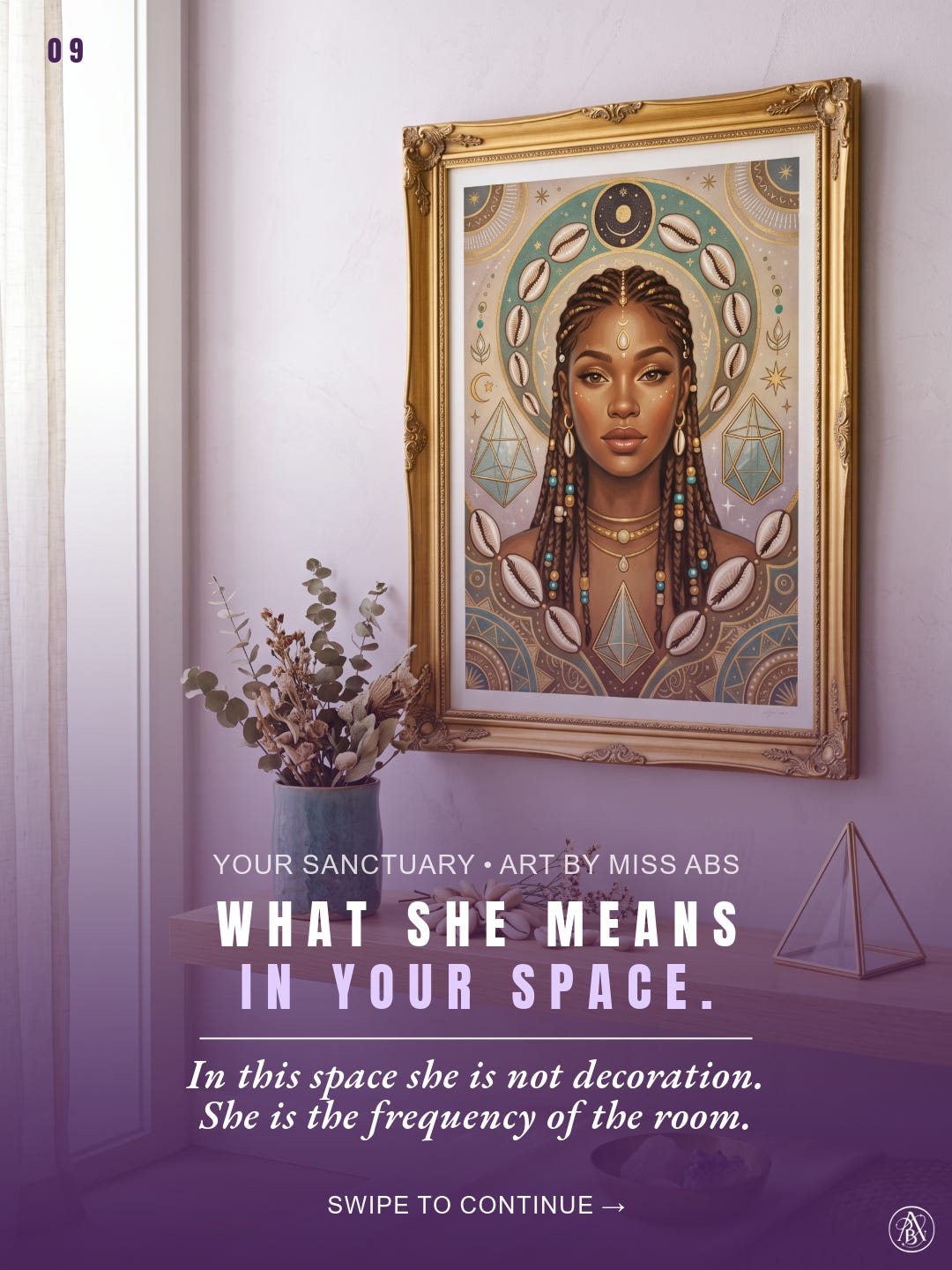

When a cowrie enters your home, she does not arrive alone.
She brings 40,000 years of feminine intelligence with her. Protection. Abundance. Clarity. Origin. The memory of every woman who ever wore her, cast her, prayed through her.
This is what I think about when I create.
In my work, the goddess portraits, the constellation maps, the geometric prisms, the cowrie’s symbolism is always present.
Sometimes literally, as a motif woven into the art. Always energetically, as the intention beneath the image.
I create art for women who want their spaces to remember what they carry.
Not just beautiful walls. Walls that mean something. Walls that say: I know where I come from. I know what has survived to reach me. I am building a sanctuary that reflects all of that back every single day.
Your home is a living archive.
Your sanctuary as a statement of who you are descended from.
10 · You Are the Continuation.
A Closing Note
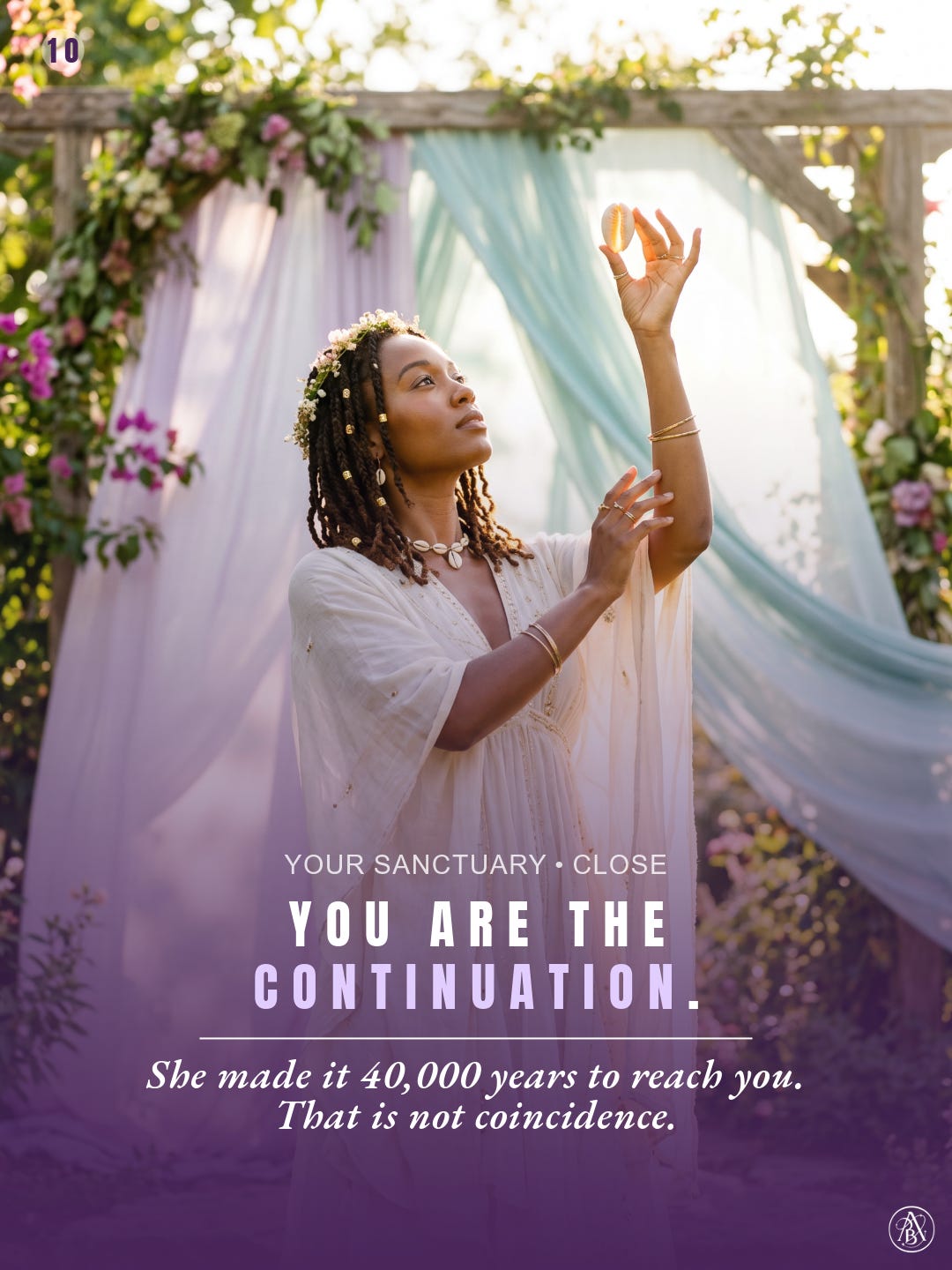
Every woman who ever wore a cowrie, cast a cowrie, prayed through a cowrie. She is your ancestor.
Not necessarily by blood. By frequency. By the fact that you are here, reading this, feeling something stir in your chest at the story of an object that has been carried by women for 40,000 years.
That stirring is recognition.
You do not need to have grown up knowing this history for it to belong to you. It belongs to you because you are here. Because something in you responded. Because the cowrie has always found the women who needed to find her.
She made it 40,000 years to reach you. That is not coincidence.
Come and Enjoy the Sanctuary
The full visual story of the cowrie. All ten images from this piece, is living over on Instagram, where the Art By Miss Abs sanctuary is always open.
Come and spend time there. Explore the goddess portraits. Sit with the constellation maps. Let the colours do what colours do when they are chosen with intention.
The collection is coming. For now, come and enjoy the sanctuary.
→ Follow @artbymissabs on Instagram
Every piece I create is built on stories like this. One ancient symbolism, feminine intelligence, meaning that has survived everything. If this piece moved you, subscribe below to receive the next story directly in your inbox.
Until next time,
Miss Abs xo
The Writings On The Wall is a reader-supported publication. To receive new posts and support my work, consider becoming a free or paid subscriber.
Comments
Nothing yet. Say the first thing.
Sign in to join the conversation.