
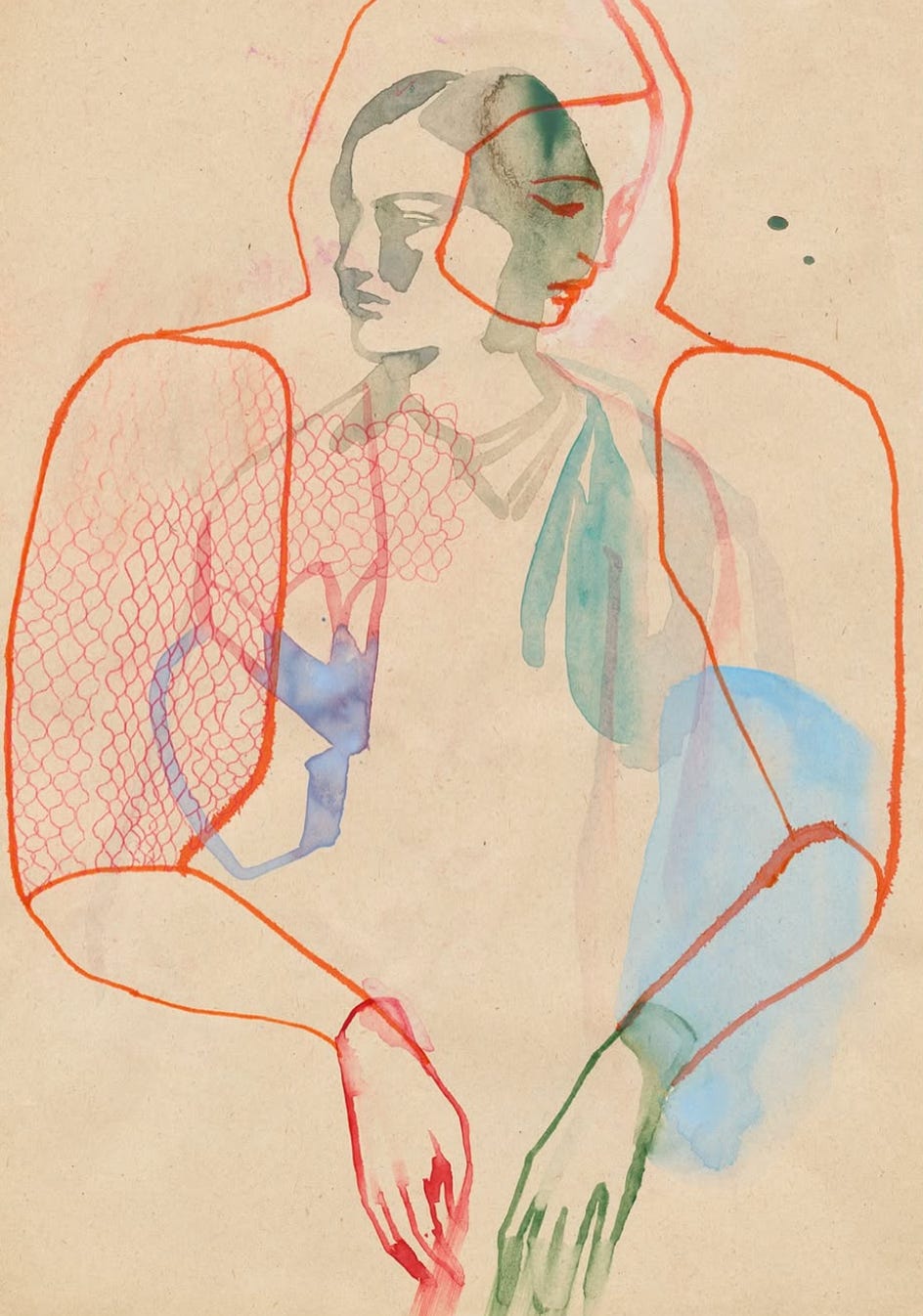
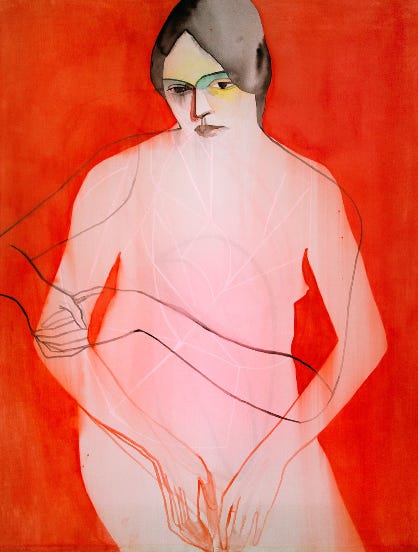
What these two artists have in common is their use of line to describe the figure and other elements. But otherwise they might be opposites in their media, approach and era in which they live or lived.
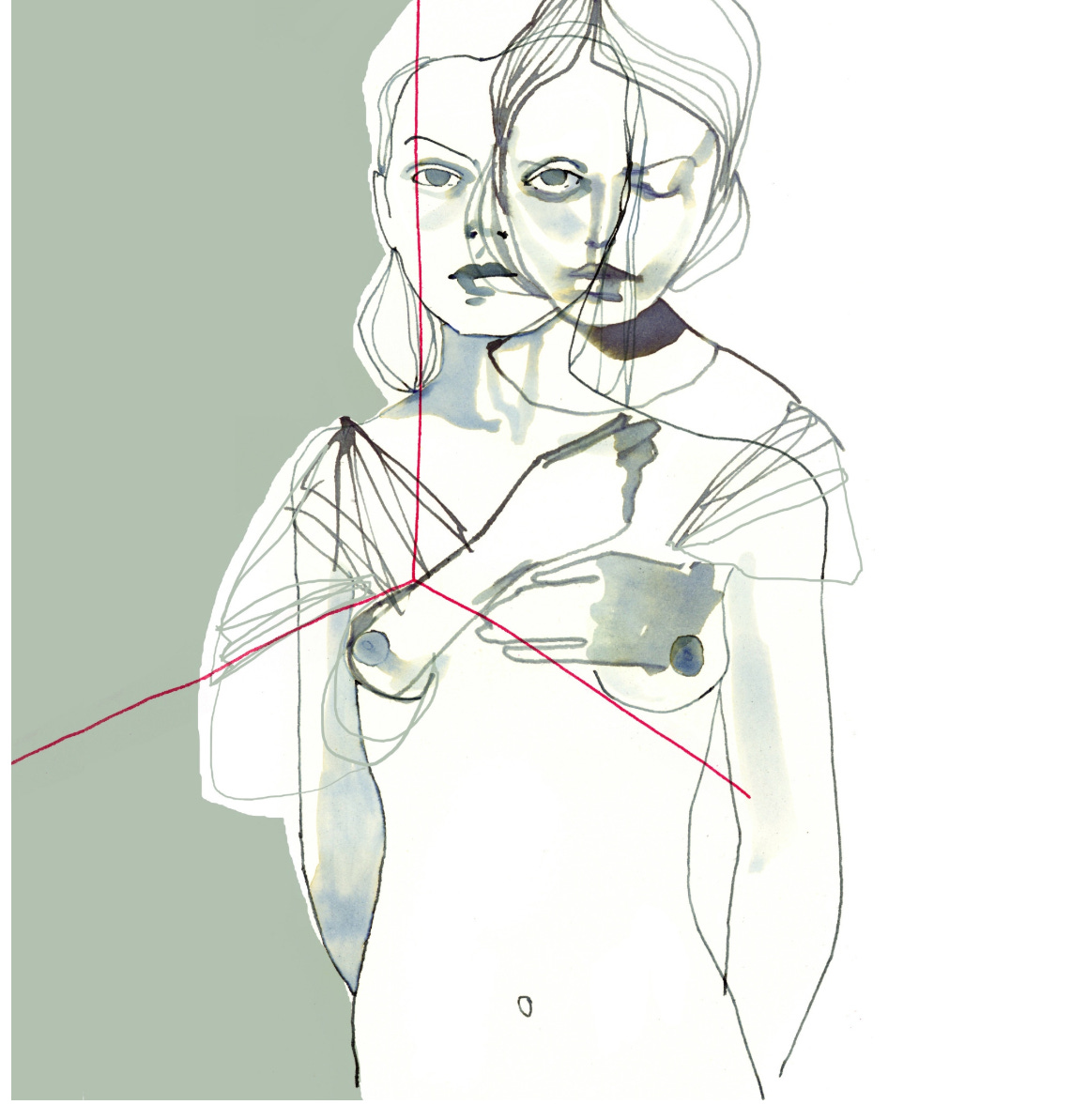
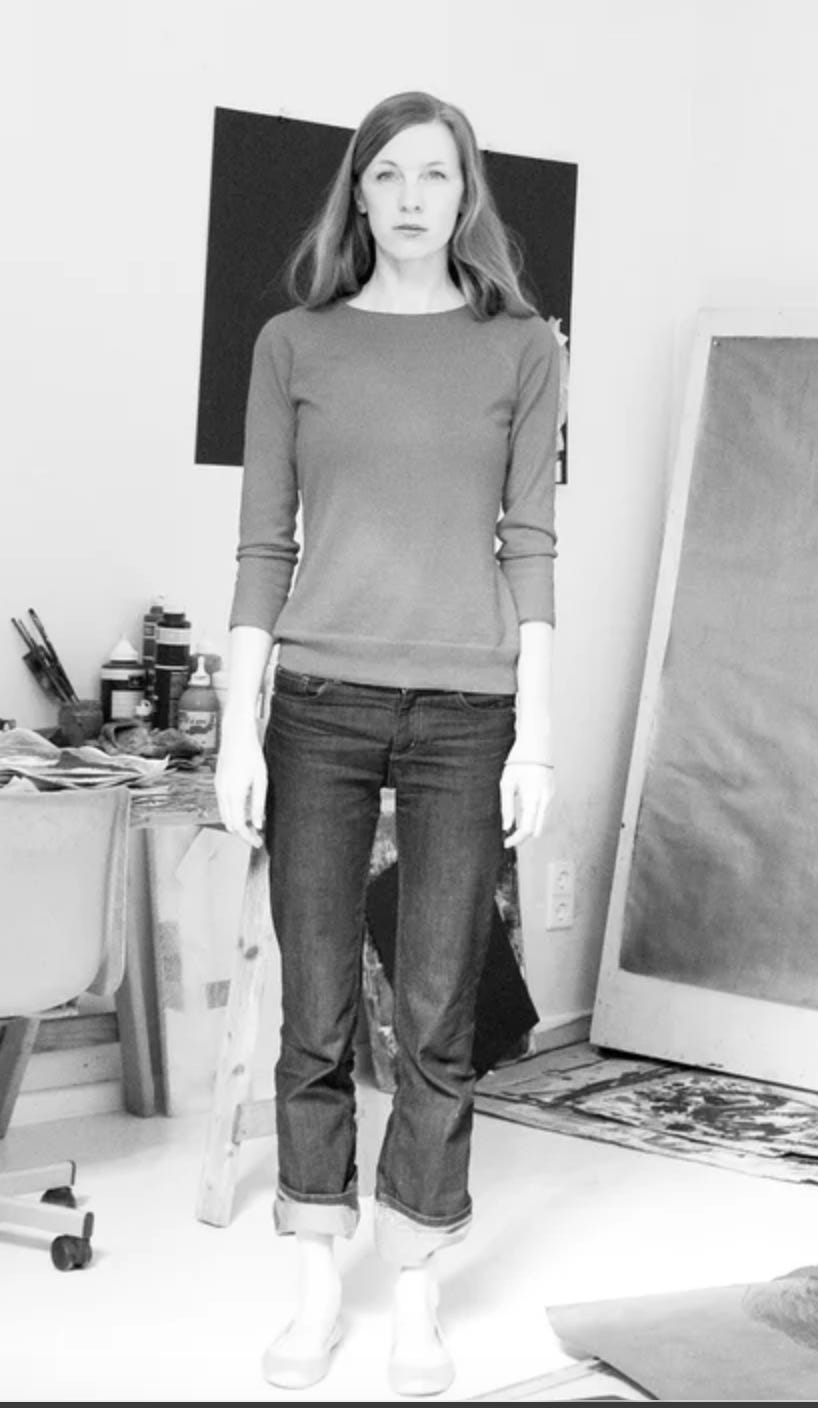
Tina Berning is a Berlin-based artist. She keeps a daily drawing/painting practice best viewed on her Instagram. She works in mixed media, including ink, watercolor, gouache, and many others, and often draws on “found paper.”
Her artwork frequently uses the word “Diary” or the date as the title of each piece.
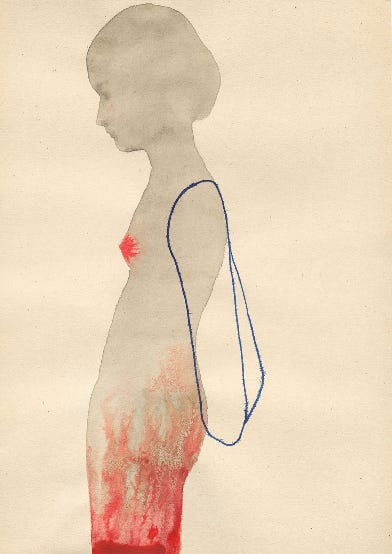
See lots more :
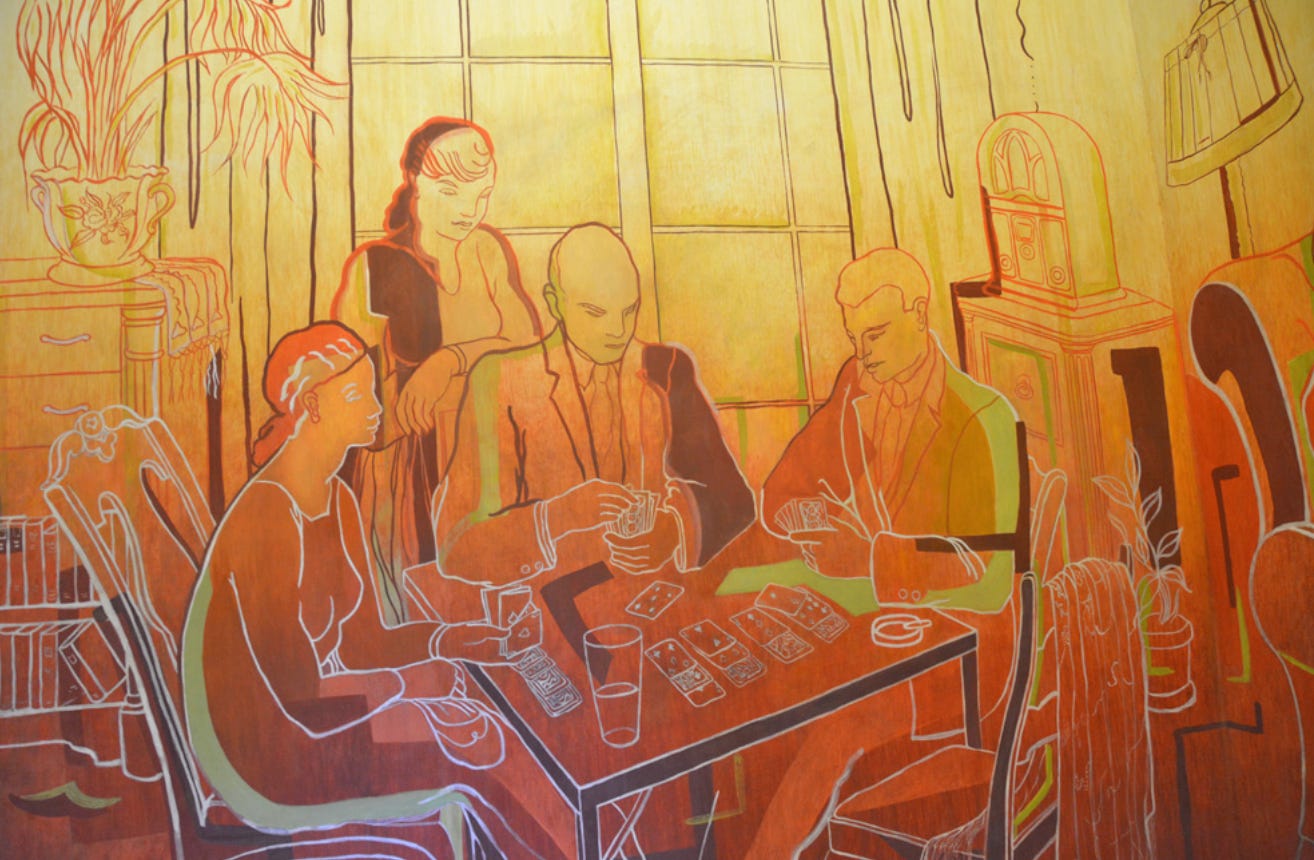
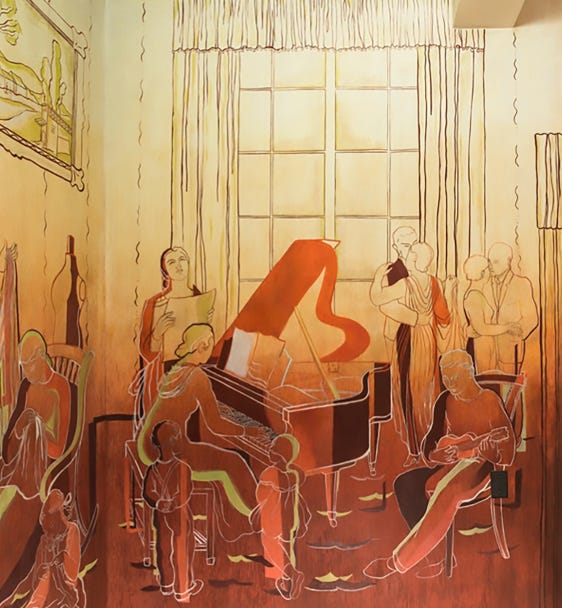
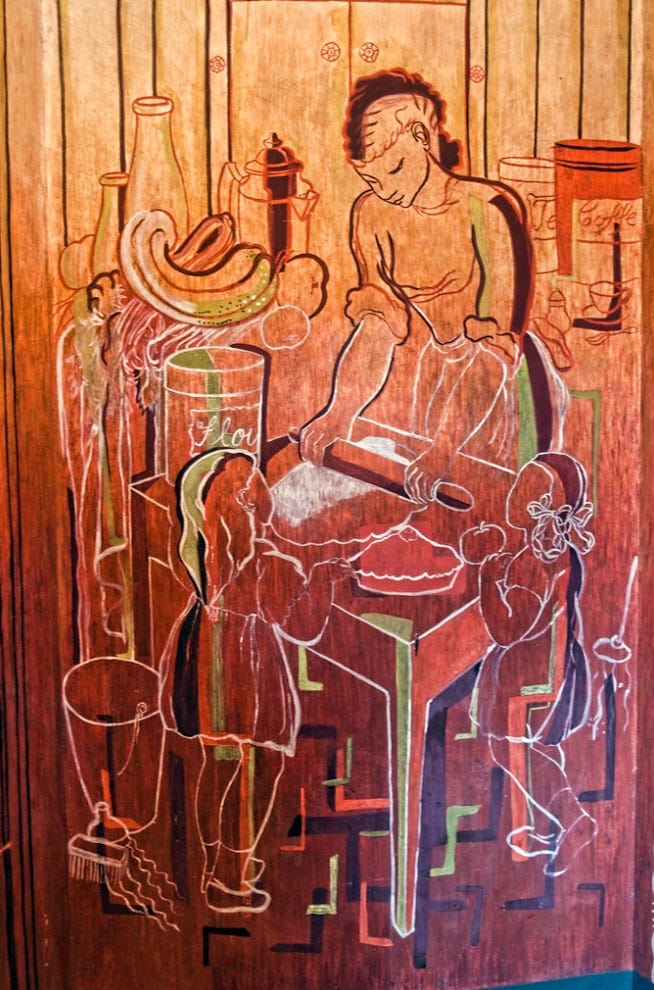
Jane Berlandina is known for her egg tempera mural “Home Life” at Coit Tower in San Francisco.1
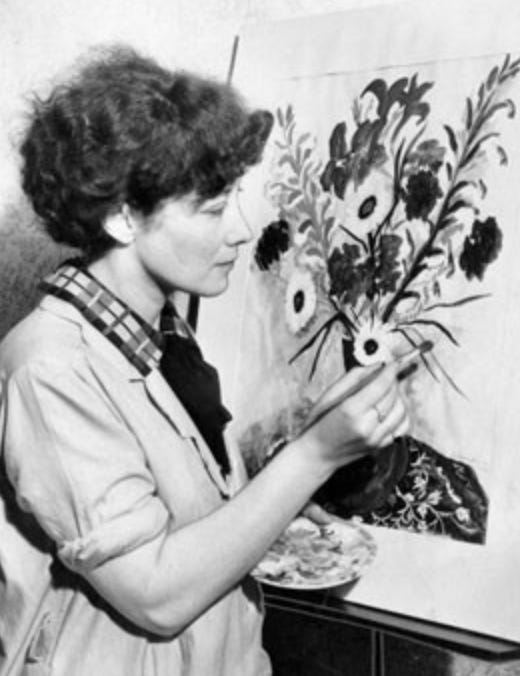
Berlandina was born in Nice, France, and was heavily influenced by Raoul Dufy. Dufy's light, decorative style was very different from that of Diego Rivera, the master fresco muralist who influenced many of the other Coit Tower artists. Her use of egg tempera set her apart from the other muralists who mainly worked in fresco.
She moved to the US in 1928 and painted “Home Life” in 1934. Berlandina was also a scenic and costume designer for the San Francisco Opera Company.
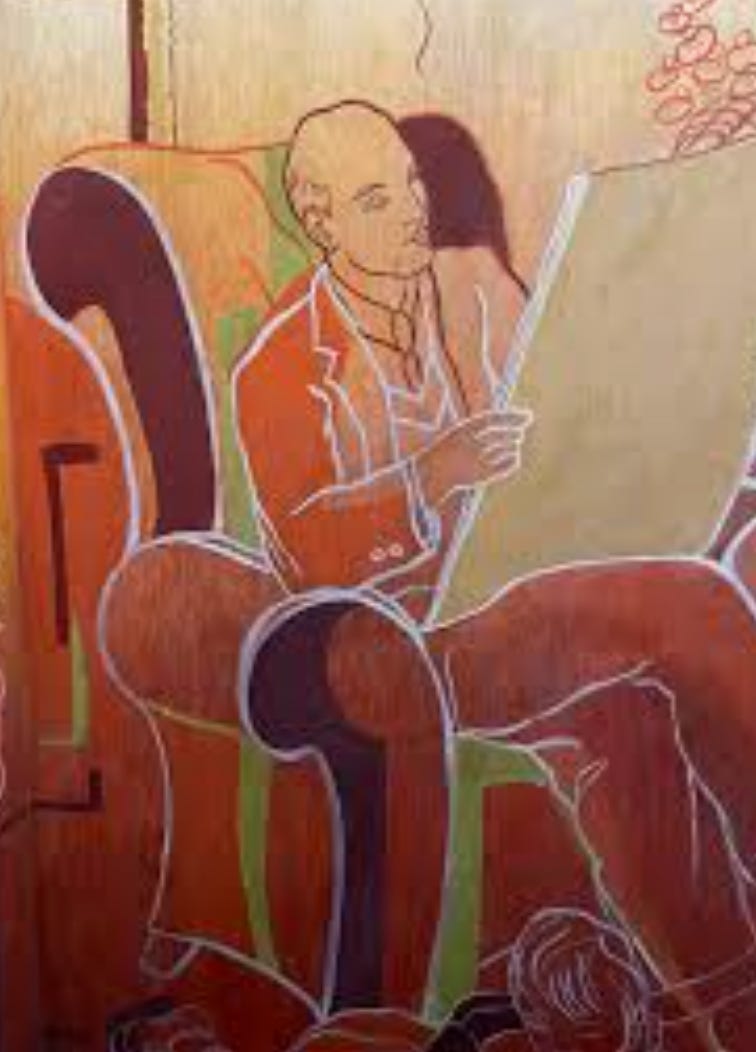
Home Life was sponsored by the Public Works of Art Project (PWAP). It measures 9′ x 34′, wrapping around three walls on the south alcove of the second floor of Coit Tower. It is accessible only during official tours.
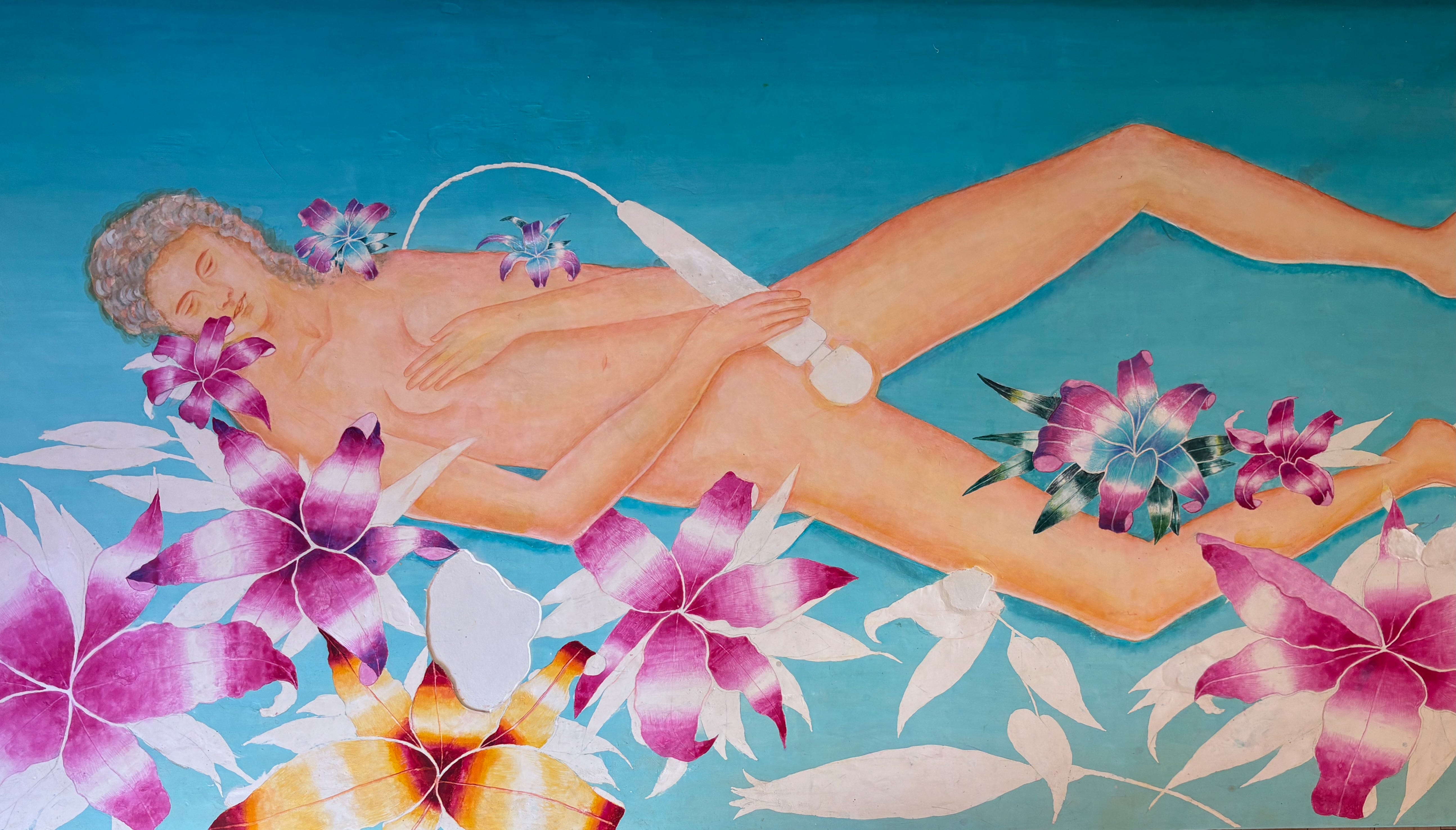
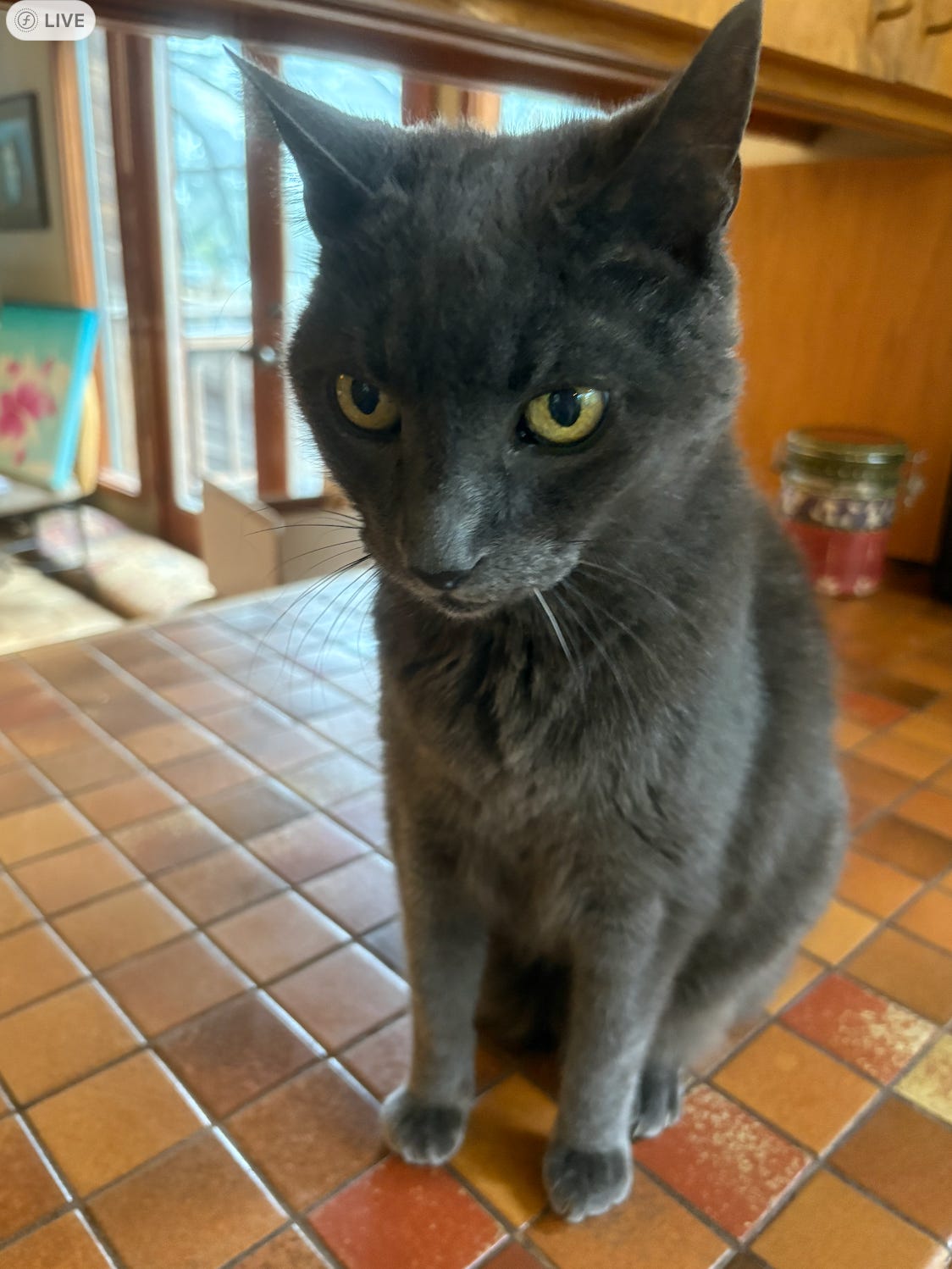
This is my 4’ x 8’ egg tempera painting, Fish Without Bicycle.2 I made a lot of progress while cat-sitting for friends in the Berkeley Hills. I told them I could not be away from my painting for 3 weeks, so they came with their van and transported the painting to their large dining room table! The flowers are blocked in - next step will be painting the leaves.
LIBRARIES
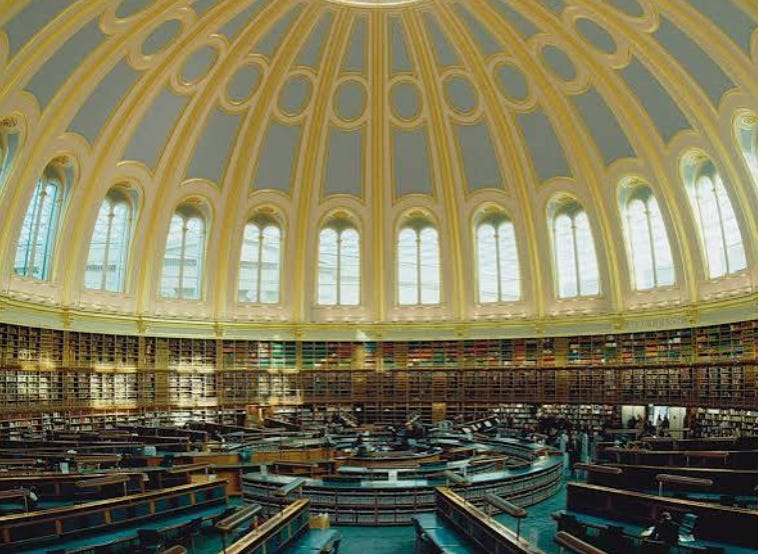
I’m thrilled that the British Library3 accepted a donation of Art & Love. I spent some time in the British Museum Reading Room (pictured above) in 1981, where my interest in egg tempera history was first sparked. At that time, the British Museum Reading Room still housed the library books, but the collection was moved in 1998 to what is now the British Library.
PURCHASE OR READ FOR FREE
Art & Love: My Life Illuminated in Egg Tempera is now on Libby for the San Francisco Public Library. The audiobook is on Hoopla.
You can buy Art & Love at Bookshop.org, Amazon, or order it from your favorite independent bookstore.
As a subscriber to Art Blotter Plus, I’d be happy to send you a link to the ebook or audiobook, which comes with a PDF companion of the 200 images displayed in the book. Send me a message if you’re interested:
PODCASTS
Creativity Found podcast dropped this month. Here is a clip where I talk about letting go of painting while writing the book and then starting again:

Amos Goldbaum website.
All of Me4 was written by Gerald Marks and Seymour Simons in 1931. In keeping with the theme of figurative art, I chose All of Me because it contains 4 body parts: lips, arms, eyes, and a heart. And it’s a great song!
Lora
Gearing up for the midterms, I’d like to introduce you to the fabulous Elizabeth Chur,

author of The Joy of Talking Politics With Strangers. Her Substack has up-to-date resources about how to get involved.
Do you have a friend who might enjoy Art Blotter Plus?
Follow me on Instagram for frequent updates. I’m also active on Facebook.
I’m grateful to Richard Rothman, who alerted me to Berlandina’s egg tempera mural at Coit Tower. We had been communicating about the egg tempera mural at the Mother’s Building at the San Francisco Zoo about which I wrote this Substack.
From my book, Art & Love: “The title of this painting, Fish Without Bicycle, comes from the feminist saying “A woman needs a man like a fish needs a bicycle.” The slogan was popularized by feminist Gloria Steinem but was actually coined by Irina Dunn, an Australian writer, social activist, and filmmaker.[1]
The concept that a woman does not need a man to experience pleasure was promoted by Betty Dodson, a sex educator who pioneered the sex-positive feminist movement. Dodson was still conducting workshops at the age of ninety-one, teaching women how to achieve orgasm. She passed away in 2020.
Traditionally, her workshops featured the Hitachi Magic Wand, the vibrator pictured in the painting. As a nod to Dodson, and for stylistic reasons, I painted the older model with electric cord. The composition is a celebration of sensuality with fragrant lilies in a lush environment.
The British Library Act 1972 created the British Library by pulling the British Museum’s library departments out of the museum and merging them with several other bodies — the National Central Library, the National Lending Library for Science and Technology, and shortly after, the British National Bibliography.
But the split was administrative long before it was physical. The books stayed in Bloomsbury, in Panizzi’s Round Reading Room under the museum’s dome, for another quarter century. The reading room closed in 1997 when the collections moved to the new St Pancras building on Euston Road, which the Queen formally opened in June 1998. So anyone reading at “the British Library” between 1973 and 1997 was still sitting inside the British Museum. That was me!
The Round Reading Room itself survived — the museum enclosed it in the Great Court, which opened in 2000.
The Great American Songbook isn’t an actual book — it’s the body of popular songs from the 1920s through the 1950s, written for Broadway and Hollywood.
If you’d like to learn more about egg tempera, watch my video which explains all about it:
Comments
Nothing yet. Say the first thing.
Sign in to join the conversation.