
I've been part of or have led book clubs for several years. I'd like to share what i've learned. I'd also like to offer ways you can make your book clubs more impactful in process and participation.
After reading this, i hope you will be swayed to create your own book club and have the tools to do so effectively.
What are the Benefits of Book Clubs?
Book clubs are a way of creating and deepening community. When you spend time with others, building trust, exploring what works and what doesn’t, getting to know them, you inevitably come to appreciate who they are. The kicker is that, because all participants are on the hook to take part (in varying degrees), the collective unit grows in empathy.
Book clubs are also a way to support not only your individual growth, but also the growth of your community. Of course, you get to better integrate what you’re reading. But you will also need to reconcile diverse viewpoints. More, you’ll learn from the activity and iterations of others’ behaviours in relation to the reading.
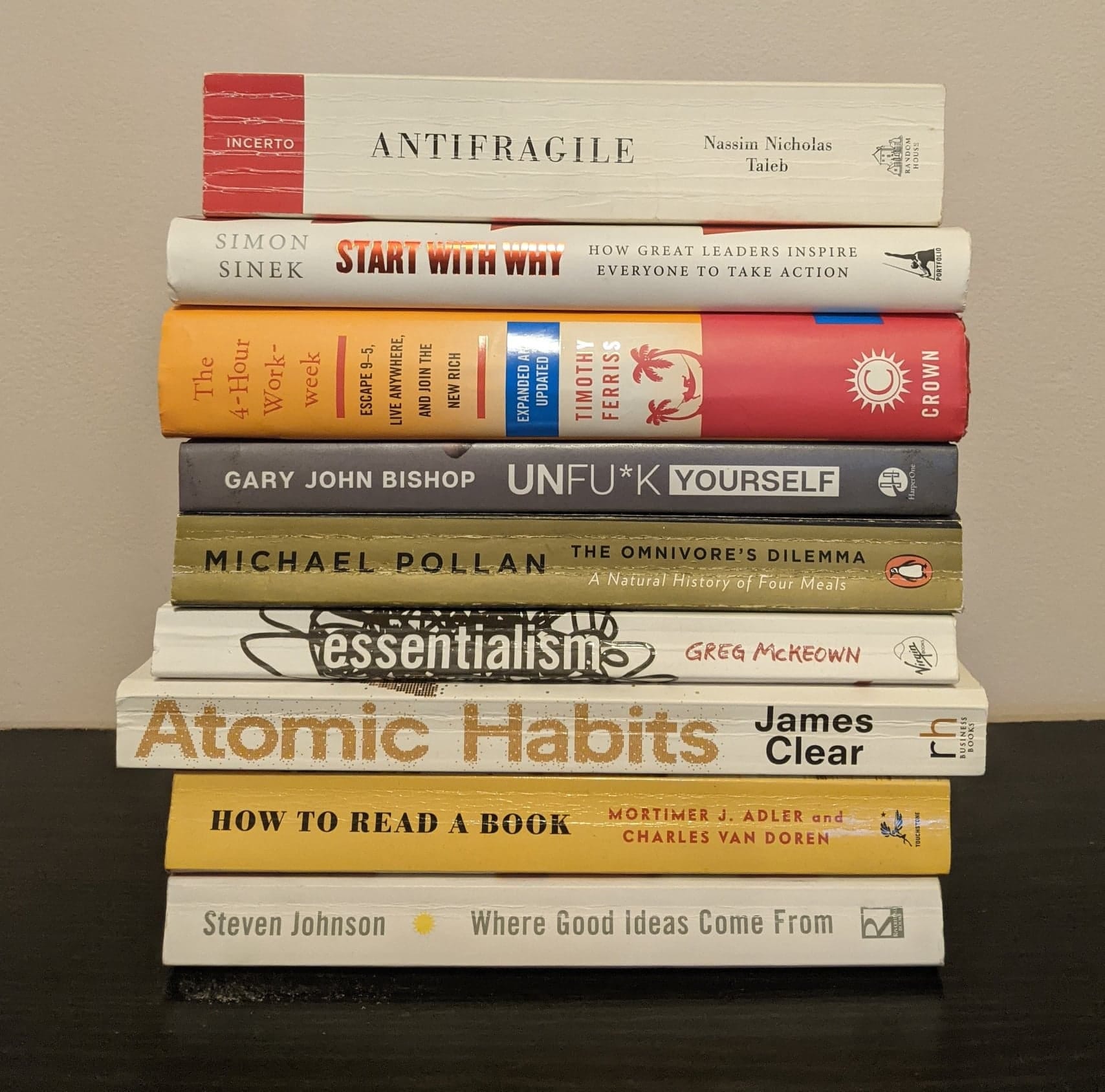
For example, when reading James Clear’s Atomic Habits, one of my group members set timelines for social media use that saved him hours a day. Whenever i consider my desire to move away from digital distraction, this person remains a model of what’s possible. There’s less mental friction in implementation because i’ve seen another person do it.
Alt text: An image of me and three others at the end of reading Tim Ferriss’s The 4 Hour Workweek.
How to Create and Lead Your Book Club
Now that you’re sold on creating a book club, you’re going to need to brush up on your leadership and recruitment skills, choose the book you’ll read, and consider how to facilitate it. Let’s touch on each of these in turn.
Leading the Way
Effective book clubs have strong leadership and diverse, invested participants. Strong leadership means recruiting humans into your vision of becoming a reading cohort. It also means sustaining momentum and impactfully facilitating during sessions.
Recruiting Your Group Members
You need to get people on board. Book clubs are not a small investment of time and energy. So, persuade them to join:
Argue for community: "Wouldn't it be great to be part of a small group of caring, supportive people?"
Argue for personal growth: "I know you're the kind of person who loves improving yourself. You'd be a great part of my book club on x."
Argue for self-identity: "I know you’re the kind of person who loves having interesting conversations with cool people."
Argue for entertainment: "Lots of people are bored to death these days - wanna do something fun and surprisingly productive?"
How Many People?
I argue that an impactful book club doesn't have more than 8 participants, including yourself. This number is big enough to have interesting, tangential conversations and viewpoints. But it's small enough that everyone can speak their piece without the meeting drawling on beyond people's innate attention spans.
Who Are the Right People?
The kinds of people you recruit will reflect your hopes for the book club. I hold that impactful book clubs have diversity across genders, ages, cultures, professions, and values. I don't like being in an echo chamber. I prefer having to work through disagreements.
At the same time, i learned that having diverse members means attending to other group members' needs. A book club is different from a lecture. There (hopefully) isn't one person imposing a viewpoint or set of beliefs. Given that this approach is inherently communal, you need to learn to tend to the group.
Can you ensure cohesion through disagreement?
Do you know how to spot discomfort?
Can you gently move conversations so the group learns while giving voice to things that may be hard to hear?
You may not have the answers until you go through your first book club experience. Keep iterating, and recognize that it’s a journey; humans change - and so will you.
Keeping Momentum
Keeping momentum means that your scheduled sessions continue along a set schedule.
This is where i've typically fallen short as a book club leader. I would overstretch myself and wouldn’t follow up with my group to book our next meeting. A way of resolving this is early on is setting a recurring time and place (a smart default). Set a quorum - if x number of people can't make it, defer to the next scheduled date.
Choosing a Book
This is the fun part!
You can be as autocratic or collective as you wish.
My bias is that behavioural, self-helpy, practical books tend to lend themselves well to book clubs. This is because there are actionable insights that group members can implement and report back on. As a result of the implementation, the group as a unit has a chance to collectively iterate through practice. This is in contrast with purely theoretical books, where development happens on the level of ideas. But - if this is your slice of pie, go for it!
For the first book club, choose a book, recruit diverse people, and then decide how to approach the next one.
At the end of a book club, i like giving continuing members the option to offer a book suggestion. Then, we vote as a collective. If there's a tie, we revote for the tied options.
This approach has one main drawback: The group may choose a book you're not interested in. But I think this is a non-issue. Deciding on a shared journey this way exposes you to a small amount of randomness. This randomness may, long-term, prove impactful.
For example, in one voting iteration, my book club chose a book on the history of the food system in America: Michael Pollen’s The Omnivore’s Dilemma. It wasn't a practical book by any means, and i loathed reading it. Towards the middle of the book, it grew on me. By the end, i realized it was one of the best-written pieces of investigative journalism i'd come across. To this day, that book impacts how i think about sustainability and making food choices.
Alternatively, you can also go down the “per-book” path. That is, you choose a book and then recruit participants anew for that book.
How to Facilitate Your Well-structured Book Club
Because you're creating this book club, the responsibility falls on you to facilitate, to guide others on a shared journey. This means keeping time, navigating around monologues, helping set intentions. You may not get this right off the bat - facilitation is a learned skill. Leave time at the end of your sessions to get feedback on how things went, iterate, and grow as a leader.
Setting up Shared Communication
You’ll need to create a shared communication channel. This helps you coordinate the group and provides a space for asynchronous reflections.
There's often a person who doesn't have Facebook Messenger. In this case, WhatsApp is usually an easy move for the rest of the group.
Creating Book Club Structures
It's helpful to have a structure for the book club sessions. The structure gives participants a shared sense of what's to come. It's okay if you don't have the structure laid out right away. Below, i'll propose a few ideas for your first go-around.
Before you hold your first book club, invite participants to read the first few chapters. Books differ in their density and length. For your first book club, reading a few chapters will let your group explore what's a feasible amount to read in a) in the time between sessions and b) to cover in the sessions themselves.
Here are examples of book club structures:
First Meeting
During your first meeting, you’ll help others get to know each other, set the pace for future structures, and determine what’s a feasible amount to read down the road.
Introductions
I think it matters strongly that people know who the others are. I hold that the main advantage of book club is development as a group. If people don't know one another, there won't be high trust. Trust is required for collective disagreement. Trust is required for vulnerability, which is where incredible growth happens.
Setting Intentions
I like writing down each person's intentions to revisit at the end of the book club - to gauge impact. A simple question like "what do you hope will be different in your life after reading this book club?" will suffice. You can also send this as a question for people to bring to the first meeting. People differ on their ability to process in the moment - anticipate that not everyone will come up with incredible insights off the bat.
Going Through Chapters
I like book clubs where we go chapter-by-chapter. The author typically makes a progressively deeper argument as chapters go on. Or, they provide more context and ideas for how to execute their main thesis. Going chapter by chapter helps the book club collectively deepen their insights and practice.
When going chapter by chapter, ask the following:
What's the main point the author's trying to make? Do you agree, disagree?
How does this apply to your life?
Do you want to try anything that the author mentioned before our next session?
When finished with the assigned chapters, i like doing a synthesis:
Overall, what is the author arguing for? Do you agree or disagree?
Have you changed your mind as a result of what we read or talked about?
Is there anything you want to try until our next session?
Conclusion
Now that you've all had a chance to read through a chapter or two, and met to discuss them, it's good to set the pace for the rest of the book. Talk about how many chapters or book parts you'll read through for the next session(s).
Don’t forget to ask for feedback on your facilitation. “What could i have done better so you had a better book club experience. Invite people to message you after with their thoughts.”
Confirm your next meeting date and time.
Subsequent Book Club Meetings
Now that you’ve had a chance to get to know each other, you’re more or less going through the established process.
Introduction
Do a check-in. See where everyone is at:
How's everyone doing - what have the past few weeks been like?
To those who said they want to try something mentioned in the book - how did that go? What did you learn?
Going Through Chapters
As above
Conclusion
Ask for feedback on your facilitation
Confirm your next meeting date and time.
Last Book Club Meeting
In the last meeting, you get to finish up the last few chapters and review the book in full. You also get to see if the book club met the intentions that participants set for themselves in the first meeting.
So, all is the same as Subsequent Book Club Meetings, with a few tweaks. At the end of the chapter by chapter review, hold a conversation about the book as a whole: impacts, disagreements, considerations. In the conclusion, bring back the intentions people mentioned and discuss those. End with a decision about your next book club.
Now that you have a sense of how book clubs can go - break the rules and do what feels right for you and your group.
Other Suggestions
There are many other ways to play with book clubs.
If you have an Amazon affiliate account, you can funnel your group's book purchases through it. That way, you can buy everyone cold cuts the next time it's feasible to meet in person.
You can create a shared Google Doc to collectively write chapter summaries. Anticipate that many people won't contribute, but that's okay. If you want to go Pro, use Roam Research.
Follow up half a year to a year after the book club ended. See if anything stuck.
Conclusion
Book clubs are a great way to build community while growing and learning with others. Books that lend themselves well to this approach tend to be practical and self-helpy. Effective book clubs rely on you to grow your leadership abilities as a leader. Consistent structure helps ensure the group knows what's coming and what to expect. Infusing your book club with ongoing feedback will help you develop as a leader while also meeting the needs of your participants.
Right now is a good a time as any to bring people on board. Go for it!
Big thank you to all the wonderful people who have trusted me to go on the book club journey. I remember our insights and experiences fondly. I am a better person because of you.
Comments
Nothing yet. Say the first thing.
Sign in to join the conversation.