
Missed earlier chapters? Visit the Thought Farm chapter page
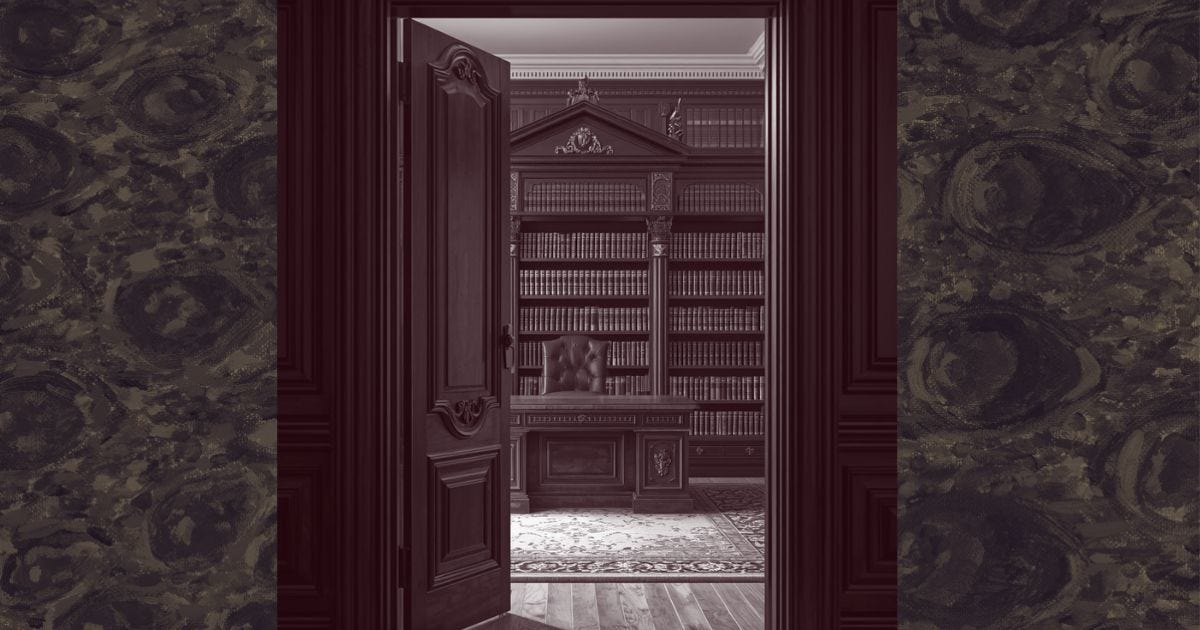
I pushed open the door of Scott’s study and surveyed the room from the hall. The space held a rarified air. The willow tree outside the window blocked the sunlight, and the walls were heavy with what seemed like thousands of books. A presidential-sized desk sat in the center of the room. Even though it was just me and the cat, I stepped lightly in the room as I neared the desk. I pulled the handle of the drawer that held the file. Locked. Of course, it would be. On the desktop, Scott’s laptop was next to a letter opener. I touched the silver point, careful not to disturb its position.
My gaze moved from the desktop to a painting that hung on the far wall. What appeared up close as petals cast onto ripples of water emerged as a reflection of a dancer in a ballerina pose when the viewer stepped back and relaxed the eye. Some people never saw the ballerina. Just like some people never discover castles in the clouds. Scott had seen the dancer right away. That was four and a half years ago.
I’d been exhibiting with a half-dozen other artists, all unknown at the time. Scott had just moved to the Bay Area from Maryland where he’d worked at a military research hospital after his residency. I’d heard someone once say that we are mysteriously drawn to those people we have something to learn from in life.
On the night of the opening, I saw him smile in that sparkling crowd. The velvet voice of Etta James rolled through the speakers, and everyone but Scott faded to a blur. His electric stare made it clear he’d noticed me too. There was something about him, that indefinable spark that the French refer to as, I don’t know what. The Spanish call it duende, dark magic. Whatever you call it, Scott glistened with it. I’d thought about his magic quality at length and decided it was more than just charisma or symmetry or some obvious fuckability factor. Scott had an unswerving belief in himself, a belief so certain it turned everyone else into believers, too.
That night, he’d zeroed in on the painting that now hung on his office wall—drawing near to examine it. He not only seemed interested in me, but this tall, mesmerizing man seemed to genuinely admire my work. Something in me knew my life was about to change.
“The Dance,” he spoke the title of the painting as a declaration. “Do you?” he asked with a weightless smile. His bangs weren’t quite long enough to tuck behind his ear, and he tossed his head to sweep them off his brow.
“Of course?” I answered. “Isn’t it natural to dance and sing?”
“And paint,” he added.
“Yes,” I agreed.
“And do you dance like you paint?”
“Do you mean, raw and uncontained?”
“I mean, do you dance with passion?”
“Oh.” I smiled and looked down at the floor. Someone had spilled a plastic cup of red wine and tossed a handful of cocktail napkins onto the spill. I resisted the urge to kneel and remove the offense from his sight.
“I’ll take it.” He nodded toward the painting and extended his hand to shake on the deal. I placed my hand in his, and he didn’t let go. He studied my face as if he could see through my veins, to blood and corpuscles, all the walled-off spaces inside my head. His scent was sky blue, and I felt myself falling upward. My pulse quickened, and I was afraid he would feel my hand throb and grow moist in his. But I didn’t pull away.
“I’d like to take you to dinner.” His voice was low and steady. “And then perhaps we’ll dance.”
I agreed without pretense, no coy moment to pause and think. He bent forward and whispered in my ear, “When I saw it, I had to have it. I knew it belonged to me.”
It had all been too polished, too easy for him. He was a hawk, and I was the sparrow, but it didn’t matter. I had something to learn in life, and I was going to learn it from him.
To belong—it was a craving. Not since I was thirteen and the family car crashed into that black oak had I belonged to anyone. Except for a crazy uncle who lived somewhere in the Montana Rockies, Scott was my only family, other than the one that existed in memory. Beyond that was a blur of names, faces, houses, each with its own strange smells, loud wallpaper, loud television. By the first anniversary of my family’s death, I’d already lived in a half-dozen homes.
Each new household was a foreign culture with a unique set of secrets and shared euphemisms. It was like learning Braille. I was always on the outside of an inside joke. The memories blurred into a collage of round, red faces with passionless eyes, so different than my mother’s—flecked with sparkles, her wind chime laugh, her pianist fingers stroking my curls, her rosy colored smell, sweet almond and vanilla.
Some of the foster parents were kind with good intentions, and some had mixed intentions. Then there was The Coach. He defied categorization. His memory wasn’t a blur—it was an imprint. His blue eyes were almost placid, still, except for the moments when he’d touched an exquisitely tender nerve. It was a dissonant memory. But he’d cared about me in his own strange way. At least with The Coach, I’d been in on the joke.
Before Coach Hubbard, my circumstances were unambiguous. I’d mattered little to anyone, and I knew it. My heart went out to the kids whose real parents told them in a hundred ways they loved them and showed them in a hundred ways they didn’t. The kids who reckoned with the acid truth fared the best. Know your ground, as The Coach would say. Denial exacts a toll. The thought caused my skin to needle.
I wrapped my arms around myself and held tight. With Scott, I was finally home. He countered all those years of tepid concern, or worse. It was Scott who introduced me to Amanda. Backed by his belief, my career had begun to flourish. From the start, he’d recognized my passion as an artist as only someone similarly driven could understand. With Scott, I finally mattered.
Our backgrounds were remarkably similar—in equal but opposite ways. We both shared knowledge of loss. At the age of sixteen, Scott came home from school to a dim house. He heard the car engine in the garage and opened the door to find his mother’s Seville, idle, exhaust spewing from the tailpipe. In the back seat, his mother lay curled in a fetal position with her cat nestled in the still curve of her stomach.
Losing a parent changes everything. But through some feat of emotional bionics, Scott used it to make him stronger. After his mother’s suicide, his father sent Scott to an elite prep school where he thrived. He valued the structure, the intellectual rigor, the clearly delineated principles for success. Those who can, do, the school taught. You are the leaders, the moral guardians of the future, the implied chosen. But a part of me wondered if deep down, Scott wasn’t still that helpless young boy who wished he could rearrange the world so his mother wouldn’t choose to kill herself.
I eased into Scott’s desk chair, aware of feeling out of place. Only in this room did I have that familiar sense of being a trespasser. The scent of the chair’s leather produced a sickly weight in my stomach and a rust-colored patch above my eye. It reminded me of a story told by The Coach. He’d been a ranger in the army. Parts of his training involved the slaughter of a stockade full of barnyard animals with a machete. It was to get used to the smell of death, he told me. I smelled the animal hormone of fear entombed in the leather of the chair.
I rose and walked to the bookshelves. As I traced my finger along the bindings, I inventoried the subjects...STRUCTURAL BRAIN ABNORMALITIES, PSYCHOTIC MANIA, AUDITORY HALLUCINATIONS. One book of medium bulk caught my attention. PARANOID DELUSIONS. I tensed at the thought of the tormented student in the psych ward.
I slipped the book off the shelf and flipped through the various states of delusion. DELUSIONS OF PERSECUTION…EPISODIC DELUSIONS, DRUG-INDUCED PARANOIA. The pages wafted the scent of printer’s ink. I traced my finger down the page. FOLIE A DEUX, a delusion shared by two or more. DELUSIONS OF REFERENCE: A belief that a pattern of random events is somehow connected to the individual.
I let out a heavy sigh as I folded the book closed and returned it to the shelf. Scott’s student had somehow strung together a chain of meaningless events in his mind, like a necklace of unmatched beads. The thought produced a dual sense, a disquiet hope.
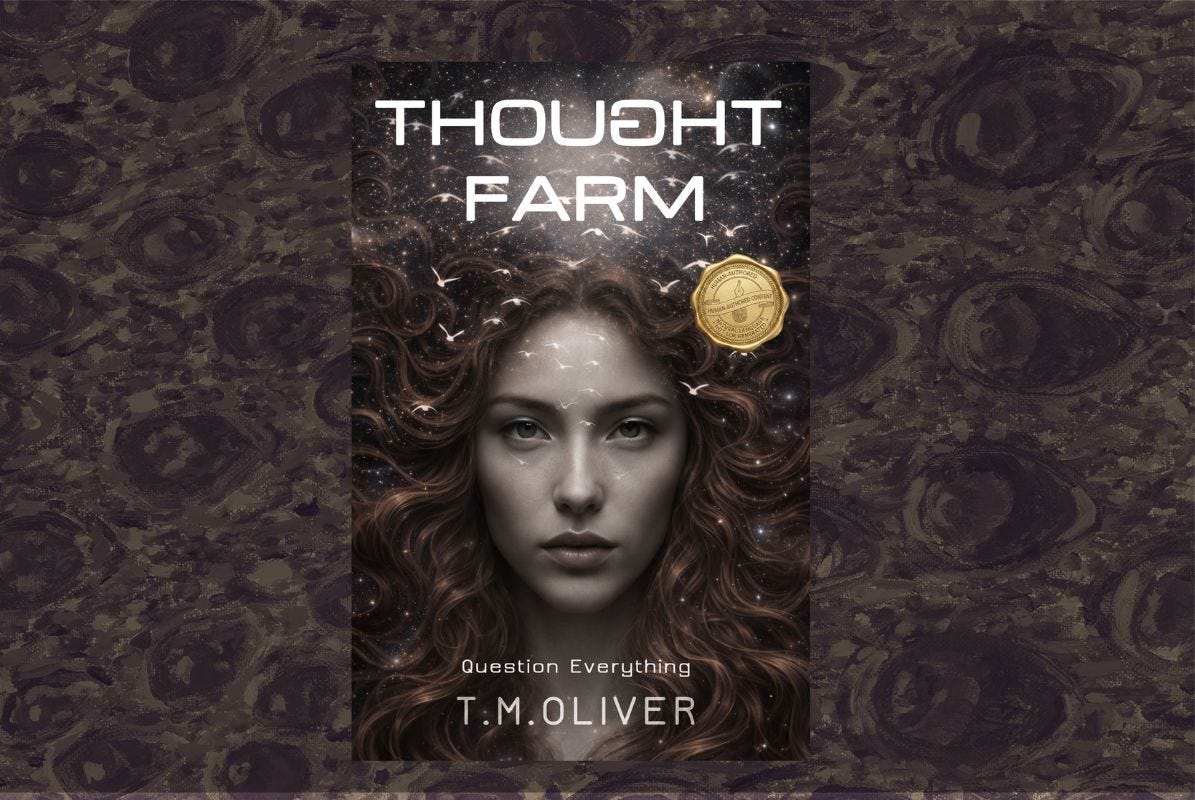
Visit the Thought Farm chapter page
Comments
Nothing yet. Say the first thing.
Sign in to join the conversation.