
Earlier this week I published a pair of preambles to this piece, an amuse-bouche of sorts, on Substack Notes here and here. They add a bit of context but are not required to understand what follows.
As a society we are really into purity tests. Nuance is dead, but impossibly high standards are alive and well. If I agree with 99% of a candidate’s platform, for instance, that candidate can go to hell.
Perhaps I’m too practical to be an ideologue.
Hank Green failed the purity test when he confessed to imperfection. Allan Peters failed the purity test when he didn’t achieve online fame in a way his detractors prefer. When each fell from grace, there was much rejoicing.
Because of our modern embrace of the purity test, when this very publishing platform released a new tool to allow writers and readers to test the purity of the words we’re writing and reading, you’d think the high standards crowd would’ve been all for it.
Imagine my surprise when the announcement was met with vocal opposition.
I don’t get it.
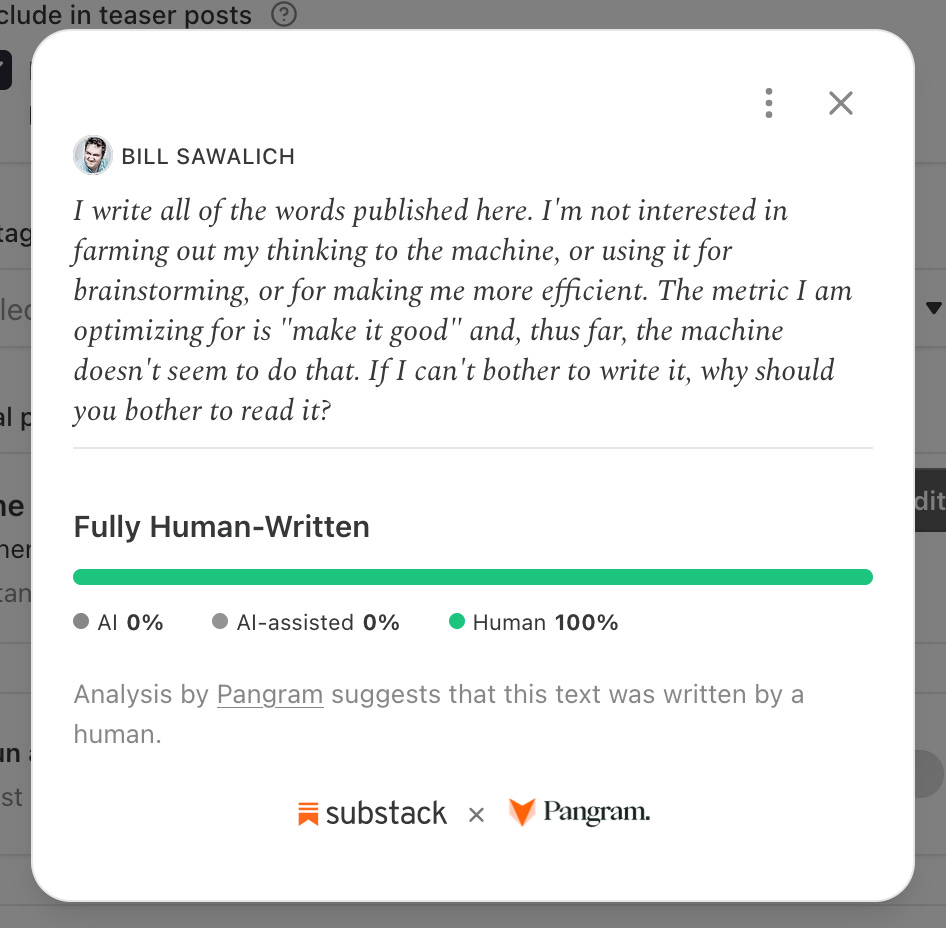
Substack’s new purity test relates to AI. The platform partnered with tech firm Pangram, whose tool is used to detect AI-generated content. Built primarily for use in classrooms, the tool has been integrated into Substack’s publishing capabilities so now, before I click publish, I can run the AI checker on my words to see how many were human made.
Spoiler alert: it’s all of them.
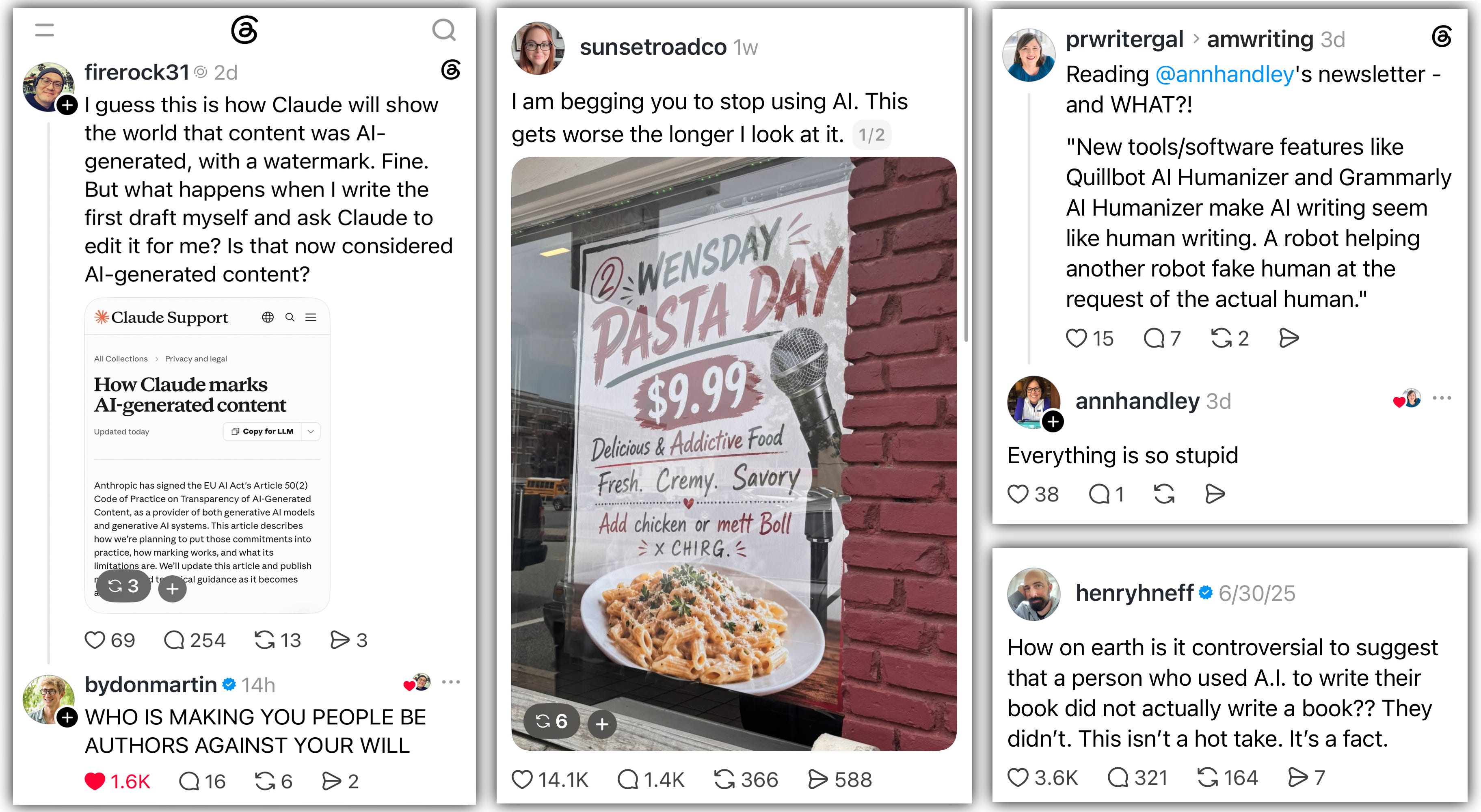
I have seen essays and tweets and notes and all sorts of commentary decrying the introduction of this tool, and I genuinely don’t understand it. I’m not being coy when I say I must be missing something.
If I’m brutally honest, my gut reaction is there are only three reasons to be against a tool like this:
False positives. Your writing has been incorrectly attributed to AI in the past, or you’re sure this is going to raise the specter of tainted work in the future.1
You’re seriously anti-AI, so you don’t like the use of AI even in cracking down on the use of AI. A hard line approach, but logical. Anti AI is anti all AI.
You’re a “writer” who uses AI in your process and you’re upset everybody’s gonna know.
I must confess, my cynical assumption is that most of the outrage comes from group #3. People don’t want to get called out for using AI.
I have occasionally run my writing through AI checkers and have yet to receive a false positive. It’s possible this is giving me an undeserved sense of superiority, and skewing my belief in the accuracy of these tools. According to my limited personal experience, however, they work.
Another interpretation is that I’m a bad writer. Technically poor, especially. I still confuse adjectives with adverbs and I love nothing more than ending a sentence on a preposition. See?
I made the mistake of spending much of my photography career aiming for technical excellence to such an extent that I forgot to spend sufficient time on the intangibles that make better pictures. In my writing I take the opposite approach. I spend very little time on technique and hope the charm makes up for it. Rules be damned, I’m going for greatness.
The AI doesn’t do this. Which is why I’m unbothered by the idea of AI evaluating my writing. And, more importantly, why I think it’s silly to rely on AI for writing anything you care about.
Maybe it’s silly to rely on AI for doing anything you care about.
I’m no hardliner, but for me, increasingly, the use of generative AI signals, “I cut corners.” It’s faster and easier, but those aren’t the metrics I’m interested in. The use of AI in creative endeavors is a great way for me to determine whether something is likely to be of interest to me.
If you can’t bother to write it, why should I bother to read it?
Author Colson Whitehead says that if you want to give over all those writerly tasks to the machine, perhaps you’re not actually interested in being a writer.
“Some people say, ‘I just use it to brainstorm ideas,’” he wrote in The New York Times. “If you don’t know what to paint or compose or write, you’re in the wrong job. Art is the business of making up stuff — go make up some stuff.”
The signal-to-noise ratio is all out of whack. There’s so much shit being pumped into the system, keyword-stuffed, search-optimized blather and slop. If I can use an AI detector to skim this layer of dreck right off the top, my experience as a consumer of words and pictures is immediately improved. It allows me to filter what I’m looking for in much the same way as changing the channel on TV.
I’ll take something real and human and imperfect over whatever the homogenized word averager thinks an interesting essay is supposed to look like.
I agree with Colson Whitehead. My favorite parts of being a writer are doing the things the machine offers to take away. And I think once I give those up I stop being a writer. Sure, I may be a producer of efficient, optimized content. But whatever that is — content creator, prompt engineer, coder — it’s not a writer.
We managed to do fine without AI writing until about four years ago, so I don’t see why I should worry about dismissing it out of hand. If I stick to reading the ideas of humans instead of machines, what’s the issue?
The machines are outputting content for other machines to input. I’ll embrace any tool that safely removes all that shit from my field of view.
There are exceptions, of course. Like the story of the debut novelist’s $2 million book deal that was just rescinded after suspicions arose about the veracity of his authorship.
“The book itself is genius,” his agent wrote. “However it came to be drafted, it’s amazing.”
Maybe it’s naive to want to read what individual humans write rather than what the machine interpolates. Maybe AI-augmented writing really is the future. Maybe AI could’ve made this essay better?
Maybe. But whatever it would be, it wouldn’t be mine.
Thanks for reading Art + Math. Please help me spread the word by sharing this post.
A person who self-identified as neurodivergent told me their manner of communication is often insultingly mistaken for AI, and I can see why that would be upsetting.
No posts
Comments
Nothing yet. Say the first thing.
Sign in to join the conversation.