
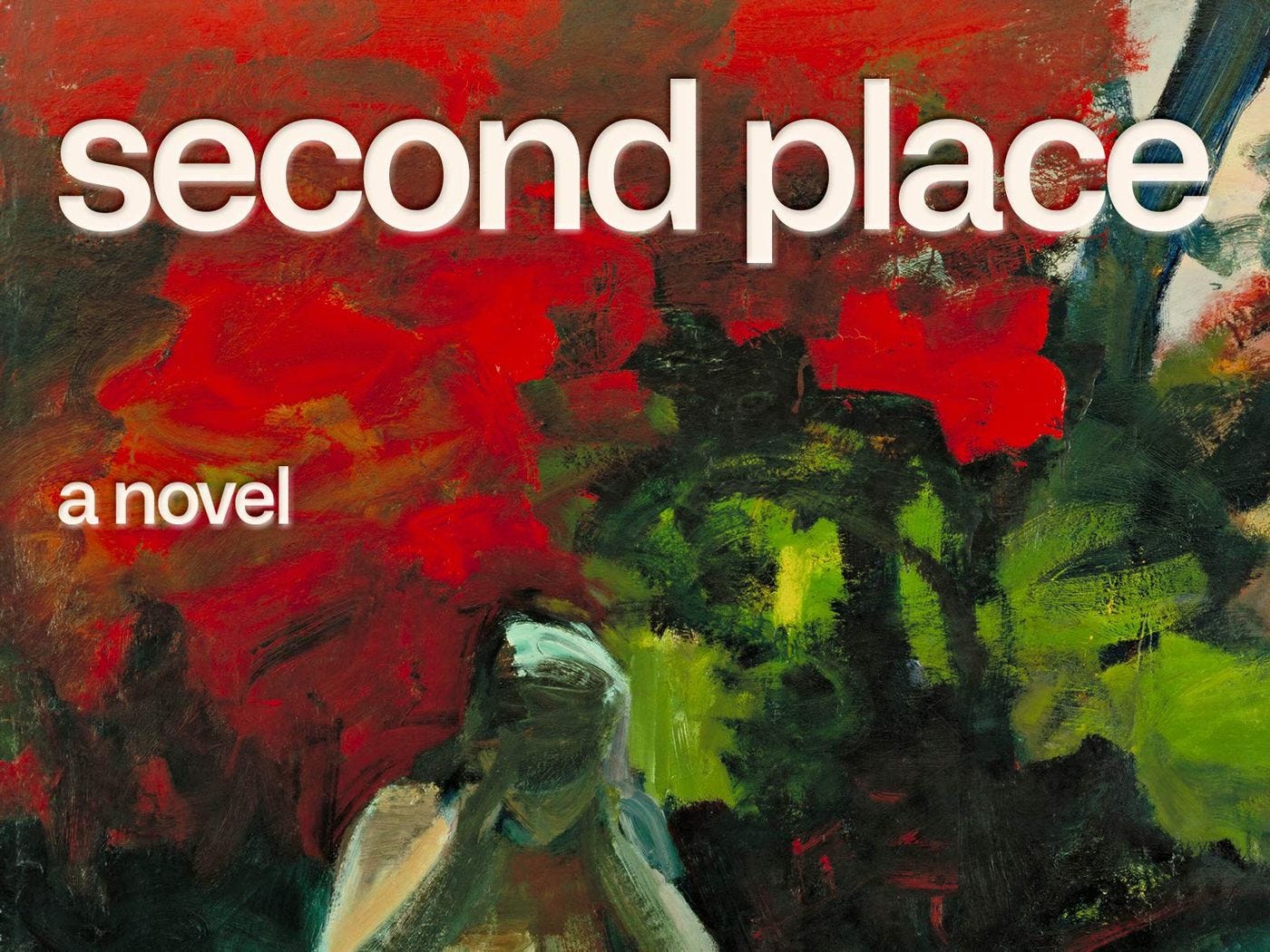
Welcome back to Arroz con Mango. This week, we’ll talk Second Place by Rachel Cusk
I was introduced to Rachel Cusk through her Outline Trilogy, of which I’ve only read the first two. My library app told me Kudos was finally available, but when I approached the shelf I found Second Place instead.
Second Place feels the most “Cusk” of her books I’ve read; her unique introspective style is delivered in the form of a nearly 200 page letter (or monologue) to the narrator’s friend Jeffers, whose name is interjected, somewhat annoyingly, every ten pages or so. Not much happens in terms of the plot: our narrator M invites an artist whose work has greatly impacted her named L to stay with her and her husband Tony. They live in an unnamed, isolated coastal marsh where Tony grey up, whose charming off-the-grid isolation serves as a great artist in residency spot. M refers to their guest house as the Second Place. Trouble ensues when L, who is now an older man, shows up with a beautiful young companion named Brett while M’s daughter, Justine and her boyfriend Kurt have also moved in. L’s presence, which M believed would finally provide relief to what I can only describe as her perpetual existential angst, instead brings turmoil and upheaval to her calm environment.
M opens up the novel by recounting the lowest point in her life: an encounter with the Devil on a train leaving Paris. She describes his disgusting, terrifying appearance and her shock at the way the other passengers are able to ignore him by reading the paper or simply looking away. This surreal encounter sets us up for her ongoing existential and interpersonal conflicts and her confusion of how to deal with past trauma. It also establishes M as an intense and overly perceptive narrator, but before we gain any backstory we are introduced to L.
M first encountered L’s work in Paris; she comes across a poster of one of his self-portraits and is drawn off the street in the first instance of many where an external, mysterious force seems to take over her body. The exhibition was a mid career retrospective, comprised of charcoal sketches of women, landscape paintings, and the self portrait. In his work, particularly the landscapes, she finds an inexplicable sense of familiarity and a sense of achievable freedom.
“There is no particular reason, on the surface, why L’s work should summon a woman like me, or perhaps any woman- but least of all, surely, a young mother on the brink of rebellion whose impossible yearnings, moreover, are crystallized in reverse by the aura of absolute freedom his paintings emulate, a freedom elementally and unrepentantly male down to the last brush-stroke.”
We later learn that L’s art served as a turning point in M’s life, inspiring a divorce from a very unhappy marriage where her ex-husband’s behavior coupled with M’s childhood of constant criticism, has left her feeling disconnected from body and mind. Because these paintings have such a central place in M’s understanding of herself and where she has ended up, she invites him to stay with her family at the marsh.
Second Place interrogates the difference between how men and women experience freedom. For M, freedom came with a price; soon after her divorce she lost her home, her friends, her money, and briefly custody of her daughter as well. In the marsh she is free to live her life how she pleases, but is left with the fear and pain of that loss. L, who grew up with an abusive mother, found freedom in life as an artist. For him, freedom comes from personal whim, from saying and acting as he pleases, disregarding the impact his actions have on those around him. M is frustrated by this because she feels she cannot have this as a woman who has been scorned, writing
“he couldn’t see his own freedom because he couldn’t conceive of how elementally it might have been denied to him.. My own experience of loss, I said, had merely served to show me the pitilessness of nature. The wounded don’t survive in nature: a woman could never throw herself on fate and expect to come out of it intact.”
The more M speaks to L, the more he drives her mad, and his irksome presence eventually causes a rift between her and Tony. Although M is happy with Tony, a caring, albeit distant, partner who helped “rebuild” her in the aftermath of her divorce, L has always lived as an elusive presence in her mind ever since her encounter with the paintings. As L continues to mistreat her and Tony, angered by her devotion to L, Tony drives off for a couple of days. Upon his return, M comes to appreciate the life she has with Tony. L’s final blow comes when he defiles the second place with a cruel mural of the pair, finally shattering any remaining illusion M had created of him. She is able to see L for what he really is- a talented, but bitter man.
In contrast, Brett, whom she first dislikes for her wealth and beauty, turns out to be a positive presence and a good influence on her daughter. Brett serves as a foil for M: she is an outgoing woman of many talents and has little shame about her womanhood. Brett draws Justine out of her timid shell and her subservient relationship with Kurt. In witnessing someone else somewhat parent her daughter, M is also forced to confront the pain she harbors from having lost Justine, exacerbated by the strangeness of seeing her as part of herself, whilst accepting she’s now an independent, young woman.
Second Place is a touching, introspective novel with incredibly beautiful prose. There are many aspects of M’s personality, such as her rich internal monologues and careful observations of the world which can be found in Cusk’s other novels. Some elements, such as losing custody of her own daughter, are also drawn from Cusk’s own life. I learned she faced much criticism in response to her very personal book about her divorce for being a whiny woman. Similar criticism L makes of M. Nonetheless, I thoroughly enjoyed this book for its honest depiction of feeling stuck and wanting to introduce something or someone into your life that would grant you permission to feel free again.
Keep a look out for next week’s review of Fuccboi and a deep dive into Sean Thor Conroe’s drama with Sam Pink. Ttyl!
No posts
Comments
Nothing yet. Say the first thing.
Sign in to join the conversation.