
Dear Readers:
Apologies for my absence the past six weeks. Life has delivered a great, unwelcome challenge that leaves me with time, spirit or interest in little else. I’m trying to show up as best I can to meet life’s journey however it dictates. As a result, my presence here will likely remain sporadic at best. Appreciation in advance for bearing with me.
~~~
As August 15th approaches, like every year, I’m posting this reminder about India’s 1947 Partition, and the social-political forces that redefined the land, the people, the polity and delivered much tragedy in their wake. While the newly divided India celebrated independence from British rule, deeper wounds and anger seethed beneath.
In this post, I offer you a Partition-related micro story followed by commentary about the saga. And events/ offerings from The 1947 Partition Archive, an organization devoted to preserving this history.
I hope you’ll read with patience and attention.

After the inter-ethnic violence of the 1947 Partition, Indian and Pakistani governments agreed to exchange abducted women belonging to the “other” side.
Sita’s family was contacted to come fetch her at the border. Sita’s husband and family refused.
“Who knows where she's been? She’s soiled goods now.”
A kindly, old uncle took Sita in. He died within a year. Surprising everyone, he left his vast estate to Sita.
Her husband’s family came rushing.
“Sita, forgive us. Return home.”
Sita refused. Instead, converting her uncle’s home into an ashram for lost girls and disowned women, she found herself a new family.
###
Reena | 2025
Note: Unfortunately, the first part of this story is true. This was the fate for many women of India’s Partition who (were) returned to India. I made up the wishful ending for this story.
It’s August 15th, the anniversary of India’s 1947 Independence from the British, and also that of its Partition, a thoughtless hacking of the country, into secular India and the Islamic Republic of Pakistan.
Every year at this time, I talk about the Partition at great length. If you tire of it, that's OK. I won’t tire of talking about it until I feel we’ve imbibed fully the lessons from that tragedy. I highly doubt that’s going to happen in my lifetime. I wrote more about this history here.
During the inter-ethnic violence of India’s 1947 Partition, several hundreds of thousands of women were abducted, raped, sometimes forced into marriage with their abductors and many into prostitution. After the inter-ethnic violence subsided, newly formed governments of India and Pakistan facilitated an exchange of these women to return them to their home countries. The word “exchange” is disturbing yet befitting for the bartering of chattel, which is pretty much how the women were treated.
In India several such “returned” women were not accepted by their families because they were considered defiled. They were sent to live in ashrams where they lived until the end of their days, away from their families. I’ve read several heartbreaking stories. It was a gargantuan amplification of tragedy. The women suffered repeatedly due to an insane “purity” culture that sealed their fates. Such madness continues in many parts of the world.
Here’s a previous post that talks about this issue during India’s Partition.
The 1947 Partition Archive is a non-profit that I’ve been a founding donor, citizen historian and contributor to, for the past fourteen years. This organization records life stories shaped by Partition from living witnesses.
They have two notable, upcoming contributions you can learn more from or even partake in, as follows:
They’re running a remembrance festival of their phenomenal work Aug 14-17th

It will give you a deeper appreciation of this history AND fill you with a sense of our global connected story! You can find more at https://1947partitionarchive.org/

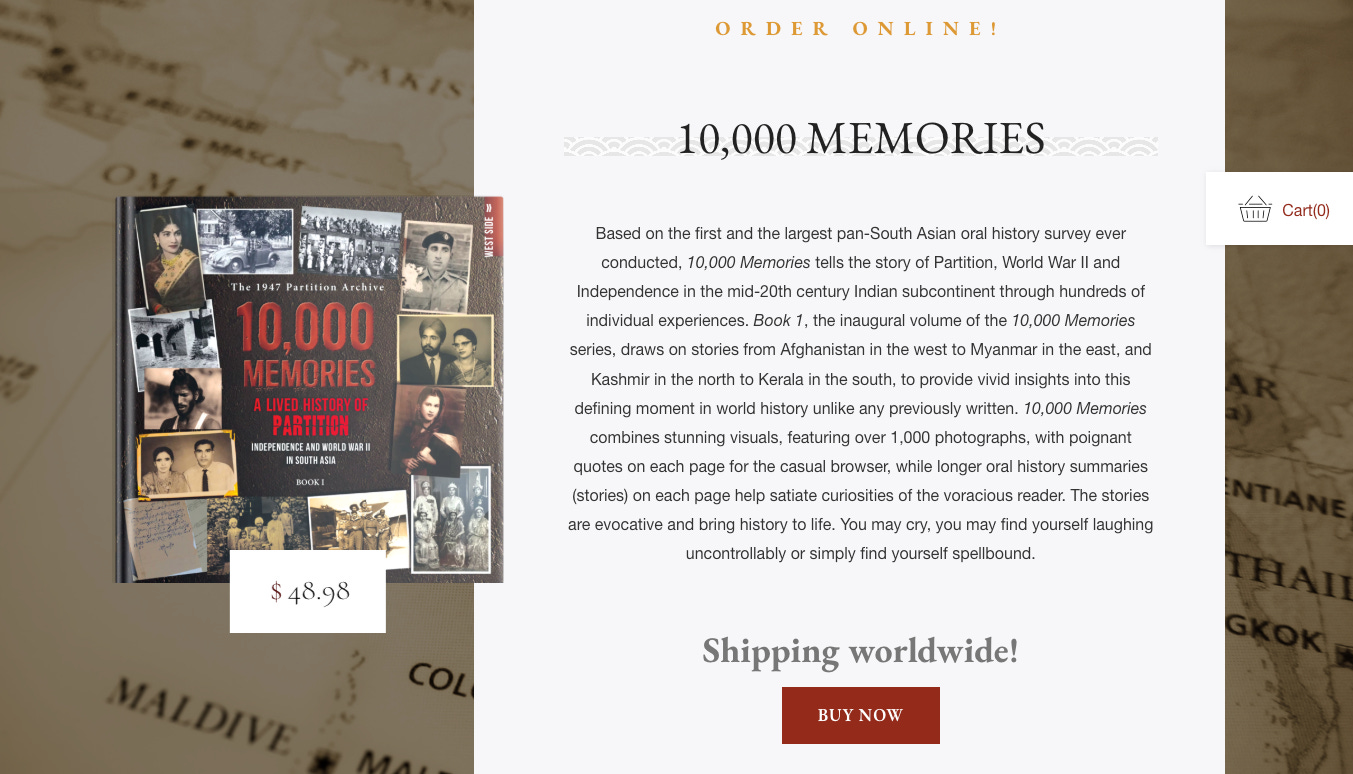
You can learn more about the over 10,000 oral histories that are foundational to the Archive’s work, by purchasing a copy of the beautiful 500-page coffee table book on exhibit.
Buy here: https://10000memories.com/ OR on Amazon here.
Comments
Nothing yet. Say the first thing.
Sign in to join the conversation.