
This edition of the newsletter contains
Btw, enrollments are open for my Systems Design December cohort (sessions start 6th Dec, ~4 seats remaining). If you’d like to dig deeper into systems, their implementation, and how to design them the way they actually run in production, check out:
The course is completely no-fluff and packed with brainstorming and discussions that will shape your thought process and intuition. You’ll feel like you’re part of a real technical discussion happening at your workplace.
How Much Are People Willing to Bet on You?
One of the most important, and often overlooked, metrics to track in your career is - “How much are people willing to bet on me?”
This is certainly not about titles or how loud your voice is in meetings. It’s about credibility, and that takes years to build by consistently delivering things.
If you are known for owning outcomes and driving results, leadership will trust you with higher-stakes work because the most important projects go to those who get things done.
But how do we measure your credibility? Here are a few proxies that indicate people are betting on you:
You are brought into critical meetings without asking
You are asked for input on decisions beyond your scope
You are given ambiguous, high-impact problems
Leadership asks you to mentor or guide others
You get looped in early when something sensitive or risky comes up
None of these happens by accident. So, how do you build this credibility?
Deliver results reliably, not once, but repeatedly
Share credit generously, but own responsibility fully
Communicate clearly and proactively, esp when the stakes are high
Demonstrate sound judgment when there’s no clear rulebook
Stay calm under pressure and solve problems when things go off track
If you do not yet have a proven track record, that’s okay. People might still think that your idea is great and worth pursuing, but they would hesitate to hand it over to you for end-to-end execution.
So ask yourself regularly: “Am I someone others are confident putting their chips on?”. Because in the end, people bet on outcomes, not just opinions.
By the way,
Being hands-on is the best way for you to learn. Practice interesting programming challenges like building your own BitTorrent client, Redis, DNS server, and even SQLite from scratch on CodeCrafters.
Sign up, and become a better engineer.
Here’s a video from me
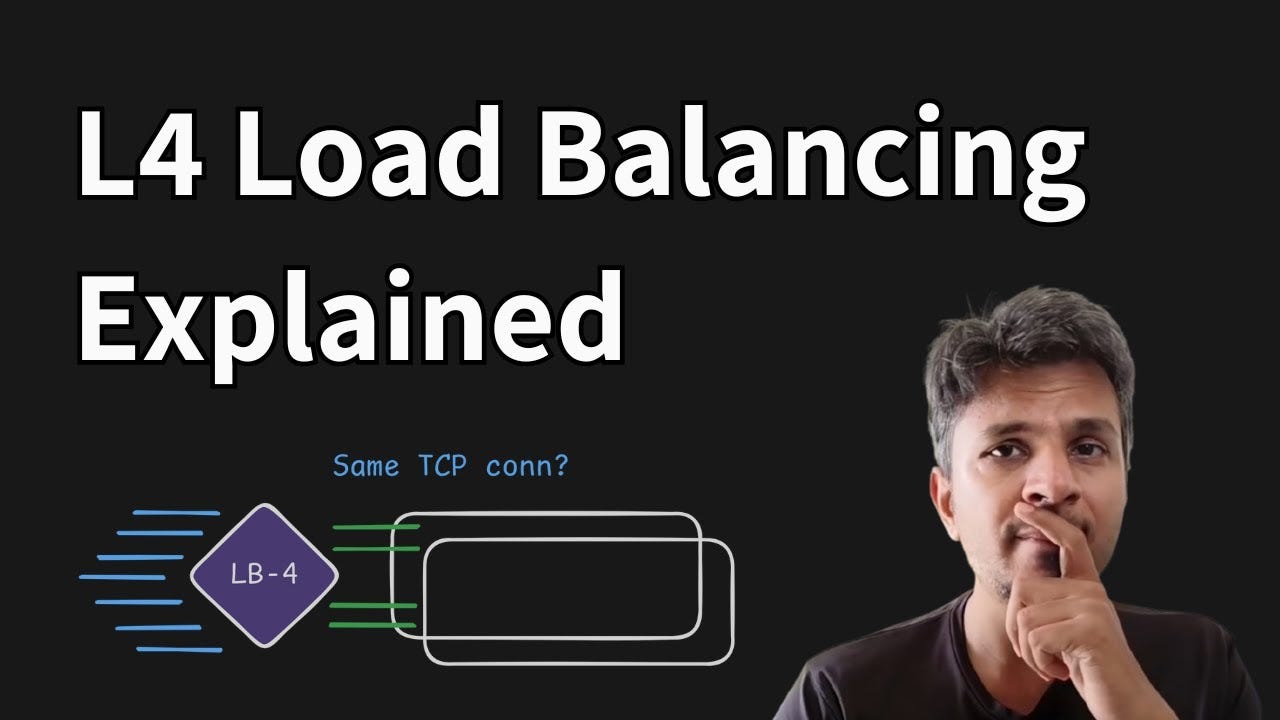
I published a video - What are L4 Load Balancers and how do they work?
There’s a ton of literature and information on load balancers, and most of it focuses on L7 load balancers. But what about L4 ones?
Here’s me breaking down L4 load balancers, keeping things practical with actual commands you can run to build one. In the video, I covered how they work, how to configure them, and the two modes: passthrough and proxy.
Here’s a paper I recently read
I spent some time reading F1: A Distributed SQL Database That Scales
Some time back, I read Google’s F1 paper - something I would have really used when I was on the Ads team. By the way, F1 is a distributed SQL database that replaced sharded MySQL for Ads.
F1 is built on top of Spanner, and the core myth it tackles is that SQL usability, ACID transactions, and NoSQL-level scalability cannot coexist. F1, while chasing this audacious goal, did take a latency hit, but the payoff was real.
I can tell you that reading this paper will definitely make you think about the shape of your data, how your ORM behaves under latency, and what a “good” schema really means when replication spans continents. So much good stuff.
Some things I found interesting: hierarchical schemas, co-location of ‘related’ rows, async schema changes, dual schemas to minimize blocking, and, like everything at Google, Protobuf is a first-class citizen :)
I’d highly recommend you read it whenever you find the time. After reading this one paper, you’ll have a solid understanding of how most distributed SQL databases work.
You can download this and other papers I recommend from my papershelf.
Three interesting articles I read
I read a few engineering blogs almost every day, and here are the three articles I read and would recommend you read.
Thank you so much for reading this edition of the newsletter 🔮 If you found it interesting, you will also love my courses
I keep sharing no-fluff stuff across my socials, so if you resonate, do give me a follow on Twitter, LinkedIn, YouTube, and GitHub.
Comments
Nothing yet. Say the first thing.
Sign in to join the conversation.