
The headlines have returned, right on schedule.
The familiar narrative has spun up once again: Prince Harry is planning a return to Britain, this time with his family in tow. The familiar chorus has resumed, demanding that the British state “beef up” his protective bubble.
It sounds sensible enough — firm, practical and moderately reassuring.
There is only one problem: nobody ever explains what “beefing up” actually means.
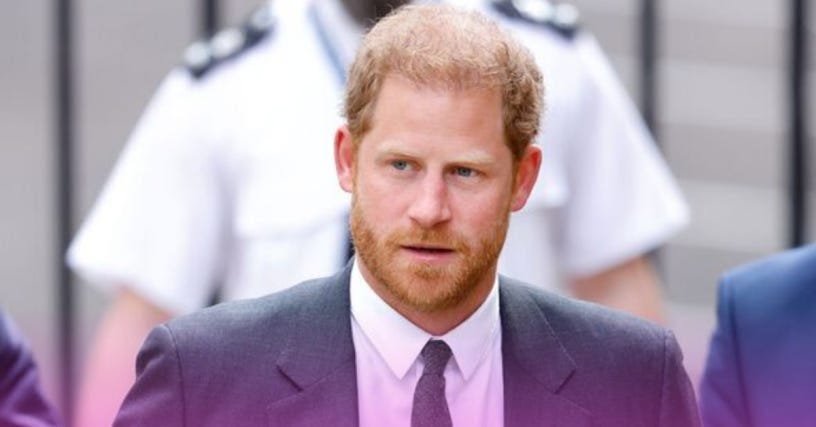
Prince Harry in British security battle
The phrase creates the impression that somewhere inside the British state sits a security dial. Turn it left and Harry receives less protection. Turn it right and he receives more. Somewhere in the middle lies a comfortable compromise where everyone can leave happy.
That is not how the system works.
The dispute over Prince Harry’s security has never really been about levels of protection. It is about classification.
The British state sees security as a function of public office. Harry ceased to be a working royal in 2020. From the state’s perspective, a fundamental change occurred. He no longer performs official duties on behalf of the Crown. Therefore, he no longer automatically qualifies for the same level of publicly funded security provided to senior working royals.
The logic is clear. The difficulty is that reality is not.
Harry may have stopped being a working royal, but he did not stop being Prince Harry. A government can redefine a role. It cannot redefine a lineage.
That distinction matters because threats do not follow constitutional flowcharts. Extremists, obsessives and unstable individuals respond to symbolism, visibility and identity.
This is where the argument becomes muddled, and where the press steps in to substitute slogans for analysis.
The state classifies Harry according to his function. The public classifies him according to who he is. The dispute sits in the gap between those two positions—a gap the media papers over with a rotating vocabulary of administrative illusions.
One week, commentators invoke “IPP (Internationally Protected Person) status” as though it were a hereditary title the Crown has spitefully withheld, ignoring the cold reality that the state cannot grant global diplomatic immunity to a private resident of California without triggering a minor international precedent. The next week, when a family visit is announced and the logistical friction becomes undeniable, the narrative shifts effortlessly to “beefing up.” Suggesting a temporary compromise can be reached without either side climbing down from their position.
It is an entirely artificial vocabulary designed to hide a structural failure.
There is no easy halfway ‘beefy’ category.
Either Harry receives automatic protection because his status as a prince warrants it, or he receives protection only when specific, visit-by-visit assessments determine it is necessary.
Harry argued that his status justified permanent inclusion within the United Kingdom’s protective framework and offered to fund the arrangement himself. The state rejected that proposition, maintaining that police protection is a public function rather than a service available for private purchase.
Everything else is simply a different description of the same dilemma.
The much-discussed “bespoke arrangement” was designed to manage this contradiction. The phrase itself is a classic piece of administrative phrasing, suggesting an elegant, tailored luxury.
In reality, the legal mechanics affirmed by the Court of Appeal reveal it to be a mechanism of deliberate friction. By enforcing a strict 30-day notice period for every visit, the state effectively treats a prince of the blood as an international visitor applying for conditional entry into its security apparatus. The Master of the Rolls, Sir Geoffrey Vos, captured this clinical reality perfectly when he ruled that because Harry lives abroad, he is merely “stepping in and out of the cohort.”
Public hostility and low polling numbers do not alter constitutional definitions, but they do alter the operational friction of a visit. When family members are added to an itinerary, the state’s rigid insistence on individual entitlement clashes directly with tactical reality: a protection detail cannot half-secure a vehicle. Yet under the current model, the presence of children does not change a fundamental classification; it merely complicates the administrative calculus of a temporary arrangement.
This system is often presented as a compromise.
In reality, it is better understood as an administrative holding pattern — one that allows the state to avoid resolving the underlying question.
The government does not want to declare that every prince automatically receives lifelong taxpayer-funded protection regardless of role. Such a position would create difficult precedents and invite legitimate public scrutiny.
At the same time, it cannot treat a globally recognised royal figure as an ordinary private citizen.
So the state did what bureaucracies do when confronted with an awkward reality: it created a process.
In constructing the bespoke model, it departed from its standard protocol, bypassing a formal assessment by the Risk Management Board. The process was designed less to measure the precise threat than to manage the category.
Processes are useful, but also excellent at disguising unresolved questions.
The security debate surrounding Harry has become a perfect example.
His supporters focus on the risks tied to his enduring status. His critics focus on the privileges associated with his former role. Both arguments contain elements of truth. Neither fully resolves the underlying contradiction.
Indeed, the most interesting aspect of the dispute may have very little to do with Harry himself.
The real significance lies in the precedent it sets for the future.
For decades, the monarchy managed these ambiguities through custom, family arrangements and institutional flexibility. Modernisation has replaced many of those informal mechanisms with administrative rules.
Suppose one of the younger members of the Royal Family chooses a private career overseas while remaining a globally recognised figure. What happens then?
The emerging answer appears to be straightforward: protection follows function, not bloodline; employment, not ancestry; office, not identity.
That may prove sustainable. It may even prove correct.
But it is a constitutional choice, not a budgeting decision.
The monarchy has always occupied an unusual position in British public life — both family and institution, personal and political, ancient and modern.
Most of the time these contradictions coexist peacefully.
Occasionally they collide. The security dispute is one such collision.
Which brings us back to the language of “beefing up”.
The phrase suggests the government is withholding some middle option — a little more security here, a slightly larger protective bubble there.
Yet the dispute has lasted years precisely because there is no straightforward middle option.
The real question is not whether Harry should receive marginally more security on a particular visit. Security assessments already account for changing circumstances.
The question is whether Britain wishes to treat a hereditary prince as a constitutional figure or a former public employee.
That is a much larger question.
And it is one that no amount of “beefy” rhetoric can resolve.
We are seeing this exact friction play out in the current media cycle. The sudden, coordinated leak of an impending family visit to the UK—complete with the emotionally charged inclusion of the Sussex children—has been presented by the commentariat as a high-stakes standoff forcing the government’s hand.
To the public, it looks like a negotiation.
To the constitutional analyst, it reveals a profound misunderstanding of state apparatus.
The upcoming administrative review of Harry’s security for his summer itinerary will not hinge on media pressure, public polling, or sentiment. It will proceed down the track laid out in 2020. A cold evaluation of temporary operational risk, completely separate from hereditary entitlement.
The British state has spent years attempting to fit a hereditary prince into a modern administrative framework. The framework has proved remarkably efficient. The prince has proved difficult to classify.
Perhaps that is because some problems are not administrative at all.
They are constitutional.
And constitutional questions rarely disappear simply because somebody invents a new process and gives it a reassuringly bureaucratic name.
By Catherine White
Having worked for The Hon. John Fahey MHR during the 1999 Australian Republican Referendum campaign, I write as a Ten Pound Pom and independent observer of the monarchy and the Commonwealth.
FURTHER READING
Comments
Nothing yet. Say the first thing.
Sign in to join the conversation.