
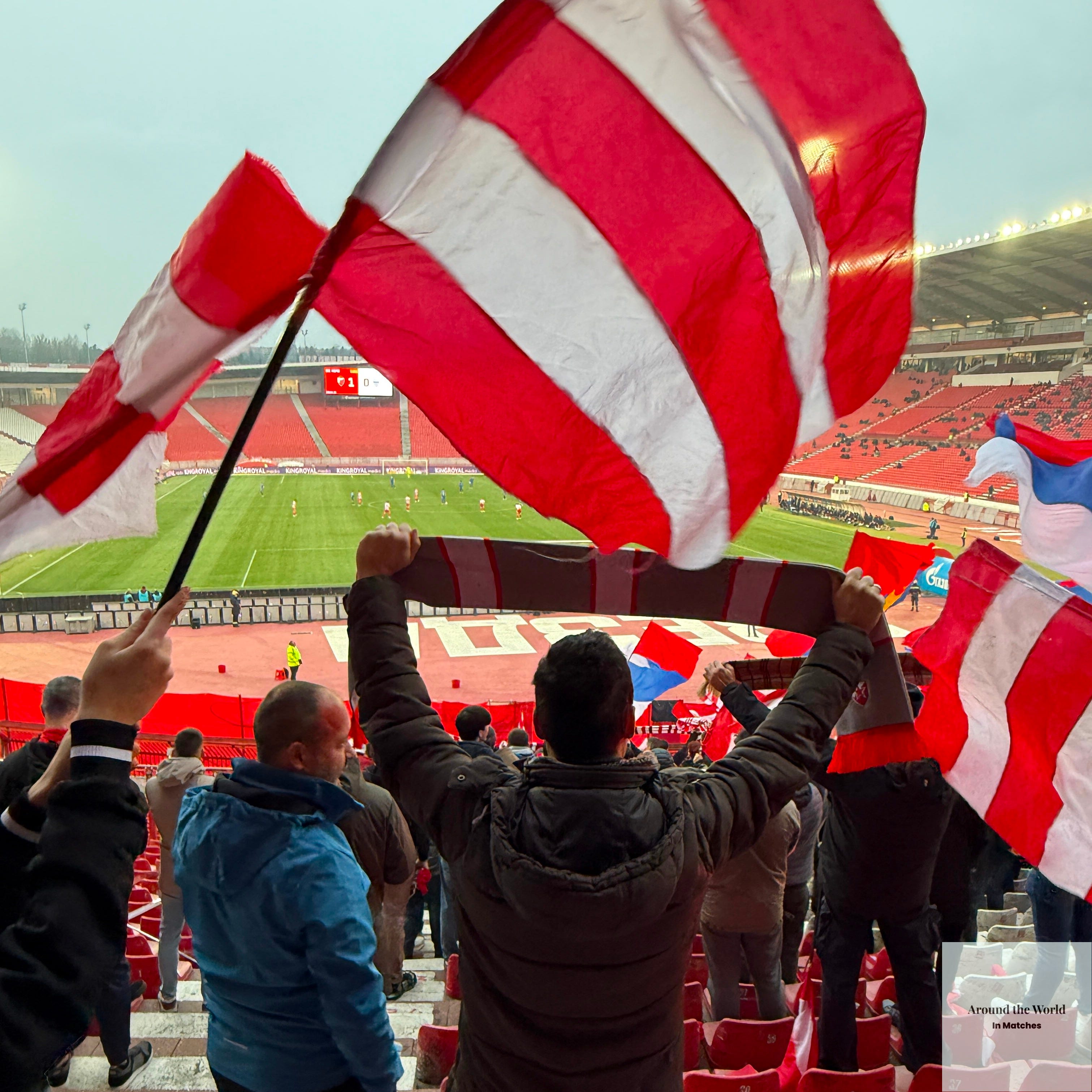
I went to Belgrade expecting a football match; I found a rhetorical war. Between the plumes of colored smoke and the rhythmic chants for war criminals, I realized that the ‘Marakana’ isn’t just a stadium—it’s a mirror reflecting a fracturing world that looks increasingly like our own.
“Sometimes, during derby matches or on European nights, there’s a store up there that still sells beer,” my host said. He quickly pointed to a small park that sat awkwardly on the downslope of a small hill dotted with trees. A handful of park benches lined a single looping pathway, and some chess tables were in a central area. Though from my single observation, they served more or less as tables to rest your beer cans on.
“I thought they weren’t allowed to sell beer close to the stadium,” I said.
“Someone knows someone,” he shrugged. “Do you want another beer before we head into the stadium?”
I was going to say no, but his question exposed his own desire. And he’d stopped walking at this point and was looking longingly toward the store. A handful of fans had gathered, but nothing like he had described on bigger match days.
“I feel like you want another one,” I said, smiling to let him know I’d picked up his signals. It was an overcast day–fog, clouds, pollution competing to block the sun. Whatever it was, it created my idealized version of perfect football weather. There was even a scintilla of cold crispness that added a layer of sharpness to the afternoon.
He nodded and then looked both ways as we walked across the road and then found some cracked concrete steps to make our way up the hill. I counted six people in the park drinking. Two friends with their dogs likely meeting up for a cheeky tall boy while using dog walking as an excuse with their spouse. Another chap sitting solo, quickly tossing back a few. And a group of three standing, greeting each other and looking around surreptitiously as if they’re about to engage in a criminal act.
We were a stone’s throw from Rajko Mitić Stadium, home of Red Star Belgrade. No beer was sold in the stadium, and I was told that beer sales were typically prohibited within a certain radius of the stadium. Fans would meet up at local pubs, have a few pints, and then make their way into the ground.
“Normally, police won’t come up here when there’s more of us, but with just a few people, they may show up,” my host explained as if reading my mind as I scanned the park.
This store, however, was a sort of glitch in the system. Well within the circumscribed space prohibiting beer sales. It felt similar to the county-line liquor stores one can find throughout the Bible Belt, as the mismatch of dry and wet counties creates fascinating economic conditions. I thought they might upcharge customers, but the prices were on par with what I saw elsewhere.
It was clear we weren’t the only ones with the idea to grab one last beer before heading into the stadium. I picked out two beers from a cooler that desperately needed restocking, then paid.
As we exited the store, however, I saw a navy blue van with tinted windows pull up. My host straightened, then shoved his beer into his jacket pocket, doing so with practiced ease. I followed his lead, and as we left the store and started walking into the park, we saw two police officers questioning several men.
Our goal looked stymied. And maybe we’d have to find a side street to duck into before cracking our cans open.
“Let’s sit here and see if they’re going to leave everyone alone,” my host said. “They may just ask those guys and then hop back into their van.”
“Hey, man. This is your rodeo. I’m just following along.”
After a few moments, he nodded and popped the top on his beer. I did the same and took several pulls. We chatted about the club, what to expect at the game, and his life in Belgrade, Australia, and his two months in Beijing.
“I like to collect paper tickets,” he told me. “So, season tickets are out of the question. Besides, my girlfriend doesn’t want me to go to every match.”
“That makes sense,” I said. I told him I was lucky that my wife gave me the space to go when I wanted, but after having kids, it’s easier to watch on TV. That’s why I ended up on trips like this.
We both took more sips. Followed by a long moment of silence. I saw my host glance toward the police. He straightened up just as he had done before, then slowly put his can down.
“We might have to leave,” he said. “Try sliding your beer into your jacket.”
Luckily, I brought my heavy coat. Otherwise, there’d be no chance. We both stood slowly, then started walking out of the park toward the stadium. As we got close to the entrance, we stopped and stood on a corner.
“Those cars are from my hometown,” he said, as he pointed to a few nearby vehicles.
“Did you plan on meeting friends here?”
“No, but I probably know them. Maybe we’ll bump into each other.”
From our vantage point, we could see fans starting to file into the ground. Folks took pictures of the surrounding area. Friends were meeting up to enter together. Families hand in hand walking up the steps into the stadium.
As we finished our beers, he tapped me on the shoulder.
“That’s Stevan Stojanovic, the hero of the 1991 Champions League final. He saved a penalty in the shootout. And it won us the title,” he explained. “Let me introduce you.”
Dressed in an everyday tracksuit, he could have blended in with the grandparents at a youth soccer match. His hair was styled in the same bulbous way as it had been when the club won its only European title. He seemed a man intent on remaining humble, waving off the suggestions that he was a hero, as it was, in fact, a long time ago. We exchanged pleasantries, and he was on his way. After tossing our beers into the trash, so were we.
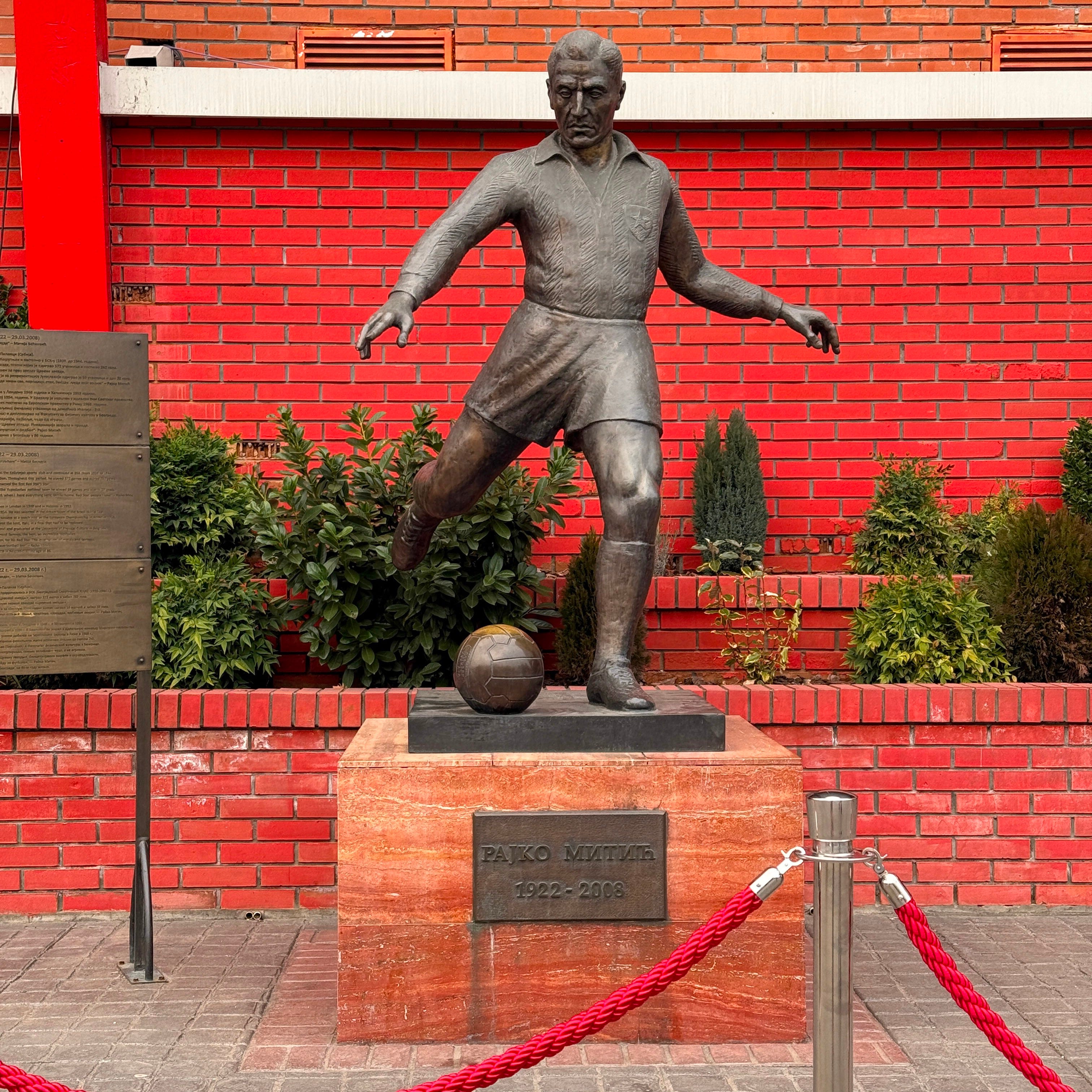
He had told me before that we would sit with the ultras. But because it wasn’t a derby match, it wouldn’t be as intense. Before entering to find our seats, we walked around the stadium, admiring the mural and taking a peek inside the team shop.
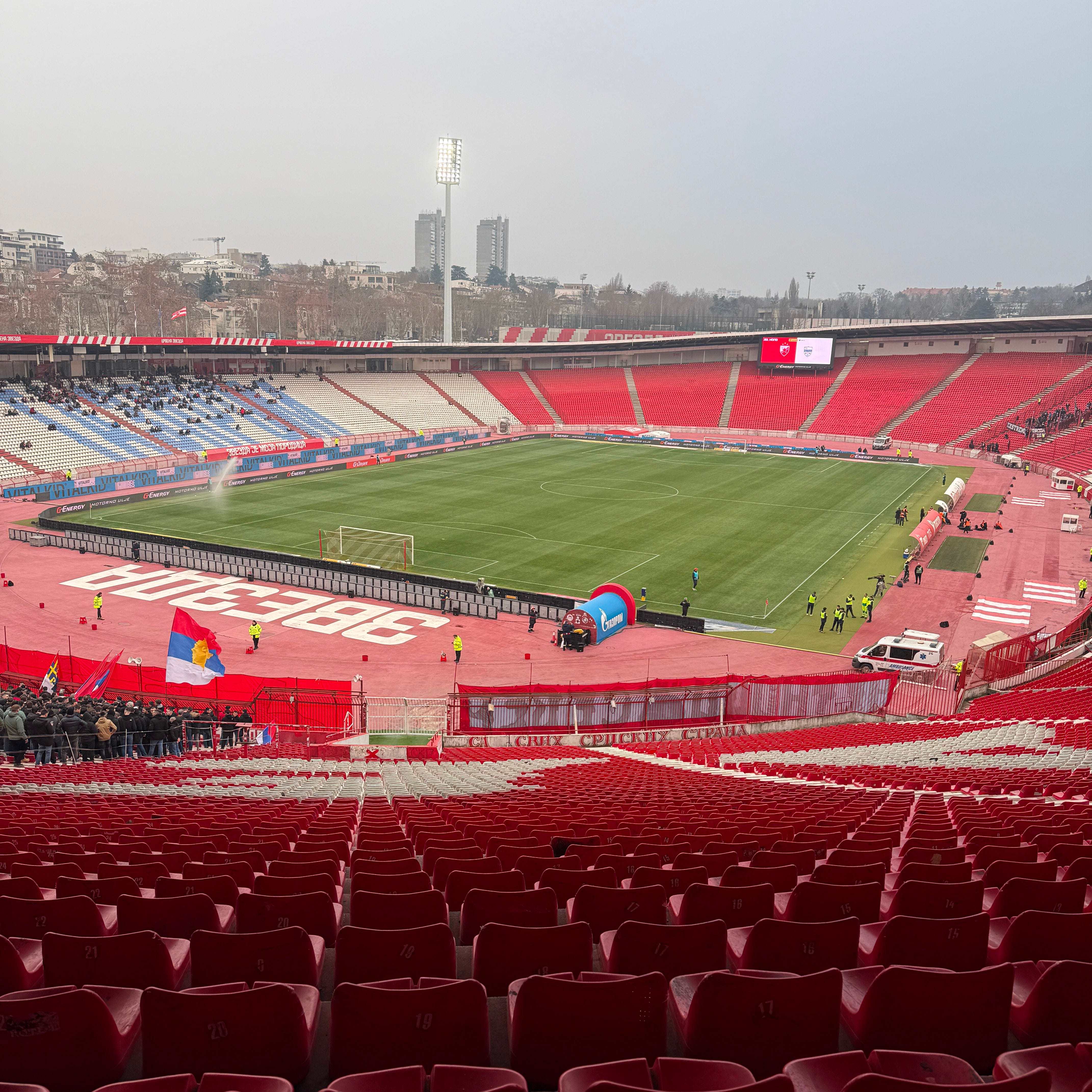
The stadium itself was built into the ground, similar to Nationals Park in Washington, DC. From the outside, it looks rather smallish, but in fact, as you walk around the concourse area before entering the stadium, you’re actually above the playing surface. That sits below you, dug out of the ground instead of being built on top of it.
I also have to mention the bathrooms. They were huge and streamlined—no lines, no waiting. They weren’t glamorous, but the functional design was exactly what a stadium needs.
Before we grabbed our seats, we hit up a local seed seller. Rolling up small squares of white printer paper to serve as a delivery vessel, he filled one with my preferred pumpkin seeds and the other with what looked like honey-roasted peanuts. I cracked mine throughout the match and considered heading for a second helping, but decided against it.
My host mentioned that some of these vendors can sneak in beer to sell. But that’s a risky endeavor. He inquired with each vendor a few times. They shook their heads, indicating they were out or weren’t able to bring any in. I’m not sure what the fine was or what was required to enter and sell their snacks, but based on my conversations, it seemed they paid a hefty fee just to enter. It was clear, though, that the foodie culture at American ballparks and sports grounds wasn’t a thing in Belgrade. Seeds, water, coke, and maybe, if you’re lucky, a cheeky beer from a lucky vendor.
With our paper cones of seeds in hand, we headed to our seats out into the open air of the bowl. We transitioned from the frenetic energy of the concourse to an atmosphere focused solely on 90 minutes of intimidation. But we were so far removed from the sprawling green pitch, ringed by the sweeping athletics track devoid of lines and painted red, I felt miles away. The “Marakana” doesn’t just hold people; it swallows them. The physical game on the grass became secondary to the human theater in the stands.
But sitting, well standing, with the ultras, who operate on a 90-minute mentality, made it worth it, especially since I was there to observe through immersion and get a proper cultural experience.
Red Star’s opponent was FK Novi Pazar, named for their home base, a city in southern Serbia. It is roughly 80% Bosniak and borders Kosovo. And the chants that both ultra sections engaged in mirrored the tension one would expect in this part of the world.
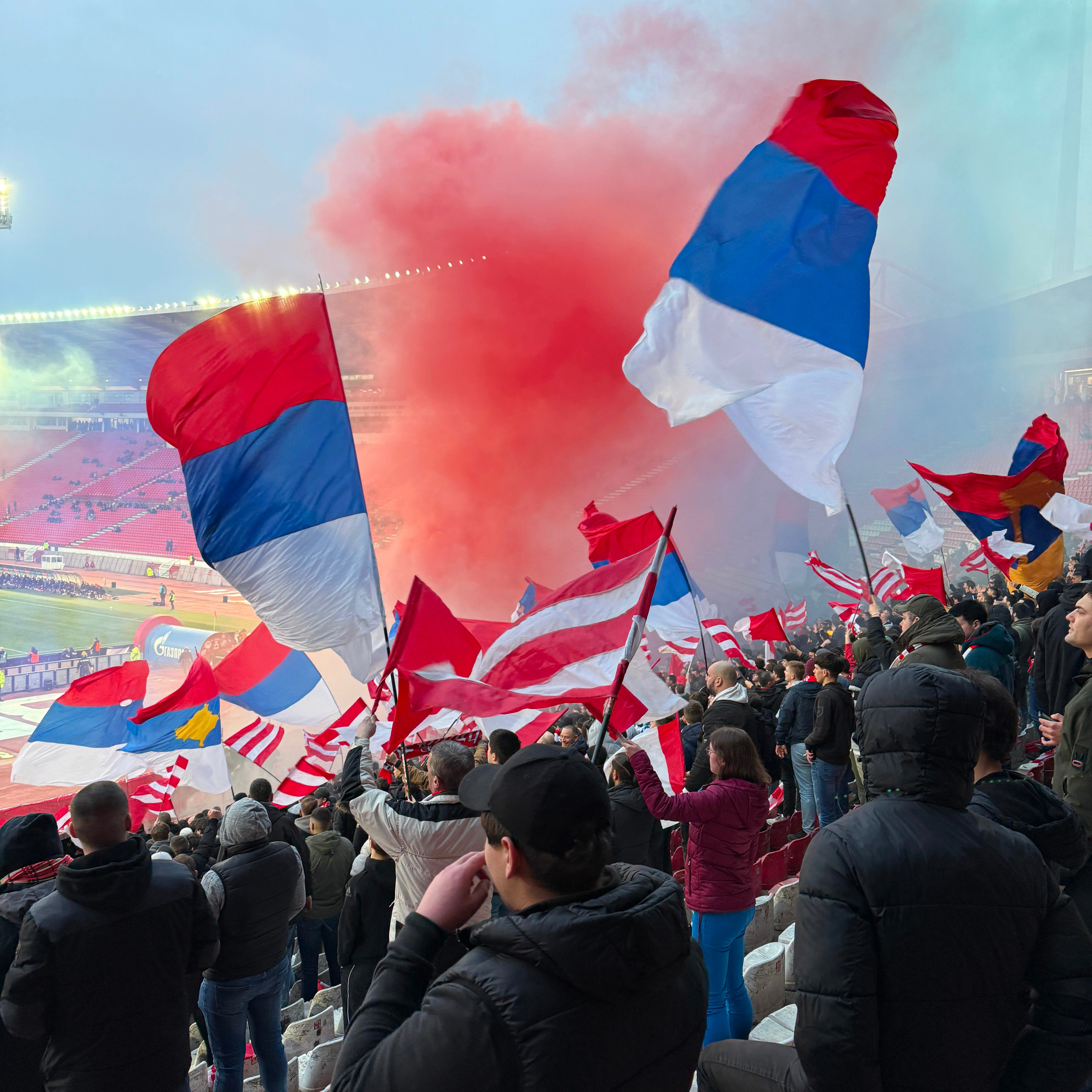
Flags waving, the sounds of instructions indecipherably shouted into a megaphone, and colored smoke added to the ambiance, but the devil was always in the details. On some of the Serbian flags that waved in front of me, the outline of Kosovo was visible. It was yet another reminder that whatever conflicts we thought were resolved were still raging, at least rhetorically, in the stands during football matches.
On some of the small red-and-white striped flags waving just below the larger ones, fans had mounted small plastic pigs. And throughout the match, they were prone to chanting Ratko Mladic’s name. For those of you keeping tabs at home, he is a convicted war criminal. Found guilty of crimes during the siege of Sarajevo and leading the Srebrenica massacre. It seemed folks in the ultras section were less there to watch the match than to puncture each moment with provocations.
It was a far cry from what I’m used to watching EPL or MLS matches. In those instances, fans sing less about the other team and more about their club’s greatness or a player’s ability. Though, as a Liverpool fan, it’s been easy to point to the tragedy and poverty chants from opposing clubs.
For what it’s worth, I was told by my host that the opposing fans were, themselves, chanting the name of an Albanian war criminal. And there was a moment when they set a handful of the seats in their section on fire. This was after a prank by the home fans in which a few smoke bombs went off in front of their section, revealing the colors of the Serbian. A signal that, despite being a Muslim town, Novi Pazar was in Serbian territory.
As I wrote in an earlier piece, I understood these sentiments existed. But I wasn’t aware that they remained a part of everyday conversation. That they were used in taunts and chants during sporting events to both provoke and establish dominance.
It felt contrived, even if it was visceral, as if there was nothing better to chant about. For example, the three fans who died and the militants who were injured in Banjska less than three years ago, after storming the Kosovar village, were also treated at hospitals in Novi Pazar. If the animosity were that deep and that ingrained, it seemed ill-advised to use that town as a fallback when things didn’t go to plan.
And knowing that the animosities have the potential to be violent, it makes the sort of provocations I heard from the terraces even more problematic. These were chants that targeted things people can’t control, like place of birth, ethnicity, religious beliefs, etc., as if the whole thing was meant to spark a wider conflagration. To sharpen the contradictions and make it impossible to build bridges between various groups across Serbia and the region.
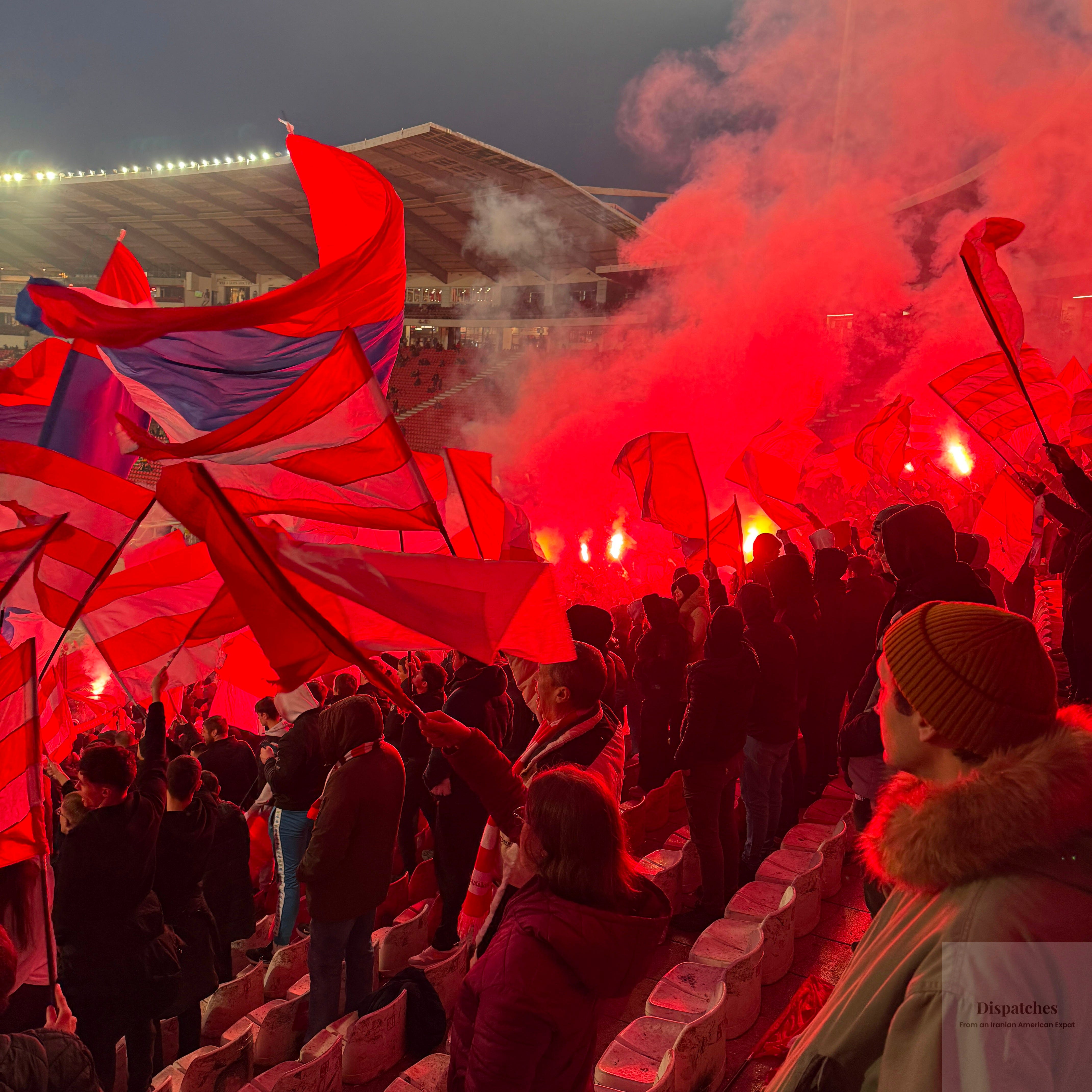
It made me deeply uncomfortable. Not just because of what was happening around me, but it was, as I stated in the piece on my other publication, a reflection of things I’m seeing in the US, where partisan politics has drawn stark dividing lines. Fans at high school football matches will yell the President’s name when hosting schools with a large population of students of color or wear mock ICE uniforms if the school has a large immigrant population. The message is clear: you aren’t one of us, and you never will be.
My trip was about watching sports: football and basketball. I wanted to experience the ultras culture in Belgrade, but I wasn’t prepared for it to be a mirror for what’s happening in my own country.
We left the match before full-time, and I made my way back to the city center where I was staying. I had some dinner and then headed to bed, sleeping fitfully once I arrived back at my hotel.
Have you ever felt a sporting event cross the line from competition into something more tribal? I’d love to hear your thoughts in the comments.
Comments
Nothing yet. Say the first thing.
Sign in to join the conversation.