
Researchers gave standardized creativity tasks to a large group of humans and AI agents, then measured how much the responses within each population resembled each other. The humans scattered all over the map, disagreeing with each other the way humans do, while the agents converged. This means that agent responses mirror other agent responses far more than humans mirror other humans, even after controlling for various confounding factors. If your AI-generated ideas feel generic, switching models won’t save you. They’re all imaginative (or rather, unimaginative) in the same way.
Why? Because the large language models that power agents are statistical machines. They were trained to predict the most probable next token given their training data, and when you prompt it once and quickly accept the answer, then you’re sampling from the middle of a probability distribution, which is not where you want to be for creative work. The valuable ideas, the ones worth building a product or solution around, live in the tails of a statistical distribution, not in the middle—your idea won’t be novel if it is the average of everyone else’s ideas. A single prompt is therefore unlikely to provide a new or creative angle on a problem you are trying to address.
In the HEAD process (human-embedded agentic design) we solve this through positioning an adversarial multi-agent system at the heart of the design process, building on two categories of agents. The first are gen agents, short for generative agents, primed to produce a variety of ideas. These agents should have their context set up to push against the model’s regression to the mean through producing multiple alternatives outputs. The second are crit agents, short for critique agents, positioned to evaluate the output of gen agents. Their job is to take the output of the gen agents and evaluate every alternative against the goals you defined. There’s no rule that says you run exactly two agents; you might have five gen agents attacking a problem from five different framings and three crit agents scoring on different criteria.
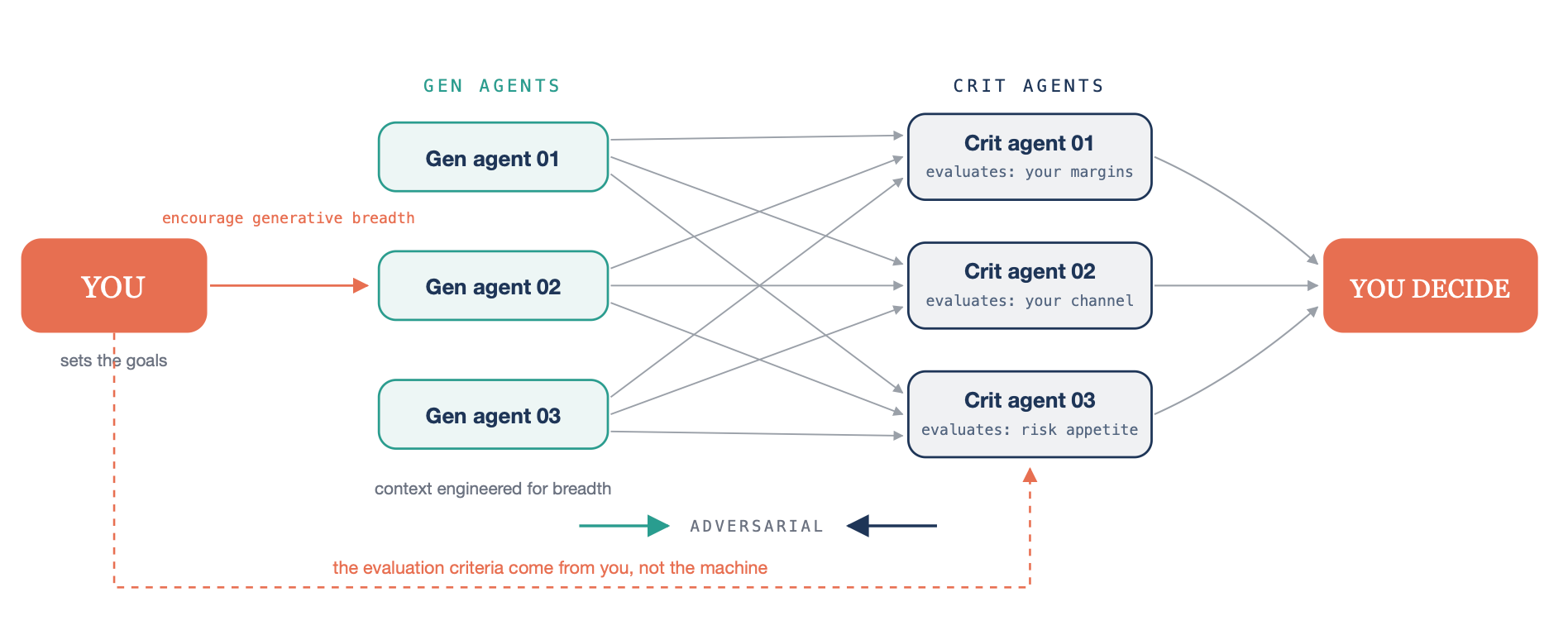
The Gen/Crit Agent Architecture
Suppose you’re positioning a new product. Using the gen/crit architecture you could spin up gen agents with different mandates (for example: one contrarian, one anchored in an adjacent industry, one focused on what incumbents would struggle to copy), then hand all of it off to crit agents that score each option against a set of constraints your particular situation warrants, for example: your margins, your marketing channels, or your appetite for risk.
The adversarial stance is the magic ingredient here. At architecture schools, the idea of a crit is core to the way design is taught. Through periodically confronting designs with critique, they can evolve to become better over time. What the gen/crit structure does is to make sure that agents take diverse and opposing perspectives, so that the regression to the mean of the training data is ameliorated. For example, recent research found that in biomedical hypothesis generation for drug discovery, multi-agent frameworks with dedicated reviewer and moderator agents substantially reduce hallucinations compared to single-model generation.
To make this work the evaluation criteria probably needs to come from a human (read: you)—to make sure the context provides the right goals and expectations for the agents to operate under. For example, recent research found that teams working with AI assistance converged prematurely and explored a narrower solution space than human-only teams, while, ironically, rating their own creativity just as high. The gen/crit architecture was conceived to prevent this type of failure, and its anchoring in human judgment is foundational, because such judgment is hard for LLMs to supply. So, the core loop of human-embedded agentic design is agents generate, then other agents critique, and the human evaluates and chooses a direction.
No posts
Comments
Nothing yet. Say the first thing.
Sign in to join the conversation.