
A team of researchers for the Iowa Department of Natural Resources has completed a four-year groundwater study of the Iowa Great Lakes that unveils startling new information about the previously unknown and unusual process that created West Okoboji Lake.
In effect, the study flips the long-accepted narrative about the formation of the lake. Reversing and amending the T. S Eliot poem, The Hollow Men, from 1925:
This is how West Lake likely was formed / Not with a whimper but a bang
And it happened not over thousands of years, as previously believed, but quite suddenly.
The surprising and fascinating story of how it happened lies ahead.
But first, let’s look at the previously accepted geologic history of the Iowa Great Lakes region.
West Okoboji Lake has been the centerpiece of the Iowa Great Lakes area since non-native settlement began in this region in the 1850s. It was the first of the lakes to be fully settled, is the home of a large and historic amusement park, and has a shoreline comprising some of the most expensive residential real estate in Iowa.
The earliest settlement on West Lake occurred along the south shore near the junction with East Lake and progressed northward along the east and west shores of West Lake.
The last virgin homesites on West Lake, near the north end on the west shoreline, were developed in the 1960s.
Development around East Lake and Spirit Lake occurred much more slowly, and property values long have been substantially greater on the West Lake shoreline.
Why? Well, because even the earliest settlers realized that for most of the summer, the water in West Lake was blue, clear, and inviting, all to greater degrees than the water in East Lake or Spirit Lake.
But, again, why? The explanations consistently have been that the relative clarity of West Lake stems from its extraordinary depth and from a mysterious, undiscovered deep water aquifer that somehow provides a continual feed of fresh water into the lake.
One problem with this explanation is that all three lakes are glacial lakes, and glacial lakes are relatively shallow — less than 25 feet deep at maximum for East Lake and Spirit Lake while West Lake has been measured variously through time at a maximum depth of 134 to 160 feet. Another problem is that the spring-fed theory has been an elusive concept with no facts to support it. Where is it? How big is it? How does it work?
The three major lakes of the Iowa Great Lakes region were among thousands in the northern U.S. created by the glaciers of the last ice age that covered North America from the Arctic southward through Canada and across roughly the northern one-third of the United States.
The glacial ice was thousands of feet deep, and the glaciers weighed billions, sometimes trillions, of tons. Eventually, most of them melted, but the process was slow and uneven. The glaciers moved back and forth over the land beneath them, advancing to the south in colder times, then retreating in warmer weather – again and again and again. The movement and the weight caused the rock and gravel beneath the glaciers to form lake-depth depressions in the land.
The process continued for thousands of years with the moving glaciers carving not only lake beds, but also deep valleys where they deposited large quantities of pebbles, earth, and boulders, a mixture known as moraine. The moraine could form dams, which then proceeded to trap water and create more lakes, according to the National Geographic Resource Library.
It was this latter phenomenon that long has been credited for the creation of the Iowa Great Lakes, as moraine deposits in the northwest and southeast corners of Dickinson County trapped the glacial meltwater. Water from ice that melted in the county stayed in the county. That story, too, is explained in the new groundwater study.
The biggest news in the study, however, is the unveiling of a new theory of creation for West Lake that is very different than the creative forces that created East Lake and Spirit Lake.
About 17,000 years ago, in the last ice age, an extension of a glacier, known as the Des Moines Lobe, moved south into Iowa. It settled for a time in Dickinson County before advancing south almost to Des Moines.
Large chunks of ice from this glacier dammed the headwaters of an ancient river in Dickinson County – known as the Paleo (dried up) Iowa River. The river flowed in the shape of the letter L, from Minnesota into Iowa heading toward Milford. When it approached Spencer, Paleo Iowa River turned east toward the Mississippi River. Ice chunks from the Des Moines Lobe also blocked the Ocheyedan River in northwest Dickinson County.
The climate was warming, and the Des Moines Lobe began to melt. But with the rivers of Dickinson County jammed shut by the ice, the icemelt was trapped, thus creating Glacial Lake Spencer just south of the Paleo Iowa River.
Glacial Lake Spencer took the form of a large semi-circle extending from the Ocheyedan River almost to Ruthven, engulfing what later would become the cities of Everly and Spencer.
Spin forward some 1,200 years. Another glacial extension, the smaller Okoboji Sublobe, discovered in the recent study, moved southward into Dickinson County. As it continued to advance, a huge subglacial (underground) lake was formed by meltwater from this Sublobe and became trapped by ice beneath its front edge. Further advancement of the Sublobe put enormous amounts of pressure on this subglacial lake.
Then, as the Sublobe continued to move south to its terminal position at Glacial Lake Spencer, the ice of the Sublobe suddenly met the subglacial lake of meltwater. The result was a sudden release of the substantial pressure on this subglacial lake, which, in turn caused a sudden release of the lake’s water.
The sudden outburst of this enormous quantity of water was considered catastrophic — fully described as a catastrophic outburst. It was extraordinarily powerful. It created a deep U-shaped tunnel valley extending northward and blew away a three-mile-wide section of the Milford Moraine at the southern edge of where the Okoboji Sublobe had come to rest.
The flood water then virtually forced its way into two closeby vacant channels — the newly formed tunnel valley and the valley of the dried-up Paleo Iowa River.
The result of this “single catastrophic event,” the study reported, was:
West Okoboji Lake.
Consider: Such an event — it might have been a kind of water explosion — releases at least 3.5 million cubic feet of water every second.
That would have been enough water to create West Okoboji Lake in less than 30 minutes, based on the volume of the lake and the speed of the release.
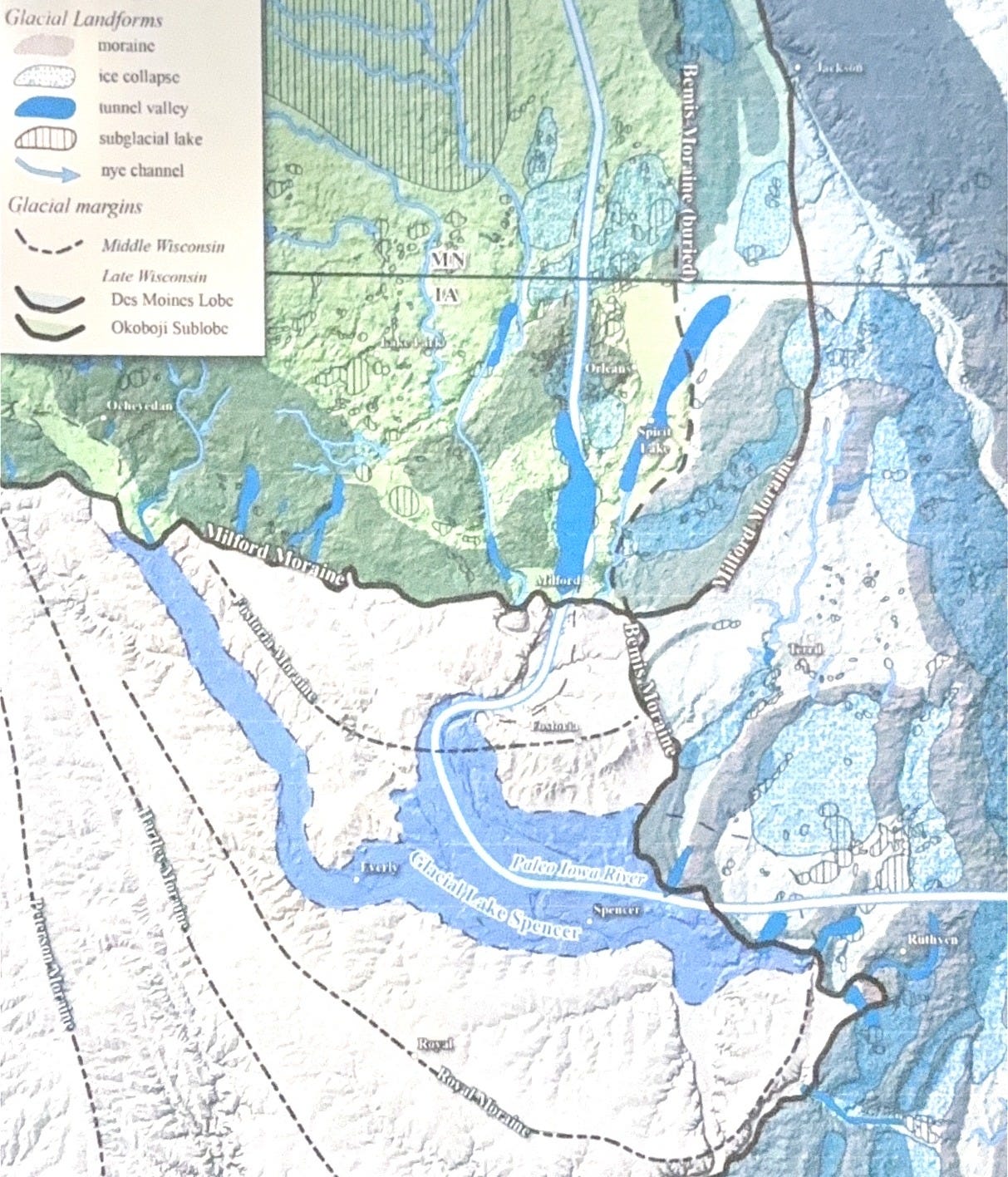
The extraordinary depth of West Lake is believed to have resulted from the fact that its north-south placement matches the locations of both the valley of the Paleo Iowa River and the tunnel valley created by the catastrophic flood.
Another surprise: The initial location of the new West Lake Okoboji would have been beneath the leading edge of the Sublobe, with the lake ultimately becoming visible on the horizon only after that part of the glacial extension melted.
West Okoboji is up to seven times deeper than either of its companion, traditional glacial lakes, East Okoboji and Spirit Lake, both formed by the melting glaciers as they repeatedly advanced and retreated. The resulting depressions eventually filled with icemelt and groundwater and became comparatively shallow glacial lakes. Unlike West Lake’s big-bang creation, this process took thousands of years.
Now, about that underwater spring that is believed to feed West Lake Okoboji: The study did not locate a deep aquifer. But it did find evidence that such an aquifer exists.
John Wills, of the Dickinson Clean Water Alliance, wrote in a recent issue of the Okoboji Protective Association (OPA) Newsletter, that the researchers discovered a significant and surprising correlation between the water levels of West Okoboji and a Minnesota Department of Natural Resources monitoring well situated 14 miles north of West Okoboji.
Wills, who also is a past president of the OPA and Speaker Pro Tem of the Iowa House of Representatives, concluded that the two systems, one in Iowa, the other in Minnesota, “move in such close harmony that it suggests the lake is a window into a massive, regional underground lake.”
Aficionados of the Iowa Great Lakes are grateful for the work of the researchers who produced this study. It promises to yield benefits in water quality for the Iowa Great Lakes far into the future.
Want to know more about the Iowa Great Lakes — how they came to be, how they were named, how they compare, and more? Here’s a link to a newsletter I wrote about all of that a while back — before the latest news about how West Okoboji’s formation was different from the other lakes.
. . . a part of the Iowa Writers’ Collaborative, which represents more than 60 professional writers with Iowa roots. My goal today was to provide an enjoyable, informative, or worthwhile reading experience – ideally, two or three of these things. Although my subject matter is widely varied in an increasingly specialized Substack world, I hope you may view this diversity as added value that promotes thought. But I digress. This newsletter is and will remain free. Which makes me all the more appreciative of those who choose to contribute. I am deeply grateful for such entirely voluntary support. In response, I will give all net proceeds to nonprofit organizations that promote freedom of speech or cover local news in the Midwest. As a paid subscriber, you are thus encouraging me to continue writing so that both of us may effect some overall good for our society. Best wishes and happy reading.
No posts
Comments
Nothing yet. Say the first thing.
Sign in to join the conversation.