
One in a series of newsletters commemorating achievement in Iowa as the state approaches its 180th year of statehood in America’s 250th anniversary year.
John Atanasoff became obsessed with finding a faster way to do mathematical calculations after spending weeks doing them for his Ph.D. in theoretical physics.
He had come to what is now Iowa State University in 1925 for his master’s degree in mathematics. He earned his Ph.D. at the University of Wisconsin, then returned to ISU as an assistant professor of mathematics and physics.
Yielding to his obsession, he examined numerous devices for making calculations, ultimately concluding that all of them were flawed.
Then, one night in the winter of 1937, he was sitting alone in a quiet bar sipping scotch, and his thoughts started coming together. His computing machine would use base-2 binary numbers (0 and 1), not the traditional base-10 numbers. He would use condensers for memory. There would be a regenerative process to avoid memory loss from electrical failure. He made notes on a cocktail napkin. He obtained a $650 grant from ISU and hired Clifford Berry, a bright and inventive electrical engineering student, who grew up in Gladbrook and Morengo, Iowa, to help with the project.
With $5,000 in outside funding, they worked together building a machine in the basement of the physics building. It was the size of a desk, weighed 700 pounds, had more than 300 vacuum tubes, and contained a mile of wire. And it could do calculations really fast for the time, one every 15 seconds. (Today’s computers can do 150 billion calculations in 15 seconds.)
They demonstrated the machine’s speed in March 1939. They continued to work on it, but the project drew to an abrupt halt with the arrival of World War II in late 1941. Atanasoff left ISU for a defense-related position in Washington, D.C.; Berry left, similarly, for a position in California. Their machine sat idle.
On a return visit to ISU in 1948, Atanasoff was surprised to discover that their creation had been removed and disassembled.
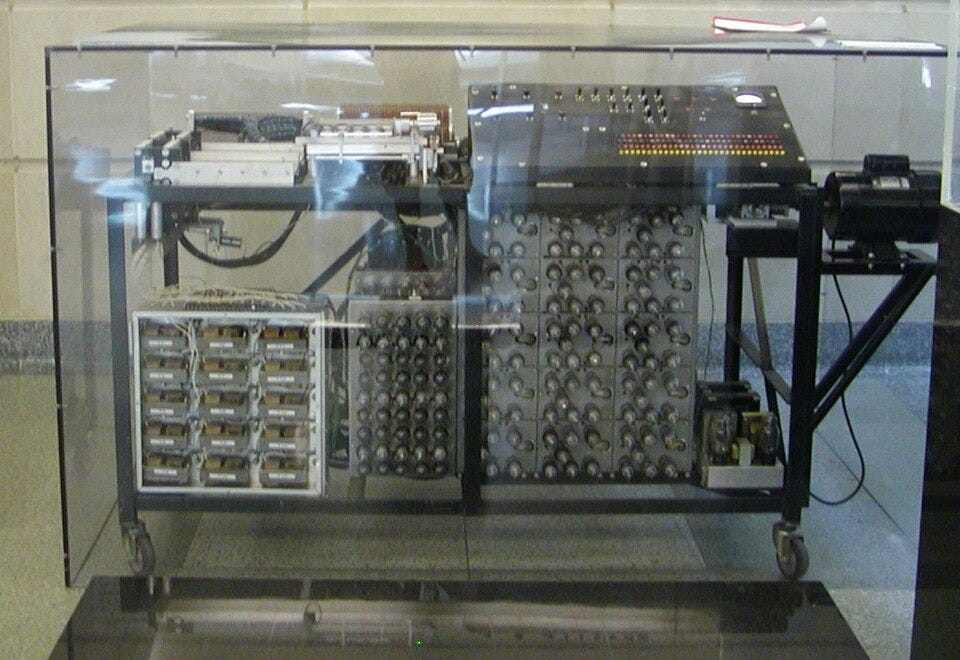
Spin forward to 1973. A computing device created at the University of Pennsylvania in 1946 – seven years after the Atanasoff-Berry Computer (ABC) at ISU – had received the first patent issued for a computer, and long had been considered the first computer. Now, in 1973, the patent for the University of Pennsylvania computer was under examination in a federal lawsuit.
The court ruled that the patent was invalid, in part because the core concepts were derived from the ABC.
John Atanasoff was the father of the computer.
Herbert Hoover was the only President from Iowa, but it was his humanitarian public service before and after his presidency that left a mark of greatness on America and served the world.
The 1929 stock market collapse, followed by the Great Depression, occurred within Hoover’s first year as president. His inaction in response to these events marks him as one of the country’s worst presidents.
Still, when World War I broke out more than a decade before Hoover’s run for President, 120,000 Americans, scrambling to get home from Europe, were trapped in London. Passenger ships were not in service, and they had no access to money beyond what they carried with them. Hoover, living in London, acted on his own to arrange temporary housing and raise money to get them home. It was a remarkable achievement of humanitarian service, something at which Hoover would prove to be quite good.
During the war, when nine million people in Belgium were threatened with mass starvation, trapped between the attacking German Army and a British blockade, Hoover, working from a position of neutrality, persuaded both sides to let food through to Belgium.
As Secretary of Commerce, preceding his presidency, he foresaw the need for federal oversight of commercial aviation and radio. He also laid the groundwork for the biggest dam built to that time. The water and electricity it provided enabled the growth and development of growing frontier regions in Nevada, Arizona, and California. The dam, opened several years after Hoover’s presidency, was named for him.
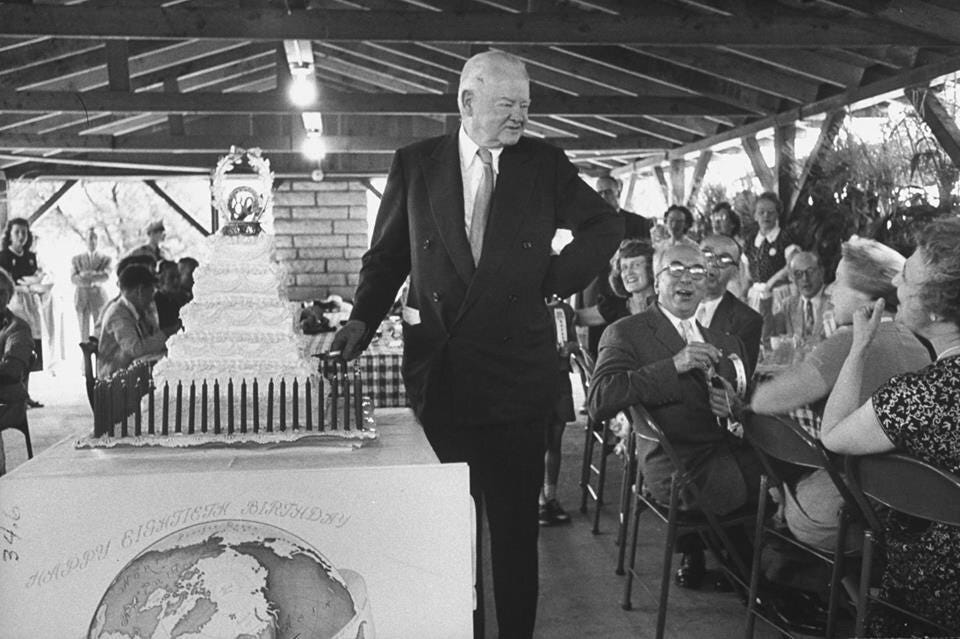
Hoover also led the government’s response to the Great Mississippi Flood of 1927, which submerged a huge expanse of farmland and destroyed the homes of more than 1 million people. He assembled hundreds of ships to bring in supplies, oversaw the creation of tent cities for the homeless, and launched an appeal that helped raise millions of dollars for the Red Cross.
He solved problems and saved lives following his presidency, as well – famine relief in Europe and Latin America, and a reorganization plan for the executive branch at the requests two presidents, a Democrat and a Republican.
Native Iowan Edwin T. Meredith got his start as a publisher in 1896, a wedding gift from his grandfather. He was 26, and the gift was a share of a small struggling populist newspaper.
Over the next six years, he built the circulation of the newspaper, sold it for a profit and started Successful Farming, a magazine that would become a cornerstone of a major, nationwide magazine publishing business, ultimately to include Better Homes and Gardens, as well.
Both magazines eventually would have 1 million subscribers and become significant forces in chronicling and influencing the business and lifestyle of farming and the world of home improvement.
He built a landmark building to house his publishing business on the Raccoon River in Des Moines.
Always looking for something bigger, he got the bug for public service. After failing in attempts to become either governor or a U.S. Senator from Iowa, he attracted national attention that projected him onto the Chicago Federal Reserve Bank board in 1918, and then to appointment as Secretary of Agriculture for President Woodrow Wilson in 1920.
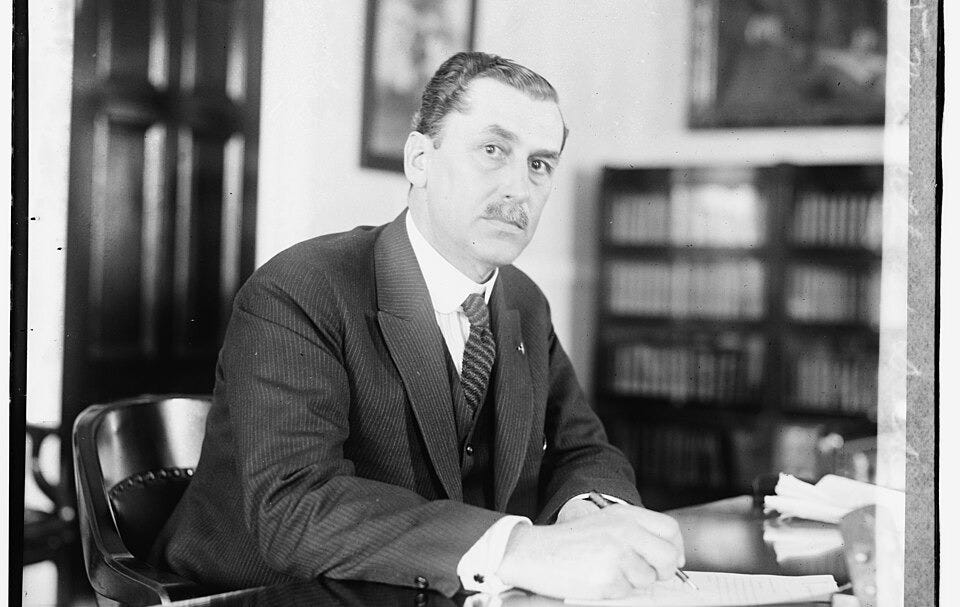
In the 1920s, especially in 1928, Meredith was a serious prospective candidate for national office – the presidency. Sadly, however, his failing health blocked that road. He died of heart failure at age 51 in 1928.
If things had turned out differently, would he have been more successful than Herbert Hoover in handling the Great Depression? Maybe, but we’ll never know.
. . . part of the Iowa Writers’ Collaborative, which represents more than 60 professional writers with Iowa roots. (See Below for Special Offer.) My goal today was to provide an enjoyable, informative, or worthwhile reading experience – ideally, two or three of these things. This newsletter is free. Which makes me all the more appreciative of those who choose to purchase a paid subscription. I am deeply grateful for such entirely voluntary financial support. In response, I will contribute net proceeds to nonprofit organizations that promote freedom of speech or cover local news in the Midwest. As a paid subscriber, you are thus encouraging me to continue writing so that both of us may effect some overall good for our society.
SPECIAL OFFER: For a limited time, new paid subscribers also will receive a copy of my new small book, AMERICA 250: The Semiquincentennial. The book includes all five of my 250th anniversary newsletters, each dealing with a 50-year segment of U.S. history; also the full text of the Declaration of Independence. Existing paid subscribers can obtain a free copy of the book as well; send an email with your mailing address to ahgarson@gmail.com.
Best wishes and happy reading. You can subscribe or upgrade to paid with the button below.
No posts
Comments
Nothing yet. Say the first thing.
Sign in to join the conversation.