
This is an untold story about the improbable linkage between two seemingly unconnected giants of national achievement in Iowa history.
First, the stories of these respective overachievers – one a corporate entity, the other an individual acting independently. Then . . . well, you will just have to wait for it.
The name Fitch Shampoo may not mean much to most Iowans today.
It should.
F. W. Fitch had been indentured by his parents at age 8 to an Iowa farmer for 13 years of servitude – child and teenage labor.
He then sought admittance to the University of Iowa, where he wanted to become a doctor. He was rejected for enrollment, however, because he lacked the required high school diploma.
Instead, he became a barber in Boone, Iowa, and began working with a local physician to develop a cure for dandruff. Fitch’s Dandruff Removing Shampoo bottles were placed in his barber shop for consumer purchase in 1893. It was the first medical/scientific approach to curing dandruff and also was marketed as a product that would grow hair, a claim that may or may not have been accurate.
It was the dandruff treatment, however, that caught people’s attention. Prior to this time, the standard treatment for dandruff was hair tonic containing a high level of wood alcohol. It wasn’t exactly the perfect remedy. It frequently resulted in scalp infections, as Fitch, himself, had discovered as a youth when barbers treated him for dandruff. Fitch, in fact, lost much of his hair as a result. But wood alcohol was a dangerous product. If you somehow got it in your eye, you could go blind.
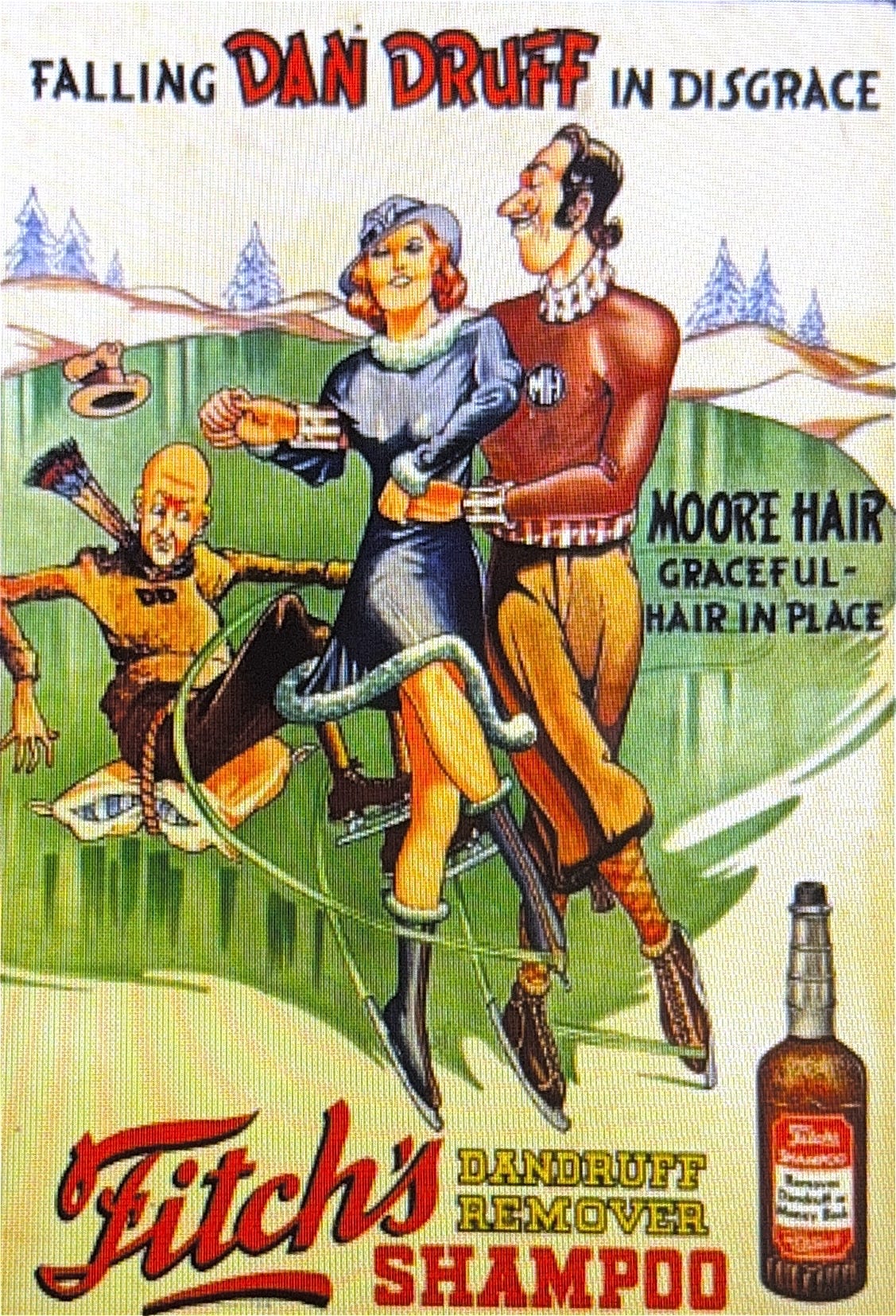
Fitch tried to expand the market for his product, which became commonly known as Fitch Shampoo, with brief periodic sales trips. Eventually, however, he launched Fitch Shampoo nationwide. He quickly added cosmetic, perfume, and personal care products to his product line.
Today, the elaborate bottles and compacts containing Fitch products are collectors’ items.
He moved the Fitch company to Des Moines in 1917, constructing the first of what would become four buildings at or near 15th and Walnut Streets. He jumped into national radio sponsorship of a weekly program in 1928, the first Iowa company to engage in national radio advertising. It paid off – Fitch Shampoo ultimately had manufacturing plants in New Jersey, California, Mississippi, and Canada, as well as Des Moines.
F. W.’s son, Lucius Fitch, founded an F. W. Fitch Co. subsidiary in 1930, which manufactured a line of janitorial supplies, including various specialized soaps and insecticides. The products were nationally marketed.
He sold the business and became an officer of the parent company in 1936. He became the company’s vice-president and general manager in 1947, then succeeded his father as president in 1948.
After a half-century as America’s top name in hair products, the F. W. Fitch Co. was sold to a pharmaceutical products company in St. Louis in 1949.
F. W. Fitch died in 1951; Lucius Fitch died in 1984.
And now, another brief story about another, very different, Iowa legend.
Cloris Leachman was born in Des Moines in 1926. By age 7, she was acting on stage.
She appeared to come by acting talent naturally, at least in the sense that her parents, Berkeley and Cloris Leachman (yes, mother and daughter had the same name), were deeply involved in local theater productions in Des Moines. Berkeley Leachman also was an officer of the family business, Leachman Lumber Co. of Des Moines, founded in 1921. It is still family-owned and operated today.
Cloris Leachman the younger, would become one of the top names in the entertainment business – theater, movies, and television – with a career that spanned more than 60 years.
She was attending Northwestern University in Evanston, Illinois, when she won the Miss Chicago beauty pageant. She then entered the 1946 Miss America contest as Miss Chicago and went on to make the cut to the top 16 finalists.
She next enrolled in acting classes at Actors’ Studio in New York and made her professional debut in 1948, soon landing on Broadway with an understudy role in Rodgers and Hammerstein’s South Pacific.
Her career really took off in the 1950s, ‘60s, and ‘70s with TV appearances in numerous major dramatic and comedy series of that era, as well as major movies. This included such TV shows as Gunsmoke, Wagon Train, The Virginian, Alfred Hitchcock Presents, The Donna Reed Show (speaking of Iowa acting legends . . .), and The Twilight Zone.
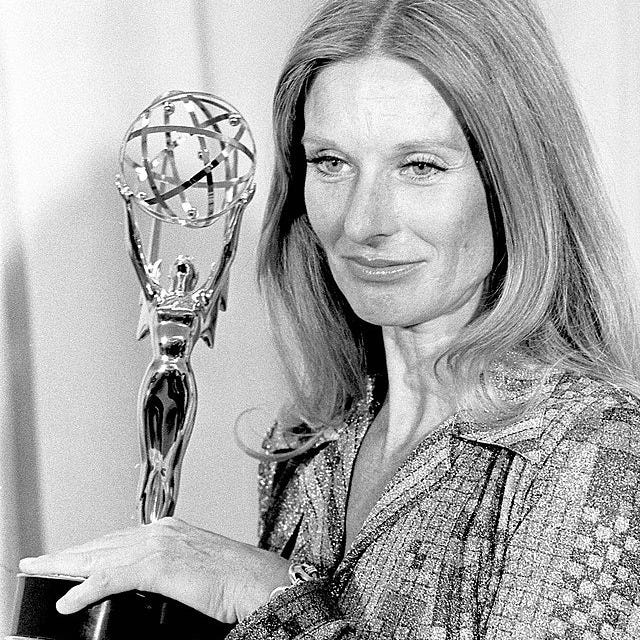
She won an Oscar for best supporting actress in Peter Bogdanovich’s The Last Picture Show in 1972. She was a regular on the Mary Tyler Moore TV series, winning two Primetime Emmy Awards for best supporting actress in a comedy series.
Overall, she won eight Primetime Emmy Awards, tying Julia Louis-Dreyfus for the most by a single actress. She received 20 Emmy nominations.
Other movie credits included memorable roles in Young Frankenstein, High Anxiety, and History of the World, Part I.
In 2008, at age 82, she appeared on TV as a contestant in Dancing With the Stars, the oldest contestant ever to appear on the show. She placed seventh.
She continued acting into her 90s. She died at her home in Los Angeles in 2021 at age 94.
Deb Fitch Roberg, originally from Des Moines, has been deeply involved in genealogy since 2012, concentrating first on her mother’s family.
She began working on her father’s family, the Fitches, in about 2016. She stumbled across one DNA match on ancestry.com that was a really close match, but only the owner’s initials were attached to this match.
Then, in 2024, another close match on the Fitch side turned up, and this time, there was a name attached: Morgan Englund.
“That name sounded familiar,” Roberg said. “I Googled it, and I’m like, ‘Oh my. . .’
“I sent him a message: ‘Hey, we’re second cousins. How are you related?’
“And he goes, ‘Well, my mom is from Des Moines. . .’ His mom? Yes, Cloris Leachman – thus explaining the CL initials on the earlier close match.
From there, Roberg said, “It didn’t take me long.” She soon put the pieces of the story together.
Cloris Leachman, the actress, revered in Des Moines for her achievement, was a Fitch, not a Leachman; her biological father was not Berkeley Leachman, it was a man in the Fitch family.
Working out the puzzle from there, Roberg was able to determine that Lucius Fitch was Cloris Leachman’s biological father.
Both Cloris the elder and Lucius had been students at Drake University in Des Moines in the fall of 1925.
Looking back, there had been at least one hint suggesting something a bit odd among some of the principals involved in this story.
Cloris Leachman, the mother, nee Cloris Wallace, had gathered 14 friends from Des Moines, all members of Klatter Klub, a social group, on the evening of October 13, 1925, for an announcement. She told her friends that she and Berkeley Leachman had been secretly married six weeks earlier, on August 30, 1925, in Iowa City, Iowa, by Rev. Mr. Reed of the Presbyterian faith.
The Des Moines Tribune published the story of her “secret marriage” and her photo at the top of Page 1 the next day. The Des Moines Register followed with a more detailed story on an inside page the next day.
The only problem here is that Cloris and Berkeley were married by the Rev. Mr. Reed in Iowa City, not on August 30, but on October 3, 1925, according to the marriage record on file in District Court in Iowa City, and now available on ancestry.com as well.
The daughter, Cloris, was born on April 30, 1926, which was 8 months after the announced wedding date of August 30, but less than 7 months after the real marriage date of October 3. An eight-month pregnancy might not raise questions among onlookers; not so for a pregnancy in the range of six months.
It is unclear whether Cloris Leachman, the actress, ever knew that Berkeley Leachman was not her biological father. In later years, she did talk, however, about how distant and detached her father seemed while she was growing up. Roberg said Lucius Fitch’s son believes his dad never knew that he was the biological father of Cloris Leachman.
DNA tests, which can identify the phenomenon known as NPE (non-paternity event) fathers, have become common in recent years. Tens of millions of such tests have been done in the United States. A study published in 2023 in Psychiatric Research suggests that up to 5 percent of all father-child relationships in the U.S. – one in 20 – are not biological relationships.
Welcome to the world of DNA.
. . . a part of the Iowa Writers’ Collaborative, which represents more than 60 professional writers with Iowa roots. My goal today was to provide an enjoyable, informative, or worthwhile reading experience – ideally, two or three of these things. Although my subject matter is widely varied in an increasingly specialized Substack world, I hope you may view this diversity as added value that promotes thought. But I digress. This newsletter is and will remain free. Which makes me all the more appreciative of those who choose to contribute. I am deeply grateful for such entirely voluntary support. In response, I will give all net proceeds to nonprofit organizations that promote freedom of speech or cover local news in the Midwest. As a paid subscriber, you are thus encouraging me to continue writing so that both of us may effect some overall good for our society. Best wishes and happy reading.
No posts
Comments
Nothing yet. Say the first thing.
Sign in to join the conversation.