
Ah, it’s hot again. I’m sulking, and should be going on vacation, but… might as well work if it’s too hot to be outside? Anyhow, if you are reading this, please drop me a note… I hear from very few readers and it bums me out to spend my weekends on this and send it into a void. Just hit reply? Only goes to me…
TOC:
AI Creativity Tools (Image Gen, Video Gen, 3D & “World Models”)
Games Related (always lots of game related in 3D too, btw)
"Drawing" the Mona Lisa with GPT-5.6, Claude, Gemini, and Grok (via Geeky Animals) — giving a drawing tool to the models to test their output ability, both at copying something and from a text prompt. The harness is open sourced at github.com/hershalb/canvas-arena. It really is too bad that models have to take pics at every step in a visual workflow…
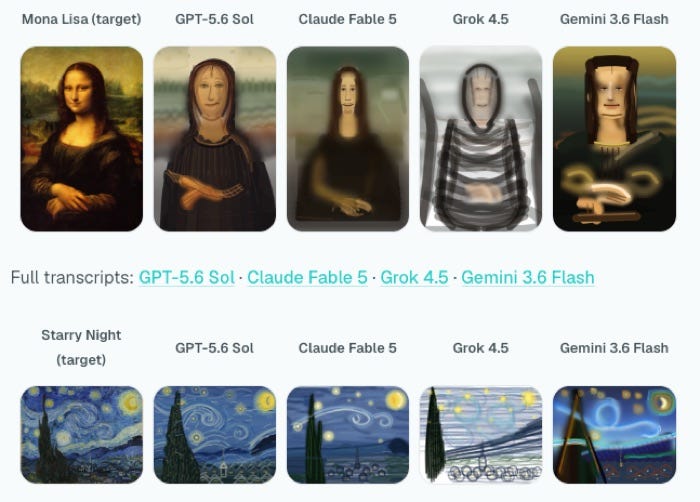
The drawings from scratch are mostly much better, although Grok continues to be insane. 5.6 Sol is really good at those.
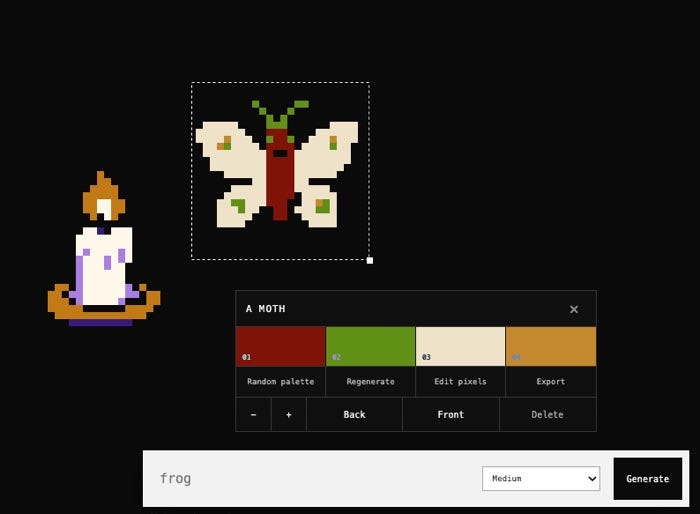
PixelGPT Canvas (via Matt DesLauriers) — a pixel-art / sprite generation canvas and a model in the browser. This is fab — not great art, but I really love my moth here:
Research: CompArt — training for “aesthetic alignment” in text-to-image generation via principles of art. Great idea… research paper with small visible samples. Also see Trinketry — “tracing and recombining visual elements in generative design exploration” (a Max Kreminski paper).
This is definitely the most exciting category of the last 2 weeks, from my angle! Two new models, soon to also have weights released, from Minimax (H3) and Black Forest Labs (FLUX 3). And this coming week, Seedance 2.5 should be out, which by early reports is amazing, generating long sequences; although also reportedly very expensive (twice the cost of Seedance 2?) and not open weights.
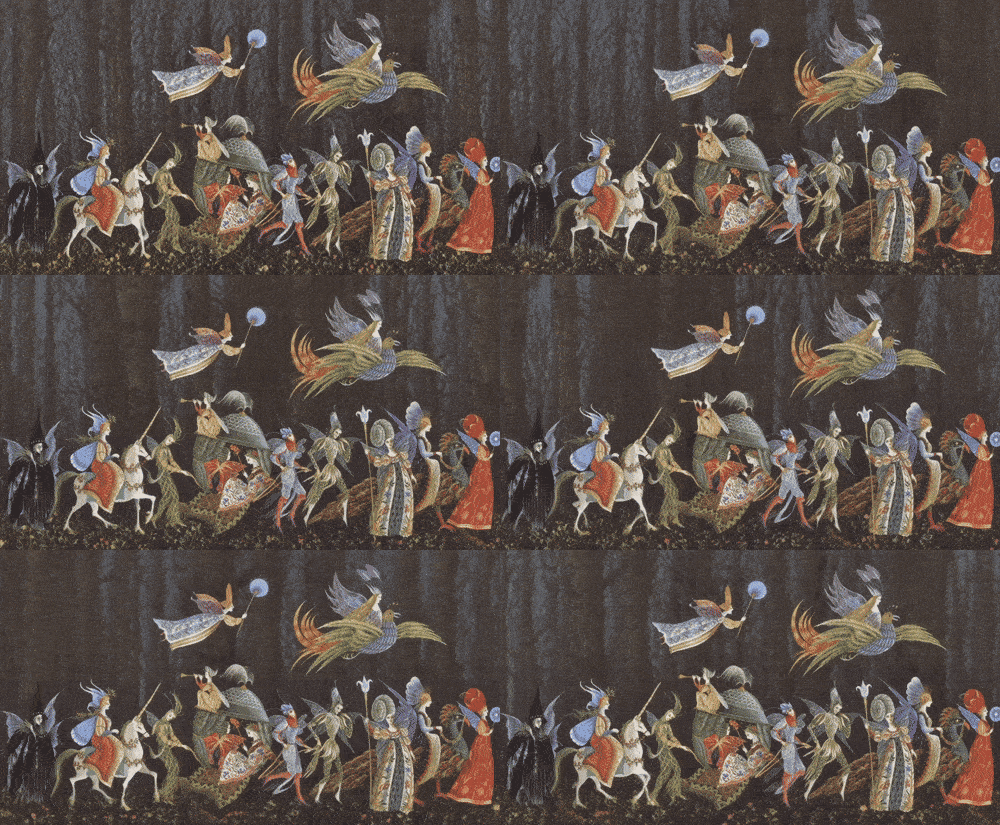
BFL’s Flux 3 early access discord felt a bit like early Midjourney for a minute there — lots of familiar names! I tested it a bunch on things I’ve been wanting to do at work (with Veo and Omni) and found it terrific. It can manage animation of styles in artwork and pays attention when you say “no cuts.” Here’s a gif where it sticks to the artwork style (Errol Le Cain) admirably:
I shared another animation of a painting, on X. Here it is doing a complicated prompt, turning a painting into a sepia photo and then a “real” scene:
Hailuo 03 (Image to Video link to Fal) — MiniMax’s image-to-video model can be tried on Fal via API and a lot of other providers including OpenRouter; also see the MiniMax video-generation API docs.
Here’s a comparison of a Flux3 (left) with H3 (right) animating a photo I took in Lyon, turning the mural alive with "the people moving” and the “cat climbing” and the “books falling.” Note how Flux 3 stays consistent with the style but arguably H3 was better at the positions from the image (the cat is actually a small figure on the right side):
And some unsurprising reading: About 300 Netflix Programs Have Used Generative AI This Year (Variety). Given the choice of not having a scene vs. having it, by cost of animators vs generation, I’d rather they had the scene. Especially since I like big space opera tv and those shows always get canned for costs.
Grace Cathedral (by Vincent Woo) — Gaussian splat of the cathedral, a really big one, navigable. With annotated tour points. Lovely use of splats (and Playcanvas).
InfiniSplat — a Gaussian-splat creation space on Hugging Face, very fast, single image input: it will give you a kind of quick cheap 3D effect. Great strides have been made here, honestly, for this to work at all.

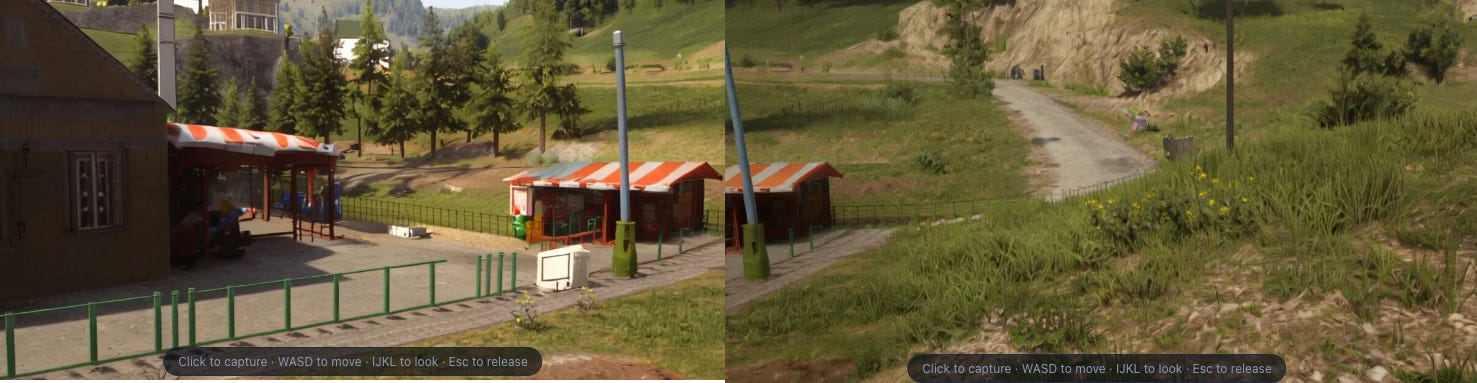
World Models: ABot-World (Reactor) — an interactive world model, also live as a Hugging Face space where you can upload a picture and have it go off piste— I uploaded this screen cap from Dungeons of Hinterberg

And then panned right past the church (see left shot) and then turned right, and I wasn’t over the water anymore. Still very interesting to see it run so quickly in the browser. Look, you don’t need to pay for a Genie 3 sub!
And see world model Wonder (coming from Adobe, and it says coming to Hugging Face too?):

PanoWorld — research on real-world panoramic generation, from the Insta360 research team, some kind of demo coming — it looks like it will do animated 3d (i.e., 4d) generations.
Opus 5 is not getting great vibe reviews for coding behavior, but for three.js and 3d content, it’s evidently doing really well according to the comps I’ve seen shared. OTOH, Ethan Mollick continues with his eerie Fable creations, including this one: "Make a game about Imminence. Something very big, very strange is happening. A suburb & the arrival of a vast & unknowable presence. Not horror, invoke the feeling of the end of all things coming, inevitably, but also not sad or scary." I liked it. Try it: https://the-imminence.netlify.app
He also had Fable do a Piranesi-like city building tool in similar style (code base). (Compare to the busier, less artistic GPT Sol version here.)
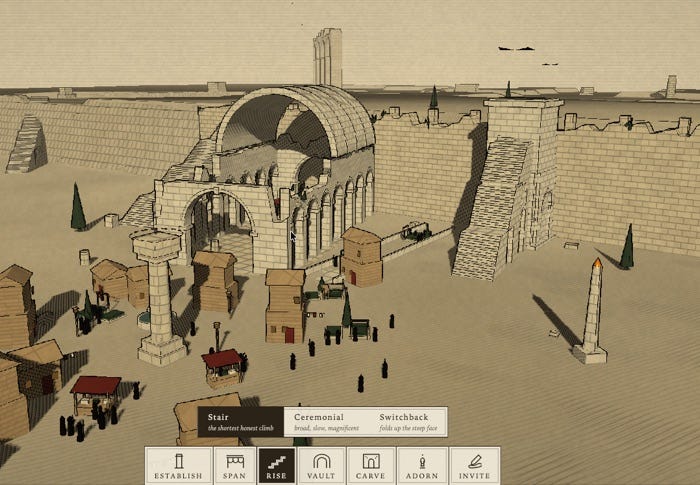
His Cezanne-style Fable city builder is also adorable:
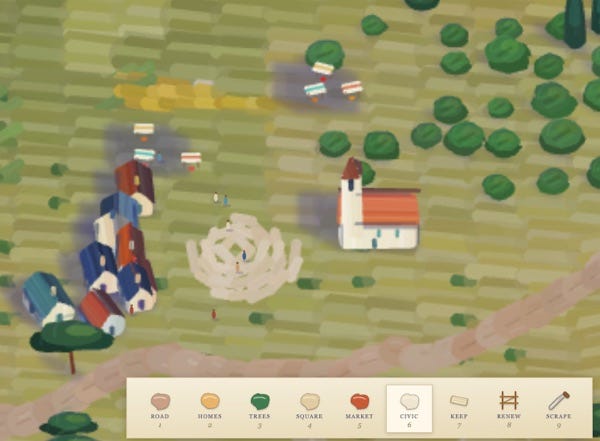
Three.js tools and code:
BasicProceduralBuilding — a procedural building generator (three.js, procgen); Blender-capable.
sakura-crossing — codebase for an explorable Japanese suburban railway-crossing neighborhood on a small planet, rendered 3D-to-2D as a cel-shaded anime background. Three.js, no image assets, evidently made by Opus 5. Very pretty, with an article about how the 3d to 2d effect was done.

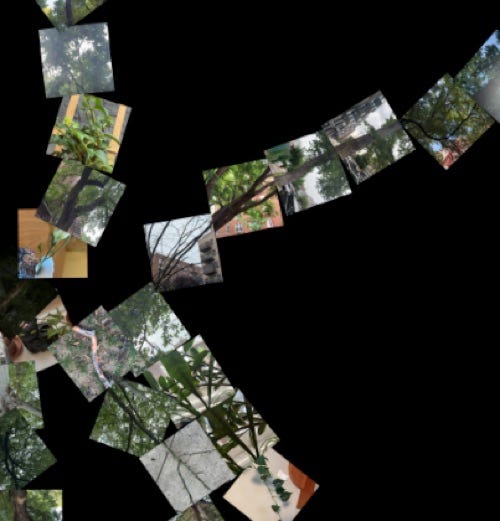
branch — a collaborative collage of tree and branch photos, since you know I love collage.
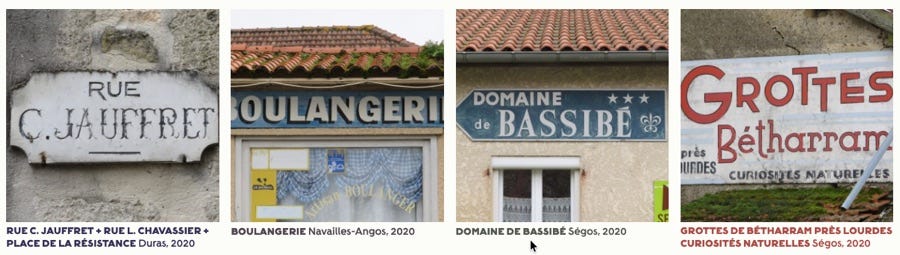
Jules Vernacular (via Matt Muir) — photos of letters/signs/fonts in the wild in France. I love this so much.
Richard Silver Photo: Vertical Churches (via Kottke) — vertical panoramas of church ceilings. Pricey to order, but very interesting to look at.
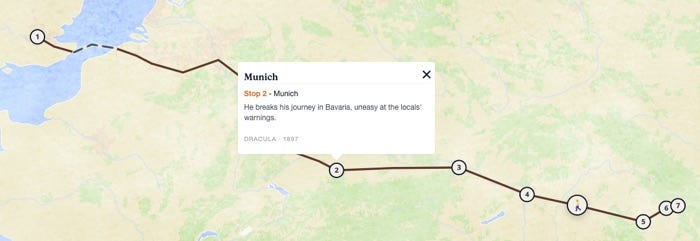
Maps & Travel Routes from Books & Films — “Reading Maps plots real-world journeys from classic novels and films - on an interactive atlas.” Via Recommendo and Mark Frauenfelder. Dracula:
STG v.boxSquad (via Waxy) — from the Space Type Generator guy. Hahaha, you can position them, and turn on twerk.

doodad gallery — a UMAP-clustered art gallery; add stickers as they’re discovered. You have to open a tray at the side and drag a sticker onto it. A way of encouraging exploration? Not entirely sure how it plays out over time.
Legibility of Effort — “LLMs have broken the legibility of effort: our ability to tell, at a glance, how hard something was.” For a human. Does is matter? It seems to for “art” definitions, but I have never liked that kind of definition. (Also, I think many artists have had the experience of killing themselves to get something out, only to have it fall flat, relative to something they found much easier, even trivial to produce. The audience doesn’t care?)
Tech tools:
aval — a new open-source format for interactive video on the web, with a built-in state machine, frame-accurate transitions, and packed-alpha transparency.
Hubble.md — markdown, with a comment feature. This is a great idea for input to LLMs and notes to self, too.
JarvisHub — an open harness for canvas-native multimodal creative agents.
How to Run a Gauntlet Loop: The Prompting Method Behind Claude of Duty
games - now X famous, from Matt Shumer, for getting good if expensive results from prompting games with top LLMs. Many examples being shared on X of web games made with this method. “The prompting method behind Claude of Duty. Give the agent a bar it can’t talk its way around, let it split the work, and never let the builder grade itself.”
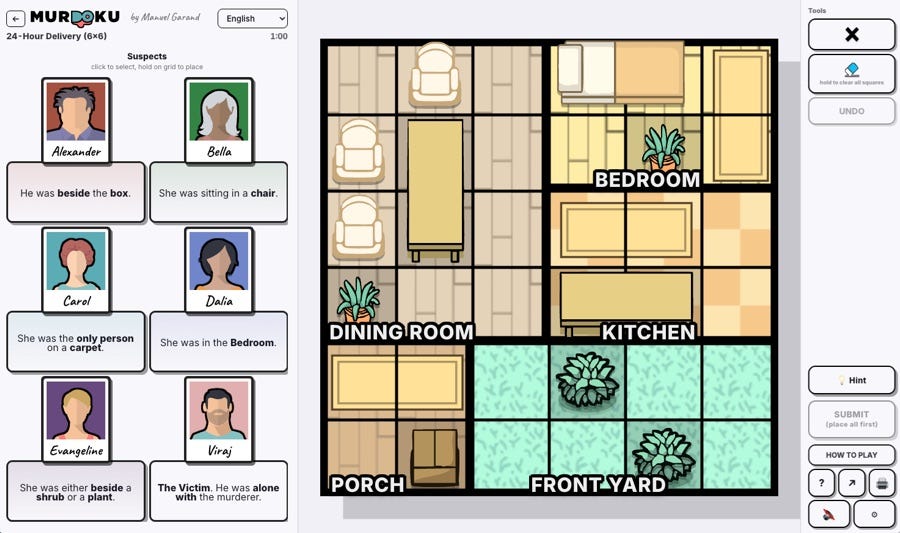
Murdoku — online and printable logic grid puzzles that are cute and visual (sudoku like). Via Installer newsletter.
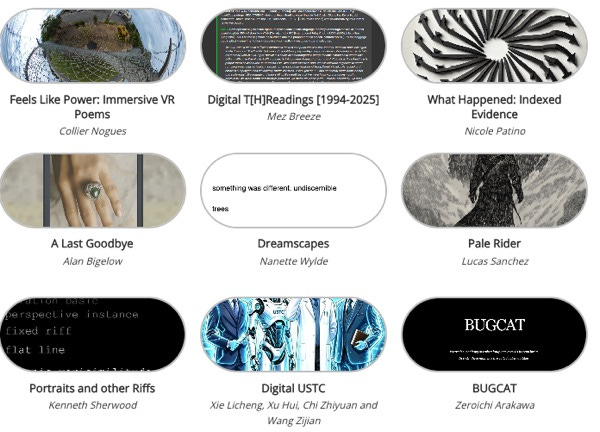
ELO 2026 Online Exhibition — the Electronic Literature Organization’s online show (text art, procgen, interactive). Games and more… there’s a lot there, and have I had time to dig in? I have not. Tiny corner of the page:
Academic/research things of note:
From Sakana, Dream-Cubed — generative modeling in Minecraft, with a codebase. The examples look great.
Playable Archives — balancing historical accuracy and player freedom via RAG-enhanced AI game mechanics (at ICCC, which I need to catch up on). An approach to cultural heritage games. “This work presents Playable Archives, a system where players experience Grounded Imagination, exploring counterfactual history while staying anchored to authentic constraints, and contributes Playable Archives as an approach for cultural heritage games that shifts engagement from passive memorization to active, speculative inquiry.”
Lots of interesting action going on in both the study of AI writing and the actual use of it. Every day there is another article about a fantastic book that had a contract and then agents or publishers dropped it because it might’ve included some AI text. Even if it was an excellent book. Even if it might’ve been a false positive from a detection app.
⭐️ Generative AI floods and dilutes the market for books — A recent study, lead by Tuhin Chakrabarty, full-text AI detection across 14,419 self-published Amazon genre-fiction books (2023–2026): AI-heavy books are a large share of the catalog but a smaller share of sales, yet they’re winning a growing share over time and taking more top-rank slots. They are selling, and some people are making serious money with them, too. But overall, given the flood of books, revenue per book has declined across all categories.
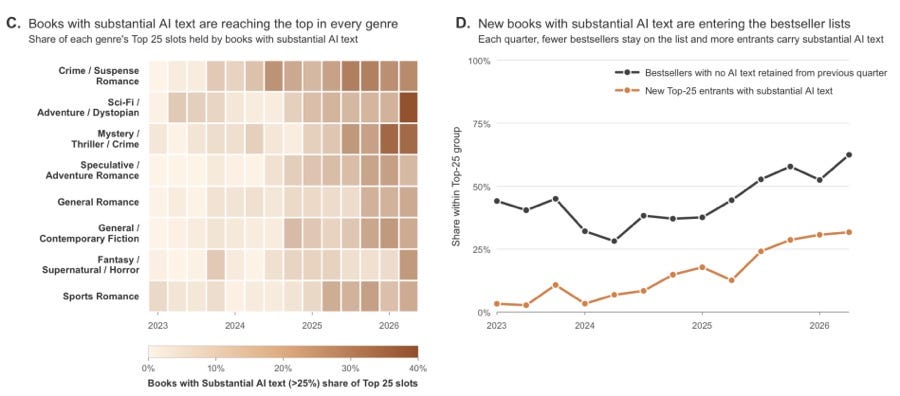
In the top earnings, romance subgenres and writers have a pretty clear edge —
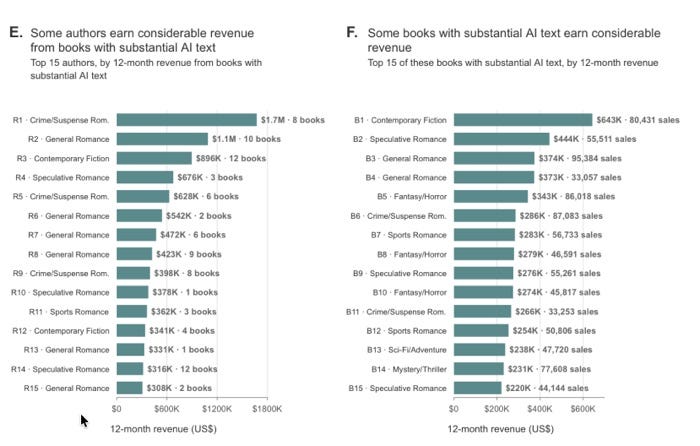
There are a lot of interesting charts in this paper, and it’s been widely summarized. Worth a look. And the following digs into it, naming names:
Is This What Comes After AI Slop? (The Atlantic) — on the Daggermouth bestseller (a legit book of word-of-mouth and discussion, despite the “tell tale signals of AI”) and more on the study above.
“If you can get 10,000 people to read 10 pages of your book, and you have 300 books you’re putting out,” she said, you can make real money. “But you’re not actually writing romances people want to read.”
⭐️ Writers Agree: AI Isn’t a Novelist. So Why Is This Author Interested? — “Naomi Alderman, best-selling and award-winning, thinks AI writing is terrible. She’s fascinated anyway.” I think you have to be already quite successful to be able to go on the record and admit this, sadly. And she says lots of people want to kick her out of her friendgroups.
I am a novelist and I’m interested in AI. Since I started playing around with it, I’ve felt an expanding sense inside my mind of what “being a writer” might mean in the future. I feel afraid and I feel exhilarated and I want to know what’s coming next. … I am absolutely delighted to do my own experiments, and explore that jagged edge: the places where it entirely fails, the places where it is unexpectedly brilliant.
This, incidentally, is a good sentence: “The whole point of creative writing is that I am trying to come up with sentences that cannot be predicted.” She is interested in games and turning books into games, endless worlds, too. This is also lovely:
Creative writing, I’m afraid, is a bit more like a séance. Margaret Atwood talks about writing as negotiating with the dead. It’s more like this: you go up to the attic inside your mind. You hold out your hand. You wait.
At the end she suggests a (possibly) agent-based theory of mind, for an LLM/s, and reflects on how post-training seems to have made them worse at creative writing as they get better at business writing. Absolutely worth a read.
Some academic work:
A Persona-Augmented Multi-Agent System for Varied Narrative Generation. “Leveraging LLM persona as proxy for semantic, tone and lexical the system can automatically define tasks demands and workflow, thus crafting more varied and heterogeneous outputs. Our approach demonstrates that agentic platforms can consistently surpass the single-LLM baseline.”
The Narrative Similarity task at SemEval 2026 (Task 4): results page with embeddings to explore, and the results summary paper.
In our triple-based classification setup, LLM ensembles make up many of the top-scoring systems, while in the embedding setup, systems with pre-and post-processing on pretrained embedding models perform about on par with custom fine-tuned solutions.
Two example submissions: StoryNet and Narrative Nexus — two SemEval 2026 Task 4 papers on modeling narrative story similarity (symbolic representations; instruction-based fine-tuning + synthetic data).
no-ai-slop — a skill to help remove “20+ patterns of AI slop” from any piece of writing.
tldraw offline — a whiteboard for your desktop that your AI can use too; now useful offline.
Ai2 Asta — improved research search from Allen AI. I thought it was useful on some things I tried.
Datatype — an OpenType variable font that turns simple text expressions into inline charts. Sparklines, basically (little word shaped graphs inline): “transform simple text expressions like {b:30,70,50,90} into visual charts”
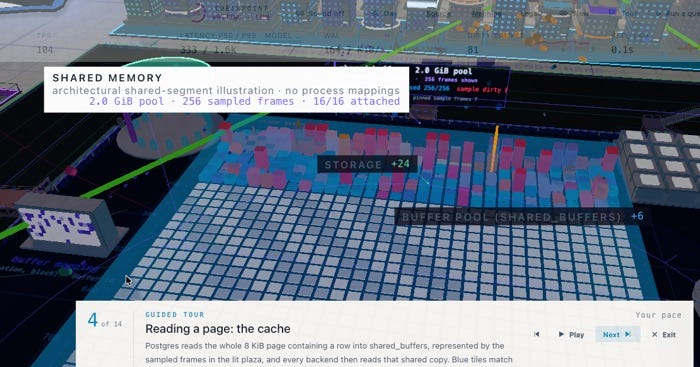
PGSimCity — how PostgreSQL works, in 3D. Hah. Bored prof?
exo — an agent + harness architecture that’s fully recursive, able to safely edit all aspects of itself at runtime. A self-editing recursive harness.
LFM2.5-Encoders (Liquid AI) — fast at long context, even on CPU. NLP encoder / BERT-style classification models.
gigatoken — language-model tokenization at GB/s; a drop-in replacement for the HF tokenizer. Very very fast.
Text within this block will maintain its original spacing when published
Afoot and light-hearted I take to the open road,
Healthy, free, the world before me,
The long brown path before me leading wherever I choose.
Henceforth I ask not good-fortune, I myself am good-fortune,
Henceforth I whimper no more, postpone no more, need nothing,
Done with indoor complaints, libraries, querulous criticisms,
Strong and content I travel the open road.
The earth, that is sufficient,
I do not want the constellations any nearer,
I know they are very well where they are,
I know they suffice for those who belong to them.
(Still here I carry my old delicious burdens,
I carry them, men and women, I carry them with me wherever I go,
I swear it is impossible for me to get rid of them,
I am fill’d with them, and I will fill them in return.)
—Walt Whitman, Song of the Open Road 1
Back to the escapism! I hope your summers are going ok. Seriously, drop me a note!
Best, Lynn (@arnicas on mostly bluesky, mastodon, ex twitter).
Comments
Nothing yet. Say the first thing.
Sign in to join the conversation.